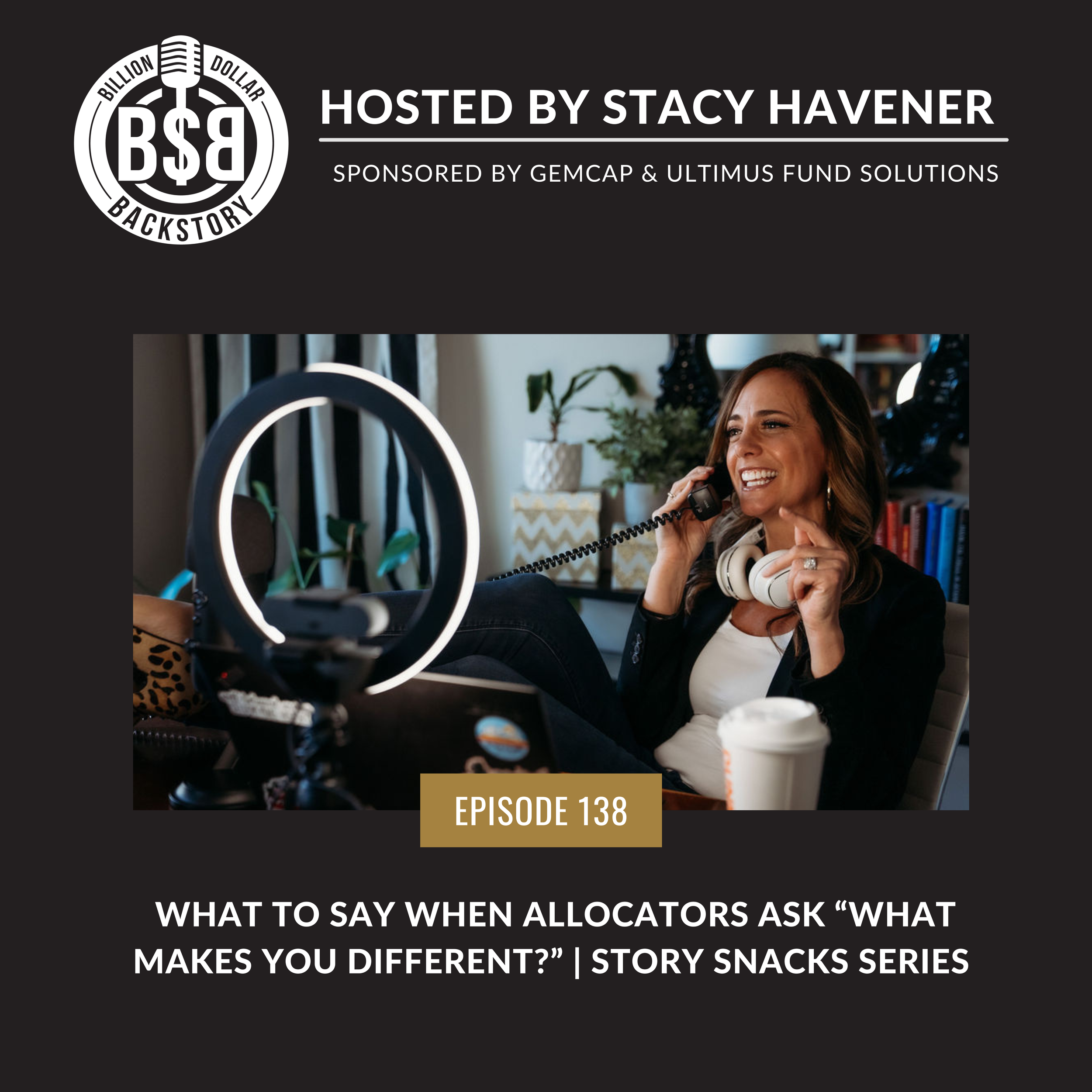
Episode 138: What to Say When Allocators Ask “What Makes You Different?” | Story Snacks Series
Subscribe to Billion Dollar Backstory on Apple Podcasts, Google Podcasts, Spotify, or wherever you listen to podcasts.
Every allocator asks: “What makes your boutique different?”
And most fund managers default to something like, “Our people are great!” or “Our process is best-in-class!”
Which is fine. It’s just… also what everyone else says.
In this episode, Stacy explains why saying “We’re better” in meetings won’t do you any favors and why being different (even if it’s uncomfortable) is the best way to stand out to allocators.
Listen in to learn:
Why you don’t want to make up differentiators in the moment
Why trying to be polite is the fastest way to blend in and be forgotten
The Truism Test (a fast way to spot a “differentiator” that’s actually table stakes)
The prompt that reveals where you’re out of consensus with your peers (and why that’s your edge)
Why the best differentiator often takes a little courage to say out loud
This is Story Snacks, a bite-sized, jam-packed series for fund managers who are ready to master strategic storytelling in under 20 minutes a week.
TRANSCRIPT
Below is an AI-generated transcript and therefore it may contain errors.
[00:00:00] Stacy Havener: Craving more knowledge, but don't always have time to sit down for a five course meal. Take a quick snack break with story snacks, bite-size content to feed your funnel. Each short episode features Stacey, digging into one question. This series has her talking stories, sales, and so much more. Oh yeah, it's time for story snacks.
[00:00:27] Somebody sent in a great question that I wanted to unpack in a snack for you today. The question's this every allocator asks what makes us different, but I freeze up because everything I want to say sounds generic. What should boutique say to stand out? Ooh, love a good differentiator Question. Also, one of my favorite phrases is that people don't [00:01:00] want better.
[00:01:01] They want different. Different is better than better. Pausing to let that sink in. Also not something that really is talked about a lot in our industry. 'cause everyone wants to be better and best. Um, let's talk about being different. I think what happens to us when we're asked about what makes us different is, is a couple things.
[00:01:22] First of all, if we haven't really prepared those differentiators and you're trying to do it on the fly, let's not do that at all. 'cause you're gonna like just be bumbling. So we need to do the work ahead of time. Really crystallize what these differentiators are, and I know it sounds like it should be easy, my friends.
[00:01:41] It is not easy. This is part of what we do in our story selling framework with clients, and it can take a long time and a couple rounds of iterations to get to your sharp edges. The sharp edges is important here because in order for a differentiator to really [00:02:00] grab. The right people, the right allocators for you.
[00:02:05] They need to be sharp enough to repel the wrong ones. This is attract and repel. So if you have a differentiator, in order for it to be compelling, it has to be repelling to somebody as well. I share that because what happens sometimes when we work on differentiators is we're like, okay, how do I write this in such a way that it's gonna vibe with everyone?
[00:02:31] That's not gonna work. Vibing with everyone is a really bad path to walk down, so we don't wanna vibe with everyone. We want to vibe with the right allocator for us, and. I'm gonna share a story. So I was doing some work with a larger boutique and they manage about 20 billion, but they still are a specialist and we're doing differentiators.
[00:02:55] And this person is like, so my differentiators are X, Y, and Z, and they were very nice. [00:03:00] They weren't very different. They definitely fell into the camp of like, we're trying to appeal to everyone. Typically, the very nice shows up like a truism, like it's something super nice, but also should be true. Like our people are great.
[00:03:14] That's what makes us different and the truism test is well, is the inverse of that even a viable option? Our people are, are really bad. No, no one, no one would have a business that's filled with really bad people, at least not intentionally. So truism test knocks all these things out. So this particular founder was a little bit stuck in truisms, had a few things that could potentially have some legs, but they weren't sharp enough.
[00:03:40] And so I asked my favorite question on differentiators, which is, what do your peers do or believe that you don't? And then that got a little bit of a better answer, but I was not really thinking it was sharp enough. So I asked it again, and now the founder got a little pissed off about it. Okay. He was kind of like, [00:04:00] like I wouldn't stop asking him these questions and we're on a Zoom call.
[00:04:04] So literally he turned his chair and just like looked up and then came back and when he came back it was with fire. Okay. This man came back inspired and he just started riffing about what he didn't like about his peers, a lot of whom were public companies. So you can imagine asset managers, public companies, lots of conflict.
[00:04:26] And you can imagine the riff that came next. And I was like, but the lips, okay, let him go. He just ranted and at the end I was like that. That's what I'm talking about. Now we, you know, edited it down and got it to like a really nice soundbite. But the fire that came out of that person from being asked, not once, not twice, but three times to make that differentiator sharper, that is what you need.
[00:04:57] And so when you [00:05:00] say these differentiators in a meeting. It's gonna require some courage because the person receiving the information may not love them, and that's okay because if they don't love the differentiators, they probably would not hire you anyway. Or if they did, they wouldn't stick around that long because from a core values or philosophy perspective, you're probably not aligned.
[00:05:26] So you might as well just get it out on the table right from the start and just, you know, if it's not a fit, like agree to be friends but not business partners and that's fine. So I think the lesson here is generic. If it feels generic, go back to the drawing board. Do this work. Get somebody who's like willing to really talk to you, real talk to, you know, sort of.
[00:05:54] You off basically, and then you'll probably come up [00:06:00] with some great differentiators. Let me know how that goes. I hope it helps. This podcast is for informational purposes only and should not be relied upon as a basis for investment decisions. The information is not an offer, solicitation, or recommendation of any of the funds, services, or products, or to adopt any investment strategy.
[00:06:20] Investment values may fluctuate and past performance is not a guide to future performance. All opinions expressed by guests on the show are solely their own opinion and do not necessarily reflect those at their firm. Manager's appearance on the show does not constitute an endorsement by Stacey Haven or Haven or Capital Partners.
Resources