Episode 151: €8B Founder Turned Family Office CIO: Harald Berlinicke on Allocator Trust, LinkedIn, and Why “Give Give Give” Wins
Subscribe to Billion Dollar Backstory on Apple Podcasts, Google Podcasts, Spotify, or wherever you listen to podcasts.
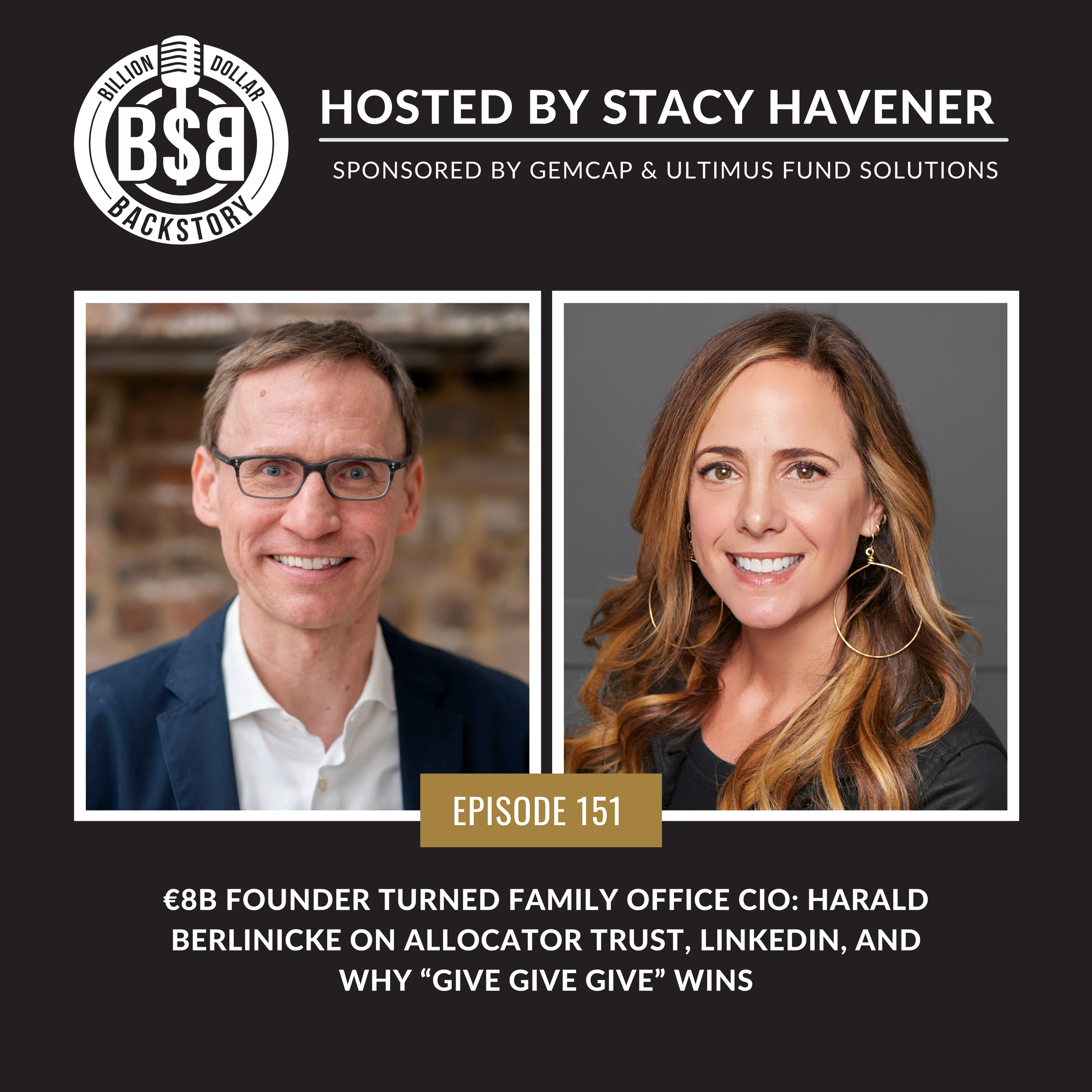
At 15, Harald Berlinicke got a front-row seat to Black Monday during a bank internship outside Berlin. It was total chaos, with people yelling "SELL!" and a 20% drop in a single day.
Most people would have run away from that pressure. But Harald ran toward it. And that's the day he knew he wanted to be in finance.
Decades later, he's the guy on the other side of the table as a fund selector and family office CIO, with a surprisingly impressive LinkedIn presence for someone who will tell you straight up that he's an introvert.
In this episode, Stacy sits down with Harald to talk about the human side of selection and why "give, give, give" beats "pitch, pitch, pitch" every single time.
Listen in to hear:
Harald's Black Monday origin story and how that early chaos shaped his view of markets and decision-making
Why "people do business with people" is painfully true in fund selection
His playbook for building relationships on LinkedIn as an introvert
The provocative CFA poll he ran and what that debate says about where the industry might be headed
TRANSCRIPT
Below is an AI-generated transcript and therefore it may contain errors.
[00:00:00] Stacy Havener: Some people know from childhood that they're destined for finance. Harald Berlinicke just needed one unforgettable day to make it official. At 15 years old, during a two-week bank internship in suburban Berlin, he watched Black Monday unfold in real time. Pandemonium, a crash, lawyers and doctors shouting, "Sell," across the counter.
[00:00:25] Instead of running, he was hooked. That moment set the trajectory for a career that took him from a German bank apprenticeship to trading floors, from Cambridge to New York to London during the structured credit era. The wild helicopter riding, billion-dollar book building days before the GFC changed everything.
[00:00:47] And through all of it, a self-described introvert, Harald found his people, and he still is as one of the most influential finance creators on LinkedIn. Because [00:01:00] here's what's true about the investment world that not everyone says out loud. It's kind of an introvert's paradise. The puzzles, the pattern recognition, the deep work.
[00:01:11] Now on the other side of the desk as a fund selector and family office steward, Harald brings all of it, the stoicism, the hard-won perspective, the belief that people do business with people, to the question of who deserves your trust and your capital. Meet my friend, Harald. Hey, my name is Stacy Havener.
[00:01:32] I'm obsessed with startups, stories, and sales. Storytelling has fueled my success as a female founder in the toughest boys club, Wall Street. I've raised over $8 billion that has led to $30 billion in follow-on assets for investment boutiques. You could say against the odds. Yeah, understatement. I share stories of the people behind the portfolios while teaching you how to use story to shape [00:02:00] outcomes.
[00:02:00] It's real talk here. Money, authenticity, growth, setbacks, sales, and marketing are all topics we discuss. Think of this as the capital raising class you wish you had in college, mixed with happy hour. Pull up a seat, grab your notebook, and get ready to be inspired and challenged while you learn. This is the Billion Dollar Backstory podcast.
[00:02:31] Harald, welcome to the Billion Dollar Backstory podcast studio. This is an incredible honor. We are friends. This is our first podcast episode, but something tells me it won't be our last. We always
[00:02:46] Harold Berlinicke: go with those first, but yeah. I appreciate it.
[00:02:50] Stacy Havener: And I wanna share something that we've just been talking about in the green room, which is the whole introvert journey And I want people to hear that right at the [00:03:00] start because I think it's important for them to know that about you and even me when they hear you tell your story, especially when we kind of come current here and you talk about LinkedIn.
[00:03:12] Because I bet you most people who follow you on LinkedIn do not know or believe that you're an introvert. But we're gonna get there when we get there. So I want you to tell me, let's go into the way back machine. Did you always know you wanted to be in finance, or when you were a young lad, what was your vision of what you'd be when you grew up?
[00:03:34] Harold Berlinicke: Yeah. Yeah. I mean, I started being quite passionate about money from really an early age onwards, and it, it really came about because I spent a lot of time with older folks, uh, of my family- Mm ... on our family property. So I, I had all these, you know, my two grandmothers here. I had a great aunt, great uncle, all living on the property here.
[00:03:58] Yeah. Sort of a multi-generational [00:04:00] setup we have here at my home base. And yeah, I mean, other kids were sort of always out meeting friends, but I mean, I, I felt quite comfortable spending a lot of time on the property here and- Oh, yeah ... just listening to these, uh, pretty incredible stories, you know, war stories and stories- Yeah
[00:04:16] from the hyperinflation, all of that. And yeah, it was just, uh, basically seeing some of the old coin collections from a very early age, like six or seven, eight years old. I must have been something like that, just having entered primary schools, you know. Eventually, maybe, uh, how old was I, eight or nine, holding my first sort of ounce of a Krugerrand gold coin.
[00:04:36] Oh, wow. And, and of course, most interestingly, you know, hearing the stories how my ancestors had to buy a, a loaf of bread with a bucket full of these banknotes, you know, which had so many zeros on them you couldn't even count them. And then over the years, I was always sort of given the, some of the coins, you know, and I started my own coin collection.
[00:04:56] I got very passionate about that. I started really [00:05:00] collecting, um, sort of getting into the numismatic thing, uh, when I was maybe 10 or 12. And then, uh, as a teenager I noticed my parents really didn't care about money so much. I mean, they cared about it from a, a frugal point of view. Right. They always sort of...
[00:05:16] That was just the generation, although they didn't have- Yeah ... to live so frugally, they just sort of really thought very carefully how to spend money. But on the other hand, they weren't shopping around for the great interest rates. So there was I at the age of probably 12 when I took them to the different banks, and I went into the different bank, uh, to the counters and asked about the interest rate, asked about, "Well, what is the 90-day interest rate versus the 360?"
[00:05:39] and this and that. So this was sort of my first time really getting hands-on involved in money management- Yeah ... but really only looking for savings rates. And it was only really, uh, when the big crash, the Black Monday of 1987 happened, and that really in hindsight was the most pivotal moment for me, from which point it was clear that [00:06:00] I had a career in finance ahead of me.
[00:06:02] Uh, so I was at that, uh, point, yeah, I was, uh, at secondary school and doing a two-week internship. And Luckily enough, I got accepted at the bank. Uh, back then banks were sexy. Yeah. Let's not forget that sort of, uh, every, every parent would've been super happy if their child had done a, a bank apprenticeship, which I later on did that.
[00:06:22] But even getting this internship wasn't easy. I had to apply at a, a number of different banks. Anyway, I did get that. So I, I was 15 years of age, uh, in the year of 1987, and as fate, uh, wanted it, I basically, uh, in the first day of the second week, it was Black Monday, and I will never forget the scenes that unfolded in front of my eyes.
[00:06:44] So I was this little guy, you know, teenager sitting next to the very experienced securities advisor of that bank branch in the southwest part of Berlin, uh, where this, uh, internship was located. And the moment one of the ladies opened the, unlocked the doors, it [00:07:00] was just, like, one lawyer, one architect, one doctor, they were all just sort of shouting, uh, towards the securities advisor towards the desk I was sitting at.
[00:07:08] You know, "Sell 1,000 Royal Dutch, and sell this." It was just total mayhem, and this was, like, the suburbs of Berlin. Right. You know, really... So and I thought, "Wow, this is unbelievable." And of course, I saw, you know, 20% crash in one day. That was absolutely unbelievable to witness that. And after that point I knew, okay, I basically, uh, licked blood and caught the bug.
[00:07:30] And, and that's when I started also investing, uh, money in the stock market and buying funds initially before then started investing, uh, into securities. So up to that point, I was thinking about becoming an architect- Ah ... which I felt very passionate about- Yeah ... uh, for a long time as a teenager, and I was always fascinated with, uh, skyscrapers.
[00:07:49] And one of my favorite books, you know, when I was four or five or six was, you know, this wonderful book about the, the tallest buildings in the world. Oh. And I still have that. But yeah, that basically [00:08:00] changed everything, that, that two-week internship and especially that one day, you know, Black Monday.
[00:08:04] Stacy Havener: Wow, that's so...
[00:08:05] And what do you think it wa- You know, 'cause I could see a path, especially if you already, you know, wanted to be an architect, and I know you love art. Like, you have a very creative side to you. Yeah. And seeing that firsthand could have also pushed you away from finance because it was- No. Yeah. Yeah ... you know, one of the most stressful- Yeah
[00:08:26] days in the history- Yeah ... of the markets. And so what do you think- You know- ... it was about that that said that instead of pushing you away, it pulled you in?
[00:08:35] Harold Berlinicke: Yeah, I think that has to do a bit with my character. I, I, I feel that very much in all stressful situations in life, whenever mayhem happens- Mm ... I'm the one actually being the calmest usually in a room.
[00:08:45] Ah. I thrive on these situations because I, I realize, I mean, you can't change the actual situation, but you can sort of, you have full control over how you react to it. So this whole More of a s- stoic life philosophy, which I [00:09:00] embraced from an early age onwards. For personal reasons I may not want to get into here, but, uh- Yeah, that's okay
[00:09:05] I had a bit of a volatile father, so I think I had, I needed a bit of a coping mechanism is the short version of it. And-
[00:09:12] Stacy Havener: Yes. Yes ... uh,
[00:09:13] Harold Berlinicke: but yeah, so the stoics have always meant a lot to me, and only later on as an investor I realized, you know, going to Omaha and even before that, uh, uh, basically that a lot of value investors, you know, swear by the stoics.
[00:09:23] And- Share that.
[00:09:24] Stacy Havener: Absolutely ...
[00:09:25] Harold Berlinicke: for, for good reasons, as we all know. It's been a, a very testing, uh- Being the calm,
[00:09:29] Stacy Havener: being the calm in the storm, whether that's in life or in the markets or in business. And so you pursued this financial career, and it's had different looks and feels. Yeah. Um, talk about that and talk about...
[00:09:46] I, I want us to, to get to the place where you are analyzing managers, because I also think this stoic philosophy is gonna come into play here. Um- Yeah ... so you, you decide finance is [00:10:00] for me after the '87 crash. Yeah. Yeah. You go into the bank, is that right?
[00:10:06] Harold Berlinicke: Yeah. Yeah. Exactly. So I did at the time, and, and this was the very early '90s, which was a, a very typical career path, certainly in Germany.
[00:10:14] I mean, as you, as many of your listeners will probably n- or some at least will know, Germany is quite famous for its, um, sort of dual, how do you call it in English? It's this, uh, where people basically first do an apprenticeship- Okay ... learn the trade before they go to university. Oh, yeah ... the entire link.
[00:10:31] Or even the people who only do a, a, an apprenticeship. The sole apprenticeship system is beautifully organized in Germany, whereby even if you become, want to become, I shouldn't say even, but I hope, uh, hopefully this is not misunderstood, but if you want to do like a trade, become an electrician- Yeah
[00:10:47] plumber. You do the apprenticeship.
[00:10:48] Stacy Havener: I love that. Exactly. No, absolutely.
[00:10:50] Harold Berlinicke: Yeah. Uh, ev- even sort of in the, sort of in the trades, people go to a, a vocational school- Yeah ... usually two days a week. Whereas in the [00:11:00] Anglo-Saxon world, people sort of learn, learn it, uh, on the job, right? Yeah. So you, you get the young people in, and they sort of shadow the experienced people, and that's how they learn.
[00:11:08] Whereas in Germany, it's very structured. You know, two out of, uh, five days you actually go to a vocational school, and you learn the theory about the subject matter you're about to- Yeah ... to enter, the field you're going to enter. Uh, so anyway, so this, um... Yeah, I think I benefited from that, doing a really a proper bank apprenticeship, you know, shadowing the cashier, uh, counting money, to servicing customer bank transfers a- across the, uh, uh, counter.
[00:11:35] And, uh, uh... But then, of course, I also, um, did the securities advisory side, which is really what interested me most. And after the two years were over, I was a fully qualified banker in Germany at the age of, uh, 21 And then the bank actually wanted to invest in me. They saw potential, and they offered me to send me to Frankfurt to become a, a properly officially qualified, uh, securities [00:12:00] advisor, uh, which I happily accepted.
[00:12:03] Uh, that was a wonderful experience where I did the whole basically range from- Yeah ... derivatives to funds to, uh, stocks and bonds, et cetera. Um, that was very proper training I received, uh, from, you know, the Central Securities Department in Frankfurt. Um, but then it was decision time. Mm. I always wanted to study, and I knew my time had come to actually break the news to the HR department that, you know, I, I really needed to do what I needed to do.
[00:12:31] But the good thing is they actually offered, uh, to, um, put me into their program of sponsored students, which actually, to cut a long story short, it meant that whilst I was doing my university degree in Berlin and Cambridge, uh, every summer I got back to Berlin, I spent like four or six weeks in the Central Securities Department of Dresdner Bank, which is now Commerzbank.
[00:12:53] And so I had like a one-tenth contract, and, uh, I only needed to work once a year, you know, these four or six [00:13:00] weeks. But it really meant that they, they were still interested in me. You know, they also ended up offering me a job in Frankfurt in the mergers, uh, and acquisitions department, uh, when I was done with my studies.
[00:13:11] I chose a different one. But I think that was nice to have that really connection- Yeah ... with the bank that trained me in the first place. And yeah. Um-
[00:13:21] Stacy Havener: And believed in you and supported you.
[00:13:23] Harold Berlinicke: Yeah. No, totally.
[00:13:25] Stacy Havener: And so when does the CFA come in? Because one of the things, if people follow you on LinkedIn, they're gonna know that you are very passionate about the CFA.
[00:13:34] I don't have my CFA. I am a- It's
[00:13:37] Harold Berlinicke: husband. Your husband does. My
[00:13:38] Stacy Havener: husband does, that's right, and I, I always said I would get it. Um, then I watched what he had to go through to get his CFA, and I was like, "Wow, that's a lot of time. That is a lot of time commitment." But so when does the CFA come in? And kind of talk about why are you so passionate about it.
[00:13:55] Harold Berlinicke: Yeah. So after my studies in 1998, I accepted [00:14:00] an offer I received from a local bank in an area, in a very obscure area of structured finance, you know, the whole alphabet- Oh ... soup of CDO, CLO, CBO, CS- Well, and this is in '
[00:14:10] Stacy Havener: 98?
[00:14:12] Harold Berlinicke: This was '98. Yeah. So why did I choose Berlin and that very obscure field- Yeah ... rather than going with the big bank in Frankfurt, mergers and acquisitions- Yeah
[00:14:21] investment banking, all that glory? Well, the smaller bank offered me more money, which was okay. I think I appreciated that. But most importantly, because during my four years of studies I spent one year in New York working for two, uh, basically a placement year for two banks in New York, and then I spent one and a half years in Cambridge at the partner university there, and only one and a half years at my Berlin university.
[00:14:47] So I think after that I kind of almost became a bit homesick, and having had a really nice offer from a, a bank, uh, in Berlin seemed quite attractive to me. And then of course, it always comes down to the [00:15:00] people. I was really- Yeah ... super impressed By the head of the department who was quite keen to get me on board.
[00:15:05] I think I love to hear the story about, you know, this small local champion being one, a big player, uh, in the boys, big boys club- Yes ... of structured credit. They were one of the early entrants. You know, the s- at the time it was only the seventh largest bank in Germany, so not really a big player, but they were big enough to really have a, a key seat at the high stakes, uh, table in structured credit where they had a massive book of triple A, uh, uh, ABS and CDOs.
[00:15:34] And mo- more importantly, what I really loved about it is they had this cross-border team and, and I hope some of my former colleagues listen to, will listen to this.
[00:15:41] Stacy Havener: Yes.
[00:15:42] Harold Berlinicke: It was a m- a really sizable team for such small player. We had, I think something like 25, uh, people based in Berlin, London, and Dublin.
[00:15:51] And as you will recall from my, my, uh, CV and from my career, uh, I did end up spending 10 years in London, [00:16:00] and it would've probably not happened if I hadn't joined, uh, Bankers Software Berlin- Uh, it's special. Yeah ... uh, with that cross-border set up because I'm quite, I think I've always been a bit more conservative generally speaking.
[00:16:12] So when I was in a position where a bank could second me to London, I think that gave me the security rather than me just saying I hop on the next- Yeah ... Ryan Air flight- Yes ... go to London and just, uh, knock on people's door there, which other people would do. Uh, uh, that wouldn't have been me at that point, at least.
[00:16:30] Uh, so that was a nice position to be in. And of course, I brought that up very early on because a year into the job, I got really itchy and I thought, "Oh, no. No, let's... I mean, I love these colleagues, uh, uh, in the cross-border team, you know, I really want to spend some time with them, uh, in the London office."
[00:16:46] And I basically asked the question to my former boss, Gerwin Scharman, whom I'm still, uh, in close touch with, a wonderful person, uh, who was really one of my key mentors. Um, and yeah, he fully supported the plans, and [00:17:00] then, yeah, so I started in autumn 1998, and then it was only at the beginning of, uh, 2000, so just less than one and a half years later that I ended up working out of the London office, and I did that for another years before then my ego got the better side of me, and I basically felt very flattered when a headhunter approached me, uh, whether I wanted to join the Canadians on the trading floor, Toronto Dominion Bank, uh, where I, uh, went to the dark side for a year and did sales.
[00:17:33] Uh, that- that's, yeah, that's a little detail I don't think you've ever heard from me, but, uh, it was, was the worst experience of my life, but also one of the most valuable experiences. So
[00:17:43] Stacy Havener: why? Because I was- Say more about that. Why? Yeah. Because we do learn a lot from our worst experiences, don't we? Yeah.
[00:17:50] Harold Berlinicke: Well, I totally believe that as well, and I'm so, uh, really grateful that I went through it, but I can tell you I didn't enjoy, uh, each morning going [00:18:00] into that office onto the trading floor. Mm. Because quite frankly, I mean, why did they poach me? Because, um, they could see... I think first of all, the headhunter and more importantly, Toronto Dominion Bank at the time realized they were really a third-tier player.
[00:18:16] Uh-huh. So they had to do something different to get the, uh, attention from the buyers, right? Mm-hmm. From basically my peers, from all the allocators. So they came up with the idea, okay, actually it may make sense to hire a former buyer, a buy side guy, put him into the sell side, then the other guys know him- Yeah
[00:18:35] and they will give him the time even though we are just a third-tier player. Yeah. I get- So I think that was the thinking ... I get the, I get the
[00:18:40] Stacy Havener: thinking. Yeah. Okay. Yeah.
[00:18:42] Harold Berlinicke: So I think that was the thinking and, you know, it was good money and, and yeah, and I think at the, at that time it was a bit of, it was very flattering, you know, and I'd never spoken to a headhunter.
[00:18:51] And at the time also, uh, and actually most importantly, Bankers Ash of Berlin had some major issues and the state of Berlin, uh, was in [00:19:00] financial trouble and there were, uh, some issues with the bank and, uh, we couldn't basically grow our book anymore. So that thing had basically run its course. Mm-hmm. My former, uh, boss and mentor had, had also already jumped ship to ABN AMRO.
[00:19:14] And so it was clear to me I had to do something this- Yeah ... unless I just wanted to babysit the book, uh, and see it and run off, um, which wasn't an attractive prospect for me. So then one thing came to another, that opportunity came up and I said, "Yeah, well, why not try it out?" And of course, as you say, I mean, you learn from your worst experiences.
[00:19:34] It just made me realize how unfulfilling and how difficult I found it to speak to a lot of arrogant assholes- ... if I may say so. Uh, because- I mean, we're dealing with basically people who thought they were like half gods, semi-gods. Yes,
[00:19:50] Stacy Havener: I agree with that.
[00:19:52] Harold Berlinicke: Uh, and, you know, managing, you know, big balance sheets, big money.
[00:19:56] They felt so self-important. Lot of... I mean, there were some nice guys too, don't get [00:20:00] me wrong. But I, I basically this feeling where people, you know, make you feel like shit, uh, when you call them, and in those days you still called, right? Yeah. You know, this important- Well, this is a whole,
[00:20:10] Stacy Havener: this is like a realm of trading that people, not a lot of people- Yeah.
[00:20:13] Well, people of a certain age remember. Yes. But not other, uh, not, yeah- Exactly ... other ages
[00:20:19] Harold Berlinicke: don't. Totally. Totally. So I think this just, uh, I, I found it really, it was so hard to get people some- I mean, I got a few trades done. Yeah. And I was, in the end, I was also getting close to approaching the whale in the market, this big, uh, the most important CDO account worldwide, uh, a guy based in Düsseldorf.
[00:20:39] I'm not going to mention names. Okay. But anyone who worked in structured credit will know whom I'm referring to. Yeah. And, uh, you know, I was sort of making inroads there. In the end, actually, a trade happened from what I heard, so it would've been a massive payday for me if I had stayed on. But I basically, um, jumped ship and went back to a buy-side role because [00:21:00] an absolutely unique opportunity presented itself where- whereby my former boss's boss, uh, a lady who ran the whole debt finance, uh, department for Bankgesellschaft Berlin, basically had secured a very substantial, a check from the largest Icelandic bank.
[00:21:17] And, uh, we got started as New Bond Street Asset Management, a credit boutique, and, uh, and I was asked to join as the head of, uh, structured credit and build the book, uh, from scratch. Uh-
[00:21:27] Stacy Havener: Amazing.
[00:21:28] Harold Berlinicke: And, you know, uh, the funny thing is I was approached basically only a few months into the job at TD. Mm. So the first thing I said, "Wow, this obviously sounds absolutely amazing, but I really want to see how far I can go with, with TD."
[00:21:42] Yeah. "You know, I've only just joined, you know, it's really not my style to, you know, make a U-turn so quickly. Uh, can you please keep me up to date? Sometimes-" Yeah. "... these things take longer." So maybe I just say, "Yeah, okay. We, we may still have a few months, so..." But then of course, you know, half a year later it was decision time and [00:22:00] one of the easiest decision of my life.
[00:22:01] And, uh- Wow ... you know, and then the big rollercoaster, uh, started, which it took me to heights I never thought I would reach and took me to lows I never thought- Yeah ... I'd
[00:22:10] Stacy Havener: see. Hey, welcome to entrepreneurship, right? That's it. When you're, when you're building something, it's a rollercoaster. Yeah.
[00:22:17] Harold Berlinicke: Yeah.
[00:22:17] Stacy Havener: Oh, yeah.
[00:22:17] Uh, and that could be before 9:00 in the morning and you're like, "Wow-" Yeah, yeah. "... this has been quite a day." Yeah.
[00:22:23] Harold Berlinicke: I mean, in my case it was billions, literally. I mean- Yeah ... it was billions up and billions down, and, uh, and the prize was in front of our eyes at the end and, and it just slipped through our fingers because the GFC happened two years too early, and that life-changing money never came our way in the end.
[00:22:38] But to be honest, this wasn't about just money, and quite frankly, it was just- It was the absolute dream job I always, uh, dreamed of having is basically every day was full job satisfaction. It was always about, uh, solving puzzles, you know, structured credits- I like that ... incredibly complicated. Yes. Yeah. And it was just playing [00:23:00] the ultimate game and that amazing responsibility of handling these billions effectively.
[00:23:04] Yeah. I mean, this was, in the end we reached eight billion, uh, within four years. We had 30 employees. We paid rent to Prince Charles at the time above the Apple flagship store on Regent Street. I was bumping into Steve Jobs in the morning, uh, and it was just every morning I was basically doing this, "Is this real?
[00:23:21] Is this real?" And I would have- Yeah ... basically put money on the table to have that job. Instead, I made, of course, decent money during that time, but also the traveling, the camaraderie, you know, having just people around us in this boutique, uh, whom I just loved spending time with, traveling to all these conferences, of course, as well, meeting our peers and, you know, every year we went to Barcelona to that big, uh, ABS conference.
[00:23:43] We went to Las Vegas twice, you know, to that annual ASF conference and all these things. Uh, and of course, it was a time that never returned to the public market side of things, I would say. I, I [00:24:00] probably, these things have moved on to private credit, private equity- Mm-hmm, mm-hmm ... but what I experienced, and which not everyone w- of my peers was able to handle in a similar way, I would say, is, uh, all the attention we got from the, uh, sell side, right?
[00:24:13] Because as I learned from my time at TD when I was in the business of trying to sell these things, so I saw the P&L effect of these trades, and we're talking absolutely serious money. Even just, uh, you know, the bonus of the salesperson selling one such tailor-made CSO trade was, was basically seven figures, and you can imagine what then the P&L- Yeah
[00:24:35] was for the bank involved. So I mean, these, these were crazy days, so the incentives were in a way where, of course, we as buy-siders got all the attention. You know, there were things like I, I remember days, and I'm now sharing that very freely because I think I've, I've come to realize this was just the market at the time.
[00:24:56] It was. This was consid- considered normal, and there was one post on [00:25:00] LinkedIn where I sort of half-jokingly say it took me 12 years to write it. But there's a kernel of truth in it because this was the post where I talked about the limousine rides, the helicopter rides across over Grand Canyon, and all these things, basically the stuff that We got to experience as buy-siders in those crazy- Yeah
[00:25:20] days of the structured credit market. And yeah, I mean, it's just, it, it seems like from a different, totally different era, and of course it is. Uh, like Credit Suisse, which was one of the largest CDO issuers, you know, once invited 30 people. So I was one of 30 who were invited for a full day of extravaganza at the Jonathan Palmer Racing ring, two hours north of London, I think something like that.
[00:25:44] So we arrived at this racing circuit, looked like to me, you know, a novice, it looked like a Formula 1 racing track. And there were like all these wonderful super cars all lined up, including a Formula 3 racing car, where this was a grand finale. [00:26:00] Everyone got to ride with a professional driver who went full speed, uh, around the...
[00:26:05] You know, this was just a ra- I mean, this was most, this was not- Yeah ... uh, but you know what I mean. Nevertheless, this was nothing out of the ordinary. And I mean, later on you may ask me some question about an anthem if, if that happens here as well on the podcast, uh, as you often ask- Oh, yes.
[00:26:23] Stacy Havener: You know that's coming, don't you?
[00:26:25] But you know, here's what's so interesting about it, Harald. Mm-hmm. And we're coming back to the CFA because I want, I want your- I hear. Sorry. Yeah. We're gonna... No, it's okay. Yeah. We'll come back to it. Yeah. But before we do, what's so interesting about this, I also was on the buy side, and you're right, it was very...
[00:26:42] Uh, I remember having a, a meal with a sell side trader who- Yeah ... who said, "There's really three industries where you can make this kind of money: sports- Hmm ... movies- Hmm ... and Wall Street." Yeah. And that was real then. That was- Hmm ... I remember saying, [00:27:00] "Okay, well I'm decent at sports, but that's probably not gonna happen.
[00:27:02] And I don't... The actress thing, I'm not sure. I guess, okay, here we are," right? Right. "We're, we're Wall Street." Um, and it was wi- it was wild times. But what's- Yeah ... interesting is that as an in... Again, remember for the listeners what I said at the beginning, Harald and I share that we are introverted. And when you think about even some of the jobs and even what you're describing during these times, it doesn't sound like that's an introvert's paradise.
[00:27:33] Harold Berlinicke: Yeah. Well, I mean, I have had times at, uh, at conferences where it just got too much to me and I just locked myself in, uh, in the toilet- Yeah. You're like, "I can do it." ... sitting here for 10 minutes just to, just to take a break from everything. So I have had that as well. But of course, who doesn't like a nice entertainment- I know
[00:27:52] like racing, uh, uh, these cars around the track. So that I think- With people that you enjoy. But, but the- Yeah ... so that, that's just pure [00:28:00] entertainment for, for anyone. Um- Yes ... but yeah, the introvert thing, I mean, yeah, it has I would say whenever there was passion involved, you know, anything investment related that just, uh, was a great way of handling that side of me- Isn't it?
[00:28:15] Stacy Havener: personality. '
[00:28:16] Harold Berlinicke: Cause you forget. And especially when you're always, uh, dealing with like-minded people. And I mean, when I was at New Bond Street and we had sort of the big checkbook, uh- Yeah ... you know, for these Wall Street counterparts, everyone saw. And the kind of people I saw, I mean, some absolute brainiacs, you know?
[00:28:31] Oh, yeah. I don't know how far they were off the chart in terms of IQ and in terms of the spectrum they may have been on. Yeah. But some absolute rocket scientists. You know, I will never forget this one, uh, head of CDO derivatives at Goldman Sachs, you know, presenting. And I knew, I, I mean, this guy was on a different planet presenting this, this new sort of Frank, uh, uh, creation from Frankenstein's, uh, lab.
[00:28:56] Uh, um, so I mean, I knew I had to have my guard [00:29:00] completely up. Yeah. And I knew I, I wasn't going to understand all the intricacies of the deal. So the good thing is with structured credit, of course, you could kind of adjust. In a, in a normal world, you could adjust by moving higher up the risk spectrum.
[00:29:12] Mm-hmm. And of course, with the CDOs of ABS, which had the subprime, uh, exposures as the underlying risk drivers, of course, uh, I was just, uh, in a way, in the end, being able to move the, the chairs on the deck of the Titanic. There was no, uh, no escaping- Mm-hmm ... uh, because the whole ship was going down. Yeah.
[00:29:29] Because correlation went to one, didn't matter whether I was in triple As or double As, single As, everything went under. Uh, so unfortunately that wasn't sufficient. But I mean, it was just absolutely... Uh, I, I saw a lot of fellow introverts, uh, sitting across me pitching. You know? Isn't that interesting? I, I just felt I belonged there.
[00:29:49] You know? It's- There's, there were so many introverts and, uh- I, I agree ... people who loved solving these puzzles, right?
[00:29:55] Stacy Havener: You know, it's, that's such an interesting comment, Harald, because I [00:30:00] think there are, this is totally anecdotal, and I've no, no data at all to support this, uh- Mm-hmm ... perspective, but it does feel at times that introverts are at home in the investment world.
[00:30:13] Harold Berlinicke: Yeah. Yeah.
[00:30:13] Stacy Havener: You know? Oh, it's- Because we meet each other and it's like, "Oh, I, I get you. I understand that." Yeah. And I also think that's why for me, when I meet fund managers who are varying levels of rocket science- Yeah ... you know, scientist- Yeah ... kind of vibes, and if we were in meetings or, you know, I felt like I could understand their anxiety.
[00:30:35] Harold Berlinicke: Yeah. Yeah. Because I
[00:30:36] Stacy Havener: shared it, and I, I could understand how difficult- Yeah ... it was for them to be in a setting where they're pitching and they've got all these people looking at them, and they have to say something, you know- Yeah ... they feel this pressure to say the right thing. And I just felt Like you said, I just felt so at home 'cause I was like, "I got you."
[00:30:57] Yeah. Like, "I can do this part. You do [00:31:00] you and all the magic things-" Yeah ... you're gonna say. I'm gonna take care of all this awkwardness." Right.
[00:31:04] Harold Berlinicke: Yeah. And it was a
[00:31:05] Stacy Havener: great team. So I think you're onto something with that comment that introverts can be at home- Mm-hmm ... in the investment space, and also that when we are with each other, maybe on some level we're less introverted or something.
[00:31:21] Yeah,
[00:31:22] Harold Berlinicke: that, yeah. Oh, totally. Yeah. Totally. I mean, uh, introverts love the investing game because it's about solving puzzles. It's the ultimate game to play. And it's funny, when you pull out a portfolio manager into these client-facing meetings- Yes ... you take that, you take that person away from what they really enjoy doing, right?
[00:31:39] Stacy Havener: 100%. I mean,
[00:31:41] Harold Berlinicke: it's like they're like, "Oh, no, I really have to do it. I want to be back at my desk," you know? They're uncomfortable. I want
[00:31:47] Stacy Havener: to...
[00:31:47] Harold Berlinicke: Yeah. They're uncomfortable.
[00:31:48] Stacy Havener: Yeah, uncom- And I wanna talk, 'cause you, you do, of course, at, at a point in your career switch to diligencing fund managers. Yeah. So I know you've been on sort of both sides of this.
[00:31:58] Harold Berlinicke: Yeah.
[00:31:59] Stacy Havener: But I think what's [00:32:00] interesting about that comment is knowing what you know, knowing all the things and experiences you had in your career, I wonder if that made you more empathetic when you met those fund managers- Yeah ... who came in, and you maybe could see- Yeah ... I know this person doesn't want- Yeah
[00:32:16] to be doing this particular meeting. I know what they wanna be doing.
[00:32:20] Harold Berlinicke: Yeah.
[00:32:21] Stacy Havener: And- Well, yeah ... you know. Yeah. I mean,
[00:32:23] Harold Berlinicke: there's, there's, well, I think there's a lot of pattern recognition going on. I see a lot of, uh, behaviors in, in those, uh, sort of counterparts and other managers that are very familiar to me. Yeah.
[00:32:35] I wouldn't necessarily say to be a successful investor, the, one of the sad things is it helps to be less empathetic. I think that's sort of the- Mm. Mm ... lightly uncomfortable truth in our business. And yeah, I mean, that, that's just one of the things. Um, the more empathetic you are, I think you, you're tilting the odds a little bit against you.
[00:32:58] Of course, there are, you know, it [00:33:00] may be a, a terrible generalization, but I think a lot of people will... It will probably resonate with a lot of people when they hear that. Yeah, it's also, it's just composure and how you deal with pressure. Mm-hmm. And just very sort of even-headed and a bit, uh, dispassionate.
[00:33:17] A bit dispassionate. That does help in this otherwise, uh, at times, highly stressful undertaking-
[00:33:23] Stacy Havener: Yeah ... of- I, I think so ... managing
[00:33:25] Harold Berlinicke: money and/or beating the market or whatever your objectives are. Uh, it's a Darwinian, uh, business we're in as inve- in investment management. But I- You can't have too many feelings, uh, is what I'm saying.
[00:33:37] Stacy Havener: Yeah, you know, that's so interesting- Yeah ... 'cause I think you're right. Yeah. Because you don't wanna make decisions based... Well, I guess there's two sides to this coin. Yeah. Yeah. 'Cause some people famously, very, very astute investors- Yeah ... made gut instinct calls that ended up- Yeah ... being right. However- I think generally speaking, you're, the less passion you have around the decision-making components is probably- [00:34:00] Mm
[00:34:00] true that it's aligned- Yeah ... with being a better investor. But I'm more thinking about the interpersonal side.
[00:34:06] Harold Berlinicke: Yeah. Yeah. That
[00:34:06] Stacy Havener: when you meet a fund manager who maybe other people would be like, "Oh my gosh, that person- Yeah ... is, you know, cuckoo for Cocoa Puffs. I can't even talk to them." Yeah. Like, "I don't even know what they're saying.
[00:34:16] I can't follow them." That's where I'm saying I think- Yeah ... some, like you can say, "Ah, I see that not everyone is gonna vibe with this, but I can work- Yeah ... through this to get to the gems of this person and determine if this is a good fit for me or not." Yeah. Yeah. Because we tend to gravitate towards some of the same managers who are not necessarily- Yeah
[00:34:40] you know, maybe the most salesy people.
[00:34:45] Harold Berlinicke: Yeah. Yeah. Yeah. I mean, this is sort of one thing which is sort of a, a default reaction of s- fund selectors, which I try to guard myself against, not to sort of immediately jump to a conclusion. But of course, when you see [00:35:00] one who's presenting in a very polished way- Yeah
[00:35:03] this is like a red flag initially. Of course then- You know, it's not an immediate no. It's not an immediate no. I mean, you have sometimes these exceptional, uh, individuals- Yeah ... who are good at all sorts of- Who can do both. Yeah ... who can do both, but of course that's more the exception. But yeah, I mean, I would say one rule I have, uh, developed over the years, and I'm using the A word again, this time I won't speak it out in full, but I basically have decided life is too short to- Yeah
[00:35:31] uh, do deals with A-holes. Yes. Even if I miss out on some great performance. And because the problem, of course, as a fund selector is there will be times when a manager underperforms, and these can be prolonged times, right? And if I don't have a direct line into the manager, and if I can't get a word out of him or really don't vibe at all, I don't want to be in that position because then I will probably sell at the worst possible time.
[00:35:56] Right. Uh, and so there has to be a [00:36:00] minimum quality of relationship with me and my managers at possibly the expense of, uh, or the, uh, cost of some marginal extra return I may leave on the table, but it's just not worth it from my perspective.
[00:36:14] Stacy Havener: Um- I, I agree. I agree. And so when did the fund selection side come in?
[00:36:20] Was after- Yeah ... New Bond? Like how, how did-
[00:36:22] Harold Berlinicke: Yeah. '
[00:36:23] Stacy Havener: Cause now- Yeah ... you know, you're sitting where you are now, but was there a transition or was that the transition? It was like New Bond Street, you know- Yeah.
[00:36:30] Harold Berlinicke: Well, I mean- I mean, simplistically speaking, fund selection, not in a, well, as a private purse, private investor, I started right after, uh, um, basically a Black Monday.
[00:36:40] So- Mm-hmm ... 15 years of age- Right ... I started selecting funds for my, for my family and my portfolio. And then I, uh, of course, I learned a lot about fund selection, especially during the bank apprenticeship, especially- Mm-hmm ... in the year afterwards in Frankfurt. And then during my time as a sponsored student, uh, in the '90s, in the summers I [00:37:00] spent in the bank, I also spent a fair amount of time in the wealth management, uh, department and in the central securities department.
[00:37:07] So there, at that point, of course, it wasn't all about funds, but funds were one- Mm ... one important instrument in addition to stocks and bonds. So that's when I also was involved in the fund selection there, which, uh, funds to put into the wealth management clients' portfolios. And then, of course, as an institutional investor, as a CDO investor, it was always about, uh, selecting CDO managers, which were asset managers- Mm.
[00:37:35] Stacy Havener: Mm-hmm. ... in different,
[00:37:36] Harold Berlinicke: uh, underlying credit, uh, uh, segments like leverage loans, higher bonds. There were some other underlyings, ABS underlyings, private equity hedge funds, all sorts of different underlyings. So this was, yeah, this was, uh, a fund manager selection in the CDO context.
[00:37:55] Stacy Havener: Got you. Okay. Uh, for
[00:37:57] Harold Berlinicke: my studies.
[00:37:58] And yeah, and [00:38:00] then after the GFC, uh, after New Bond Street and asset management and my decade in London came to an end, I then, uh, worked for nine years for, uh, Europe's largest rating agency and, and fund analysis, uh, house where I basically used that time to become a, a proper multi-asset, uh, specialist because there I covered alternative investments.
[00:38:22] So, you know, private equity, uh, renewables, uh, real estate, uh, transportation, all sorts of different infrastructure, all sorts of different asset classes. Uh, and I was for many years in charge of the asset management rating side there. So always going out to, uh, to the asset managers, doing the management interviews, uh, and kicking the tires there, uh, as part of the rating mandates.
[00:38:45] And yeah, that was a absolutely fantastic experience I had there. So yeah, it's really been the common thread Of course, there have been times throughout my career, especially in my own portfolio and later on when I took over from my dad, the family office. [00:39:00] Uh, of course, I've also invested directly in stocks and bonds- Mm-hmm
[00:39:03] and tried to s- do that. But, um, over the years, I've come to the realization that this is not really my strength, you know? My strength is to identify really great talent- Mm ... uh, in our industry and give them the money, uh, and pay them some fees. And yeah, this, this works out very well for me, and this is sort of my chosen path.
[00:39:25] Yeah. It's not the only one, it's one of many, uh, up the investing mountain, but it works beautifully for me, and I wouldn't want it any other way,
[00:39:32] Stacy Havener: uh- Yes ... really. So what advice do you have in your travels and in your journeys and that common thread that you said of, you know, of really vetting fund managers throughout your career?
[00:39:45] What advice do you have to fund managers who are listening saying, "Okay, I have a lot of respect for Harald. I follow him on LinkedIn." What is the common mistake that you saw that's controllable? So there's some stuff you can't control. Yeah. Like, your asset class is- Yeah ... getting [00:40:00] smashed in the face. Yeah.
[00:40:00] There's not much you can do about that. Yeah. But then there are other things that, you know, you can control as a fund manager. Mm. And I wonder what some of the common mistakes are/advice that you would have for fund managers.
[00:40:13] Harold Berlinicke: Yeah. I mean, the fund managers can control what they give me. So I think it's, for them it has to be sort of similar to what I did on LinkedIn for three and a half years, sort of give, give, give, and not expect- Mm-hmm
[00:40:23] something in return. Yes. And I always, in many cases, I, I feel a lot of, uh, impatience. Mm, yeah. I mean, just today I received another message, you know, uh, from a fund manager who probably, yeah, could have a place in my portfolio, but it's always gotten to a point where he chases me too much because- Ah ... it just becomes off-putting, and it's kind of, this is when my stomach tells me, "Hmm, I don't know."
[00:40:49] I, I just don't feel good- Mm-hmm ... about this anymore. Although objectively speaking, it may still be a great manager to team up with. And this is actually, uh, I'm not talking about the salesperson [00:41:00] chasing, that's sort of-
[00:41:00] Stacy Havener: Yeah, no, it's the actual fund manager. I mean- Yeah ... the actual
[00:41:02] Harold Berlinicke: fund manager. Yeah. Exactly.
[00:41:04] Chasing me. So this is of course something, yeah, uh, that, that needs to be done wisely. But what I mean is, especially in this day and age, we are, we're now where, you know, you have a platform like LinkedIn, a wonderful platform with lots of relevant target audience of managers- Yeah ... uh, there. Now many of them every day just using us as a source of, uh, great information, of peer exchange, et cetera.
[00:41:28] So I think this definitely, I mean, you're doing a wonderful job there, of course, in your capacity to guide your clients what kind of content they can offer. Yeah. And I think the key is really to become, as you always rightly point out, and I'm, I've quoted you so many times on this- ... people do business with people, right?
[00:41:46] And it's, it's that simple. I mean, life is too short. There are like 40, 50,000 funds to pick from. Why would you pick a fund from somebody you either don't know or don't like? Or there has to be something, uh, it has to be a feel [00:42:00] good, uh, element to your decision at the end of the day. Uh- I think that's right
[00:42:05] to pretend, to pretend otherwise I think is disingen- ingenuous. Maybe not for the very b- big institution, but even there it's, it's individual, uh, selectors making that decision. Yeah. And so I would say, yeah, get your story out there, the story just behind the numbers, exactly what you've been teaching. Yeah.
[00:42:24] I think that is really make it a bit more personal. I think if I see one of these potential managers, you know, talking about their hikes in the mountain, well, I would probably immediately send a message, "Oh wow. Is that a mountain you would recommend? How was it?" Exactly. And all of a sudden you're almost immediately going.
[00:42:40] It doesn't mean I'm going to write a check to that manager the next week, but he's already a bit in my good books. I find him interesting. Right. And then when the right moment comes, I will then probably look at his fact sheet and say, "All right. Okay." What have we got
[00:42:55] Stacy Havener: going on? Uh, see, I love this, Harald. I love this.
[00:42:58] So let me ask a leading [00:43:00] question. So it... Let's stay with this hypothetical fund manager who you see hike in the mountains and they posted a picture on LinkedIn and now you've, you've pinged him. And then if that person happened to be in your neighborhood and said, "Hey, Harald, would you like to grab a cup of coffee?"
[00:43:15] You would say? Yeah, of course. Yeah. Yes, of course. Right? Yeah. And so I think part of what the fund managers miss, and maybe it's because they are, you know, very, very smart and therefore have a complexity bias- Yeah ... to go back to CFA again- Yeah ... as CFA is always a thread for us. And so they think, "Well, it can't be that simple."
[00:43:35] It can't be that, it can't be that simple that I, that Harald and I- It may be ... share a passion for, for hiking mountains and now we have coffee together. It can't be that simple. And the reality is-
[00:43:45] Harold Berlinicke: Well, sometime it often is. It often is simple. I mean- The next step is not, of course, is not straightforward necessarily- Right
[00:43:53] but at least, at least there is a path that one can try to move together or move [00:44:00] along. And yeah, whether the sort of desired outcome is waiting at the end of that path, well, that, that remains to be seen, but at least you are on that path- Exactly ... which other managers never get on, right?
[00:44:11] Stacy Havener: Exactly. So it's time for us to talk about LinkedIn.
[00:44:16] Yeah.
[00:44:17] Harold Berlinicke: Yeah. Isn't it? Of course. Yeah.
[00:44:19] Stacy Havener: So- Yeah. Don't
[00:44:20] Harold Berlinicke: forget about the CFA, though. Oh my God. That too. Okay,
[00:44:22] Stacy Havener: let's do... 'Cause we keep referencing the CFA. Yeah. So let's spend a couple minutes. Yeah. I, I'm gonna ask you, this is all unplanned obviously, 'cause this is what's- Yeah ... great about podcasts. So you did a poll.
[00:44:32] It may still be open. Oh, yeah. But the good news is this is- May I just- ... gonna go after, after this poll closes. Oh, yeah, yeah. And it's
[00:44:37] Harold Berlinicke: closed, yeah, yeah. Right? 'Cause you were
[00:44:38] Stacy Havener: like, "I'm not gonna say how I think," but you recently did a poll about the CFA designation- Right ... which I thought was really interesting.
[00:44:47] Yeah. And the premise being... Well, basically what w- Set, set the stage of this poll, and then I want you to kind of talk about how you feel about it.
[00:44:55] Harold Berlinicke: Yeah. No, absolutely. It was maybe phrased slightly more [00:45:00] provocative than I normally phrase these poll, polls- Yeah ... because I don't do them, you know, for hype, uh, or for them to go viral.
[00:45:07] I really use them for my community building, for people to really feel they have a say here. Yeah. Because topics tend to resonate with the, sort of the community of fellow peers I'm building on LinkedIn. But this time, you know, I, I went a little bit maybe more provocative than I would normally go.
[00:45:25] Nevertheless, I think it hit a spot. So the question of the poll was CFA in 2030. Mm. Thriving, muscle emoji. Yeah. Muscle emoji. Thriving or facing, or facing extinction, then a skull, right? And then the, the answer options were, A, thrives. Uh-huh. So the CFA bulls would pick that. Second one, survives but weaker.
[00:45:50] Mm. Third one, major revamp needed or dead, right? And the fourth one, soon obsolete despite changes. [00:46:00] Okay? So I mean, this will probably get around about 800, 800 votes in the end. Um, it's pretty much there. And yeah, I mean, it's... We probably, I mean, we don't need to talk about sort of the results. Anyone who's interested will be able to pull that up, say go to my, uh, profile- Yeah
[00:46:18] and go back in time. This was- But what's your point of view? Yeah.
[00:46:21] Stacy Havener: What's your point of view? Yeah. 'Cause this will come out after that poll is closed, and I know you were like, "I'm not gonna-" Yeah. "... weigh in in the comments because I don't wanna sway the, the..."
[00:46:30] Harold Berlinicke: Yeah. Now I can talk about it
[00:46:31] Stacy Havener: because it is
[00:46:32] Harold Berlinicke: closed.
[00:46:32] Yeah, that's right. Um, I think it's a very serious question also. I mean, there has been some volatility in the leadership. We've just had, um, the r- previous, um, CEO and president step down a bit unexpectedly, so there's an interim CEO. Um, again, we've had that in the past as well a few times. Um, and of course, the whole COVID disruption was very bad, where- Mm
[00:46:59] [00:47:00] CFA had reached the, the stage where it went ex-growth. Now it looks like growth may be coming back a little bit thanks to India and a few, a few other bright spots.
[00:47:09] Stacy Havener: Oh, interesting.
[00:47:10] Harold Berlinicke: But, but overall, I would say an institution that had been very used to getting it always their way and really growing and having lots of tailwind into a position where there ha- have been lots of headwinds lately.
[00:47:24] Also, regular bloodletting, uh, in, in HQ and amongst CFA Institute staff, generally speaking, over the years. Mm-hmm. Which I think has damaged morale a little bit, if I may say that. Yeah, that's my personal- Yeah ... personal view. So yeah, the, the challenges are formidable, uh, I would say because it's kind of how quickly can CFA Institute adjust to the new world, the new reality, where, you know, people are digital natives, the young generation, the whole, basically the [00:48:00] whole AI, um- Yeah
[00:48:01] disruption coming to the industry. And then don't forget, this was an exam, I mean, your husband will, will- Yeah ... remember that very readily, which was all sort of paper-based.
[00:48:11] Stacy Havener: Yes. And, and like offered one day, right? Yeah. Like at the same time. That's right. Yep.
[00:48:18] Harold Berlinicke: Absolutely. This was once a day, uh, once a year- Mm-hmm
[00:48:20] uh, exam, so you were like an Olympic, uh- Yeah ... sports person, you know, just trying to be in your best form on that one day, you know, where it all mattered. But I mean, that, that, that had changed even before COVID. But what I'm saying is this is an organization which I think was, uh... before COVID, was rather slow to adjust to- Ah
[00:48:41] digitalization. So then COVID forced the changes. The institute had to, had to basically, uh, change that. So then they went computer-based, uh- Oh, okay ... testing, CBT, and then also became a lot more candidate friendly in that, uh, instead of having particular [00:49:00] dates of, uh, for the exams- Mm-hmm ... levels, candidates were basically offered windows because- Ah
[00:49:06] under CBT, uh, CFA Institute works with service providers who basically- Mm-hmm ... have these secure facilities where people then, candidates show up and, and sit in front of a computer and, and, uh, sit the exam that way. Um, but I would say, uh, the feedback I get from some of, uh, my friends, uh, in academia- Mm ... is that The attention span has gotten so short amongst young people these days that, , I mean, it's just, uh, the reality is basically when students, uh, are asked to, to prepare, uh, read 100 pages for an exam at university, half of them, want to specify which of the pages they should look at.
[00:49:47] I mean, yes, it's only some anecdotal evidence, but I've shared that with, uh, quite a few people since I heard that for the first time. And yeah, the feedback I hear, yeah, it, it is a challenge.
[00:49:58] And of course, your husband will, [00:50:00] will- Yeah ... will remember also, uh, the, the size of their curriculum, right? Oh my gosh. I think he still has the books. He, he- Yeah. Yeah. Yeah. Me too. So it used to be something like 5,000 or 6,000 pages in total. Yes. Now I think it's been whittled down and- Oh, wow ... I don't have the exact number, but it's still something like 3,500, I think, or 4,000.
[00:50:19] So it's been condensed a bit. But you can imagine, you know, if, if, if there's any truth to that anecdote I've just shared- Yeah ... you know, three, three to 4,000 pages is still an awful lot, right, for- Yeah ... you know, you just need to put in the hours. Uh, and- That's what I was gonna say. I mean... It's, yeah, and, and that's the challenge the institute has because they can only grow or avoid, you know, massive drop in, uh, registrations if they can get sort of new recruits in.
[00:50:50] Yeah. And the new recruits can be pretty young, and they are the generation that has, you know, all the distractions, you know, uh, that come with, with this modern era. Yeah. That's a, that's a [00:51:00] heartbreaking anecdote, but I, it's not surprising, which I- Yeah. No, no ... you know. I mean, like, after you said it, I'm like, uh, first reaction was, "Okay, my heart just, like, broke in two.
[00:51:11] Stacy Havener: I can't believe that's what's happening." But then at the same time you're like, "But I understand." It makes sense in the context of the way the world has moved, and really probably what's happening to everyone's brain on some, you know- Yeah. No ... neuros- neuroscience level, that it's probably even more difficult for them to, to commit and to get their brain- Yes.
[00:51:32] I, I- ... to actually commit to that. Yeah. No, t- I have to share one story with you. Yeah. And n- now I'm not sure whether I hope that my, my oldest son is, is, is not listening to the podcast. I'm sure he will. I, I'm sure he'll be fine when I s- Yeah ... hear this. So my oldest son was an absolute b- bookworm. He's now 19.
[00:51:49] Harold Berlinicke: Mm-hmm. Yeah. So he read all-- He grows up bilingually. He, he read all Harry Potter volumes in English- Yes ... and in German- Wow ... from to cover when he [00:52:00] was 12, 13, 14, right? This guy- I recently showed that one post I mentioned earlier where, which sort of was 12 years in the making- Yeah ... where I sort of tell people how it was, the heydays of the structured credit market, helicopter rides here and there.
[00:52:16] So I show, put this in front of him, the LinkedIn, and we all know- Yeah ... the 3,000 character limit. Yeah. He said, "Do I really need to read it all?" And I mean, I, I must have caught him in, in a sort of a, a, a bad moment, of course. Yeah. You know, I have to say that in his defense. He probably was too absorbed with something else, and it was the wrong moment.
[00:52:32] But, you know, it just shows you, I mean, you know- It's- ... even kids of that cohort of, you know, of that generation- Yeah ... who were bookworms. Yes. You know? Now, of course- Yes ... it's a very fast-moving world with so many snippets here and there, and, uh, yeah. So the CFA Institute, I think they have got their work cut out just to finish that topic- Yeah
[00:52:56] maybe with that. And it's so, um, yeah, I mean, I'm very [00:53:00] involved in, in different ways there. I'm flying over n- um, you know, to LA next week to meet with other consultants there on the exam development side, and yeah, I mean, let's see where it stands. So- Yeah ... I mean, I'm very curious to see how that, uh, poll goes, and, uh- Yeah, me too.
[00:53:16] I thought it was a great, great poll. Thanks. Thanks, yeah. Yeah, I really do. So let's spend a few minutes in closing before I ask you your fast, your fast fire questions. Um- Okay ... on LinkedIn, because we're both unlikely LinkedIn cr- I don't know what even, what is the phrase, influencer? Yeah. Which sounds weird, but creators.
[00:53:39] Stacy Havener: Creator. I think we, yeah, we both stumbled onto the platform, and- Yeah ... we both are big proponents of CFA, both big proponents of LinkedIn, and I guess- And boutique managers. And boutique managers. We are, we are kindred spirits, Harold. That's what that says. Um, yes, we are. Yeah. But so I'm gonna ask you a question- Mm
[00:53:58] which I hear a lot [00:54:00] from fund managers when I suggest that LinkedIn is a platform to share your thought leadership and also who you are as a person, going back to your previous comment, and you know what they, that I hear the most frequently? Mm. "Yeah, but there's no real allocators there." Ah, okay. That's funny.
[00:54:17] Harold Berlinicke: Yeah, that's- ... well, may- maybe two, three, four years ago maybe, yeah. But I think, yeah, things have changed. Things have absolutely changed. I see that, I mean, you see some of the photos I post, you, uh- Yeah ... whenever I attend the Citywire or some other fund allocator- Yes ... and then so many people approach me because, and these are peers- Right
[00:54:35] you know, fellow allocators and fund buyers who obviously, and, and, and, uh, I mean, you've talked about that so many times, these silent, the ph- phenomenon- The shadow fans ... of silence followers. Yes. The shadow fans, that's, that's absolutely fascinating, too. There's so many of them. So yeah, that's, um, that's a myth, I think, that needs to be buried, uh- Right
[00:54:53] sooner than later in the minds of those, you know, managers, uh, you're talking to. And, and what do you think about, I'm gonna just give you all the [00:55:00] things I get. The other one I get is Yeah, but we're institutional Yeah. Well, yeah. Well, yeah. Welcome to my world, Harald. Yeah. So, so what advice do you have for me?
[00:55:16] Stacy Havener: Or what do you advise... So they're like- Well- ... we're institutional, and we're, uh, you know, institutional. You know- Mm-hmm ... one can see me, but I'm air quoting. Hmm. Institutional asset managers don't do LinkedIn. And you're talking about boutiques here, true boutiques as well who say that? Yeah. True boutiques or the bigger ones?
[00:55:31] Yes, because I, you know, because I think there's still a group of boutiques- Hmm ... this is my point of view. I think there's still a group of boutiques who look at, you know, Bridgewater. I'm picking people I know, by the way, who are on social media. Point72, Stevie Cohen's firm, all these, you know, well-respected- Yeah
[00:55:48] maybe alternative managers, and they think, well, they don't even like... You can't even find out what their commentary is. That's all gated. It's all locked. Yeah. No one can get it. But actually, that's not true. [00:56:00] Hmm. I mean, Ray Dalio was one of the first people who was doing- Yes ... YouTube explainer- Right ... videos about the economy.
[00:56:06] Yeah. Point72- Yeah ... has a great presence on LinkedIn. Yeah. Yeah. But yet you have these boutiques who somehow feel like, it's almost as if they feel that because they're a boutique, they need to be more- Yeah ... quote, "institutional"- Right ... in order to prove their gravitas somehow. You know, the veer of exclusivity and- Yes
[00:56:26] Harold Berlinicke: sort of make, being intentionally opaque and intransparent- Yes ... and increase the allure. Well, that's a very, uh, uh, doesn't appeal to me at all. I mean, this, uh, um... Yeah. I think that's very dated thinking and, uh, unless you put out absolutely smashing numbers year in, year out- Agreed ... how are you going to grow if you don't sort of, uh, be, uh, m- are more approachable, uh, and transparent and tell your story, and go with the modern times and, uh, what's available out here, uh, you know, at your fingertips.
[00:56:59] Uh- Yeah ... [00:57:00] so. What is the journey last on- I wish them the best. I know. La- last LinkedIn one for you, and we're gonna have you- Yeah ... come back on. We'll have to have you come back on, and we'll do like a whole thing about LinkedIn. But when... Was there a moment with LinkedIn where it clicked for you? Where it clicked that you were like, "This is something"?
[00:57:18] Yeah. Yeah. I would say it was clearly, uh, when I came up with the idea of LinkedIn Buddies and sort of took it to- Yeah ... uh, sort of the real-life element, uh, coming out of COVID And I think then I just realized this is something potentially really beautiful what's, uh, developing here is because I, I, I could already see how I broadened and freshened my network.
[00:57:41] Mm-hmm. Some people, you know, I was in touch with on a daily basis, chatting and exchanging comments on posts, and yeah. So I could already see that developing very nicely, but of course it's then a co- uh, I mean, it, it takes things to the next level when you meet [00:58:00] somebody in the flesh and, uh- Yeah ... you know, have a good, good hour together, uh, over a tea or coffee or a drink.
[00:58:07] And yeah, I think that's when I realized, wow, this is something really special here, uh, which I n- uh, just need to keep on doing, you know? Yeah. And see where it takes me. I love that, and that's a great place to end and transition to our fast fire, because I think there's a perception, and there's certainly a lot of studies about this, that, you know- Yeah
[00:58:26] Stacy Havener: LinkedIn and social isn't, is not a substitute for actual personal relationships in real life relationships, and I agree with that. But I think what you've said is really important for people to hear, which is LinkedIn allows you to make those initial connections and establish that relationship, whereby then you can take it to the next phase, which is that closer, you know, in real life relationship.
[00:58:54] Hmm. And, and so it's almost a precursor or like a door opener to that more [00:59:00] connected- Totally. Totally. Yeah. Yeah. Yeah, I agree. Okay, well, I am grateful to LinkedIn for bringing us together as friends and kindred spirits. Yeah. Well- And I have a couple fast fire questions for you- Yeah ... to get to know you- Okay
[00:59:13] a little more, but you've been very candid, Harald. Thank you so much, um, for your candor- I miss- ... and your time. All right, so first one, what book inspires you, besides the CFA Institute books that I, I know you have on your desk, what else inspires you? Yeah. So if, if inspired is a word that would come more my thought.
[00:59:36] Harold Berlinicke: No, I know what you mean. Um, no, I mean, I really have to say it. It's, um, I'm not going to pick a novel or a poetry here. Oh. Um, I think it has to be writ- No, not, I'm not going to, so- A chart ... it's, it's, uh, sorry about that. But I think it definitely has to be my, my Bible really, and I'm not getting paid for this, but I've made so much, uh, uh, sort of, uh, sort [01:00:00] of- What is...
[01:00:00] Wait, who is the author of this? Hold it up a little higher ... uh, Will- William Green. Oh, yes. Rich and... Yeah. Yeah. So I mean, this is sort of, as a fund selector, this is my bible because I've always loved biographies. I think- Yeah ... I'm a very practical person and not very academic, and I've always loved sort of learning through other people's lives, you know, how they've done it.
[01:00:23] And so I've always loved reading biographies, and this is basically a collection, if you will, of sort of really astute observations, mini biographies- Oh, I love that ... of some of the, the greatest investors that have ever lived, and- So good ... uh, and it's, it's written in an absolutely amazing way. There's one chapter on Nick Sleep, who had never given any, uh, any interview, and finally he agreed to, uh, sit down with W- William Green, and that one chapter, it's almost...
[01:00:51] It has an almost divine quality to it. Uh- Oh, okay ... I absolutely love that book. I'm gonna order that book. Oh, I mean, it's, it's absolutely fantastic. I can't recommend it, uh, [01:01:00] highly enough. Uh, so yeah, I mean, this is it. All right. We love it. Okay, we're going from books to places. What place inspires you? Place.
[01:01:08] Uh, Scotland. Scotland. Love Scotland. Yeah. Uh, the love of my life, Scotland. I've been there. I've been coming back every year, often multiple times for 40 years. It's my second home. Uh, I'm happiest in the Highlands- Oh ... with my best friend, who's the son of my host family, who took me on, uh, when I was a teenager and, uh, trying to improve my English in Edinburgh.
[01:01:30] So- Oh, that's a wonderful story ... yeah, has to be Edinburgh. I love that. I have yet to make it there, but it is on my list. Oh, you should. Especially at the, especially at the holidays, I've heard it's absolutely magical. Yeah. Oh, yeah, yeah. Yeah, that as well. Oh, yeah. Yeah. Okay, we're going from places to songs.
[01:01:48] Songs, yeah. Yeah. Okay. What is your walkout anthem? Yeah, I was giving this a lot of thought, uh, last night. Um, so I knew it had to be a U2 song, a, a, a U2, [01:02:00] U2. Oh, okay. Yeah. I'm clearly, personally a big, a big U2 fan. It's the only band I've ever seen twice, more than once in a concert. Mm-hmm. So, and my favorite album is Achtung Baby, which came out in 1991.
[01:02:11] Classic. I was listening, I was listening to the songs, uh, you know, again, uh, sort of making sure I picked the right one, but it's got to be Even Better Than the Real Thing. That- Oh, it's such a good one. It's such a good one. That's great. You know it? You know it? Yes, of course we know it. Even Better Than the Real Thing.
[01:02:28] Okay, good. Yes. Good, good. I'm gonna listen to it after we, we wrap. Yes, please. That is a great call. Yes, please. Good. Okay. Now, here we go. Yeah. We got two sides of a coin. Oh, okay. First, what profession other than your own would you like to attempt? Yeah. I mean, I'm, I'm super happy obvi- obviously- ... what I'm doing, so it would only ha- it could only be sort of a complement.
[01:02:51] Mm. Sort of maybe a little side thing I would, I would add. And I think there, there I would love to, uh, potentially partner up sort of as a, a co-partner of [01:03:00] a, um, a gallery, uh, um- Yeah ... an art gallery for young artists in particular, helping them sort of find a market. I've done that a little bit in my, um, past life.
[01:03:11] In my decade in London, I once met a, a partner at Goldman Sachs in the early 2000s in Barcelona, and he was an avid, uh, art collector, and I actually organized for him a tour of art studios in Berlin. And in the end, he picked one artist, and we shipped over 12 paintings to St., uh, St. John's Wood in London.
[01:03:32] And he, um, in a gated community where he lived, he provided the space, and we had a private exhibition and invited contacts from, uh, from, from London. So great. And it, it was a absolutely fantastic night. We sold half of the paintings, and it was a absolutely beautiful experience. So that, I think, would be, uh, would be something I would love to- That is a great one
[01:03:52] Stacy Havener: have, have on the side. Okay. Now here's the flip side of it. Flip side. Yeah, yeah. Oh, what I wouldn't want to do. What profession would you not like to do? [01:04:00] Yeah. I mean, I wouldn't want to go- Well, we know you wouldn't wanna be on a trading floor. Yeah, yeah, that, yeah, that, that, yeah. I know. I know. In addition, in addition- Been there, done that.
[01:04:10] Don't need to go back. Exactly. Yeah. Totally. So in addition to that, let me just add, I wouldn't want to be a lawyer. Yeah. Okay. Fair. Wouldn't want to be a lawyer, and why is, why am I saying that? Yeah. Because when you think about the profession of a lawyer, it's all about sort of risk avoidance, right? Mm.
[01:04:28] Harold Berlinicke: And what I love when I get up every morning, I look for opportunities, how to make money- Yeah ... how to, uh, allocate my money wisely. And I know that in order to beat returns you get, uh, from a savings account or from treasuries, you have to take risks. Yeah. But you have to take them smartly. So I'm all about finding, uh, smart risk return opportunities.
[01:04:50] Yeah. And lawyers, you know, their focus is just on risk, risk avoidance and all. Yes. It's not my world. I, I would be deeply unhappy. Okay. And last but not least, what [01:05:00] do you want people to say about you after you've retired or left the industry? Yeah, I mean, that's, that's of course a very, quite a deep and meaningful question.
[01:05:08] Um, maybe not the easiest one to boil down. Um- Mm. But I would say, uh, I want to be remembered as somebody who sort of followed his passion- Mm-hmm ... and inspired others to do the same. That would be one point. Um- Mm. I love that Then I think, uh, everyone who's spent some time with me, uh, along the whole journey, uh, I've been around knows sort of how much I've always placed emphasis on being authentic and just being my own person.
[01:05:41] Yeah. Uh, not fitting a mold so easily. So I would say, uh, I would want to be remembered as somebody who lived a very, uh, authentic life and, um, according to his own inner scorecard- Mm. ... right? Not to the expectations of [01:06:00] others. Uh, and I can only highly recommend that to anyone- Yeah ... who's sort of thin- thinking about their place in the world and, um, sort of their path to happiness.
[01:06:10] Uh, and then lastly- Yes ... um, I would say I would also want to be known as somebody who didn't take himself too seriously, but still gained the trust and respect of the people around him. So basically- Well- ... this whole thing about injecting fun also into the finance- Yeah ... industry. So anyway, that's sort of my thing.
[01:06:33] I think, Harald, I think people are saying all of those things already, and I also think they're saying Harald was a friend, and I think that's that LinkedIn buddy spirit. There are so many people who are friends of Harald, and in an industry that perhaps doesn't prioritize people as much as it should, I think you are a bright light and [01:07:00] reminder that, as we said before, every industry is built around the people, and you are one of the good ones, my friend, and I feel grateful to know you.
[01:07:09] Thank you so much, Stacy. You're welcome. Much appreciated. Thank you for being here. This podcast is for informational purposes only and should not be relied upon as a basis for investment decisions. The information is not an offer, solicitation, or recommendation of any of the funds, services, or products, or to adopt any investment strategy.
[01:07:27] Stacy Havener: Investment values may fluctuate, and past performance is not a guide to future performance. All opinions expressed by guests on the show are solely their own opinion and do not necessarily reflect those at their firm. Managers' appearance on the show does not constitute an endorsement by Stacy Havener or Havener Capital Partners.
Resources