
Episode 154: Want More Allocator Meetings? Start Here. | Story Snacks Series
Subscribe to Billion Dollar Backstory on Apple Podcasts, Google Podcasts, Spotify, or wherever you listen to podcasts.
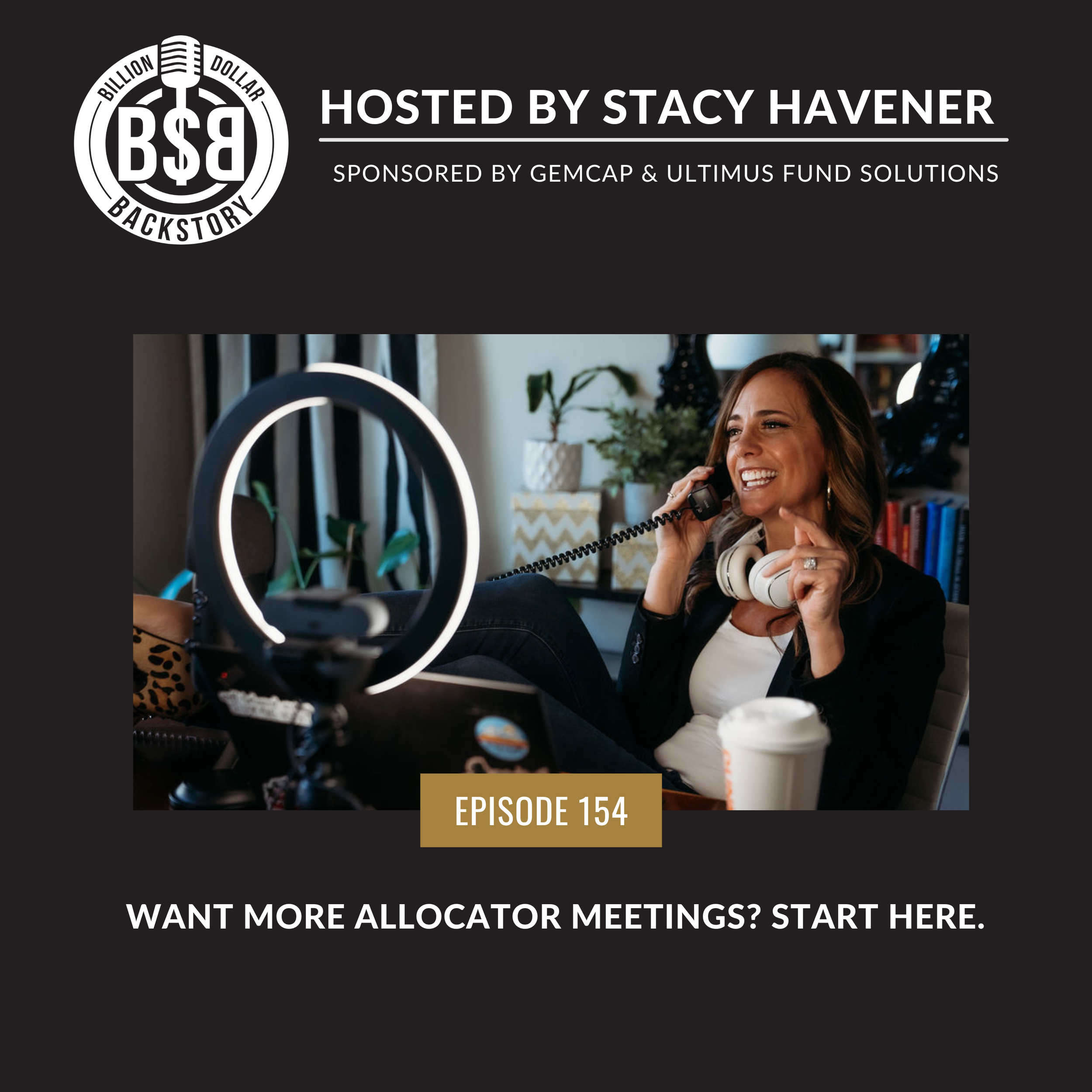
The capital-raising memo says: pitch harder, send the long intro email, and voilà, meetings.
Stacy Havener never got that memo.
She came into this industry as an English lit major who wanted to be a college professor. Finance was a means to an end, not the whole plan. She had no idea there was a "right" way to do capital raising.
So she just led with what she knew best, which was storytelling and creating human connection.
It wasn't until someone tapped her on the shoulder and said, "What are you doing? Because you keep raising money," that she realized what she was doing was different.
Different, and working.
She took her high school soccer coach's fund from $1M to $500M in two years. Then joined a firm at $17M and helped grow it to $5B in three.
In this Story Snack, she's breaking down exactly how and why the answer is never more volume, more cold emails, or more at-bats.
Listen in to learn:
Why "get more meetings" is the wrong goal if the meetings you’re getting aren't converting
How to use small, genuine "gives" to build trust before you ever ask for a meeting
Why give, give, give, ask beats pitch, pitch, pitch every time
This is Story Snacks, a bite-sized, jam-packed series for fund managers who are ready to master strategic storytelling in under 20 minutes a week.
TRANSCRIPT
Below is an AI-generated transcript and therefore it may contain errors.
[00:00:00] Stacy Havener: Craving more knowledge, but don't always have time to sit down for a five-course meal? Take a quick snack break with Story Snacks, bite-sized content to feed your funnel. Each short episode features Stacey digging into one question. This series has her talking stories, sales, and so much more. Oh, yeah. It's time for Story Snacks
[00:00:26] Be cool if you could diversify your investor base and add some non-US investors? Europe could be fun, or Latin America. Maybe Antarctica. Hey, icebergs aren't really my jam, but you never know. You've only got one problem: how the heck do you do that? Fair question, but maybe this is a who not how thing. Meet my friends at gemCAP.
[00:00:51] Not only do they handle all the back office stuff, the how, they'll also solve the who in your distribution conundrum. [00:01:00] They have an incredible network of distribution partners who can help you sell the thing once you've built the thing. And gemCAP won't just help you launch globally, they'll tell you where to go, and maybe more importantly, where not to go, saving you time, money, and annoying headaches.
[00:01:18] Want to find out if your investment firm is ready to go global? Visit
[00:01:25] billiondollarbackstory.com/gemcap, G-E-M-C-A-P. We've created a quick quiz that'll help you figure out if you're ready to expand beyond the US, and side note, it's pretty fun too. Get your firm in front of the right investors in the right places with gemCAP. Take the quiz and get more info at billiondollarbackstory.com/gemcap, G-E-M-C-A-P.
[00:01:57] So after working for years inside the [00:02:00] industry, you obviously saw something that compelled you to start HavenAir Capital. So what did you see about the way that asset managers were going to market, and why was it broken? You know, what I like about that question is the part about what did I see? Because actually, it's about what I didn't see, and that was the memo.
[00:02:22] You know, the memo that you're supposed to get when you get into this industry and you're gonna do capital raising? I didn't get that one. So I came in, into the industry with a background in writing, poetry, literature. I'm an English literature major. I wanted to be a college professor. I'm a storyteller, and I was also paying my way through school, and I was gonna have to pay my way through grad school.
[00:02:47] So, you know, the asset management industry for me initially was a means to an end. It was a way to work for someone I respected, who was my high school soccer coach, who had a day job, which [00:03:00] was managing a billion-dollar small cap equity strategy in 1998. And I went there for a few years to save money.
[00:03:07] That was the plan. I never left, because the fact that I didn't get that memo actually empowered me to do things differently. And as luck would have it, the place I went was my strength, storytelling, connecting people with each other, behavioral science things that I didn't even know behavioral science things were happening inside my brain that just naturally had been.
[00:03:37] And so when I didn't get the memo, I actually was able to write my own blueprint that became foundational at Havener for how we do things today. So I think it's a great example of why we want people on our teams who have non-traditional backgrounds. We of course want [00:04:00] expertise, but we also benefit from people who bring a creativity that can sometimes come from not getting the memo on how it should be done, because they are going to creatively find the things that actually work.
[00:04:15] And in my case, I probably didn't even know that what I was doing was different until someone who had said memo tapped me on the shoulder and said, "WTF are you doing? Because you keep raising money for all of these firms." My high school soccer coach, that fund we took from a million to 500 million in two years.
[00:04:36] I went on to work for a firm that had 17 million in a fund, and we got it to 5 billion in three years. Like, there were a lot of examples of it working that other people were seeing. And again, I didn't know it wasn't supposed to work. I didn't know that what I was doing was difficult until someone told me.
[00:04:56] And then I had to kind of step back and figure out what [00:05:00] was I doing repeatedly. Because I think sometimes too, you're solving a problem in a creative way, you probably go back to the well, but you may not realize that you're going back to the well. You, you may not realize there's a system. And so it took me a good seven plus years of doing before I could sit down and step above it and find the pattern And once we did, we're now able to use that for all the challenger brands that we represent, and it's been super successful.
[00:05:34] I think they call that serendipity in science, don't they? When you do something that you don't realize, it's like an experiment that goes well. So I guess I'm a serendipity in many ways. Managers want meetings, but meetings aren't that easy to get. Yeah. How, how do you actually get them? How do you get meetings?
[00:05:53] Yes. Well, you know, it's interesting. I actually did a survey on LinkedIn, a poll [00:06:00] I believe they call them, on this topic of how many meetings do managers actually want? Because we have clients in various stages of their evolution. I mean, our client base is everything from startups to billion-dollar firms to $20 billion firms, and they have various points of view on how many meetings they're willing to take.
[00:06:24] So I said, "You know what? I'm gonna turn to my, my fave people on LinkedIn and ask this question in a poll." And I think my options were something like one to two meetings, three to four meetings, or five-plus a week. Okay, so this is like a weekly quota. There were a couple people who said like, "I want five meetings a week."
[00:06:48] That is really difficult. Just wanna like say that. But the majority of the people who answered that poll said one to two, which I think is very doable. Like a meeting a [00:07:00] week You're gonna get somewhere between 40 and 50 meetings, like with vacation and all the things. That's great, but as you said, that's not easy to do.
[00:07:10] The reason I wanted to quantify it a little bit is because this is often a misconception with managers that they want at-bats, air quotes on at-bats. Um, they want at-bats, so they are like, "Gosh, you know, I'm not closing as many deals from the meetings I'm getting, so what I need to do is do more meetings."
[00:07:35] And my point of view would be, "No, no, no, you don't need to do more meetings 'cause they're broken, so you're doing more of a broken thing. What we need to do is fix the meetings you're doing so that you win, and then do more meetings." Which is why the framework that we use for getting meetings is not get meetings, it's get more better meetings.
[00:07:58] I do not want you to [00:08:00] get more losing meetings, more worse meetings. That's a no. Get more winning meetings, get more better meetings is a yes. Double thumbs. So, if we want to get more better meetings, we have to understand our target market. This is a big part of it, because if you just say, again, the old way would be, "Doesn't matter.
[00:08:28] Get a warm body in a seat. Every dollar is green and every dollar is for me," all of that kind of mindset, no. We're gonna get rid of that. We need to understand who it is that is the right fit client for us. We don't want every dollar, we want the right dollars. So that exercise is foundational for us in the story framework, so we solve that in month one with clients.
[00:08:53] So if meetings aren't working, I suggest you go back to that drawing board and really figure out when the meetings do go [00:09:00] well or when they do close, what does that allocator look like demographically, psychographically, geographically? Just look for any patterns, okay? So that's point one But point two is once we figure out who, now it's like, okay, how do we get the meeting?
[00:09:19] And I'm gonna give you a framework. It's one of my faves, and it's actually patterned after Gary Vee, who has this thing, and I'm looking over Mary's shoulder here because there's a book on the shelf. Oh, there it is. Jab, jab, jab, right hook. Okay, I don't know why we're punching our prospects or why this is, like, often the vernacular and sort of analogy we use in sales of, like, beating someone down.
[00:09:48] I would like to be on the same side with my prospect, not jabbing them in the face. So our version of that is give, give, give, ask. Okay, [00:10:00] just, let's just soak that in. Jab, jab, jab, right hook or give, give, give, ask. I'm a positive gal. I like the latter. It also works And it works because of behavioral science.
[00:10:12] Uh, think Robert Cialdini's book, "Influence." If you've read that, this is sort of the likability, the reciprocity principles in Cialdini's influence framework. The gives are what you do for someone else without expecting anything in return. And so that means if I'm hanging out with Mary like I am right now, and, um, she did something great yesterday, this morning, she wrote a great post, whatever it is, I could say to her, "Mary, oh my gosh, awesome job on that.
[00:10:50] I read that. I laughed out loud. You're amazing." Right? Giving flowers, your words to someone, that's a give. It doesn't have to be-- This is not like send someone, [00:11:00] you know, a super expensive anything. Also culture of compliance, we can't. But give them some small token of appreciation, be it your words, like their LinkedIn post, comment on their LinkedIn post, send them an email with something nice without an ask, okay?
[00:11:18] So do that three times before you ask for a meeting. Why? Because by the time you ask for a meeting, they're already kind of like digging you. They're like, "Wow, that person's so nice. Oh, there's Stacey again. Gosh, she keeps showing up on my post. That makes me feel good." If I now come in and say, "Hey, by the way, I've like been loving what you're writing.
[00:11:43] I've, I've read your commentaries. They're amazing. I feel like I would just love to hang out with you. I've-- Can we grab coffee?" That person is more inclined to say yes. And I know this is not what we're taught in this business. You know, we're taught to pitch. We're taught to [00:12:00] write these long intro emails.
[00:12:01] And what I'm saying and what I'm doing is giving you permission to stop doing that and be a person, and approach the meeting from a human place and not a product place. So I hope that helps. Let's be real. No one wakes up and says, "I can't wait to build some operational infrastructure today." You're here to manage money, to build something that lights you up, not chase down reports across five systems and 15 service providers.
[00:12:31] That's where Ultimus Fund Solutions comes in. They're your ops dream team, consolidating all your middle and back office chaos into one clean, scalable setup. Registered funds, private funds, SMAs, all integrated. One team, one tech platform, one rock-solid source of data. But here's the real differentiator: service.
[00:12:58] I know that fund in a [00:13:00] box sounds convenient. It's also a box. Know what you can't put in a box? A human who picks up the phone when you call and need help. Real-life people who know your name and your fund, and they care about getting it right. Ultimus was built on people doing business with people. You get institutional strength combined with boutique-level service without getting stuck in a phone tree of doom.
[00:13:26] If you're ready to simplify, scale, and start working with a team that feels like an extension of yours, check out billiondollarbackstory.com/ultimus. That's U-L-T-I-M-U-S. You've got the investment strategy, the vision, the track record. Now it's time to upgrade the engine behind it all with Ultimus. This podcast is for informational purposes only and should not be relied upon as a basis for investment decisions.
[00:13:58] The information is not an offer, [00:14:00] solicitation, or recommendation of any of the funds, services, or products, or to adopt any investment strategy. Investment values may fluctuate, and past performance is not a guide to future performance. All opinions expressed by guests on the show are solely their own opinion and do not necessarily reflect those at their firm.
[00:14:18] Managers' appearance on the show does not constitute an endorsement by Stacy Havener or Havener Capital Partners
Resources