
Episode 158: No Fancy Degree, No Problem: Lindsey Stewart on McDonald’s, Morningstar, and Making Finance Make Sense
Subscribe to Billion Dollar Backstory on Apple Podcasts, Google Podcasts, Spotify, or wherever you listen to podcasts.
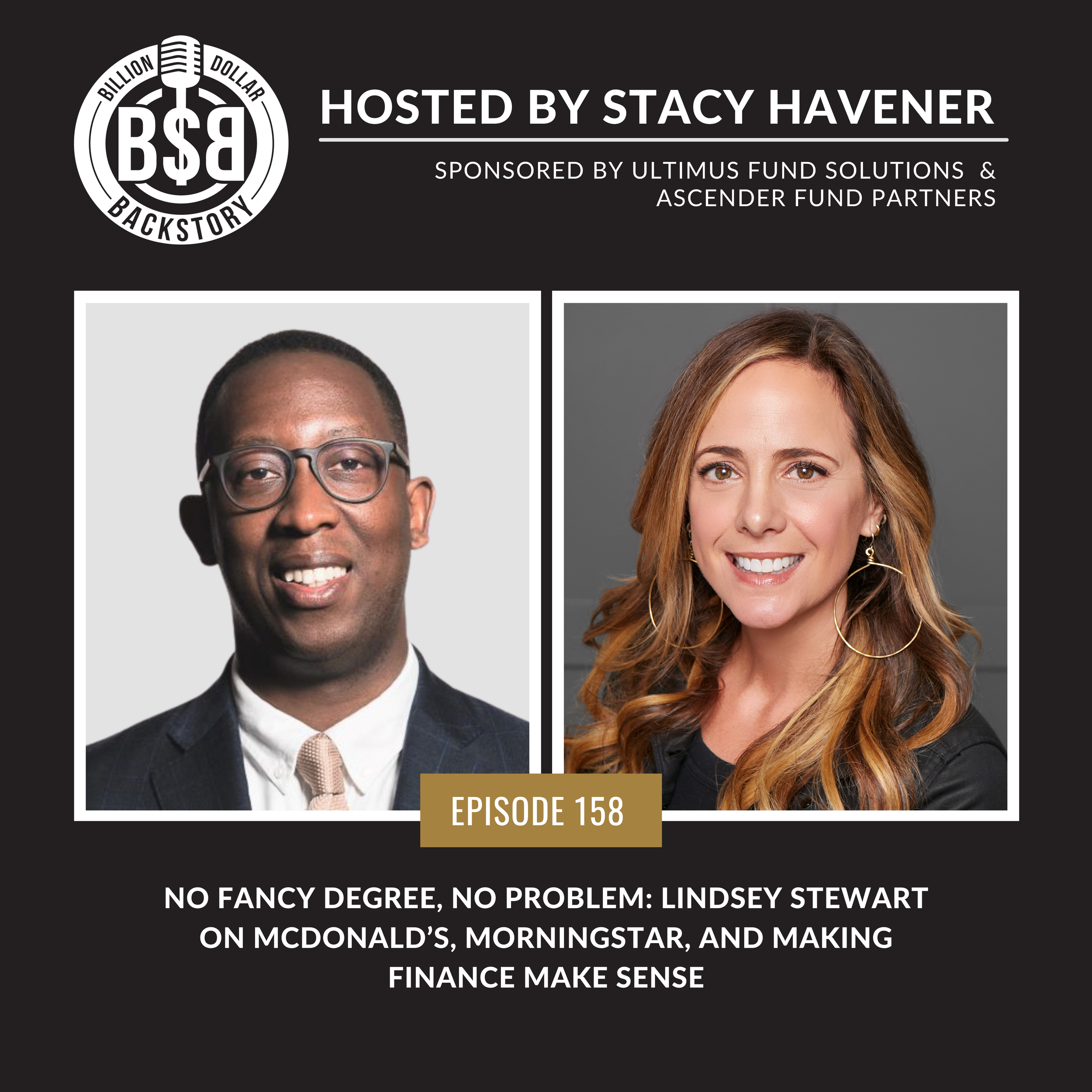
Most people assume a successful career in finance starts with the "right" degree.
Lindsey Stewart's started behind the counter at McDonald's.
At 18, he made the decision to skip university, avoid student debt, and learn by doing. Years later, that path led him to Morningstar, where he now helps some of the world's largest institutional investors turn complex data into better decisions.
In this episode, Lindsey and Stacy discuss:
Lindsey’s backstory – from an investor relations firm to a Big Four acquisition to Morningstar
Why he put McDonald's back on his LinkedIn profile after years of leaving it off
What nearly broke him about the CFA exam, and what finally helped him pass
The bias he sees across the finance industry (and why it may be holding talented people back)
Why "sounding smart" and being understood are not the same thing
More About Lindsey Stewart:
Lindsey Stewart, CFA, is Director of Institutional Insights at Morningstar, where he leads content and outreach for institutional investors. His 25-year career spans investor engagement, financial regulation, and communications at firms including KPMG and the UK Financial Reporting Council.
He is a Chartered Management Accountant and holds the CFA designation, and was a Senior Leader Finalist at the 2021 Black British Business Awards.
Resources Mentioned in This Episode:
Books:
The Madness of Markets: Why Smart Investors Make Crazy Decisions – And How to Exploit Them
Grow the Pie: How Great Companies Deliver Both Purpose and Profit
Podcasts:
Song:
TRANSCRIPT
Below is an AI-generated transcript and therefore it may contain errors.
[00:00:00] Stacy Havener: A fancy university degree almost seems like a prerequisite for anyone who wants to start a career in finance. Not for Lindsay Stewart, though. He didn't take the traditional path. In fact, he started behind a McDonald's counter, and he recently added that to his LinkedIn profile. It's the thing that jumped out to me because it's a promise to others, that there is a path for us.
[00:00:26] At 18, straight out of high school in the UK, he decided university debt wasn't worth it and struck out to pave his own way instead. Lindsay started at an investor relations advisory firm, which became part of the Big Four and led to capital advisory work across the UK and Europe. He parlayed that into a communications role explaining banking regulation to people who'd really rather not think about banking regulation.
[00:00:53] Somewhere in there, he passed all three levels of the CFA exam on the first try, though he'll tell you the [00:01:00] material nearly broke him, until he stopped reading the prose and started drawing it instead. Today, Lindsay is Morningstar's Director of Institutional Insights, doing what he's always done, providing a path of clarity and possibility, turning dense data into a story real people can act on for some of the largest institutional investors in the world.
[00:01:25] This episode was recorded live at the Morningstar Investment Conference in Chicago, where I had the honor of being part of their first ever brand ambassador program. It's a conversation between two people who have made their way in this industry their own way. It's an episode for anyone who's ever wondered if the part of your story that you're tempted to hide is actually the one you should be leading with.
[00:01:50] Without further ado, meet my friend Lindsay. Hey, my name is Stacy Havener. I'm obsessed with startups, [00:02:00] stories, and sales. Storytelling has fueled my success as a female founder in the toughest boys club, Wall Street. I've raised over 8 billion that has led to 30 billion in follow-on assets for investment boutiques.
[00:02:13] You could say against the odds. Yeah, understatement. I share stories of the people behind the portfolios while teaching you how to use story to shape outcomes. It's real talk here. Money, authenticity, growth, setbacks, sales, and marketing are all topics we discuss. Think of this as the capital raising class you wish you had in college, mixed with happy hour.
[00:02:41] Pull up a seat, grab your notebook, and get ready to be inspired and challenged while you learn. This is the Billion Dollar Backstory podcast.
[00:02:53] Let's be real. No one wakes up and says, "I can't wait to build some operational infrastructure today." [00:03:00] You're here to manage money, to build something that lights you up, not chase down reports across five systems and 15 service providers. That's where Ultimus Fund Solutions comes in. They're your ops dream team, consolidating all your middle and back office chaos into one clean, scalable setup.
[00:03:20] Registered funds, private funds, SMAs, all integrated. One team, one tech platform, one rock-solid source of data. But here's the real differentiator: service. I know that fund in a box sounds convenient. It's also a box. Know what you can't put in a box? A human who picks up the phone when you call and need help.
[00:03:46] Real-life people who know your name and your fund, and they care about getting it right. Ultimus was built on people doing business with people. You get institutional strength combined with [00:04:00] boutique-level service without getting stuck in a phone tree of doom. If you're ready to simplify, scale, and start working with a team that feels like an extension of yours, check out billiondollarbackstory.com/ultimus.
[00:04:15] That's U-L-T-I-M-U-S. You've got the investment strategy, the vision, the track record. Now it's time to upgrade the engine behind it all with Ultimus Lindsay, thank you so much for being here in the Morningstar podcast studio at the Morningstar Investment Conference as a stellar employee of Morningstar. This is just a Morningstar episode of the Billion Dollar Backstory podcast, and a chance for me to meet someone I've been friends with on LinkedIn but haven't had a chance to meet in person.
[00:04:53] Mm. So thank you so much for being here.
[00:04:55] Lindsey Stewart: My pleasure, my pleasure to be in Chicago, uh, representing Morningstar, as you say. [00:05:00] Um, everything's going well and I'm super pleased to, to be here. I've been following your work for some time. Um, I can't believe we even talk, to be honest with you. So, um, yeah, it's, uh, it's really great.
[00:05:10] Great to be having a conversation.
[00:05:10] Stacy Havener: Okay,
[00:05:10] Lindsey Stewart: this
[00:05:10] Stacy Havener: is fantastic. So I'm gonna mix it up a little bit. I normally have kind of a way I like the interview to go, but I'd like to do something different. I'm gonna start with today, and then I wanna go back.
[00:05:23] Lindsey Stewart: Okay.
[00:05:23] Stacy Havener: Okay? So tell us, I mentioned you are one of the faces of Morningstar.
[00:05:28] Tell us what you do today.
[00:05:30] Lindsey Stewart: Right now I am Morningstar's Director of Institutional Insights. Um, I mean, we're sitting here at a very advisor and retail-focused conference, but I think it's important that everybody also realizes that institutional investors, Morningstar has a lot to offer that particular audience as well, the deep analysis and independent thought that we put in.
[00:05:51] You've seen it around things like the SpaceX IPO that we, um, covered last week. That independent voice is really, really important, and so we've got a lot to offer [00:06:00] institutional investors. I'm just making sure that that audience's attention is on that side of things.
[00:06:05] Stacy Havener: Okay, so that's perfect, and that's where you sit today.
[00:06:09] And now I wanna go back. There was something in your LinkedIn bio that really jumped out to me and spoke to me, and I asked if it was okay if we talked about it, and you graciously agreed.
[00:06:22] Lindsey Stewart: Sure.
[00:06:23] Stacy Havener: Okay. So when I looked at your LinkedIn profile, which is amazing, and you have all these, you know, fantastic credentials, and you can see your journey and your evolution.
[00:06:32] But the most special part to me was right at the beginning, you had something that said that you worked at McDonald's.
[00:06:42] Lindsey Stewart: Right. Yeah, we're going back a long way with
[00:06:45] Stacy Havener: that. We're going back a long way, but what really jumped out to me was that was, that was intentional. You didn't have to include that. And so I want you to talk about, I want you to talk about the experience, but also why you chose to put it on your LinkedIn profile.
[00:06:59] Lindsey Stewart: Oh, sure. That's such [00:07:00] a thoughtful question. Um, you're right. It is intentional. I haven't always had that on there-
[00:07:05] Stacy Havener: Yeah ...
[00:07:05] Lindsey Stewart: because, see, I came into the finance industry at the age of 18, straight from high school. Didn't do the degree. Decided to just- Uh-huh ... get a job, learn on the job, and, you know, I've been good with that.
[00:07:16] I did management accounting. I've done the CFA charter and a bunch of other qualifications. But, you know, you're kind of mingling around a lot of people with these elite degrees and you never- Yeah ... quite think, "Do I match up to this standard?"
[00:07:27] Stacy Havener: Yes.
[00:07:28] Lindsey Stewart: Yeah. And so for a long time I didn't have that on there.
[00:07:31] Eventually, I got to a point where I was confident in my career, the things that I'd done, the things I knew I was good at, where I wanted to take my career, and I just thought that I owe it to everyone in the same position who thinks, you know, "I could do that. I don't really see the way to, to be able to get from the situation I'm in where I'm doing a job that most people don't consider to be prestigious-
[00:07:56] Stacy Havener: Yeah
[00:07:57] Lindsey Stewart: and work their way from there to a senior [00:08:00] position in the industry of their choice, particularly in finance." And so for all of the people who thought, "You know, I'm gonna try and make that journey," I thought it would be important for them to see it, so that's why that's there.
[00:08:10] Stacy Havener: It's-- I mean, I could just drop this mic, but I can't 'cause it's in-
[00:08:14] a really great setup. Uh, that is so near and dear to my heart. I'm so proud of you for doing it. I'm so proud of you for talking about this part of your story, and that was one of my questions because as I was researching, you know, and learning about your bio, and I didn't see university on there.
[00:08:34] Lindsey Stewart: Right.
[00:08:35] Stacy Havener: And you just said, "This is a very non-traditional path."
[00:08:40] Lindsey Stewart: Right.
[00:08:40] Stacy Havener: And I wonder, you know, when we look back at our stories, they make a lot of sense. When we're living them in the current moment, sometimes we can't see exactly how things are connected. Yeah. When you're sitting here in the role you're in now, as you said, with this confidence that you belong here, because [00:09:00] you do belong here, and you think back, what lessons did either of those things, the fact that you worked at McDonald's, what, what did that teach you or how does that show up for you now?
[00:09:11] And the fact that you didn't take the typical go to the fancy school and get the fancy degree path- Mm ... in finance. Yeah. How do those show up for you now?
[00:09:20] Lindsey Stewart: Ooh, that's a, that's a big conversation. Yeah. Where should I start with that? I think in terms of the decision, uh, not to go to university and get a degree, I think the conversation's become very, very live recently because I don't know how it is in the US, but in the UK there's a lot of talk about social mobility-
[00:09:38] Stacy Havener: Yes
[00:09:38] Lindsey Stewart: in particular. How do we get people from a wider range of backgrounds into professions like finance, like law, like professional services, so that they are better able to come up with the solutions that, that clients need?
[00:09:51] Stacy Havener: Yeah.
[00:09:51] Lindsey Stewart: So that's one aspect of it. But also, I think- The conversation around the sheer cost of going to university- Oh, yes
[00:09:59] and [00:10:00] the debt that people have to take on-
[00:10:01] Stacy Havener: Mm-hmm ...
[00:10:02] Lindsey Stewart: that's also come back around, and I was very sensitive to that at the time. Now, looking back, I feel like it wasn't as big as I thought at the time, but you know, I was 17, 18 years old. What did I know about making a decision of that magnitude, right?
[00:10:17] Particularly coming from a very working class background where it wasn't really the career path you took. You kind of got into a job, learned the trade that way. I applied to an elite university but didn't quite get the grades to go in there, and for some reason, you could call it hardheadedness or whatever-
[00:10:32] I just decided, you know what? I'm just going to strike out on my own path. I've heard that some employers, you know, will give you training while you work. I was quite attracted to that because I wanted to avoid all the debt and cost- Yeah ... of going to university, so that is what I decided to do. I worked at an investor relations advisory company straight out of school.
[00:10:51] Not that I knew what investor relations was when I started
[00:10:54] Stacy Havener: doing it. None of us do in any of the jobs we start, right.
[00:10:56] Lindsey Stewart: Um, they just gave me the confidence that, you know, I had some [00:11:00] math skills. I was a reasonably good communicator. I could get the hang of it. Yeah. So I did that. That company was eventually acquired by a Big Four accounting firm.
[00:11:07] I did some work on capital advisory for listed companies in UK and continental Europe for a while, and then went into a communications role of all things-
[00:11:17] Stacy Havener: Mm-hmm ...
[00:11:18] Lindsey Stewart: where I was helping people understand the nuances of financial reporting standards and banking regulations, but really experimenting with how to do that in a very accessible way.
[00:11:29] Stacy Havener: Mm-hmm.
[00:11:30] Lindsey Stewart: And so the time I spent doing that has set the great foundation for the sort of thing I'm doing now, where you're digging into sort of very in-the-moment topics, very quantitative information, and trying to pull out the story, the narrative that makes sense to people, but is also very, very based on the fact.
[00:11:48] Because capital markets is largely just a collection of narratives, and people select which ones they want to kind of attach their capital to. Mm-hmm. And so the ability to [00:12:00] pull a narrative out of those numbers and explain it to people- Yes ... in an understandable way is absolutely critical to success around
[00:12:06] Stacy Havener: all of that.
[00:12:07] I love this. And all roads lead back to story for me. Hmm. Yeah. And so the fact that somebody who is more in the statistics and numbers, when I hear that from you, it really lights me up. And I wanna talk about some of the challenges in this industry with exactly what you described. When we were having breakfast this morning, I, I shared with you one of the things I find asset managers and wealth managers struggle with in this space- Mm
[00:12:35] is presenting data in a way where it resonates, where the data itself can tell a story. People love charts, and they'll show a chart, and it'll just be like, "Isn't this chart amazing?" Because in their head they have that narrative, and they have all the, all the reasons why that chart is amazing. But s- often they forget to tell anybody else or invite anyone else into that [00:13:00] conversation.
[00:13:00] So how do you take data that can feel heavy or maybe dry, maybe boring on the surface, how do you bring that to life? How do you light that up?
[00:13:12] Lindsey Stewart: Yeah. I think there's a saying that's often attributed to Albert Einstein that if you can't explain something simply, then you don't understand it, and I've tried to live by that in a way.
[00:13:24] I think one of the skills I realized I had while I was doing the CFA exams-
[00:13:29] Stacy Havener: Yeah ...
[00:13:30] Lindsey Stewart: was learning exactly how I absorb information. And it may sound, sound strange for someone who, you know, passed all three levels of the CFA exam first time to say this, but I actually struggled quite a lot with, uh, the CFA exam because of the way a lot of the information is presented, long prose, Greek letters everywhere.
[00:13:51] But you can understand it after a while- Totally ... but it takes a lot of effort.
[00:13:54] Stacy Havener: Yeah.
[00:13:55] Lindsey Stewart: And quite a lot of the time while I was studying, I would just abandon the book-
[00:13:59] Stacy Havener: [00:14:00] Okay ...
[00:14:00] Lindsey Stewart: get a large piece of paper, and just try and plot out what this would look like if I just tried to work out certain answers based on the mathematical principles.
[00:14:10] And so it's like different colored pens, arrows, shapes everywhere, and just trying to boil it down to the fundamentals of if I had to explain this visually, what would it look like?
[00:14:21] Stacy Havener: Ooh, yes.
[00:14:23] Lindsey Stewart: And so having done that, you realize that you can explain things a lot more simply through those visuals if you have a, like a fundamental understanding of those relationships and you can draw them in a way that people find very accessible.
[00:14:37] And so I've tried to carry that in through my work. Um, really just trying to break things down into the simplest form possible. Like, does this chart need this axis and that axis on it? Uh, can we differentiate using color instead of shapes or something like- Yes ... thinking about the simplest way to present information.
[00:14:56] A lot of the most popular, the, [00:15:00] the charts that have resonated the most with audiences are basically just green and red blocks to show voting data when I analyze that kind of clip. Mm-hmm. And if you make things accessible, you create something that is both visually engaging, so you pull in an audience that might not have otherwise been interested in what you're doing, but you also make the narrative you're trying to get across very readily understandable and more accessible.
[00:15:21] And so it gains more traction with more people, and that's really, really important in the kind of work we
[00:15:26] Stacy Havener: do. It's so interesting because I, I shared with you a phrase that is sort of a bee in my bonnet that I hear in this industry a lot, and not kidding, when I walked into the exhibit hall today, somebody said the phrase to me, and I was like, "No, I was just talking about this."
[00:15:41] Lindsey Stewart: Oh, yeah?
[00:15:41] Stacy Havener: Which is, "Oh, yes, I, I hear what you're saying, Lindsay, you know, getting it to the most simple, most accessible point and delivering the narrative in that way, but that's dumbing it down. That's watering it down, and I'm really, really [00:16:00] intellectual, and I need to prove how, you know, how intellectual I am, and so I don't wanna dumb things down."
[00:16:07] Mm. And how do you respond to that?
[00:16:10] Lindsey Stewart: You can see where the temptation comes from to make things complicated, to speak in a particular language that suggests learning, but I think what you end up doing is you're shutting a lot of people out from accessing the idea that you're trying to get across. And so I think if you can explain something simply, you've opened the door for more people to be in the conversation.
[00:16:32] You can find a way to take them on that journey with you and introduce- Yes ... more advanced concepts over time. Yes. But if you start with that-
[00:16:39] Stacy Havener: Yes ...
[00:16:40] Lindsey Stewart: you can lose a lot of people immediately, and you don't get the traction that you need to get. Now, obviously, there's a lot of context to that. It really depends on the audience you're speaking to.
[00:16:48] Of course.
[00:16:49] Stacy Havener: Yeah.
[00:16:49] Lindsey Stewart: There are, you know, university academics that you can go straight into- Yeah ... the detail and start talking Greek- Right ... letters and theories and, and things like that. But for most people aren't at that level, and even for a lot of [00:17:00] people who are, do they have the time and the bandwidth to dive back into their- Right
[00:17:04] education and think, "Okay, yeah, yeah, I remember we learned that in 1996."
[00:17:09] Stacy Havener: Yeah.
[00:17:09] Lindsey Stewart: A vague... Right? Yeah. So just meeting people where they are-
[00:17:13] Stacy Havener: Yes ...
[00:17:14] Lindsey Stewart: is hugely impactful.
[00:17:16] Stacy Havener: I agree. And I, I also think this idea of zero-sum or some sort of battle that gets perpetuated in our industry of like, "I have to prove I'm the smartest person in the room."
[00:17:30] Mm. "I have to be the best." It's not inclusive, it's exclusive, and it's actually... There's an element of intimidation. If I come into the room and I only speak at this very high level that only a small percent of people can track with, I am creating a wall.
[00:17:50] Lindsey Stewart: Mm. Yeah.
[00:17:51] Stacy Havener: I'm not welcoming people in, as you said. I am actually keeping them at bay, and I don't think that's the vibe.
[00:17:59] I don't [00:18:00] know if people are conscious of that vibe when they're doing it-
[00:18:03] Lindsey Stewart: Right ...
[00:18:04] Stacy Havener: but it's not helpful. It sort of perpetuates the complexity bias, which I think our industry is very prone to falling into.
[00:18:14] Lindsey Stewart: Yeah, I agree with that, and I think the competition to be the smartest in the room can actually make you a bit rigid, a bit inflexible when things start to change.
[00:18:25] I mean, we've spoken a lot at this conference and others about public/private convergence. Yes. If you're the smartest in the room on public equity or public fixed income, what happens when most of that starts moving into other areas? Are you still going to be the smartest in the room, or do you accept that- Yeah
[00:18:41] actually I need to approach this with a bit of humility. I need to think about what are the basic principles at work here and find a way to communicate to a wider audience.
[00:18:51] Stacy Havener: I agree with you I think there's also a thread here- Mm ... that reminds me of something you wrote about, [00:19:00] I think, pretty recently. You know, there's a, there's a perception in the fund space that fund managers are arrogant, and there certainly are fund managers who are arrogant.
[00:19:11] However, having worked with hundreds of fund managers, more often than not, I don't see arrogance. I see shyness.
[00:19:22] Lindsey Stewart: Mm.
[00:19:22] Stacy Havener: I see nervousness. I see introversion, being uncomfortable in social settings, in a meeting, in a biz dev role, and it can sometimes show up as what we're describing. Like, they're comfortable talking Greeks, and so that's where they go because they're already feeling uncomfortable, and they go to what they know.
[00:19:46] And so you wrote recently about this topic of introversion. I think there are a lot of us in the investment industry, myself included, who identify as introverts. Can you share a little bit about the piece I'm [00:20:00] referencing and the quote that you pulled out?
[00:20:02] Lindsey Stewart: Oh, sure.
[00:20:03] Stacy Havener: Yeah.
[00:20:03] Lindsey Stewart: So I spent a quite a lot of last month covering, um, the comings and goings at a particular oil company, at BP, and toward the end of that, there was an article in the Financial Times that was talking about the new CEO, uh, Meg O'Neill.
[00:20:20] And it noted that the chair of her previous business had noted that she was an introvert, she thinks before she speaks, and that he considered her suitability for that senior role in the business might be in doubt because of this sort of introverted nature or at least his perception of it. And I thought that was absolutely outstanding, uh, to me.
[00:20:44] Like, and not in, not in like a, a positive kind of way. It's like- Not in a positive
[00:20:48] Stacy Havener: connotation, yeah ...
[00:20:48] Lindsey Stewart: um, because, you know, if, if we've got senior executives who are being selected for the quick answer, not necessarily the right one, who are impulsive, I mean, there's times when you need [00:21:00] that, but there's times when you also need the other stuff.
[00:21:02] To pause, to reflect, think about a course of action, plan things out. And so it was really, really eye-opening to me, and so I made a comment saying that, you know, maybe one day this will be an unremarkable- Yes ... characteristic in senior executives, but for some reason right now it's not, and I, I feel like it may be costing all of us.
[00:21:20] Stacy Havener: Are you an introvert or an extrovert?
[00:21:22] Lindsey Stewart: So I'd say I have introverted tendencies- Yes ... most of the time. If you were to ask me the question five years ago, I would've said absolutely I'm an introvert. Now I think so much of it is contextual. But I'd say generally in most situations, um, I would identify being introverted.
[00:21:41] And what I mean by that, 'cause I think a lot of people confuse introversion with shyness.
[00:21:45] Stacy Havener: Okay.
[00:21:46] Lindsey Stewart: Introverts generally just have to consume their own energy in social situations like the one we're in now, right? But I wouldn't say I was shy, otherwise I wouldn't be on a podcast. No. I wouldn't be on stage. No.
[00:21:56] I wouldn't be on video. I wouldn't do any of it, right? So it's not [00:22:00] always the same thing, but yes, I can, I can relate quite a lot to having to pause and reflect and think about- Yes ... coming up with a careful answer, not necessarily a quick one. Puts me in a disadvantage in meetings when a lot of people are very inclined to say the first thing that comes out of their mouth.
[00:22:15] Right. But I think we need everyone. We need all of those characteristics. But the way that introversion is often portrayed in a, I wouldn't go so far as to say negative, but people are reticent to include- Right. Yeah ... introverted tendencies as signs of leadership or to prioritize them for high-profile roles, and I think all of that needs a bit of a rethink.
[00:22:39] Stacy Havener: I agree with you, and it's interesting in the example with Meg O'Neill that you were sharing because it does also make us contemplate, well, what is the role of the CEO?
[00:22:55] Lindsey Stewart: Right.
[00:22:55] Stacy Havener: Because I think there's probably a camp that says, well, it's a very front-stage role, [00:23:00] especially if it's a public company. You're the face.
[00:23:03] You need to have the charm and the charisma and give people hope and communicate the message and all of these things that maybe lean more extroverted. But then there's probably a camp that says, "Yes, true," but there's also sort of a backstage role for someone in that seat, which is maybe more where she shines per se in the traditional introvert/extrovert-
[00:23:27] Lindsey Stewart: Mm
[00:23:27] Stacy Havener: dichotomy of being thoughtful and being a leader and thinking and processing and giving people space, other people space to share. And so it's almost, it's there needs to be room for both, and also I think we need to be thoughtful about what different roles, what is the, the job of that role? What is the primary goal?
[00:23:51] Lindsey Stewart: Right. Yeah.
[00:23:52] Stacy Havener: And I think there's, there's a lot of different points of views on that CEO seat especially.
[00:23:58] Lindsey Stewart: For sure. I think it's important [00:24:00] to remember that there is no perfect CEO out there that has all of the skills. And that everything you need to be a CEO, a senior executive, any role, can be taught and learned.
[00:24:12] Stacy Havener: Yes.
[00:24:13] Lindsey Stewart: And whisper it quietly, CEOs actually get a lot of help.
[00:24:16] Stacy Havener: Of course.
[00:24:16] Lindsey Stewart: Right? So- Um, so this idea that- ... you know, we have this tendency to just classify people.
[00:24:24] Stacy Havener: Yeah
[00:24:25] Lindsey Stewart: And we'll say, "You are one of these, therefore I don't think you can do this." Mm-hmm. And I think, you know, there's a, a lot more flexibility that needs to be applied to this.
[00:24:34] Think about, okay, where is this person strong?
[00:24:36] Stacy Havener: Mm-hmm.
[00:24:37] Lindsey Stewart: Do those skills fit what we need for this business, and where do they need help with- Yes ... strengthening certain aspects of the way they present to others? Because I can tell you, maybe 15 years ago, nobody would've even suggested, even including myself, nobody would've thought that I'd be on stages giving keynotes at conferences, making videos once a week- Yes
[00:24:57] uh, and literally doing that for a living. Those [00:25:00] are skills that I recognized I needed to push for leadership roles- How- ... and was willing to work on and get good at.
[00:25:07] Stacy Havener: How did you do that, and what advice do you have? Because again, I think more often than not, we're gonna find introverts in this business.
[00:25:14] Lindsey Stewart: Yeah.
[00:25:15] Stacy Havener: And they may want to become better at communication or more comfortable in, you know, client-facing settings. What advice do you have? What was your evolution? How did you work through that?
[00:25:27] Lindsey Stewart: Um, I think a lot of my evolution was just taking note of painful but valuable feedback from people I respected, right?
[00:25:38] Stacy Havener: Yes.
[00:25:39] Lindsey Stewart: Like, there are times when maybe I'd write something or deliver a presentation, and somebody that I respect-
[00:25:46] Stacy Havener: Yes ...
[00:25:46] Lindsey Stewart: you know, a mentor if you like, would say I'd ask them how it went, and they'd say, "Oh yeah, that was, that was all right. That was good." And I could sense that what they're trying to tell me is that this fell short of a standard that I needed to hit.[00:26:00]
[00:26:00] And so I would probe. I would try to find out exactly where I needed to get to- Mm-hmm ... what were the weaknesses, and try and work on those and improve and get to a point where I was getting my points across properly, where I was preparing adequately enough. But quite a lot of what goes into that is just basically accepting who you are, who you've become, and being okay with it, and thinking, "Okay, this is what I do naturally.
[00:26:26] These are things I can work on."
[00:26:28] Stacy Havener: Mm-hmm.
[00:26:29] Lindsey Stewart: All I really need with these things is time and practice, and just make sure you put in the practice.
[00:26:36] Stacy Havener: Mm-hmm.
[00:26:36] Lindsey Stewart: Go into places where you feel uncomfortable.
[00:26:39] Stacy Havener: Right.
[00:26:39] Lindsey Stewart: Put yourself on a stage. Find yourself an audience to talk to.
[00:26:42] Stacy Havener: Right.
[00:26:43] Lindsey Stewart: Write things and actually publish it. A lot of people don't publish things because they are waiting for it to be perfect.
[00:26:50] Stacy Havener: Oh.
[00:26:51] Lindsey Stewart: Right?
[00:26:51] Stacy Havener: Yes.
[00:26:52] Lindsey Stewart: But if you think of your favorite book, your favorite song, your favorite film, whatever it is, somebody took the [00:27:00] decision to publish it despite the fact that they knew it wasn't perfect, right? You might think it's excellent, but the creator of it thinks, "Actually, I would've changed that. I would've done that differently.
[00:27:12] This should be shorter. This should be longer. I needed to speak up here. I needed to be more quiet here." Right. They've got 100,000 notes in their head on this piece that they've put out. And I can think of times where I published things, and I've been miserable thinking about all the things that I would change, when other people have told me, "Actually, this is excellent."
[00:27:30] And I'm like, okay, so I need to listen to the voices that say, "Okay, this is good. It's also done, and it's good enough."
[00:27:36] Stacy Havener: That's right.
[00:27:37] Lindsey Stewart: Um, but it's been a real journey
[00:27:40] Stacy Havener: So that spotlight effect of thinking that people care as much about us as we care about us- Right ... which is obviously not true. People care about themselves.
[00:27:51] We care about ourselves way more than they do. Mm. So I think that point is really important, and it should be freeing-
[00:27:58] Lindsey Stewart: Yeah ...
[00:27:59] Stacy Havener: to know that people [00:28:00] don't care as much as we think. It should give us permission to launch something, publish something, even if it's not perfect. Yeah. I have a saying that I just, I, I just re-underwrite, like, daily, which is people don't want our perfect, they want our real.
[00:28:16] Yeah. And it kinda goes back to that intellectualism we talked about prior, which is if we showed up as, you know, the perfect social media, edited everything, that's also intimidating. Right. That also creates a wall because the people receiving us in that form are not perfect.
[00:28:37] Lindsey Stewart: Right.
[00:28:37] Stacy Havener: Right. And it makes them feel bad in some way to see that.
[00:28:41] It makes us not relatable.
[00:28:44] Lindsey Stewart: Yeah. Yeah. I love that point, and it, it kinda does take us a bit back to how we opened this talk- Yeah ... because I think if there are any advantages at all to starting your career in a fast food restaurant- Yeah. ... um, it's that I've never been [00:29:00] permitted the opportunity to have that perfect facade, right?
[00:29:03] Ah. I don't have the Oxbridge degree and I didn't work at this investment bank early in the career. Right. And so if you've got to build up a reputation without all of that prestige, and I'm not throwing any shade on it at all, um, you have to think about how are you going to keep it real but also demonstrate competence.
[00:29:21] Stacy Havener: Yes.
[00:29:21] Lindsey Stewart: And so it just takes your, your mind where you direct your energy in just different directions. That can benefit the teams that you work with, the, your employers you work for, absolutely, so.
[00:29:32] Stacy Havener: Yes. Yeah. Okay. There was one other point I wanted to make though about the idea that does capability build confidence, or does confidence build capability?
[00:29:45] Meaning, do you not do the thing until you have the confidence, or is it that by doing the thing you build the confidence?
[00:29:56] Lindsey Stewart: Oh, oh, that's a great question. Okay, so it's both
[00:29:59] Stacy Havener: [00:30:00] Okay ...
[00:30:00] Lindsey Stewart: but I would say doing the thing builds confidence. Yeah. You have to make the decision to start,
[00:30:10] Stacy Havener: right? That's right. I
[00:30:11] Lindsey Stewart: agree
[00:30:15] with that. And then the circle starts, the wheel starts turning from there. You, you made the decision to start. I don't know where I read this, but it's, it really resonated with me. You don't feel ready because ready isn't a feeling, it's a decision.
[00:30:27] Stacy Havener: Oh.
[00:30:27] Lindsey Stewart: Right?
[00:30:28] Stacy Havener: I love that.
[00:30:29] Lindsey Stewart: Ready is a decision. It's a choice.
[00:30:31] Decision, I'm doing it today.
[00:30:32] Stacy Havener: Yes.
[00:30:33] Lindsey Stewart: Right? So whether it's going up on stage at Morningstar's Investment Conference, right, I'm doing it today. I'm going to publish that, that blog I wrote. I'm going to record that video and put it on-
[00:30:45] Stacy Havener: Yes ...
[00:30:46] Lindsey Stewart: social media or, right? Ready is a decision
[00:30:49] Stacy Havener: I love that. Okay, you mentioned books.
[00:30:52] I wanna talk about books. I love to read. I'm an English literature major-
[00:30:56] Lindsey Stewart: Uh-huh ...
[00:30:57] Stacy Havener: who's happily in, in the finance industry and [00:31:00] also doesn't make any sense, but that's part of my magic. So tell me, like, is there a book you're reading now that you love? Is there a book you're excited to read next?
[00:31:09] Lindsey Stewart: I've got- gotta make sure I get this right.
[00:31:11] Okay. But I feel like every time I'm asked for book recommendation, I come back to- Oh, and
[00:31:15] Stacy Havener: it doesn't
[00:31:15] Lindsey Stewart: have to be business ... Alex Edmonds. Um, well, this one's about markets. Okay. Obviously we're at the Morningstar conference. So yeah, uh, Alex Edmonds recently announced that he's coming out with a book called The Madness of Markets: Why Smart Investors Make Crazy Decisions, and I'm a big fan of his previous-
[00:31:30] Stacy Havener: Yes
[00:31:31] Lindsey Stewart: work, uh, Grow the Pie and May Contain Lions. He's always got this really incisive but evidence-based perspective o- on everything. So I'm really, really excited to read this one amid the volatile markets we're, uh, encountering right now.
[00:31:44] Stacy Havener: Okay.
[00:31:44] Lindsey Stewart: Mm-hmm.
[00:31:44] Stacy Havener: Love it. How about a podcast? Again, doesn't have to be business.
[00:31:48] It can if you want. Okay. What's a podcast you're geeking out on right now?
[00:31:51] Lindsey Stewart: I am gonna keep it business. Uh, is it a podcast though? It's The Bottom Line on, on BBC Radio- Ah ... back home in the UK.
[00:31:59] Stacy Havener: Okay.
[00:31:59] Lindsey Stewart: It's [00:32:00] always a, a good discussion on a particular topical theme within the world of business, but approached from a variety of angles.
[00:32:08] Usually a few business leaders or a few experts gather together to just discuss the topic and I really, really enjoy listening to it. I love that. I think it is downloadable though as a podcast- Okay ... as well outside the UK.
[00:32:17] Stacy Havener: I have one for you, The Curiosity Shop.
[00:32:20] Lindsey Stewart: Okay.
[00:32:20] Stacy Havener: With Brene Brown and Adam Grant.
[00:32:22] Lindsey Stewart: Oh, right.
[00:32:22] I-
[00:32:23] Stacy Havener: Oh my gosh ... love
[00:32:24] Lindsey Stewart: them both.
[00:32:24] Stacy Havener: Goodness me. Okay. I love- So good ... I love the content- Yeah ... but I also love the dynamic between them.
[00:32:29] Lindsey Stewart: Uh-huh.
[00:32:29] Stacy Havener: And I think that is really interesting to watch.
[00:32:32] Lindsey Stewart: Okay. Okay.
[00:32:33] Stacy Havener: Okay, last but not least, you're taking the stage at a conference. It could be the Morningstar Investment Conference back in UK-
[00:32:41] or here. They say, "Lindsay, what is your walkout song gonna be?" And you say...
[00:32:47] Lindsey Stewart: My walkout song. Oh. For the longest while I've always gone with You Don't Know by Jay-Z. But any- So good ... anything by Just Blaze I think- Yeah ... 'cause like- Yeah ... it just gives you that get out there and do it energy. Yeah,
[00:32:59] Stacy Havener: totally. So yeah.
[00:32:59] [00:33:00] I love it. I love it. Thank you so much for this conversation. I have enjoyed every minute. Thank you.
[00:33:06] Lindsey Stewart: My pleasure, Stacy. Great to be here.
[00:33:08] Stacy Havener: This podcast is for informational purposes only and should not be relied upon as a basis for investment decisions. The information is not an offer, solicitation, or recommendation of any of the funds, services, or products, or to adopt any investment strategy.
[00:33:22] Investment values may fluctuate and past performance is not a guide to future performance. All opinions expressed by guests on the show are solely their own opinion and do not necessarily reflect those at their firm. Managers' appearance on the show does not constitute an endorsement by Stacy Havener or Havener Capital Partners.
Resources