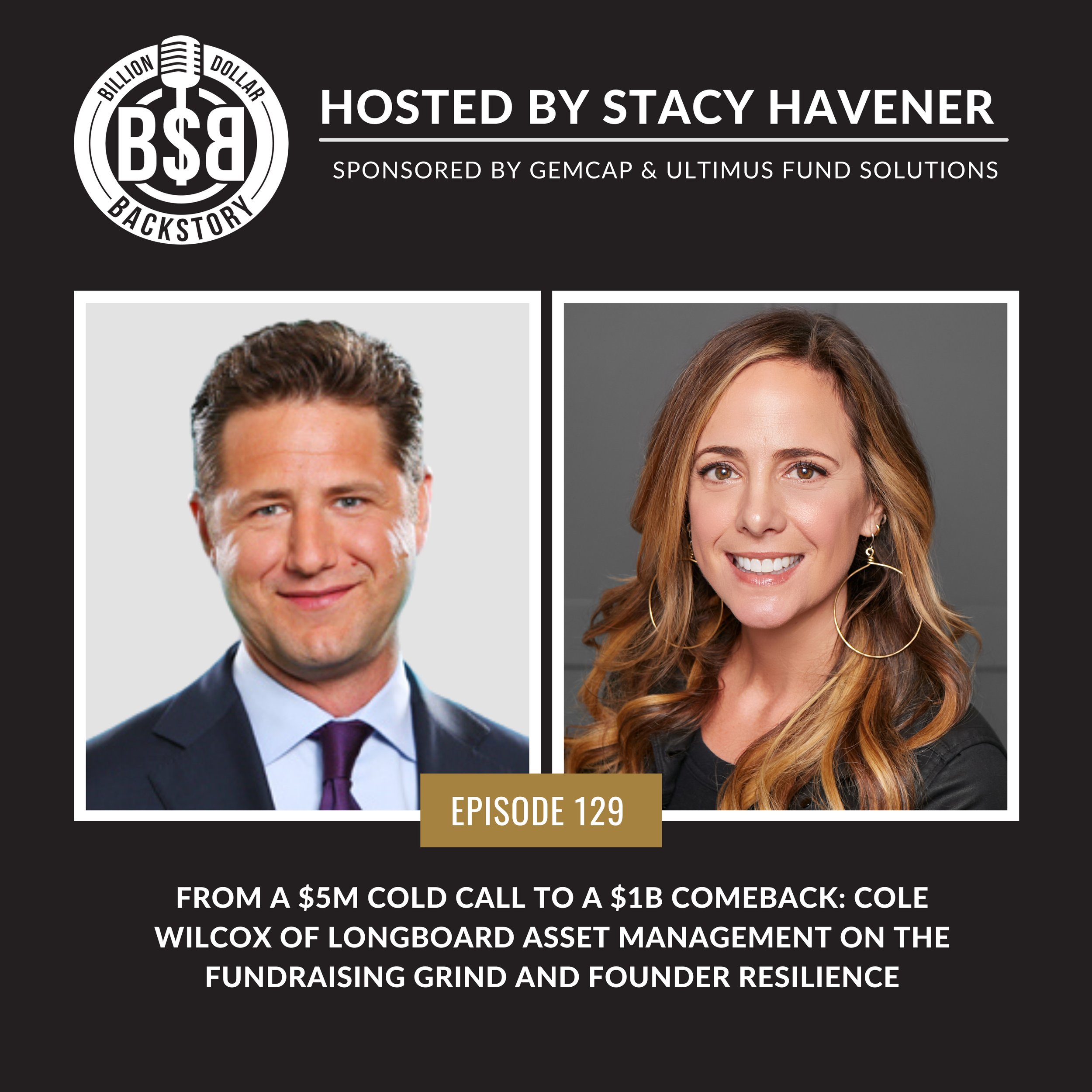
Episode 129: From a $5M Cold Call to a $1B Comeback: Cole Wilcox of Longboard Asset Management on the Fundraising Grind and Founder Resilience
Subscribe to Billion Dollar Backstory on Apple Podcasts, Google Podcasts, Spotify, or wherever you listen to podcasts.
Everyone loves a success story, but what we don’t talk about enough is what it costs to get there.
And what it’s like before the money is wired or anyone cares.
Before all of that, there was a guy with a phone, a thesis, and a long list of people telling him no.
That guy was Cole Wilcox.
In this episode, Stacy Havener sits down with Cole, CEO & CIO of Longboard Asset Management, to talk about what it really takes to build an investment firm when you don’t start with pedigree, proximity, or institutional backing, just conviction and the willingness to keep going when quitting feels rational.
In this episode, you’ll hear:
How one cold call turned into Longboard’s first $5M
Why founder-led fundraising is unavoidable in the early years, no matter how strong your strategy is
What it feels like to hear “call me at $100M”… and then hear it again at $1B
How surviving multiple market crises permanently reshaped Cole’s relationship with risk
The moment Longboard nearly shut down, and the structural pivot that kept the firm alive
The real cost of broken partnerships (and why people issues end more firms than markets)
What resilience actually looks like when walking away feels like the logical move
Why staying power might be the most underrated edge a founder has
More About Cole:
Cole Wilcox, Chief Investment Officer at Longboard, has specialized in trend following investment strategies for over 20 years. As a co-author of award-winning research, he has been profiled in bestselling investment books, featured in major media outlets such as The Wall Street Journal, CNBC, and Bloomberg, and is a frequent guest on popular podcasts. Cole leads a highly accomplished team at Longboard, delivering innovative, low-correlation investment strategies that leverage trend following to capture market opportunities.
TRANSCRIPT
Below is an AI-generated transcript and therefore it may contain errors.
[00:00:00] Stacy Havener: Founder life is a rollercoaster full of ups, downs, and plot twists, and sometimes that's before 9:00 AM. Today's guest has been an entrepreneur for over 20 years. Cole Wilcox of Longboard Asset Management, a boutique asset manager specializing in liquid alternatives. Cole's research led him to white space, not occupied by traditional hedge funds trend following in stocks.
[00:00:30] His white papers have made the favorite list of some of your favorites in the investment biz, and his advice on the entrepreneurial journey just might make this one of your favorite episodes. So sit back and let his story move you because it will meet my friend. Cole. Hey, my name is Stacy Haven. I'm obsessed with startups, stories, and sales.
[00:00:57] Storytelling has fueled my [00:01:00] success as a female founder in the Toughest Boys Club, wall Street. I've raised over 8 billion that has led to 30 billion in follow-on assets for investment boutiques. You could say against the odds. Yeah, understatement. I share stories of the people behind the portfolios while teaching you how to use story to shape outcomes.
[00:01:22] It's real talk here. Money, authenticity, growth, setbacks, sales and marketing are all topics we discuss. Think of this as the capital raising class you wish you had in college mixed with happy hour. Pull up a seat, grab your notebook, and get ready to be inspired and challenged while you learn. This is the Billion dollar Backstory podcast.
[00:01:50] Wouldn't it be cool if you could diversify your investor base and add some non-US investors? Europe could be fun, or Latin America, maybe [00:02:00] Antarctica. Hey, icebergs aren't really my jam, but you never know. You've only got one problem. How the heck do you do that? Fair question, but maybe this is a who not how thing.
[00:02:13] Meet my friends at Gem Cap. Not only do they handle all the back office stuff, the how. They'll also solve the who in your distribution conundrum. They have an incredible network of distribution partners who can help you sell the thing. Once you've built the thing, and Gem Cap won't just help you launch globally, they'll tell you where to go, and maybe more importantly, where not to go.
[00:02:39] Saving you time, money, and annoying headaches. Want to find out if your investment firm is ready to go global? Visit billion dollar backstory.com/gem cap ge. CAP. We've created a quick quiz that'll help you figure out if you're ready to expand beyond the [00:03:00] US And side note. It's pretty fun too. Get your firm in front of the right investors in the right places with Gem Cap.
[00:03:08] Take the quiz and get more info@billiondollarbackstory.com slash gem cap ge. M-M-C-A-P.
[00:03:21] Okay. This is fun because we're friends.
[00:03:25] Cole Wilcox: Yes, we are.
[00:03:26] Stacy Havener: And now we're hanging out in a podcast studio.
[00:03:29] Cole Wilcox: Long time friends. First time caller.
[00:03:31] Stacy Havener: Yeah, absolutely. We're gonna do some storytelling and we're gonna just talk about cool stuff, but I have to tell you what I was watching before I jumped in here.
[00:03:40] Cole Wilcox: Okay.
[00:03:41] Stacy Havener: Which was you on the compound with my other friends.
[00:03:45] Cole Wilcox: Oh, Josh and, and Michael. Yeah.
[00:03:47] Stacy Havener: What was that like?
[00:03:49] Cole Wilcox: They run a pretty professional operation over there. You know, I mean, I've done CNBC Uhhuh Studio stuff in studio things before, and I would say they got like a pretty pro setup there. I mean, [00:04:00] it's designed for efficiency.
[00:04:01] Like you can tell that Josh and his experience in media has really translated into how they run the show.
[00:04:07] Stacy Havener: Yeah,
[00:04:07] Cole Wilcox: it's impressive.
[00:04:08] Stacy Havener: It is. I've seen the studio. It is very impressive. It's also sort of not overdone, which I like, but I can imagine putting myself in your shoes. Were you nervous?
[00:04:20] Cole Wilcox: Uh, no. Well, I wasn't nervous with them, only because I know them.
[00:04:23] Yeah. Like, oh, you're just talking to friends.
[00:04:25] Stacy Havener: Yeah.
[00:04:26] Cole Wilcox: Also, I think the background of having done like in studio media stuff? Yeah. Or being on tv. If you haven't done that and had no like, yeah, then I would be like, yeah, they just throw you into the deep end of the pool. Yeah, the pool and like, you know, sink or swim, figure it out.
[00:04:41] Stacy Havener: Well, maybe we'll come back to this because I know there are a lot of people who listen to podcasts. There's also probably a lot of people who kind of want to be on podcasts but maybe don't really know where to start or how to do that. Yeah. And maybe with your background, we can kind of give some advice later on if you're cool with [00:05:00] that.
[00:05:01] Cole Wilcox: Yeah, for sure. And like I would, I would tell you anybody can do it because if you went back to be the first like. Media thing that I ever did, you know, years ago Yeah. Was like, wow, this guy, this guy is like terrible. Like, I don't,
[00:05:14] Stacy Havener: well, that's a, can't
[00:05:14] Cole Wilcox: even, can't even make eye contact with people. What's wrong with him.
[00:05:18] Stacy Havener: So maybe that's a good segue. Yeah. Because when you were growing up, did you ever imagine, and maybe you did, I mean, I always think there's like always a, a plot twist, but did you imagine that you would be a fund manager? A, did you imagine you'd be in the investment business B, did you imagine you'd be on CNBC?
[00:05:36] Was this like, was this the plan?
[00:05:39] Cole Wilcox: Well, in my case, kind of, yes. Okay. In the sense that it was always like, imagine like, yes. Ever since I probably saw that movie Wall Street in 1987, like as a kid, I was like, wow, stock market stuff. Like I'm really interested in it. My mom would tell you when I was a kid, I was always talking about gold and silver prices and what's the dow doing.
[00:05:58] So
[00:05:59] Stacy Havener: you were really [00:06:00] popular at school.
[00:06:01] Cole Wilcox: Well, actually I actually was, I was like, uh, you know, voted class treasurer. I ran to treasurer, you know, I was really into the stock market business in general. Just kind of fascinated me since I was a kid. I was always running little businesses. My first business that I ever had Yeah.
[00:06:17] Was, uh, the pope came to town and we lived in an area near where the church was at. And so I was like, well, all these people are gonna be here. I'm probably, you know, I'm like seven years old, okay. And I'm like, oh, these people are gonna be here, gonna need places to park. I made all these signs, Pope Park, 20 bucks.
[00:06:40] There was, uh, a empty lot next to our house. I didn't own the lot, nor did I have permission to park anybody's cars on the lot. But like, we just make a buck and charge charging people to park their car for the Pope Park.
[00:06:54] Stacy Havener: The Pope Park. This is brilliant. This is brilliant. So what, [00:07:00] what town was this, by the way?
[00:07:00] Where did you grow up?
[00:07:02] Cole Wilcox: I grew up in Phoenix. Okay, so you did, yeah. So in Arizona? Mm-hmm. Yeah. Grew up here. I was born here. Parents grew up here, so. Yeah, this was in the early, would've been in the early eighties that, uh, that Pope came and, and made his visit.
[00:07:14] Stacy Havener: Well, and so this also kind of speaks to the entrepreneurship.
[00:07:17] So tell us the story. So you grow up, you're the cool kid that also can be the treasurer and talk about gold and silver prices at a young age. Where does this take you? Like do you just, are you like, I'm going to New York City, wall Street, like, let's do this. How does this all play out?
[00:07:35] Cole Wilcox: Well, so my father's an electrician, so, okay.
[00:07:38] Like, there was pretty far removed from having any kind of like stock market or, you know, business experience or things, uh, like that pretty blue collar, you know, work hard. They were all in the contracting business. They, they would've preferred me to get involved with the family business. They're like, what's wrong with this kid?
[00:07:54] Like, yeah, why is he talking about stock markets? Things that we have no idea Yeah. About. [00:08:00] But it was just, you know, people are interested in whatever they're interested in. That's right. Kind of like played it out along. They also played a lot of sports. You know, I was, I was into, you know, every sport that there kind of is playing it.
[00:08:10] I liked competitive things. I'm a very competitive person, so I think that's part of the markets too that attracted me to it. It is a way to kind of have a perpetual competition in something that's quite challenging intellectually and a game, you know, to be winning at, um, that you can play a long time.
[00:08:28] You know, like Charlie Munger, my longtime hero, he is playing it. The Wall Street Journal just did an article. He was playing it till the day he went out and he was 99 years old. You know,
[00:08:39] Stacy Havener: it's amazing. So
[00:08:41] Cole Wilcox: it's something you can do for a long time and, you know, give you, give you a purpose.
[00:08:45] Stacy Havener: Yeah. So how did you make your way?
[00:08:48] I mean, I, I very much relate to the blue collar bit because unlike you, I didn't sort of have the vision of wanting to get into this business. But I can imagine if you did want to, you were gonna [00:09:00] need to figure out how to make that real.
[00:09:03] Cole Wilcox: Well, so for me, I can, I know that intrinsically my big motivation for money and around it had to do with, I feel like in our family, money was always a struggle.
[00:09:11] Yeah. Like, there was just something that has just felt like it. It was the one thing that if there was any fighting, it was like, it was around that.
[00:09:17] Stacy Havener: Mm-hmm.
[00:09:18] Cole Wilcox: Not having enough money or challenges associated, you know, with it. And also I saw how it kind of like controlled people's lives. Like you had to go out and find money to feed your kids and do these things.
[00:09:31] It was like a super stressful, like for my parents. Yeah. So I think that I saw money as, uh, a, well, if you could just as a, you know, child like mine, well if you just had money, you would just have freedom and you wouldn't have to have all these things and our family wouldn't be fighting about stuff. So I intrinsically found it like you just wanted to get to a point of independence.
[00:09:51] It wasn't money for the sake of consumerism, right? Mm-hmm. Or what you could do. It was for the sake of, you now found a certain [00:10:00] level of. And dependence where you were able to do whatever you wanted. Yeah. And didn't have to be running around, scrounging up to, you know, get your next meal kind of thing.
[00:10:08] Stacy Havener: Yeah.
[00:10:09] Cole Wilcox: I, I think that's the, the, the emotional, psychological thing that I had in terms of why it was interesting to me, it just seemed like a very logical way to solve all of my family's problems. If we just, you know, kind of we're above this threshold, everything would be fine.
[00:10:21] Stacy Havener: Yes, yes. It's so true that financial freedom.
[00:10:25] And I think if you grow up in an environment where you, your family doesn't have that, it can be an incredible driver of creating it.
[00:10:35] Cole Wilcox: And also not just creating it, but like in the financial services, I'm in the business of serving other people.
[00:10:40] Stacy Havener: Yeah. And
[00:10:41] Cole Wilcox: so I think that knowing, you know, how important financial security is to people and how much it impacts your lives, like there's a real value.
[00:10:50] In the industry. I mean, a lot of things I think they think, oh, you're just like a finance bro. Yeah. And you get into this business 'cause everyone's like, make money and get a Lambo and a private jet. I'm like, [00:11:00] well no, there's an actual, you know, bene like, I genuinely see the impact that it has on like, helping people have piece of mind, financial security, stability.
[00:11:11] How do they protect their nest egg? How do they grow it? How do they achieve these things that they want, you know, in life and, and how it's really important to people's general wellbeing and happiness, which is motivating to me as a, as a career.
[00:11:24] Stacy Havener: Yeah. I love that nuance that you added. 'cause it's not just what you saw in your family and wanting to sort of solve that issue personally.
[00:11:32] It was also realizing that this is not an issue that's just in your family. It's an issue that all people have to confront and it that is, I think in its most pure positive form. I think that is sort of what finance. Sh not to should, but should be about right. Yes. Helping people generate wealth. It's morphed in a lot of non-positive ways, of course.[00:12:00]
[00:12:00] Cole Wilcox: Which we mostly hear about. Right. So that's like, which, which mostly hear
[00:12:02] Stacy Havener: about. 'cause also that's news and also stereotypes are very real. So the finance pro thing,
[00:12:08] Cole Wilcox: and I can't say anything positive about it, you know, that would be not useful. Well,
[00:12:12] Stacy Havener: no, and everyone eye rolls at it because it's like Sure.
[00:12:15] Yeah. Okay. You know? Oh, and you're an alternative, so Sure. You're, you're, it's an altruistic thing. Sure. Right. Um, but I do think it has its roots there for many people, and I appreciate you sharing that with us. So what was your path?
[00:12:32] Cole Wilcox: Uh, oh, path? Well, I, I just started very early, right. So actually I, I got into the industry.
[00:12:38] Very early, like I think I was nine 19. Okay.
[00:12:41] Stacy Havener: I
[00:12:42] Cole Wilcox: got a series seven license and I got this job at this brokerage firm, and it was like, I, I read a story recently that Warren Buffet got his like, stock brokerage license and started when he was 19 working with his dad. Uh, his dad was a broker, I guess. And yeah, just started very early, like, you know, the [00:13:00] various lowest rung
[00:13:02] Stacy Havener: mm-hmm.
[00:13:02] Newbie
[00:13:03] Cole Wilcox: working at a brokerage firm and just learning about that side of it. So my original job in the industry was as a stockbroker, uh, or whatever the, the, the low man on the totem pole. Yeah. Inside of a stock brokerage company. I learned a lot about, uh, what doesn't work
[00:13:21] Stacy Havener: and people,
[00:13:22] Cole Wilcox: I'm sure you learned, learned a lot, a lot about people learned, I learned a lot about people, I learned about a lot about incentives and disincentives and, and I learned, uh.
[00:13:31] It just wasn't what I wanted to do.
[00:13:33] Stacy Havener: Yeah.
[00:13:34] Cole Wilcox: Uh, pretty, pretty quickly. And I, I learned that most people are losing money.
[00:13:39] Stacy Havener: Mm-hmm.
[00:13:39] Cole Wilcox: And very few people are winning except for the broker.
[00:13:43] Stacy Havener: Mm-hmm. Right. So
[00:13:43] Cole Wilcox: it was kind of, you know, winning the, the losers' game or then there's the reasons why they, they have the books written, like where are the customer's yachts because you're, um, it's good for the brokerage firm, not so good for the, the end, uh, investor is what I would [00:14:00] say that I observed in that, you know, couple, two year stint working in the brokerage firm.
[00:14:04] Stacy Havener: Yeah. So you were like, you know, this has been good. Here's the thing about those experiences though, I find when you look back, you're like, I wouldn't really wanna do it again. Nope. But I'm kind of glad I did it because I learned so much from it. And sometimes the more painful the experience is and the more things you walked away and said, well, I know what I don't want.
[00:14:23] And I've experienced that. That is, that's a thing. Like that's that.
[00:14:30] Cole Wilcox: Yeah. Because the, the reason that you can spot a red flag is 'cause you experienced a red flag. Right, right. Like in the real world, not just the theoretical, you know, kind of thing. So yeah, I, you see a lot of stuff and, and you're like, okay, like I, I, I see it, I experienced it, it's not for me.
[00:14:47] Stacy Havener: Yep.
[00:14:48] Cole Wilcox: But, you know, time to move on.
[00:14:50] Stacy Havener: And so where did you go after that?
[00:14:52] Cole Wilcox: Well, uh, quickly I kind of realized that the kind of hedge fund model and, and that sort of, and being a portfolio manager is what my [00:15:00] real kind of passion and desire was. So I just started calling fund managers and trying to get introduced to them and saying, Hey, this is who I am.
[00:15:09] Stacy Havener: This is from Arizona now.
[00:15:11] Cole Wilcox: It's from Arizona.
[00:15:12] Stacy Havener: Yeah.
[00:15:13] Cole Wilcox: I just kind of get, trying to get them to do, to become brokerage customers. Right? Ah, so not retail, but we're focusing on fund managers as being a customer, uh, giving them trading ideas, right. For their portfolio. So I'm just cold calling hedge fund managers.
[00:15:27] Oh my gosh. Basically. And, you know, trying to give 'em my ideas or stock ideas or whatever I had at the time. And I got, uh, a client out of it and kind of developed a, a relationship with him for, you know, a year or two. And then he eventually recruited me to come work as like a junior PM on their team. So that's how I kind of transition from the brokerage side to the buy side.
[00:15:55] Stacy Havener: And this is where everybody who says cold calling doesn't work
[00:15:58] Cole Wilcox: well. Anybody who says [00:16:00] cold calling doesn't work, is not in sales or hasn't.
[00:16:02] Stacy Havener: Thank you. This is like, I'm telling you, it just. It's fun to talk to people of a certain age and generation because we know what it was like. And I feel like there's a generation now that they've never had to make a cold call.
[00:16:18] It is very different.
[00:16:20] Cole Wilcox: Oh, they feel they might make a cold DM now, right? Well that's so that's what I was gonna say,
[00:16:24] Stacy Havener: but that's different. That is very different. Sending a cold email, sending a cold DM is very, very different than picking up this corded phone and having to talk to a human being and being nervous af and maybe getting hung up on that builds character.
[00:16:43] Cole Wilcox: That builds character and you know, you learn a lot from it. And just something you need to do is just get over. I mean, the magic happens when you get uncomfortable. So I would say yes, if you're not putting yourselves in a position to be uncomfortable in life, probably not doing anything that's very important.
[00:16:58] Stacy Havener: Ooh. I love [00:17:00] that. And so this cold call not only leads to a client, but it leads to a job
[00:17:05] Cole Wilcox: mm-hmm.
[00:17:05] Stacy Havener: Doing something that you really wanted to do. So what was that like?
[00:17:09] Cole Wilcox: Well, and more importantly, it led to a learning opportunity, right? Yeah. Because what I wanted to learn was, I mean, I had this vision of I want to be a fund manager.
[00:17:16] Yeah. This is my future life. I, it's gonna take time, but this is the career path that I want to pursue. I was very passionate about it, and I need to learn what I don't know. Right. I, I was intelligent enough to know that I don't know what I don't know.
[00:17:29] Stacy Havener: Mm-hmm.
[00:17:30] Cole Wilcox: And so I wanted to get into kind of a mentorship type situation, learn about the legality part of it, how to set it up, how to do these things, how to attract assets.
[00:17:40] Mm-hmm. Build strategies, whatever. And this fund that I went to go have this opportunity allowed me to do all of those things. It was a, an amazing opportunity. You know, a guy is a great friend to this date.
[00:17:52] Stacy Havener: Mm-hmm. And,
[00:17:53] Cole Wilcox: uh, even though this kind of goes back 25 years ago.
[00:17:56] Stacy Havener: That's awesome.
[00:17:56] Cole Wilcox: And yeah, so that's kind of how it got got started.
[00:17:59] [00:18:00] And I tried to just maximize my opportunity that I had. Uh, there. It wasn't a big money making kind of thing. It was a, it was the asset that I got out of it was the knowledge. Mm-hmm. And the understanding and the things that I didn't. And then, uh, after a few years there, I decided that I was gonna, you know, put on my next step of career in entrepreneurial cap and hang a shingle and start my own shop.
[00:18:27] Stacy Havener: And that's longboard. And I was Is that longboard or was there That's,
[00:18:29] Cole Wilcox: that's longboard and I was 25 years old. So six years of this tour of duty between initially the stockbroker thing for retail, then hedge fund institutional ideas, and then a two year stint working. At this, uh, hedge fund. And then I'm like, okay, I'm young.
[00:18:51] I had just gotten married. I'm ready to go stake my claim in the world, and I'm a six year veteran. At this point, I'm gonna, I'm gonna go do it. [00:19:00] I love that.
[00:19:03] Stacy Havener: Oh, to be young again, when you just like, you just, I love that you did it and it's still going. That's incredible.
[00:19:12] Cole Wilcox: Yeah. So it's pretty good. I hope
[00:19:14] Stacy Havener: you feel really proud of that.
[00:19:16] Cole Wilcox: Well, the one thing that I feel proud of, I was, and I shocked me, uh, that I was looking back at our, like from when we started, like my kind of track record started in 2005 with this strategy until now. And I was like, oh man, gross of fees. We've, we've kept pace with Berkshire Hathaway over that 20 year, you know, kind of window.
[00:19:39] I was like, wow, that's really, really surprising of just like you put one foot in front of the other and just a series of compounding. And I mean, we navigated some treacherous environments, you know, oh seven to oh eight, uh, COVID, you know, different stuff, different market cycles that had gone through to, you know, continue to compound, don't make unforced errors and just keep, [00:20:00] you know, kind of executing to the point where one, you still survive.
[00:20:02] Stacy Havener: Mm-hmm. And
[00:20:03] Cole Wilcox: two, you survive with quite an impressive long-term result. But like, it just took many years. It's very slow. Right. This compounding process of
[00:20:13] Stacy Havener: Yes.
[00:20:14] Cole Wilcox: You know, it's like watching paint dry.
[00:20:15] Stacy Havener: Oh, exactly. Also very slow building a business, getting clients to sign on all the things that, you know, don't operate on the timeline that we want them to operate on.
[00:20:28] Nope. And that's why I think the staying power, and I would love to hear your thoughts on this, like the staying power is almost the most critical power you can have the commitment to just keep going. That one foot in front of the other, through good, through bad. I'm just going to stay alive in the tough times because I, if I make it through to the other side, there are other people who won't, who will throw in the towel, who will say, you know, f it, I, I don't have time for [00:21:00] this.
[00:21:00] Entrepreneurial bs. Right? Yep. Um, so talk about that. 'cause that's incredible that, that you've managed it. Well, I
[00:21:07] Cole Wilcox: think in, in this industry, you know, especially because it's a long-term, you know, compounding, you know, kind of process of, of investing. I, I do believe that is the secret of, you know, success is that, you know, you need to be a lifelong learner and keep learning and improving, going, and you just have to keep going
[00:21:25] Stacy Havener: right.
[00:21:26] Cole Wilcox: And continue to. Um, there's this book that I have here, the Triumph of the Optimist, right? Mm. And so it's about the performance of the stock market, and yet, you know, you need to be an optimistic person to invest in stocks, right? Pessimistic people are bond investors, optimistic people are equity investors.
[00:21:45] Totally. You know, uh, and so pessimistic people are short sellers. Yeah. And put option buyers. Optimistic people are venture capitalists. Right. Right. There's just, it's a, it's a mindset.
[00:21:57] Stacy Havener: Mm-hmm.
[00:21:58] Cole Wilcox: And so the stock [00:22:00] market part of it, and being an entrepreneur, like you have to be kind of a irrational optimist, right?
[00:22:05] Yes. You have to have a certain sense of the future is going to be better, and you're making a bet on your own personal call Optionality, right? Like you are the call option. You can improve, you can get better, you can change your destiny. You can meet a big client in the future. You can make your product better.
[00:22:25] That's all it really is, is that if you're constantly trying to improve and get better, and you have a optimistic viewpoint on your abilities to do that, even if right now your skills don't actually have it. But if you believe that you can gain those skills and you work towards, you know, achieving it, you will transform into that better thing.
[00:22:43] Now, that doesn't mean that. You know, just because you're like, oh, if I keep practicing and I keep working at being a basketball player, that I'm just gonna be entitled to be in the NBA. There also is a certain, you know, cognitive and physical kinds of things that are gonna [00:23:00] prevent you from achieving a top 1% elite kind of pro sports player.
[00:23:04] Uh, it's not dissimilar in investing. I would say that in investing though, you don't, it doesn't require the, the, the, the physical
[00:23:13] Stacy Havener: mm-hmm. Part
[00:23:13] Cole Wilcox: of it, right? Mm-hmm. Like, you can practice all you want, but if you're five two, you're not getting in the NBA. Yeah. It doesn't matter how good you are at shooting free throws.
[00:23:20] But if you're an investor, it doesn't, you know, height doesn't matter. Uh, you do need to be intelligent. Mm-hmm. And you do need to be disciplined, uh, you know, those kinds of things. But those are, you know, uh, I mean like intelligence you form with a certain amount of it, and then other parts, you can improve it.
[00:23:36] Stacy Havener: Yeah.
[00:23:37] Cole Wilcox: Uh, discipline is something that you can work on. Mm-hmm. And, and be, and honestly, being more disciplined. Behaviorally disciplined is more important in investing than being smarter because you could be the smartest person in the world, smartest investor in the world, but the undisciplined, it doesn't matter.
[00:23:54] You're just gonna be one of those people that has great ideas and makes no money.
[00:23:57] Stacy Havener: Ooh, I've never met anyone [00:24:00] like that in this business. Wink, wink. Um, so, you know, I love what you said here, and it makes me think about something I said on a panel recently, which was the idea that in the investment industry there, okay, so there are a lot of things about it that are not level playing fields, but one of the things that to me, in my opinion, is a level playing field is the thought leadership.
[00:24:25] Because, you know, you can't out BlackRock, BlackRock on all the, you know, on all the resources they have and the money they have to spend and the salespeople. But you can have ideas that are as good as interesting, as compelling as somebody at BlackRock. Right. And you can be a boutique and you've done this because you've written papers and you've done research and it just seems like it's that place.
[00:24:53] We can talk about the distribution in the media component as well, but like the thought leadership is a place [00:25:00] where you can actually compete, whether you're a boutique or one person or whatever.
[00:25:06] Cole Wilcox: Well, so here's the thing. You're not gonna out BlackRock a whole company of, of content and then the variety of content.
[00:25:13] Yeah. And the, the amount of ideas, but it's not necessary. You only need to have one great idea in your whole lifetime to be successful.
[00:25:23] Stacy Havener: Yeah.
[00:25:23] Cole Wilcox: It only takes one great idea that you just stuck with that, you know, that kind of works out. And the reality is, even in investing, like we contributed to a paper about the historical performance of the stock market.
[00:25:36] And 5% of companies are responsible for a hundred percent of the market's historical gains. The white paper is called Do Stocks outperform T-Bills, which sounds like a dumb, of course, they outperform T-bills, but they actually don't. The average stock underperforms T-bills the market as a whole, if you own everything it, it outperforms T-bills because that 5% is like this power law [00:26:00] where they're just massive out performers.
[00:26:02] And so it's not your average idea that matters or how many ideas that you have. It's whether or not you have a couple of great ideas in your life and that's gonna produce like all of the returns, like Berkshire Hathaway greatest, you know, investor ever. You take out their top five investments, they have very mediocre re results.
[00:26:22] You take out anybody's, uh, you know, performance that they have and take out their top five ideas, mediocre results.
[00:26:28] Stacy Havener: Yeah. And that's the maths math thing right there, because that's how stats work. That's the preto principle. That's how 80, 80 20 rule is a thing.
[00:26:38] Cole Wilcox: It's a thing. So that's what I'm saying. You don't need to have more content or to have more ideas than everybody else.
[00:26:43] You just have to have better ideas. Yes. And then communicate them very well.
[00:26:48] Stacy Havener: And different ideas.
[00:26:50] Cole Wilcox: Yeah.
[00:26:50] Stacy Havener: Different ideas. And so you just mentioned you contributed to that paper. You've also authored your own white papers.
[00:26:57] Cole Wilcox: Yeah, several.
[00:26:58] Stacy Havener: Several,
[00:26:59] Cole Wilcox: yeah.
[00:26:59] Stacy Havener: And [00:27:00] I saw you're on Meb Faber's podcast and he said in his little intro, like This is one of my favorite papers of all time.
[00:27:07] Yeah. Think about that. That's what I mean by the thought. Leadership has incredible power.
[00:27:13] Cole Wilcox: Yes. I mean, you, you have to have an idea that's unique and interesting or different or whatever, and you have to communicate it, right? Mm-hmm. So if you don't communicate your ideas as a fund manager or as an asset manager or a financial advisor, how would anybody know what they are?
[00:27:27] Right? Right. So it's, you gotta take 'em outta your head and put them into the real world. So whether it's a white paper or a presentation or other kinds of, you know, things I've documented, you know, kind of those things. Like, I had a whole thesis around why Tesla was gonna become the, was the next Apple.
[00:27:46] And, and I wrote a white paper about it and published it. It was in 2013.
[00:27:52] Stacy Havener: Wow.
[00:27:52] Cole Wilcox: Market cap was 10 billion, the $1.5 trillion market cap today. So if I [00:28:00] don't put those ideas out there, yeah. But at the time people were like, what are you talking about? You're an idiot. Like, this is, uh, this company doesn't make money and it's gonna go to zero.
[00:28:08] Stacy Havener: It takes a lot of bravery. It takes a lot of courage. It's, you know, this is where the authenticity piece is challenging 'cause it's vulnerable to put yourself out there and have people you know, come at you or disagree or say you're crazy and having the, the strength to withstand that. But on the flip side, it also gets, and I know this is gonna sound bad and I don't mean it to, it gets eyes on you.
[00:28:34] So it's not that you wanna just come up with a contrarian point of view to be contrarian. It's that being willing to share your thoughts with conviction, a unique differentiated point of view, and to stand by that and to talk about that and to not hide after you release that paper.
[00:28:51] Cole Wilcox: Yeah. Well, I don't know why anybody would hide because the reality is to embrace the difference part.
[00:28:56] If you're unwilling to be different. Or you're [00:29:00] uncomfortable with that, but that's a necessary ingredient to produce Alpha. If you are a portfolio manager or your investor that's seeking outsized results, you're not gonna get outsized results doing anything other than deviating from what the consensus view is.
[00:29:14] The consensus view is going to get the consensus view. It's not gonna get outsized returns from the consensus view, but you also have to be willing to take the risk to get a different result than consistent view. If you're gonna do something different, it could be different disastrously or it could be different and wildly good.
[00:29:30] Stacy Havener: Yeah.
[00:29:31] Cole Wilcox: If you're not willing to take that risk, then you know, I would say you should get outta the business. What are we doing? 'cause it's a necessary factor for producing something that's different than an index fund, which nobody needs to hire you to do. There's no room in this world, you know, for hug indexes and charge fees for that.
[00:29:50] That's not a thing.
[00:29:51] Stacy Havener: It never was. It's getting less and less of a thing if you're in that game. Seriously reconsider. I, I agree with that wholeheartedly. [00:30:00] Let's be real. No one wakes up and says, I can't wait to build some operational infrastructure today. You are here to manage money, to build something that lights you up, not chase down reports across five systems and 15 service providers.
[00:30:16] That's where Ultima Fund Solutions comes in. They're your ops dream team, consolidating all your middle and back office chaos into one clean, scalable setup. Registered funds, private funds, SMAs, all integrated. One team, one tech platform, one rock solid source of data. But here's the real differentiator service.
[00:30:42] I know that Fund in a box sounds convenient. It's also a box. Know what? You can't put in a box? A human who picks up the phone when you call and need help. Real life people who know your name and your fund, and they care about getting it right. Ultimas was [00:31:00] built on people doing business with people. You get institutional strength combined with boutique level service without getting stuck in a phone tree of doom.
[00:31:11] If you're ready to simplify scale and start working with a team that feels like an extension of yours, check out billion dollar backstory.com/ultimas. That's U-L-T-I-M-U-S. You've got the investment strategy, the vision, the track record. Now it's time to upgrade the engine behind it all with Ultimas. So let's talk about that paper that was Meb Weber's paper.
[00:31:40] 'cause I think it, it speaks also to sort of something that is a differentiator for you. What was that paper about?
[00:31:46] Cole Wilcox: So, my background, uh, going back to the, the fund, you know, that we originally started or the fund management company that I used to be at, I had, I started my career in a kind of a weird environment, right?
[00:31:57] So it was the, it was the late nineties. [00:32:00] It kind of started with 1998, which was like the long-term capital management famous blow up the markets. Oh
[00:32:05] Stacy Havener: yeah. Mm-hmm. Yeah.
[00:32:06] Cole Wilcox: Kind of. And then after that, the markets boomed with the TechNet Telecom bubble.
[00:32:11] Stacy Havener: Yep.
[00:32:12] Cole Wilcox: And then there was a bust in oh oh two, the tech rec bust.
[00:32:17] So that was kind of like, you know, a bust, a boom, a bust again, five year window of time. That's like a lot. And then later on I went through like the 2008 thing I like of the three largest market blowups in the last a hundred years, two of 'em existed in my career. Yeah. So it's, this gets kind of tattooed into your psyche, like early on.
[00:32:37] Right. So and so what it was, was like, Hey man, I, you know, a healthy respect for risk management, I guess, you know, if I grew up in a early career and I just had a booming bull market for 15 years and none of that, I probably would be. Have a very different mindset, but I experienced real risk and I thought, Hey, there's gotta be a better way than just this boom bust cycle.
[00:32:57] And I came across the hedge fund [00:33:00] strategies and the hedge fund, you know, model, but specifically trend following, right? Mm-hmm. Like macro hedge funds and trend strategies. And they were very interesting, you know, to me, I think probably discovered 'em through Jack sch swagger's like market Wizard series book.
[00:33:13] Mm-hmm. Book. And it had like great book. Paul Tudor Jones is in there, and, and Stanley Druckenmiller and kind of these other people. So that's how I got introduced to trend following. And I, I was an investor. I started calling these hedge funds that did these strategies and due diligence. And I convinced that fund that I was at, that we should start allocating to these strategies.
[00:33:32] Stacy Havener: Mm-hmm. So
[00:33:33] Cole Wilcox: I became an allocator to these, you know, systematic trend strategies and learned about it. And in that process, I said, I, I always wondered in asking them like, how come you guys are all doing trend following? On multi-asset classes. Mm-hmm. Or currencies, commodities, whatever. But also stock indexes.
[00:33:49] So I said, well, how come you guys don't do trend following systematic on individual securities? Why don't you just do the index? Why don't you unpack the index and like do the [00:34:00] individual, you know, winners and losers there? And I didn't, and it didn't work. I got really like, basically lame answers to it.
[00:34:07] Yeah. And there was no, you know, it was tons of research on systematic trend, on multi-asset. Like everybody, that data has been tortured by everybody in, in on earth. But this area was new research. Nobody had done this part of it. So we, we put the data together and we did this research and we published a thing it was called does trend following work on stocks to kind of just like, does this thing that works so well in multi-asset portfolios, is it as effective in, in securities and.
[00:34:34] The answer to that question was, was yes. And we decided that there was a, a gap in the market, right? Nobody was doing that.
[00:34:41] Stacy Havener: Mm-hmm.
[00:34:42] Cole Wilcox: So where it also just happens to be, what's interesting later on that we discovered is it works, but it's also highly uncorrelated to other forms of trend following. So if you are a trend investor and you have these types of strategies, [00:35:00] those managers in that bucket are kind of all doing the same thing, right?
[00:35:03] So they're gonna, it's like hiring, it's like having 10 managers that are all just s and p 500 large cap.
[00:35:08] Stacy Havener: Yeah.
[00:35:08] Cole Wilcox: They're gonna kind of go up and down, very similar to one another. Slight differences, but basically the same thing. This trend on stocks was trend following the core logic, the investment philosophy, but zero correlation to the other multi-asset trend.
[00:35:22] So when kind of combined together as part of a trend allocation, you just got a better overall portfolio result from your collective team of trend people. Yeah, that's, so we had done this research, we saw that it, you know, worked. It was different and unique and that's where we decided to found the fund and, and get going, you know, with it, uh, originally.
[00:35:45] Stacy Havener: So great. Also, like even though this is the investment world, classic entrepreneurial moves there. Classic, right? Curious, experimenting, calling, seeing a [00:36:00] gap. Wait, this seems weird. What would happen if I, let me try this. Let me experiment. Let me understand. Oh gosh, this applies to equities too. There's a white space.
[00:36:10] Let's step into it. I mean, that is classic entrepreneur right there.
[00:36:14] Cole Wilcox: Yeah. And then going back to the conversation, you know, before about, you know, the cold call. Yeah. My business got founded that we have today with a cold call. I mentioned the Market Wizards book.
[00:36:23] Stacy Havener: Yeah.
[00:36:24] Cole Wilcox: Well we needed a seed capital investor kind of get going, come on and happened to be that there is a.
[00:36:29] Local market wizard that lived in Arizona, Tom Basso,
[00:36:33] Stacy Havener: come on. And
[00:36:34] Cole Wilcox: so I picked up the phone and I called Tom Basso and I said, I, you know, I want to introduce myself. And went down and got a meeting and explained to him who I was and what we were doing and, you know, seeing if he could help. And it happened to just be kind of the right timing where he was retiring and looking to kind of put money to work with his family office.
[00:36:58] And, you know, this was in [00:37:00] 2003 and, you know, became our first kind of seed investor in the firm and got us going, originated off of a cold call and originated off of somebody that I met through reading in a book. Uh, that had been such a heavy influence on my early, you know, kind of approach to trend following and kind of the efficacy that this worked because these were multi-billion dollar hedge funds that were doing these things.
[00:37:26] And he was one of 'em.
[00:37:28] Stacy Havener: I'm like, this is mic drop right here. That is so many of your worlds colliding together. And so, wait, I wanna understand this because also I want to a plus one on cold calling skills. Again here, people who are like, oh, I'm, I'm, you know, I deserve a billion dollars yesterday and, but I, you know, I don't have it.
[00:37:50] And it's like, well, what are you doing? Well, first of all, you don't deserve
[00:37:52] Cole Wilcox: I, well, you don't deserve anything, right? Like, there's no, there's no, you're not an entitled person. The world doesn't owe you anything. Yeah. You need to go out there [00:38:00] and, you know, make things happen. That's right. You know, it's, you don't just create a product and then, you know, everybody's baby's beautiful.
[00:38:06] Stacy Havener: Yeah.
[00:38:07] Cole Wilcox: We all know that's not true, but every portfolio manager on earth thinks that their baby is the most be beautiful baby on earth, and everybody should just fawn over it and just give them gifts. And it's absurd. But that is the way this, the, the people in this industry think.
[00:38:23] Stacy Havener: They should all go watch the Seinfeld episode.
[00:38:27] I'm the ugly baby. Okay, so listen, there's so many lessons here. I really like, can we go back to how this call went? So you go, you get the meeting, first of all. God, I love it. It's so great that you made that, that phone call. And so were you at that point, had you done this research? Yes. On I've, look, I've, I love trend following.
[00:38:48] I've done the research. It applies to stocks. There's a white space in here. Was that part of the conversation?
[00:38:54] Cole Wilcox: Uh, no. 'cause we, this was in 2003. So the original thing that we were [00:39:00] doing was a fund of funds. It was a multi-manager. Ah, okay. Trend following focus, macro, hedge fund, multi-manager kind of thing.
[00:39:09] That was what our first. Idea. Okay. You know, kind of was, so
[00:39:13] Stacy Havener: it was pre this research that we're talking about now? It's pre,
[00:39:15] Cole Wilcox: it is two years prior to this research.
[00:39:17] Stacy Havener: Okay, okay.
[00:39:17] Cole Wilcox: Yeah. As is when we, uh, you know, kind of, uh, started, uh, that's that, and this also kind of actually goes back to the whole start a business and try something.
[00:39:27] Yeah. That first idea that we had of like this multi-manager, we thought, I thought it was a great idea. I I was just too naive to know that it was a terrible idea. And that fund of funds is a terrible business model. Well, yes. And that the world doesn't need this thing. What you thought was this great thing was an unneeded product that already actually existed.
[00:39:47] I was just unaware that it existed, but I learned that. Right. So we kind of started, it realized after a couple years that this isn't a thing and we ended up, you know, shutting it down because Right. Not, it worked, it made money, but it just wasn't a [00:40:00] commercial success. Yeah. There was just no need for it.
[00:40:03] And Fund to Funds was not a business model to. Pursue. No. And this is going back to 2003, right? A long time ago. You realize early, my
[00:40:10] Stacy Havener: friend, there are still people doing it.
[00:40:12] Cole Wilcox: Yeah. Well, it's not a it's not a thing. No. But yeah, that's, that's how this whole thing started. And I cold call too. I would say, Hey, when we say cold call, remember we're talking cold call doesn't have to be literal.
[00:40:22] Could be a phone call, could be a dm, could be an email. It's reaching out to somebody you don't know and taking the risk that they ghost you, ignore you don't call you back or tell you to take me off their list or yell at you or whatever. Right. Or take your phone call one or the other. Just some way that you're reaching out to a stranger.
[00:40:37] Stacy Havener: I also think it's different, especially in the early days. It's different when it comes from the founder. Yep. Right. It's different. And, and in the beginning, that is really, I won't say it's all of the, of the, of the bet. Quotes, so to speak. But like in the early days [00:41:00] of, of a founder led company, people who are become clients or invest with you, they are investing in you if you don't have a track record yet.
[00:41:09] If you don't have it is a bet on you as a person and how you think and how they believe you're gonna, but it's, that's what it is.
[00:41:17] Cole Wilcox: Yeah. Because as an early manager, you too. It's kind of like, it's a bet on you and whatever your prototype Yeah. You haven't been around 20 years or whatever. So it's you and prototype early product thing and the confidence that you're gonna kind of like figure it out.
[00:41:30] But like that, that investor, the first hedge fund guy that gave me a, a job, right? The, yeah. Big opportunity. He now runs one of the most preeminent like seed investing BC companies.
[00:41:44] Stacy Havener: Cool. That,
[00:41:44] Cole Wilcox: um, and their, you know, so they, they were the original backer of Robinhood. Right. The Robinhood markets. Okay. Right.
[00:41:53] First 2 million in it. $8 million valuation. It's one of the largest s and p companies now, [00:42:00] uh, if you talk to him or anybody, like, kind of, it's, you're making bets on founders, right? You're, you're making a bet on the big idea behind what they're trying to do. Yeah. The problem, the problem they're solving.
[00:42:10] And then secondarily, you're making a bet on that person and their ability to be that person who can solve that problem.
[00:42:17] Stacy Havener: That's right.
[00:42:17] Cole Wilcox: Because that's all you got in a seed stage, you know, kind of thing. And I would say any early boutique manager, it's the same thing. You're making a bet on the person, you're making a bet on their prototype and their ideas and their ability to follow through and execute on those things.
[00:42:33] Stacy Havener: 100% agree. Which is why I think for me. Without realizing what I was doing, but because we were working on new funds or new firms or spins or breakaways and going in and really having these amazing stories, like your story that you're telling us right now, I mean, that lights me up. So I was like so jazzed to tell those stories.
[00:42:54] And then of course the person I'm talking to has an amazing story. I'm like, well, you guys would be best friends. You just have to meet, like, how do we [00:43:00] get this? And I mean, I don't, I'm oversimplifying here, but like at the heart of it, that's really what it's about. Two people that are gonna vibe and are are jazzed to do something together.
[00:43:13] Cole Wilcox: People invest with their head and with their heart. Yes. Meaning they, they invest in things that are emotionally interesting and appealing to them and intellectually interesting and appealing to them. And you need to find the overlap, you know, between what you do and who those people are at there, you know?
[00:43:28] 'cause as we go forward in time to build our company there, it's just a similar kind of story. So as we evolve, because it wasn't like, oh, we just started this company. We haven't gotten to the part of the story where it didn't work. So like, to take us there, I start this thing.
[00:43:42] Stacy Havener: Yeah.
[00:43:43] Cole Wilcox: We, we start this hedge fund to do the trend following on stocks in 2005.
[00:43:48] Stacy Havener: Yeah.
[00:43:49] Cole Wilcox: And, you know, I'm off my successes of getting, you know, the thing launched and we're going and, and I think I've got this really interesting product that people are gonna invest into. And guess what? It's just pretty much [00:44:00] crickets. You know, we just talk to a lot of people. And I get a lot of this, uh, interesting.
[00:44:06] Call me when you're in a hundred million.
[00:44:07] Stacy Havener: Yes, I know it. Uh,
[00:44:09] Cole Wilcox: interesting. Uh, you know, whatever, or, or somebody you know, uh, like not really. Uh, it's stocks. I don't know. It's not, it's not futures. We don't really do that. Like I just wasn't in, we over and over and over again, I never was able to get the private fund.
[00:44:25] Oh. Oh. You know, I was like, oh, who are you guys? You're from Arizona.
[00:44:29] Stacy Havener: Right. You
[00:44:29] Cole Wilcox: know, like, it's not exactly like the
[00:44:31] Stacy Havener: hedge fund mecca.
[00:44:32] Cole Wilcox: Yeah. Hedge fund Mecca. Yeah. Or like, aren't you, is, is it the real estate fund? Right. Are you a land broker? Like, what are you selling me? And so that's kind of like what, you know, what happens oh 5, 0 6, 0 7, just grinding, like through that period.
[00:44:46] Then Bernard Madoff happens in oh eight. And we all, anybody who's in the industry of hedge fund understands that if you were a small to mid-size manager, after that, you can't, nobody wanted to put money in these private funds. That all went to [00:45:00] institutional capital to that a hundred million to call me when you're a hundred million.
[00:45:03] You, they, they, you called 'em back and they said, oh, you're at a hundred million. Cool. Call me when you're at a billion.
[00:45:07] Stacy Havener: Yeah.
[00:45:08] Cole Wilcox: And then, you know, the, the hurdle rate just goes higher. Mm-hmm. It's kind of demoralizing.
[00:45:12] Stacy Havener: Yes, it is.
[00:45:12] Cole Wilcox: So in oh eight, honestly, this is the closest that I ever got in my career to just close packing it in where, 'cause I'm, I've now worked from 2003, 4, 5, 6, 7, 8, grinding, not making any money, funding this thing out, you know, and that happens and I'm like, okay, like this is toast.
[00:45:34] Like we're, this is never gonna work. And what happened out of that though is I, I took a little bit of a step back of a kind of a sabbatical and like, Hey, I'm just gonna like reevaluate for six months, cleared my head and didn't focus on doing anything and remodeled my house. You know, it was like my wife was pregnant at the time and kinda thick focus on that.
[00:45:54] And then I realized like, wow, we have a good track record. We survived this whole market crisis but hasn't really solving our [00:46:00] distribution problem of telling our story. And then I saw that a QR Cliff Asness and the a QR folks kind of got smoked in the drawdown in their, in their private funds. And like they were looking for a new business model to pivot to new customers.
[00:46:16] And they figured out how to port their hedge fund strategies into mutual funds. Mm-hmm. 40 act, you know, funds. And I thought, oh, that is a very interesting thing that they've been able to do that. So if I could pivot the business model from a private fund to a fully registered fund, we could access the markets that we haven't been accessing.
[00:46:36] Financial advisors, individual investors, these people that, you know, weren't we, it was just the hedge fund allocators didn't want to buy our product. Yeah. You know, the pensions, the endowments, the people who were telling me you're too small. I need the people who like would take risk on you or be willing to invest, or where your smaller denomination was actually valuable to them.
[00:46:55] Stacy Havener: Yeah.
[00:46:56] Cole Wilcox: And so. Like decided to pivot the [00:47:00] business model, not the strategy. Same strategy, just different wrapper, different distribution. Yeah. Into a, a mutual fund structure. Well, obviously that's expensive and I don't know how to do that. And it goes back into, I've never done a mutual fund, don't know how to do it.
[00:47:12] And it's costly. 'cause you're basically creating a publicly traded company and then selling it to people, which is not cheap.
[00:47:19] Stacy Havener: Right.
[00:47:20] Cole Wilcox: And you gotta pay all those lawyers kind of figure out how to do it. So I said, well we gotta raise some operating capital, right? We're not bootstrapping it with the fund.
[00:47:28] We're gonna have to get some CapEx to be able to invest in this idea. So the next year of my life there was just knocking on doors. I have this idea to pivot my successful performance track record yet unsuccessful money raising capabilities. Yes. Into a mutual fund. You should back me. And I got a lot of people that I talked to, uh, you know the story.
[00:47:49] Trying to raise 5 million of operating capital. Make a bet on me. Make a bet on this business model. Anyways, after a while. We meet, a guy comes into the office, had a [00:48:00] liquidity event, happened to like, was investing in trading strategies and liked the story, was already predisposed to that. Liked me, was in single check writer 5 million on a Saturday morning meeting.
[00:48:15] Said I'm in wired the money. The next week we were in business to be able to go pursue, you know, this, this thing.
[00:48:24] Stacy Havener: Wow. It just takes one,
[00:48:26] Cole Wilcox: it just takes one. Now I had to talk to maybe 150 people.
[00:48:30] Stacy Havener: That's right. That's right. And
[00:48:30] Cole Wilcox: 149 of them
[00:48:31] Stacy Havener: Yeah.
[00:48:32] Cole Wilcox: Told me
[00:48:33] Stacy Havener: No thanks,
[00:48:34] Cole Wilcox: but no thanks. Yeah. Or well some version of that, you know?
[00:48:36] Yeah. Whatever it was they said, they said no. Uh, but it only took one. And that's where you got to. And, but that's where like, Hey, no, no, no. But I, I got told no for a year before I met the person who said yes. So not quitting, being persistent, believing in yourself, believing what you're trying to accomplish.
[00:48:54] What you want is, is out there, it's on the other side of the phone. If you are willing to continue to [00:49:00] take the nose, grind through it and know and have that confidence and that optimism that your person is out there,
[00:49:05] Stacy Havener: yes. Just
[00:49:06] Cole Wilcox: because a hundred people weren't your person doesn't mean the hundred and first person isn't gonna be, that's exactly your right.
[00:49:11] Stacy Havener: It's on the other side of the phone. It's on the, they're on the other side of your fear. On so many levels and what that is like to be told no 149 times and keep going. So that's amazing. So now you've got,
[00:49:27] Cole Wilcox: and by the way, everything that I've ever had in life that it was successful probably started with a no.
[00:49:32] Some of our biggest clients Yeah. We've ever gotten started with a no
[00:49:35] Stacy Havener: life lessons with Cole Wilcox. Um, it's so true though. So, okay, so now you're off to the races and Yep. What happens next as I have my popcorn?
[00:49:46] Cole Wilcox: What happens next? So we, well, it's just, we got 5 million in a product and two people, and we're just now like, we gotta go build a company to do this.
[00:49:55] And I, from that point is, it was like drinking from a fire hose. Yeah, right. It was, you gotta [00:50:00] recruit people, I gotta find people that work with us. I gotta build product, I gotta build marketing, I gotta build distribution, I gotta figure stuff out. It was just, you know, a hundred hour work weeks go, go, go.
[00:50:10] Just now you have the resources to do these things, but now you actually had to go execute it and
[00:50:14] Stacy Havener: Yeah.
[00:50:15] Cole Wilcox: And do it. And so we got funded in end of 2011.
[00:50:21] Stacy Havener: Mm-hmm.
[00:50:21] Cole Wilcox: We launched the, the fund the following year when we actually got into the market with it in 2012. And from 2012 to 2016, the collective business that we built and raised and hired the sales staff and everything, we raised a billion dollars of assets.
[00:50:40] Stacy Havener: Bing.
[00:50:42] Cole Wilcox: So the thesis that if we could just get the product into this wrapper and market to this audience and get the story out there, it would work. Uh, turned out to be correct.
[00:50:53] Stacy Havener: Yeah.
[00:50:54] Cole Wilcox: So, but you'd be like, oh, you guys are super successful. Like, yeah. But it also took us [00:51:00] 15 years,
[00:51:00] Stacy Havener: the overnight success that took 15 years to build.
[00:51:04] Yes.
[00:51:05] Cole Wilcox: Or the three year rocket fuel kind of. You had this three years of amazing growth that took you 15 years to build the foundation for that. So,
[00:51:13] Stacy Havener: okay. So that amazing growth, is that still, are we still there? Like, is this still the chapter we're living or has, is there a new chapter?
[00:51:22] Cole Wilcox: Oh no, the, the second, the chapter after that was the, uh, what is the story of, is it Icarus?
[00:51:28] The guy who flies up, flew too close
[00:51:30] Stacy Havener: to the sun,
[00:51:31] Cole Wilcox: flew ose to the sun, and the wings melted. Wax wings melted and he fell back down to earth. That's correct. That's what happened Till longboard, uh, not from a performance standpoint. We, we actually outperformed our, you know, benchmark and product performed.
[00:51:46] Exactly. You know what it is. Um, that's where the lesson of life of building a business and being, you know, successful and. Things sometimes go where partnerships don't always work out, you know, the way [00:52:00] that you thought that they would be. Right. So maybe you're in a world where you're Warren Buffett and Charlie Munger and you're, you're in it till the end.
[00:52:07] Maybe your partner doesn't feel that way.
[00:52:10] Stacy Havener: Mm-hmm.
[00:52:11] Cole Wilcox: And the firm ended up fracturing
[00:52:15] Stacy Havener: oh boy.
[00:52:15] Cole Wilcox: Into, you know, two different pathways and one group went and pursued their future and the other group went and was forced to go pursue their future. And, uh, kind of what we had built,
[00:52:32] Stacy Havener: melted
[00:52:33] Cole Wilcox: all the way back down to the base.
[00:52:36] So that was a, an interesting learning lesson in entrepreneurship and partnerships and, and things like that. Uh, but like in all good things, uh, that could have been the end of the story, right? Right. We just like put it out of business. So that fun that we had grown and whatever ended up. Eventually we had to, it just went to zero, right?
[00:52:55] Where the assets filtered out, people competing with each other, stuff like that. So, [00:53:00]
[00:53:00] Stacy Havener: can I say one thing before you keep going? Yeah, go ahead. Because I really want you to hear this. You're not alone in that. The firms that I've seen shut down or close something when it's working, right, because this happens.
[00:53:12] Everyone's like, why would they do that? That's crazy. It is always about people. Yes, it's about people on the up and it's about people on the down as well, right? Like if times are tough or great people are people and they're gonna have things they wanna do that either align or don't. And more often than not, that is what I have seen as the main reason companies shut funds or shut down completely, is because people are not on the same page.
[00:53:44] Cole Wilcox: Yeah. So I mean,
[00:53:45] Stacy Havener: it's life.
[00:53:47] Cole Wilcox: It's life, right? And it's normal. It might, I might feel bad at the time, feels horrible, feels horrible, or might feel horrible or whatever. But those are just, you know, kind of feelings. And the reality is like, now having gone through that and other things, you know, [00:54:00] kind of in life, like you realize as a more mature person that's less young and naive, it's normal.
[00:54:05] Stacy Havener: It's
[00:54:05] Cole Wilcox: yes. Like it doesn't feel normal at the time. It does it, but the reality is you feel like no, everybody goes through this, right? Yes. So like, whatever, it's not, it's not abnormal.
[00:54:14] Stacy Havener: Okay. So now we're in chapter, I don't even know what chapter this is, but it's the next one.
[00:54:19] Cole Wilcox: Well this is so kind of like basically made the decision to close up shop, right?
[00:54:27] Yeah. Like kind of, hey, go pivot some, figure out what you're gonna do, you know, with your life. Hey, you made a good run. Yeah. You know, it was worth pursuing whatever. And, you know, went through a downsizing and you know, getting people to safe places and doing everything right. They're doing it the right way.
[00:54:42] And then kind of was ready for that. Like I had gone through the acceptance death phase, and what happened was COVID happened and we had a second fund that we had started. It was never really got any traction. And the, [00:55:00] the previous team wasn't really focused on it, it wasn't very big, but it had a great track record.
[00:55:04] It was a process that was, you know, the, the stock trend strategy. Mm-hmm. In a, in a fund. The other one was like a futures trend strategy. We performed very well in COVID and I thought, you know what if just kind of tip, we never were able to find product market fit, you know, with this follow. Mm-hmm. Just wasn't there and it wasn't really going anywhere.
[00:55:22] And we tried several ways, uh, and I'm like, let's check one more. Know, like we feel like maybe we pumped on this thing doing CPR in as long as we can, that I was like, let's, let's try one more time, right? Mm-hmm. Without any distractions from the other bond or the old team or how things were going. And we just put all of our focus on that during COVID.
[00:55:40] And it just happened to be that we got a pulse and then a pulse turned into, you know, a little bit more than a pulse, and then it was breathing and then all of a sudden it was like standing up and walking around, you know? Then we were, you know, full on. Yeah. Full on exercising and jogging and it's growing and all.
[00:55:59] Next thing you [00:56:00] know, we had a hundred million in the fund from eight over the course of the COVID cycle.
[00:56:05] Stacy Havener: Wow.
[00:56:05] Cole Wilcox: And that kind of like, I was like, okay, from the ashes of this kind of mm-hmm.
[00:56:12] Stacy Havener: The Phoenix rises,
[00:56:13] Cole Wilcox: boom, boom, bust, the phoenix rises. And we are not only have in business with this great fund and this great product and great track record, but I'm also in business with great people
[00:56:23] Stacy Havener: Yeah.
[00:56:23] Who are
[00:56:24] Cole Wilcox: highly aligned, who have gone through, you know, the ups and the downs who have stuck together, who believe in each other, who maintain this optimism of the future and our ability to make the thing, you know, kind of happen and build something. And that's the phase that, you know, we're in now is just the continuing growth and acceleration and optimism of the next 20 years of our lives.
[00:56:50] Like that I gave gave you in this today's podcast, like the 20 year journey.
[00:56:54] Stacy Havener: Yeah.
[00:56:55] Cole Wilcox: To date, but then we're focused on the next, the next one.
[00:56:58] Stacy Havener: The next
[00:56:58] Cole Wilcox: 20 years.
[00:56:59] Stacy Havener: [00:57:00] Yeah. You know, gosh, I love when, when this happens on podcast, by the way, because I haven't looked at my questions one time. I have no idea like what just happened.
[00:57:11] But this is the magic where we just forget that we're actually recording a podcast. It's,
[00:57:16] Cole Wilcox: well, when we started you, you mentioned like, oh, you asked some people on your podcast about their favorite, you know, books or things? Books. Yeah. We're, well, we're gonna end
[00:57:24] Stacy Havener: with those. We're doing that. Don't, don't, don't jump the shark.
[00:57:26] 'cause I'm gonna end with that for sure. But I think just generally speaking, what I loved about this conversation, and I've known you for a couple years now.
[00:57:35] Cole Wilcox: Yeah.
[00:57:35] Stacy Havener: It was so honest about the good and the bad because there are always both. Yeah. And I think from an outside point of view, it can look very.
[00:57:48] Rose colored glasses, but you don't often get to see what is happening behind the scenes. And you let us do that with you today. And I'm really grateful for that. And I know our listeners will be too, because [00:58:00] it's not always rainbows and unicorns, but that doesn't mean that it's not ultimately gonna work.
[00:58:06] Cole Wilcox: Yeah. I think earlier in life, in my career and things, I was definitely like, I think it's normal to be like, I don't wanna show any vulnerability or weakness because like people expect you to be perfect. But the reality is I found that the more authentic that you are about the good, the bad, you know, kind of whatever, the higher degree of like, people don't actually expect you to be perfect.
[00:58:26] You don't want it. They know that you're not perfect. And if you are, they don't trust it.
[00:58:29] Stacy Havener: That's right.
[00:58:30] Cole Wilcox: And so you might as well just be honest about who you are and who you're not and what you're capable of and what you're not capable of. And then use that to seek out. Relationships with people where there's aligned expectations.
[00:58:45] Yeah. And, and mutual fit. If somebody's expecting you to be perfect, which I'm, I'm sure there are people out there like that. Yeah. And you're not, you shouldn't be in a relationship with those people because it's gonna, it's, you know, you're never gonna live up to never gonna live up. You're never gonna live up to, there's no margin for error, no margin [00:59:00] for anything.
[00:59:00] So it's like, uh, I, I have just found that I'm much more comfortable being, I know who I am, I know who I'm not.
[00:59:08] Stacy Havener: Yeah. And
[00:59:08] Cole Wilcox: being willing to be honest about that because it just saves everybody else time. It does. And heartache.
[00:59:14] Stacy Havener: Yeah. Yeah. Okay. So the questions that we were talking about. All right. Are you ready?
[00:59:19] I'm ready. They're not, I'm fast fire, but they're fast fire ish. Okay. Okay. First one is the one you wanted to go to right there, which is what book inspires you?
[00:59:28] Cole Wilcox: So I always give the, the same answer to this thing. 'cause it was like a life changing Yeah. Uh, book. At 30 years old, I got introduced to like Charlie Munger.
[00:59:39] Uh, uh, Warren Buffett's, uh, former partner. He died like two years ago. Anyways, uh, this book that he wrote or about, it's his Life life principles. It's called Charlie Munger's. Uh, poor Charlie's Almanac.
[00:59:53] Stacy Havener: Yes. So I think
[00:59:53] Cole Wilcox: there's like, it's a, it's a Benjamin Franklin reference, but, um, it's, it's really that. So this [01:00:00] book, it changed my life.
[01:00:02] It's just act with most important things, mental models and how to think about stuff. And Charlie was a huge influence in my, in my life about how to think about stuff and just, you know, myself. Like I, up to the point at 30, I was frustrated. I didn't have the success that I really thought that I should be having.
[01:00:20] Going back to that entitled PM kind of thing. Yeah,
[01:00:23] Stacy Havener: totally.
[01:00:24] Cole Wilcox: And realize like, okay, what is it about me? That's preventing me from being successful instead of like other people else.
[01:00:31] Stacy Havener: Yes.
[01:00:33] Cole Wilcox: And this book helped me better understand myself and just gave me kind of a, a, a real, I don't know, just inverting.
[01:00:42] There's, there's a whole thing in here about inverting, always invert the logic. So that's in here. And so I started kind of doing that with myself. But anyways, the reason that this particular copy is, you can see that it's a, it's an autograph copy from Charlie,
[01:00:56] Stacy Havener: which is why it's so treasured.
[01:00:58] Cole Wilcox: This is a treasured [01:01:00] thing, but I, this book is amazing.
[01:01:01] I recommend everybody you know in, whether you're an investor or not, to read it and think of it and use it to be a lifelong learner.
[01:01:11] Stacy Havener: That is fantastic. Okay, we're gonna go from books to places,
[01:01:17] Cole Wilcox: places. Okay. What
[01:01:19] Stacy Havener: place inspires you?
[01:01:21] Cole Wilcox: Well, my favorite place, and everybody knows this is what the foundation of longboard mm-hmm.
[01:01:26] Uh, asset management comes from is I used to live in the summers, the majority of the summer, uh, or a good portion of it in Hawaii on the island of Kauai. So in the north shore of Kauai is a, is a little beach town called Hanoi. And it is the most beautiful place like on, in the, in the US at least for me, you know, personally.
[01:01:48] And it has always been a, a place that is magical go to and energizing and I just love it there. And it's actually how the company got founded originally was [01:02:00] that capital partner that we got the 5 million. Yeah. Kind of from, I had met him through a colleague that we came together as partners by randomly meeting in Hawaii together.
[01:02:10] No way. So
[01:02:12] Stacy Havener: I'm, you know, places have stories and they have roles in stories and I think it's often underestimated. Yep. The power of place. But I love that. That's, I I have been to Hawaii once. I have never been to Kauai, but I've heard it's absolutely
[01:02:30] Cole Wilcox: stunning. It's, it's, yeah, it's a beautiful place. It's like they filmed, uh, some of the Jurassic Park Yeah.
[01:02:35] Movies there. The Nepali coastline kind of there. Super famous. It's just a beautiful spot.
[01:02:39] Stacy Havener: Awesome. Okay. We're going from place to music. So we are painting a picture here. You are taking the stage. I like to just really go with this. Maybe you've written a book about all these different chapters. As an entrepreneur, you're gonna give a talk to a stadium full of adoring fans.[01:03:00]
[01:03:00] What is the song, what is the walkout song they play that hypes you up as you take the stage?
[01:03:06] Cole Wilcox: So I don't, I don't know the theoretical one, but I had a, a real world example where I actually did this. I had, there was a a, something we were doing at a company meeting. And they asked me for a walkout song.
[01:03:19] Yeah. And so we gave it to them and it was actually a Wu-Tang song. So it, it was me coming out to Wu-Tang Clan, I think it was Cream was the song. So,
[01:03:31] Stacy Havener: I mean, I have no words, but obviously, you know, I love that. That is, I love it on all the levels. And I Well, it's also,
[01:03:39] Cole Wilcox: we're of the same era, right? Oh, we totally are.
[01:03:42] Stacy Havener: The cold calling Wu-Tang clan listening era.
[01:03:45] Cole Wilcox: Yeah. Along with Josh Brown. I think he's like, along with Josh Brown, big Wu-Tang, and he uses the Wu-Tang clan, like in his, like biopic or something, so, yeah.
[01:03:53] Stacy Havener: Yeah. Without a doubt. Okay, fantastic. What profession, other than your own, would you like to [01:04:00] attempt?
[01:04:01] Cole Wilcox: Uh, attempt?
[01:04:02] Uh, I, I don't know if I would attempt it, but I, what I've come to realize is that if I could do it all over again, there was a way easier way of making money and being like successful, which is to be a commercial. Property casualty insurance agent or one that is a benefits commercial or benefits, uh, kind of agent.
[01:04:23] These people make a lot of money with a limited amount of work.
[01:04:29] Stacy Havener: Unreal.
[01:04:29] Cole Wilcox: Uh, and huge like retention. So the business model of a commercial property casualty broker is a, an amazing business model. Actually used to be one of our, what is, uh, it's like brown and brown as a company, but what's the business
[01:04:42] Stacy Havener: model?
[01:04:43] Cole Wilcox: You sell insurance. The businesses.
[01:04:45] Stacy Havener: That's it. You just go in, you sell insurance. You,
[01:04:48] Cole Wilcox: you're an agent, but I'm like large premium Yeah. Policies to commercial businesses that are buying commercials. Not, not, not home, not not small scale transactions. Right. These, a large premium [01:05:00] be large.
[01:05:00] Stacy Havener: Yeah.
[01:05:00] Cole Wilcox: Maybe it's 50,000 or a hundred thousand premium or more.
[01:05:03] Right. And large commission. Annual renewal, right? You getting 10% commission every year, but from the same customer and you're not churning their account like you would be as a broker, you're actually providing a useful service. So the commercial property, casualty insurance, brokerage firms have been some of the best performing stocks that you could have like owned.
[01:05:22] I was waiting for that amazing industry, brown and Brown Gallagher. So that's probably the one where I'm like, this is in, in hindsight way easier, way more money than being in the asset management industry.
[01:05:37] Stacy Havener: It's not an easy biz, is it?
[01:05:39] Cole Wilcox: It's very difficult.
[01:05:40] Stacy Havener: It's very difficult. Okay. Flip side, what profession would you not like to do?
[01:05:45] Cole Wilcox: Well, uh, I guess goes back to the story we said in the beginning about my, my roots of my family as electrical contractors. So I was, uh, you know, had to do the tour of duty with my dad in the summers and growing up, and that very much taught me that I do [01:06:00] not want to be in the, uh, electrical contracting business or be an electrician, and especially one working in the summers in Arizona.
[01:06:06] Oh God. But I have a lot of respect for blue collar work and trades that's very, um, challenging and, and, and difficult work and provides a lot of value. I just didn't love it. Right? Mm-hmm. Like, wasn't passionate for me. Uh, my dad loves it and he just really enjoys it, so that's great. I think people, you know, what is it?
[01:06:23] The, uh, love what you do and you never work a day in your life kind of thing. Yeah. So I would've been working every day of my life if I had to be an electrician because I did not enjoy the work.
[01:06:33] Stacy Havener: Yeah. And this is why we need all types, right? Because somebody needs to enjoy that work because we need them when we need them.
[01:06:42] We need them Like for real electricians, like my son Plumber, he enjoys that kind of work. Yeah. Yeah.
[01:06:48] Cole Wilcox: My son enjoys trades. Yeah. And
[01:06:51] Stacy Havener: you can make a ton of money.
[01:06:53] Cole Wilcox: Yeah, for sure. 'cause
[01:06:53] Stacy Havener: very few people wanna do that work now. Yep. Okay. Last but not least, what do you [01:07:00] want people to say about you after you've retired or left the industry?
[01:07:04] Cole Wilcox: Uh, I think I would like people to say that he was an, an honest, ethical, good human being. Yeah. That would be, you know, the end result. I think when I think of like, retire your, the end or you know, whatever. It's like your life is really, you know, who's there to celebrate you and what it is that you're doing and what value did you create And ultimately.
[01:07:26] If it's like that guy provided opportunity for me, that guy taught me something. If you had a number of people in life, or your track record wasn't your, how many money did you make? Ooh, it was, what kind of impact did you have? Ooh, how many people showed up and said, that guy made an impact on my life for the better.
[01:07:43] I think that that is ultimately what you would want to do, is to have the most amount of people that said he was a memorable, I guess teachers, you know, kind of get this kind of thing. Yeah. Like, Hey, I had a teacher and they really did this thing. But yeah, having that is, is kind of, uh, you know, important to me.[01:08:00]
[01:08:00] Stacy Havener: I love that. And also, I want you to know that I think we have people, I love the track record concept right there. We have people who are in our lives that we interface with and we kn and we think, you know, wow, I'm making an impact on this person. The crazy thing about media or a podcast or sharing your content is that you make an impact on people that you may never meet.
[01:08:22] And you may never even know that you're making an impact. But it's happening. And I think today's conversation is going to inspire a lot of people who are on the journey call. I really do.
[01:08:36] Cole Wilcox: You never know who you're gonna make an impact and what it is that you're doing. I mean, honestly, one of the most amazing things that I saw this year was the incredibly sad Charlie Kirk like assassination, uh, thing.
[01:08:51] And because Charlie Kirk is local, you know, he lived here, you know, and, and so I'm familiar with like, kind of with the story [01:09:00] and they had a huge funeral, right? Mm-hmm. But like they filled an entire stadium.
[01:09:05] Stacy Havener: Yeah, right.
[01:09:05] Cole Wilcox: There was a hundred thousand people at this thing plus an overflow thing. But if you looking like this is a person that.
[01:09:11] Most people have never met. Right. They've only seen a YouTube video or a clip or whatever, and somebody, you know, facilitating a debate and look at the emotional impact that this person, that millions of people around the earth have never met.
[01:09:24] Stacy Havener: Mm-hmm.
[01:09:25] Cole Wilcox: That he had some kind of impact on them in some way.
[01:09:28] And it's like he would've never known that. Yeah. Like individually you never would've known.
[01:09:32] Stacy Havener: That's right.
[01:09:32] Cole Wilcox: How much of an impact that that person had touched emotionally, whether he touched you emotionally negatively. Right. Or positively. He made an impact in your life. Yeah. And on the world. And it's just really, really crazy to me that you never would know it until that person's gone.
[01:09:51] That's right. Right. When you remove that person, that's when you see what impact they had, you know, on the world. And it tends to be, it's the [01:10:00] people who had an emotional impact on you in some way. I think the best quote that I ever heard was people remember. How you made them feel. That's right. They don't remember what you did.
[01:10:10] Stacy Havener: Yeah.
[01:10:11] Cole Wilcox: They remember how you made them feel.
[01:10:13] Stacy Havener: Yeah. I love that. And you know, this is why I'm such a big fan of giving flowers because one of my favorite things is in terms of, I mean, real flowers. Sure. But like flower your words as flowers of telling someone that you're grateful for them or they inspired you, or you know, just those words.
[01:10:35] People in our lives, people we don't know, like those notes that we get from people that say, Hey, I listen to this podcast, or I watch your beach walk and talks, or whatever, like those fill me with it because it's so unexpected and you don't realize it. And it's incredibly overwhelming. But I think it's a good reminder to take the time to say thank you to people along the way so that they do [01:11:00] get a chance to know.
[01:11:01] Cole Wilcox: Well, on that note, I would like to say thank you Oh, for having me on the show.
[01:11:05] Stacy Havener: Yes. Thank you for being here and we've
[01:11:07] Cole Wilcox: gone through this today and sharing, you know, stuff together. And also thank you for all the stuff that I've learned from you. Thank you. Because we've learned a lot from you and used it to, you know, build the business, help other people, share ideas with the industry.
[01:11:18] I think you do an amazing job in trying to pass on information that's gonna help people in their careers and help them build their businesses. And I think you're just awesome for the industry, so, oh, well that's
[01:11:30] Stacy Havener: so nice. And, and I certainly wasn't trying to get you to give me flowers, but that idea, and I could say it right back to you.
[01:11:38] I think. So let's end with this. If people do wanna get in touch with you, what's the best way?
[01:11:43] Cole Wilcox: Uh, best way is the website, right? Okay. So longboard funds.com. And on there, you know, we're pretty accessible. You can set up a, see the stuff on the site or reach out to Howard, uh, Fraser, our head of investor relations, he's, we're just all about educating.
[01:11:59] [01:12:00] And helping people optimize what they're doing in their trend following sleeves or in their alternative investment things. It's not about selling a fund, it's just really about helping you get the best out of this area that we happen to be a domain expert in, which is all things trend, following all things alternative investments.
[01:12:16] Stacy Havener: Yeah, and also I will tell people if they wanna get in touch with you to say thank you for this episode, for instance, you can also do that on LinkedIn. 'cause I know he's on, yeah. Oh,
[01:12:26] Cole Wilcox: we're, yeah. Yeah. LinkedIn. I'm also on LinkedIn from a socialist where probably spend most of the amount of time or X, but mostly
[01:12:33] Stacy Havener: LinkedIn.
[01:12:33] Okay. Thank you my friend. Thanks for being here. Thank
[01:12:36] Cole Wilcox: you.
[01:12:36] Stacy Havener: This podcast is for informational purposes only and should not be relied upon as a basis for investment decisions. The information is not an offer, solicitation or recommendation of any of the funds, services, or products, or to adopt any investment strategy.
[01:12:51] Investment values may fluctuate and past performance is not a guide to future performance. All opinions expressed by guests on the show are solely their own opinion and do [01:13:00] not necessarily reflect those at their firm. Manager's appearance on the show does not constitute an endorsement by Stacey Haven or Haven or Capital Partners.
Resources