
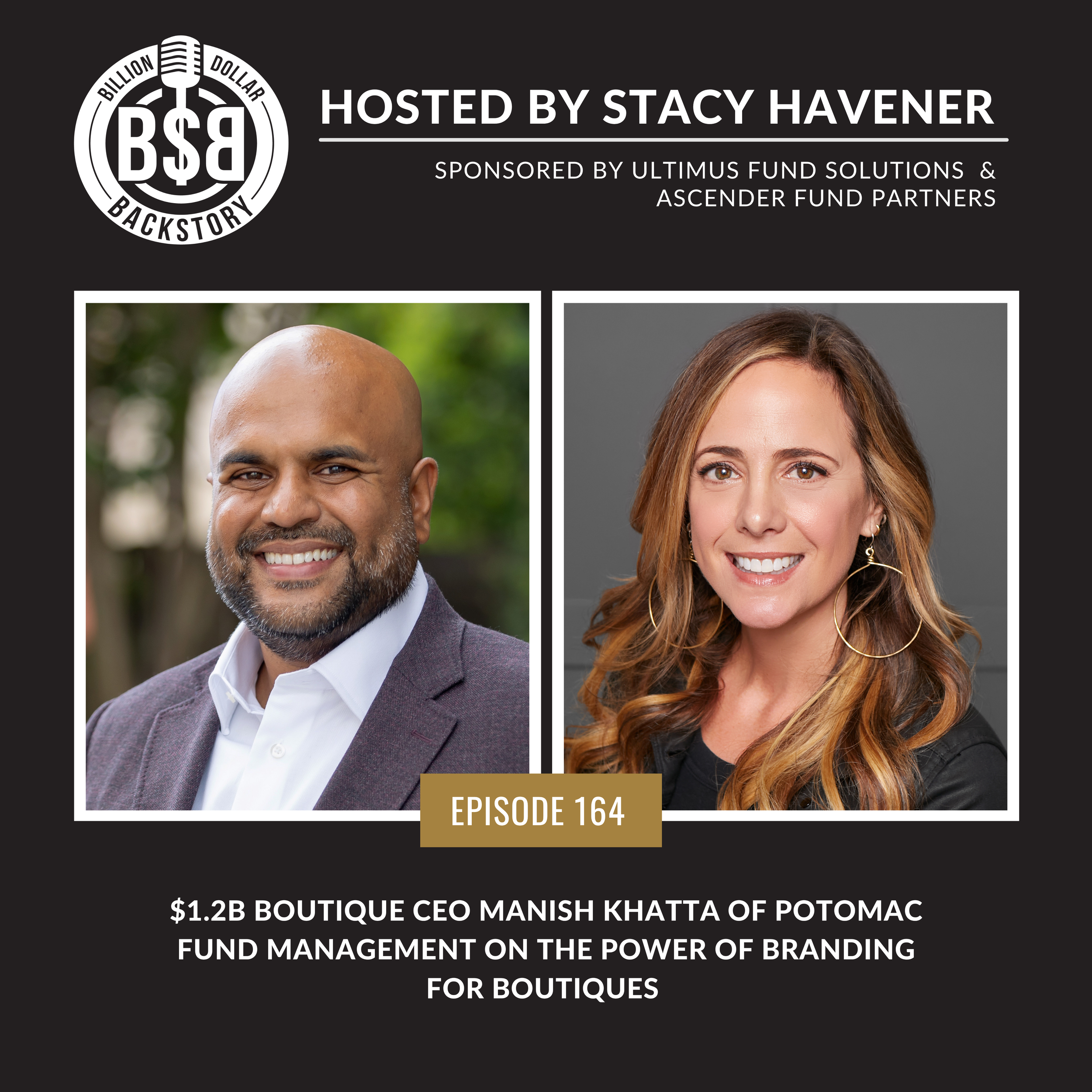
Episode 164: Encore: $1.2B Boutique CEO Manish Khatta of Potomac Fund Management on The Power of Branding for Boutiques | Insights into His Modern Marketing Playbook He Used to Add $1B in 3 Years
Subscribe to Billion Dollar Backstory on Apple Podcasts, Google Podcasts, Spotify, or wherever you listen to podcasts.
Most boutiques market the product. Manish Khatta barely mentions his.
Roughly 90% of what Potomac Fund Management puts out has nothing to do with the funds. No performance charts. No fact sheets. Their most successful piece of content is a five-minute video series about fintech gossip that never says the word Potomac.
It sounds backwards. It's also how Potomac went from around $130 million in 2020 to $1.2 billion today, after more than three decades of hovering in the low hundreds of millions.
In this episode, Manish and Stacy get into:
What "eyes on brand" actually means, and why product marketing comes second
The scrappy pandemic video that started it all
Why he told his team not to measure ROI for two full years
The Eminem clip he was told not to play at a conference, and why he played it anyway
What happened when Potomac started partnering with its own competitors
Why he's now pivoting back to postcards, suits, and old-school marketing
About Manish Khatta:
Manish Khatta is a quant who has spent his entire career creating and refining technical trading strategies. A lifelong Potomac employee, he programmed the initial work behind Potomac's mechanical trading systems and now runs the firm as CEO and CIO. He's a father of four who leads an RIA built on content and transparency, and he spends his free time playing tennis and being on the water.
TRANSCRIPT
Below is an AI-generated transcript and therefore it may contain errors.
[00:00:00] Stacy Havener: You know that moment at a concert when the lights go down, but the crowd won't stop clapping until the band comes back out for one more song? That's what this is. Welcome to Billion Dollar Backstory Encore episodes. An encore only happens because people liked what they heard the first time around, and they want more.
[00:00:21] So today, we're doing exactly that, bringing back one of our favorite conversations just for you. Sit back, grab your popcorn, and enjoy. There is an old guard in the investment industry. It's the stereotypical one in all the movies and books. Picture it: bunch of middle-aged white men sitting around a long conference table in a big, fancy office building in New York City.
[00:00:44] They're talking about stocks or bonds, buys or sells, while a boiler room scene of dialing for dollars plays out around them. There are narratives and industry constructs that still persist from that old guard, what the investment world should [00:01:00] look like, who should lead, how sales and marketing should be done.
[00:01:05] Today's podcast guest is not that, not at all. My friend Manish Katta is the CEO and CIO of the fast-growing investment boutique Potomac Fund Management, with 1.2 billion in AUM. Potomac is the first job that Manish got out of college. It's the only company he's ever worked for. It just so happens he now owns the joint.
[00:01:31] This is an inspiring story of commitment and perseverance, but it's also a master class in modern marketing. The new guard is here. Take note and take notes, and cue Tupac, all eyes on Manish. Let's dive in. Hey, my name is Stacy Havener. I'm obsessed with startups, stories, and sales. Storytelling has fueled my [00:02:00] success as a female founder in the toughest boys' club, Wall Street.
[00:02:04] I've raised over 8 billion that has led to 30 billion in follow-on assets for investment boutiques. You could say against the odds. Yeah, understatement. I share stories of the people behind the portfolios while teaching you how to use story to shape outcomes. It's real talk here. Money, authenticity, growth, setbacks, sales, and marketing are all topics we discuss.
[00:02:30] Think of this as the capital-raising class you wish you had in college, mixed with happy hour. Pull up a seat, grab your notebook, and get ready to be inspired and challenged while you learn. This is the Billion Dollar Backstory podcast.
[00:02:49] Okay, this is so fun for me because Manish and I have been friends on LinkedIn from afar for years, and this is literally the first time [00:03:00] we are sitting down face-to-face, if you wanna call it that, to talk, and everybody who's listening to the podcast gets to be in on that conversation. It's going to be amazing.
[00:03:09] So Manish, please tell us the backstory of how you came to sit here in this CEO, CIO seat of a multi-bill- well, billion-plus, right? $1.2 billion boutique. How did this happen? What's the story?
[00:03:26] Manish Khatta: It's a funny story to start with. So essentially, this was my first job out of college. I got out of school a year early and was gonna go to law school to be a sports agent, because that's what I wanted to do.
[00:03:36] That was my passion. I mean, I was 21. I didn't know really what I wanted to do. So I'm sitting there, and my parents are in India. They call, and they tell my brother, they say, "Hey, you know, Manish is not gonna sit around and drink for the next 12 months until law school starts. He needs to go get a job." And so my brother takes the Burtonsville Gazelle, which is a local paper, back then they had papers, classified.
[00:03:58] He circles Potomac Fund [00:04:00] Management and says, "Go apply." And the whole goal was to apply and quit in 12 months, go to law school. And so I apply. I start getting into the weeds with trading and operations and systems testing on the investment side, and just kinda fell in love with it and the business and saw there was a lot of opportunity.
[00:04:21] And I think also, once you're out of school for six months, the last thing you're gonna do is wanna go back, right? Yeah. And yes, and now it's 21-some odd years later. You know, I was given the opportunity to purchase shares over the years, and then in 22- 2017, I had the opportunity to buy 100% of the owner out.
[00:04:40] It was a long grind, but it started with just kinda, you know, throwing, uh... My parents forcing me to get a job.
[00:04:46] Stacy Havener: Isn't that wild? And how, how much we want to reject that, of course, when your parents tell you to do anything. You're like, "That's not a good idea at all and not at all what I wanna be doing." And then here, you know, it makes sense when you look back at it, but it [00:05:00] doesn't, you know, when you're in it.
[00:05:01] But you said something to me in the green room that I wanna stay in the backstory piece a little bit, because you said, you know, Potomac started when you were seven years old. And I wanna talk about that because one of the things I really want us to dive into is how you built this billion plus boutique.
[00:05:22] You did it differently. You did it your way. You didn't use a playbook that anyone else was using. But we need the backstory even of the firm in order to really get that context. So can you talk about Potomac's backstory a little bit too?
[00:05:36] Manish Khatta: Yeah, and, and when we were communicating prior, I w- I wanted to make that clear that I'm not the founder of this firm.
[00:05:41] It was started in, in 1987. I was seven years old, and so I admit to people, like I have no context of what happened back then. From '87 to 2003, uh, it was ran by a certain owner who then sold it to the president at the time in 2003, and that person w- who, who, uh, [00:06:00] ended up selling to me in 2017. So there was two owners from '87 to 2017 before I was able to buy 100% of the firm.
[00:06:08] And I think the important part here that we're gonna unpack is you had those two owners, different viewpoints on how to run a business. You know, what happened between those two owners and me that changed it? You know, I'm not any better of a money manager. The track record was good before I got here. The performance was good before I got here.
[00:06:26] We had fact sheets. We had all those things. What was the catalyst that changed that? And I think that's obviously gonna be the gist of this conversation, right?
[00:06:35] Stacy Havener: Yeah, I think so too. It's gonna help so many people, and just, you know, give them a different way of thinking about it than maybe they're used to hearing.
[00:06:42] So one more component of backstory for me is what was the AUM when you bought 100% of the company?
[00:06:51] Manish Khatta: $180 million.
[00:06:53] Stacy Havener: So that is bonkers, and what's the AUM today?
[00:06:58] Manish Khatta: 125, give or take, 1.25 billion. [00:07:00] Yeah.
[00:07:00] Stacy Havener: Right. So anyone who's in this biz, and certainly if you are running a boutique, you realize how extraordinary that growth is because from Would you say '87 to 2017?
[00:07:14] Manish Khatta: Yep.
[00:07:15] Stacy Havener: They put up 180 million, you said?
[00:07:17] Manish Khatta: Yeah, it just oscillated. Like, when I came on board, it was like 32 million, and it just kinda just went up and down for years. Yeah, it's hard.
[00:07:24] Stacy Havener: It's tough. It's so tough. So and I wanna come back to your backstory because something there is an interesting thread for me on the sports agent piece.
[00:07:35] Because I think when we hear how you've built the biz and some of the marketing that you leaned into, it doesn't have its roots in asset management by any means, but I could see some ties back to, like, sports and entertainment. So I want us to keep that in the back of our mind 'cause I wanna come back to it.
[00:07:55] So I mean, look, if people know you, which many people do, [00:08:00] talk about some of the things that worked for you going from 180 to a billion plus. Like, what did you do differently in your marketing playbook to get that level of success?
[00:08:11] Manish Khatta: Well, if I take a step back, I'm gonna segue really into this. When I bought the company in 2017, within the first six months, the ink wasn't really even even dry on the contract, and we ended up losing about 40 to 50% of our assets from things that weren't our fault.
[00:08:28] Uh, there were some changes with broker-dealers and how they were moving away from direct solicitor business into platforms, yada, yada, yada. The fact is, I bought the business 2017, immediately lost a bunch of money. I had a $30,000-a-month SBA loan, pregnant wife, already had a kid. All the financial buffer that I built into the purchase evaporated in the first six months.
[00:08:51] And so, you know, it was a lifelong dream to buy the firm, to be your own boss, to, to do it my way, and then right away you [00:09:00] kind of are left with this, "What do I do now?" And we tried so many things. Right now we manage money for financial advisors, and we're a TAMP. At the time, I was like, "You know what? Let me just go get clients."
[00:09:11] You know? I had my, uh, one of my staff members get a CFP. We started marketing to clients. We started doing all these things that just weren't us, right? The way we were marketing, just your, you know, suit and tie, PDF brochures, same old script that people were running. The, the changing point for us was 2020, and there's a specific thing that we did in 2020.
[00:09:32] And I hate to say this out loud, but the pandemic is what really changed it for us because what happened is that we were all on the same page. So if I'm competing against American Fund wholesalers or larger TAMP wholesalers, guess what? They're at home in their pajamas just like us. And so there was five of us at the time, and I told everyone, I said, "Guys, ladies and gentlemen, this is our time."
[00:09:55] You wanna talk about no better time in history for a small firm to compete- [00:10:00] This is it. And so the first piece of content we ever made was a video of all of us at home struggling with working from home during the pandemic. Kids running in and out of the room, and it was a funny video of us trying to manage.
[00:10:15] And the feedback we got that was tremendous. Advisors just loved the fact that we were showing everyone who we are and what we were struggling with. That was the light bulb moment for us in terms of marketing. That just leveled the playing field for us.
[00:10:31] Stacy Havener: So that's fascinating, and because what you did, whether it was intentional or not, was you just showed up as your real selves.
[00:10:39] You were like, "We're gonna make a video that has absolutely nothing to do with funds, finance. Like, it has to do with being a human being in the pandemic trying to work," and it's real.
[00:10:52] Manish Khatta: It's... Listen, our marketing campaigns start with eyes on brand. It's a big tagline here. Everything we create [00:11:00] is eyes on brand.
[00:11:01] We actually rarely put out marketing material that's fund and performance specific. Uh, 90% of it has nothing to do with what we do. We follow up with the 10% on, on the product, but the first thing is eyes on brand.
[00:11:17] Stacy Havener: Let's be real. No one wakes up and says, "I can't wait to build some operational infrastructure today."
[00:11:24] You're here to manage money, to build something that lights you up, not chase down reports across 5 systems and 15 service providers. That's where Ultimus Fund Solutions comes in. They're your ops dream team, consolidating all your middle and back office chaos into one clean, scalable setup. Registered funds, private funds, SMAs, all integrated.
[00:11:50] One team, one tech platform, one rock solid source of data. But here's the real differentiator: service. I [00:12:00] know that fund in a box sounds convenient. It's also a box. Know what you can't put in a box? A human who picks up the phone when you call and need help, real live people who know your name and your fund, and they care about getting it right.
[00:12:16] Ultimus was built on people doing business with people. You get institutional strength combined with boutique level service without getting stuck in a phone tree of doom. If you're ready to simplify, scale, and start working with a team that feels like an extension of yours, check out billiondollarbackstory.com/ultimus.
[00:12:39] That's U-L-T-I-M-U-S. You've got the investment strategy, the vision, the track record. Now it's time to upgrade the engine behind it all with Ultimus. If I put myself in the shoes of people listening, they're like, "What are you even talking about? You [00:13:00] don't create marketing materials about what you do, then what are you creating?"
[00:13:04] So you have this epiphany, you create this video, and what happens next? Do you start realizing, "Wait, this is working, and there's, there's a lane we can go down here"?
[00:13:17] Manish Khatta: Yeah. Like anything, it's not immediate success, right? We just started going down the path of, all right, let's create marketing materials that literally just puts eyes on our brand.
[00:13:27] And head down, let's do that for a considerable amount of time before we pivot to anything else. And I always tell this story about if you're driving down the highway and you see a Coca-Cola bill- billiard or billboard, whatever they're called. Coke does not need to put that there. No. Right? We all know who Coca-Cola is.
[00:13:45] So why is the billboard there, right? It's this whole concept of constantly making sure that eyes are on the brand, and then the product comes second in terms of following up. So I'm not saying that the product marketing's not important, but as a smaller firm that's trying to grow, [00:14:00] no one knows who you are.
[00:14:01] So what's the point? No one cares about your product. They don't know about it. So the first things first is getting the eyes on brand. And so we started doing podcasts and videos. And when I say literally has nothing to do with what we're doing, I mean it. Like, our most successful podcast was something called Industry Gossip that ended up getting anywhere from 20 to 40,000 views per episode.
[00:14:20] Stacy Havener: Wow.
[00:14:21] Manish Khatta: And all we do is me and my CMO. It's a five-minute video where we talk about news in the fintech and wealth management space. He asks me the question. It's lighthearted. We joke about it. I answer what I see the future being for that product. That's it, and it's done. It doesn't say Potomac anywhere. It doesn't talk about Potomac.
[00:14:40] And that concept of eyes on brand, we just pressed really hard. And we can come back to this later because now we're pivoting into something else, which is kinda what we're doing. Yeah.
[00:14:49] Stacy Havener: Yeah, I want to. 'Cause I think what's interesting here is it didn't say Potomac, wasn't really about what you were doing, but it was you.[00:15:00]
[00:15:00] It was you as the face of the brand And people getting to know you. And that's something that I think our industry's super bad at because they're like, "Oh, well, no, I can't show who I really am. I need to do kind of what you described. Like, I'm gonna send my representative into the meeting with the suit that everybody wears, and, like, the c- you know, the standard uniform.
[00:15:24] Here I come." Like, you know, shake, shake. Like, here we are, right? And that doesn't work.
[00:15:31] Manish Khatta: It doesn't. But to give people credit, a lot of people were raised in an environment where it was Wall Street, it was buttoned up, it was suit and tie. You were supposed to sell this a certain way. Technology changed that, and really pandemic was the icing on the cake in terms of getting rid of that old guard because no one was at the office.
[00:15:51] There was no Manhattan office, right? And so what followed from that was the fact that you could now embrace that side and embrace who you are as a person. [00:16:00] And, and I really do believe that the way I was raised in this industry affected me and how we acted going forward because I was taught under that old guard.
[00:16:08] Stacy Havener: 100%.
[00:16:09] Manish Khatta: Don't tell people who you are. Don't tell people why you're doing certain things in the investments. You know, act a certain way. It got old after a while.
[00:16:17] Stacy Havener: Yes. And you're 100% right that that's what the industry teaches. Like, that's the industry's narrative. This is what you do. This is how you do it.
[00:16:27] This is how you show up. This is what you wear. This is what you say. It's a revolution of sorts for people to buck that. It's not even a trend. Just break the narrative. Break the ceiling that's been put on all of us that says you can't be a person first.
[00:16:43] Manish Khatta: Especially if you're a boutique. I feel like if you're a big firm, you probably can't do that anymore, right?
[00:16:48] You're corporate.
[00:16:49] Stacy Havener: No, they're not. They don't want you to do that. No no, no.
[00:16:52] Manish Khatta: Em- embrace the fact that you're corporate and move on. But for boutiques, you're not corporate, and so don't act like you are.
[00:16:59] Stacy Havener: You hit [00:17:00] on something really powerful there, which is the things that make us different, maybe even the things that we are kind of, like, embarrassed about.
[00:17:13] I'm a boutique. I'm not, you know, one of the bigs. I, I don't have the army of wholesalers. Like, the things that we try to act like, "Let me just show up like I'm bigger than I am," so to speak. We spend so much energy on that when really the flip side is true. If we leaned into those exact things, we would repel people Sure.
[00:17:37] But we're also going to attract people who want something different, who want to challenge the status quo, who believe there is a place for a boutique, and I think that's what you've done so well. It's like the bigs are fine, and there's a place for that, but there's also a place for a specialist and for a special person, and to lean into the things that maybe we're frightened of.
[00:17:57] Manish Khatta: Well, so let, let me touch on that because the second [00:18:00] marketing campaign we ran after that first one about being home from pandemic was called the On Hold campaign. And essentially what we did is all of us ran videos from our desks with voiceovers of us either waiting on hold for 27 minutes. You know how you press zero 100 times and never get anywhere, or they mispronounce your name.
[00:18:20] So we did four or five of those campaigns where at the end of it said, "You know, there is a better solution." And we were embracing the fact that you can call us. There isn't a 27 minute hold. We're not a big business, we're a small business. And so that is the perfect example of you embrace who you are because that is who you are versus what you're trying to become or, or what you think that, you know, they should be.
[00:18:44] I think ultimately, like, what social media in a lot of ways has taught me in, in doing this business the way we've done it, is that no matter what you do, there's always gonna be a hater.
[00:18:53] Stacy Havener: Oh, yeah.
[00:18:54] Manish Khatta: No matter what you do, you're always going to attract certain people and piss off certain people, so [00:19:00] who cares, right?
[00:19:01] Stacy Havener: Right. It's very freeing.
[00:19:02] Manish Khatta: And maybe that comes with age, maybe that comes with kids. I don't know. But I did a presentation at Jolt, and the title of it was Zero Fox, F-O-X, Given. And that's kind of what we embraced early on. We just said we were gonna do it the way we wanted to do it, and if you like it, great.
[00:19:20] If you don't, you probably weren't gonna be a client anyway.
[00:19:23] Stacy Havener: 100%. And you know, I did listen to some clips from that speech when I was prepping. It was great. It was so great. And here's the thing, you know, you're right. Like age, having kids, and also there's a little something that happens when you just start realizing, like, this is difficult to do, and I'm getting frustrated, and I'm starting to not care anymore about what I'm supposed to do because it doesn't work.
[00:19:53] And so you start like that frustration or the chip on your shoulder starts to get bigger and more pronounced, and you [00:20:00] start realizing like, "You know what? If it's not gonna work, I might as well do it my way, a more fun way, something that's more authentic to us, and it still might not work. Great, at least I tried.
[00:20:10] At least I tried-"
[00:20:11] Manish Khatta: That was what the, when those assets went down, I mean, I, I had the come to Jesus conversation with myself. I said, "What's the worst that can happen?" Like, I'm already thinking about what am I gonna close the doors, how am I gonna make this loan payment? It's already crossing my mind, so what's the worst that can happen at this point?
[00:20:26] And so if you're gonna go down, you might as well go down swinging, right?
[00:20:29] Stacy Havener: The, yes, exactly. So you're doing these things, and if I'm right, you had a couple different versions of your podcast or different kinda channels, if you will. You really kinda leaned into the videos and the podcasts. And what happened?
[00:20:43] Did you see an immediate impact, or was it just like keep going and fingers crossed? Like, how... So what happened?
[00:20:51] Manish Khatta: Yeah. So early on, my CMO, who I brought on a couple years ago, was a brand guy who really felt that you should make intentional pieces [00:21:00] that tell a story. And early on, we really clashed because I am a Gary Vaynerchuk guy, where you take the hose out and you just spray content.
[00:21:08] Just get it out there as much as you can. And we clashed early on, but we finally got on the same page where we were producing anywhere from six to 10 original pieces per week that we were putting out there. So the goal was just as much content as literally possible, and we varied it. We did long form, we did short form, video, audio.
[00:21:31] We'll do random campaigns. We put our fact sheet on a cereal, sent it out to journalists, sent it out to top advisors, and asked them to make videos. We made a bourbon when one of our strategies turned 20 years called Bull Bear Bourbon, and we put a label on it and sent out these bourbon to people. And the whole point was just getting these conversations started and then backing into it with the content, right?
[00:21:53] So, so once you hear about Potomac, you see about these silly things, then you go watch some content, then you start clicking around, [00:22:00] like, what is it that these people actually do, and then that's where the other stuff comes in afterwards, right?
[00:22:05] Stacy Havener: That's brilliant. And in some ways, that's how this podcast episode has started.
[00:22:09] Like, I realize we're sitting here and people are, like, Googling Potomac, like, what does Manish even do? They haven't even said it. And I love that because I don't wanna say it's not the point, but sort of who we are and why we do what we do are as important, if not more, than what we do and how we do it, right?
[00:22:29] Like, as you said earlier, like, you get there, you get to the product, you get to the what, but we need to start the conversation, and it's probably gonna happen in a different way than maybe we were taught. So that was 2020. What were your assets in 2020?
[00:22:43] Manish Khatta: In 2020, as we were coming to year, like 125, 130-ish, so from 185 in 2017 down to about, you know, I think a little under 130 at the time.
[00:22:54] Stacy Havener: Then you start doing this- Kind of, you know, content marketing campaigns, really [00:23:00] leaning into who you are and, and your vibe and your culture and all these things. And I mean, that's quick.
[00:23:07] Manish Khatta: Yeah, I mean, look, like anything, like it starts off, you know, you, you get some good momentum. You know, we got some big top clients that were been with us for a while and we, we made some structural business changes that allowed them to come onto our tamp.
[00:23:17] And you made some business changes too. I don't wanna sit here and say that it's all content, right? There's obviously some business aspect to it. And, and we made some good changes and, and started raising some good assets. And like anything, you know, you have that immediate bump and then you kinda plateau a little bit as you're finding your way.
[00:23:34] And now it's basically been about 100 million a month since last, uh, December that's coming in in new flows. So it turned into a machine. Actually, to be quite frank, we, we turned off a lot of it, and we'll come back to that at the end because I have a, I have a reason where I'm going with this. But, um, yeah, from 2020 is when it started.
[00:23:52] It went from about 130 to roughly 600 in a couple years, which at that point we thought was great. You know, at [00:24:00] the beginning of this year we were at 600.
[00:24:01] Stacy Havener: It is great.
[00:24:02] Manish Khatta: And so we were, we were ecstatic about it, and then we just kinda hit the gas pedal and it, and it took off.
[00:24:08] Stacy Havener: Okay, so that's the perfect segue.
[00:24:09] I mean, that's the true hockey stick, by the way. Like, it is great. Everything you... Yeah, that growth is amazing. So that's a great segue though into the business side. So let's switch gears from content and talk about what it is you do. And how it's different. And then maybe we can get into some of the business things that you pivoted, it sounds like, in partnership with your clients, which I love.
[00:24:32] That's so smart to do it that way. So talk to us about what Potomac does and how it's different.
[00:24:38] Manish Khatta: Yeah. So there's two silos to the business that drive most of the revenue. On one side, we have tactical model portfolios that we put on other TAMPs. So the larger TAMPs that are out there through broker dealers or custodians, our models would be available.
[00:24:53] So if someone is an advisor out there, they like what we do, they can access our models on [00:25:00] that platform. Uh, we also have four mutual funds that we launched back in 2020 as well as a scale play. Uh, it was very hard to manage money across the industry with all these different TAMPs. It was actually inefficient in a lot of ways.
[00:25:13] This was better for the client, better for the experience to manage them within these '40 Act funds, and every client has the same experience no matter how they're accessing us. And so those models and those funds are out there. And then we also have our own TAMP that we don't compete with our partner TAMPs, but they're just meant for RIAs who are struggling with technology and putting things together.
[00:25:36] So it's a TAMP and servicing offering where we will be their technology solution and service them as well. You know, a new thing that we're doing is we're putting a lot of money into developing our own software for a proposal and new account opening and servicing and stuff like that. So we have a six-person fractional development team right now that's building a lot of that technology out.
[00:25:57] So that's probably the future in terms of where, [00:26:00] where we're gonna go in, in addition to the money management.
[00:26:02] Stacy Havener: That's fascinating. How would you say the revenue kind of split is between those two sides? Is it equal or is one significantly more?
[00:26:11] Manish Khatta: So, you know, it started with the TAMP being more, and then it went to 50/50, and now because of just pure scale, the models and the funds are about...
[00:26:20] So I'd say it's about 60% the models and the funds and 40% the internal TAMP.
[00:26:24] Stacy Havener: You said something I found fascinating when you talked about your own TAMP, 'cause you were very clear that you were not competing with the other TAMPs, 'cause obviously that's where those models and those funds are living. So that's fascinating to me.
[00:26:37] So tell me, like, you could be on TAMP A and also use Potomac as basically an extension, like an- another TAMP to do servicing. Like, you're collaborating in some ways with the TAMPs. Like, how does it... Tell me how it works.
[00:26:53] Manish Khatta: So the thought process was, and I'm gonna bring Coca-Cola back in, um, to this mix, I always felt, listen, if [00:27:00] there's a fridge out there, I wanna be inside of it, right?
[00:27:03] And so I want the product to be in as many places as possible. So the TAMP was really separate. The TAMP was a solution that we have internally for RIAs who want to access not just Potomac, but a bunch of institutional strategists, get the service and the technology offering. If you're at a broker-dealer or another TAMP, we don't even bother saying, "Hey, come over."
[00:27:24] We're like, "Hey, stay where you are," 'cause you're a broker-dealer pro- it's probably better that you stay with them. We don't wanna compete with them. But guess what? Just use our product there. We're perfectly fine with that. One of the things that was of much different the way we sold Potomac as my prior ownership here was that this is a real issue with boutique managers.
[00:27:43] They think that their product should be 100% of a client's offering. And the light bulb moment is that, you know, we are honest with people that you shouldn't have 100% of anything. And so all we're trying to be is that slice of the pie where we can add value. So if we're on someone [00:28:00] else's TAMP and we can add value to your Vanguard, to your American, to whatever else you're doing, slide us in for that 10 or 15%.
[00:28:07] We're more than happy just complement that. One of the things that's really helped us is we partner with what other people think are competitors. We go partner with other money managers and go to advisors and say, "Hey, here's a sector rotation, here's a small cap, here's a tactical. Look how they work well together," right?
[00:28:26] And so we ran a whole campaign called Great Alone But Better Together, and we started marketing that whole concept of, you know, using these different players. And advisors love that because they're so used to one product coming in saying, "Use 100% of us. Uh, you want small cap? Here, we have something. You want large cap?
[00:28:43] Here, we have something." And that's obviously disingenuous, right? Because you can't do all things well. That's the product side of the marketing that really took off, is this whole concept of being open about the fact that we're just a small part of the solution and we work well with these other folks.
[00:28:57] Stacy Havener: I love that.
[00:28:58] And again, thinking [00:29:00] back to your dream of being a sports agent and sort of like the sports and entertainment industry, I often reference that. Like, you see so many collaborations in other industries. You know, fashion, music, everybody kind of collabing and doing things together. And yet you get to the asset management space and, like, you know, it's fight to the death, like, for every dollar, and it doesn't need to be that way.
[00:29:25] It sh- collaborating versus competing is a huge mindset shift that puts the investor, the client, at the center. Of course, no one should be 100%. That is just, like, it's silly that that's even still a conversation. And so instead of, you know, fighting against it, what if you leaned into it? It's kind of like what we said before, w- and you did that with your campaign.
[00:29:48] Look at how we complement. Look at how well these things work together. Brilliant.
[00:29:52] Manish Khatta: Yeah. And it was weird at first 'cause an advisor would look at us, say, "I don't understand. You're telling me that I should only use 20% of Potomac?" [00:30:00] And we were like, "Well, in this situation, yeah, you probably should only use 20%."
[00:30:04] And typically, when we build portfolios, 'cause we have an OCIO offering where we build portfolios for advisors, Potomac's never over maybe 30% max, you know, sometimes 40, depending on the strategy. Because depending on your risk profile and your goals and all that jazz, obviously it's not advice. But it's just disingenuous to think that you should be the, the only solution for them.
[00:30:24] And so it's that collaborative effort that that's another old guard thing that has gone away because, you know, the old school way is no, that everyone's a competitor, right? You wanna take their money. That's the thought process.
[00:30:36] Stacy Havener: And even if they're not in your asset class, by the way. It's like- It was like everyone who's trying to get capital from these people is a competitor.
[00:30:46] The New Guard way is so much more about collaboration. I love that. I'm curious, the groups that you had in that campaign, were they, like, part of the campaign? Did they know they were in the campaign? Were they like, "Let's do this together"? [00:31:00] Like, what did the actual collaboration-
[00:31:02] Manish Khatta: Not at first, because they were run by, uh, gray-haired suits who just don't wanna do that, right?
[00:31:08] And once they started figuring out that we were actually putting them in portfolio combinations and getting referrals, they started scratching their head. They're like, "What's going on?" We're like, "Well, we built this, you know, combination for this advisor, and we included 30% of your product in it." And then it started taking off once they saw that, "Okay, I see where this is going."
[00:31:27] Now we routinely, you know, help each other out in terms of running proposals for advisors and making sure they understand how these combinations work together, and that's been a huge driver of assets because advisors just love the fact that, you know, we're working together. And in some cases we're competitors, right?
[00:31:44] In a lot of cases, you know, there's another tactical manager that does something better than us, and we're like, "Hey, just use them for that and use us for this, the equity side," or whatever it means. So it's gone really well.
[00:31:53] Stacy Havener: And it takes a lot of bravery and a lot of confidence to do it. I think that's a, [00:32:00] a thread that I'm really seeing as we talk and I'm learning more about the strategies at use.
[00:32:05] It takes incredible courage and confidence to do something like that, and I hope that as people are listening and taking notes here, you're thinking about how you can push yourself even a baby step in this direction away from the Old Guard towards the New Guard, because I do think it's game-changing.
[00:32:24] Manish Khatta: Well, look, when I did this Joel presentation I was kind of nervous because there was- ... there was an Eminem clip in there, right?
[00:32:29] Stacy Havener: Oh, I didn't know!
[00:32:31] Manish Khatta: Oh yeah, there was a whole Eminem clip that everyone told me not to play, you know. My wife was like, "I can't believe you're even doing this," but- Oh
[00:32:38] Stacy Havener: my gosh ...
[00:32:38] Manish Khatta: I really thought it was the greatest marketing message of all time in pop culture that advisors need to embrace.
[00:32:44] And it was the rap battle scene where they're saying all these things to him and, and at the end of it he gets this light bulb where he's like, "You know what? Why don't I just tell them exactly who I am? Like, you know, I am white trash, I do live here, I do live with my mom," and he goes through all these things.
[00:32:59] And the [00:33:00] other person is sitting there baffled because they don't know what to say now, right? And so what part of the presentation was, listen, when you're talking to clients or when you're marketing to people, the old school mentality is let me not say anything that might come back as a negative, or let me avoid questions.
[00:33:16] Let me avoid questions about fees and, and whatever it may be. Whereas we took the idea and said, "Why don't we just show them everything we're about and beat them to it?"
[00:33:26] Stacy Havener: That's right. Take it away.
[00:33:27] Manish Khatta: Yeah, just take it all away, right, to start. And then what happens is it's, it's just, it's funny how then you attract, you know, who you want to attract, right?
[00:33:35] And so yeah, I think that's, that's the best message.
[00:33:38] Stacy Havener: That's brilliant. So what happened? Did you show it at Jolt?
[00:33:42] Manish Khatta: Yeah, it was on the main screen.
[00:33:44] Stacy Havener: And what was the feedback you got? I bet it was phenomenal.
[00:33:46] Manish Khatta: Yeah, I mean, they loved it. Of course, listen, I curse a lot, I get it, some people don't like that, but, uh, I wanted to play that because I do think that that concept is what advisors struggle with the most.
[00:33:57] To them, and a lot of businesses, you market your [00:34:00] strengths and you hide from your weaknesses, your perceived weaknesses, right? And my whole thing is take those perceived weaknesses, wrap 'em up in a pretty little box, and throw 'em at your prospects and, and just beat them to the punch, right?
[00:34:14] Stacy Havener: 100%. That's right.
[00:34:16] Manish Khatta: It's like that whole gym mentality of embracing the suck. It's the same thing, embrace ... You're not good at everything. You're not good at everything, you're not a $20 billion firm, you may not have 10,000 years of investment experience. And so just embrace who you are and roll with it.
[00:34:31] Stacy Havener: And we give our clients this exact advice, which is, like, the elephant in the room question.
[00:34:36] You know, you go into a meeting and they're like, "Don't ... Let's not talk about this." It's those exact things that you actually should talk about because guess what? Everyone's in the room is thinking about it. If you don't talk about it, it makes it worse. You know Daniel Crosby.
[00:34:52] Manish Khatta: Yeah. Yeah.
[00:34:53] Stacy Havener: Okay. So we're doing a little podcast miniseries, speaking of collabs, where I give him, like, stuff that I [00:35:00] see in the wild that's not rooted in any sort of PhD expertise, and then he tells me why that works, right?
[00:35:07] So that's, like, one of the things we do. And I brought this exact thing up to him, and I'm gonna send you the link to it after, and I'll put the link to the episode in the notes. But he calls it, it's the blemishing effect. It's actually a behavioral ... Like, it's rooted in neuroscience that that, what you did quite naturally, and what Eminem did quite naturally, works, like scientifically.
[00:35:31] So high five to us for, you know, getting there somehow, but it's a real thing.
[00:35:37] Manish Khatta: And the funny thing is none of it was rooted in science when we did it, right?
[00:35:41] Stacy Havener: That's right.
[00:35:41] Manish Khatta: Once again, it, it was just a part of being raised in this industry where I was always taught to say something without saying something.
[00:35:49] And, like, for example, let's say that we're a money manager, and we have a buy signal because of X, and we make a PowerPoint that says something completely different, [00:36:00] like the jobs report came out or ISM, and all this bullshit had nothing to do with what actually happened. And I was spending all this time creating all this work to say something that didn't even happen.
[00:36:12] Why not just tell people what happened? And so, you know, it's this whole concept of being transparent. It's easier. It's harder to come up with marketing material that beats around the bush and doesn't actually say anything. It's just much easier to just be totally transparent. So it's a function of what we believe and also just the fact that we thought we could get to market faster, get content out there faster, if you just kinda did what you do, right?
[00:36:37] And, and that's the whole concept of just being open and transparent. And sometimes it does come back to bite me sometimes, but, but that's fine.
[00:36:47] Stacy Havener: So I was gonna ask, let's talk about compliance for a second, because my gut would say that some of the stuff that you're doing when it's very, like, it's not related to the fund. [00:37:00] You're not talking about performance. You're not even talking about what's in, you know, where you are in the cycle or what's in the portfolio or model right now.
[00:37:08] Was the compliance easier or more difficult with some of the strategies that you talked about?
[00:37:15] Manish Khatta: It was easier before. We actually did one of our first webinars in five years last week, and because we're doing a little bit of a pivot. That is so much harder to prepare for compliance-wise, making sure you're not saying anything promissory.
[00:37:28] Me and my CMO shit-talking about fintech news, what is there to talk about, right? And so eyes on brand, and that's the hardest thing for advisors to grasp. It's like eyes on brand is the easiest compliance marketing you're ever gonna get, 'cause you're literally not saying anything about your firm.
[00:37:46] Stacy Havener: 100%. And then they go, "I can't say that.
[00:37:48] Compliance will never let me say it." And it's like, no, it's the opposite. The things that you're trying to say is the stuff compliance doesn't want you to say. The stuff about, that we're suggesting is the [00:38:00] stuff they don't care about. And in fact, it's more powerful, so that's good to know. Um- The other thought I had as you were talking is that, you know, we talk a lot about qualitative.
[00:38:12] We talk a lot about qualitative due diligence. We, you know, people do business with people. Are you really, you know, buying a fund or are you hiring a human? Yada yada. What I'm curious about is your take on that because everything you've described so far really puts qualitative at Potomac, like who you are as people and your culture and your values and your vibe, front and center.
[00:38:37] And yet, once you get under the hood, what you're doing is very quantitative. So I wonder if you've... Do you ever think about that juxtaposition or-
[00:38:46] Manish Khatta: We had our conference a couple weeks ago. We do an annual conference for all of our advisors, and I, I did the opening, and I was telling them about this story about this advisor.
[00:38:54] He asked me about a, a fellow money manager. And I said, "You know, they're great. They do a great job for their part of the [00:39:00] business. I'm not gonna throw any shade at them." I said, "You just have to feel comfortable with the word proprietary." And he said, "Why?" I said, "Ask them about their process, ask them about everything, you know, they, they trade and what they do, and do me a favor.
[00:39:12] Every time you hear the word proprietary, take a, a shot of tequila." A mini shot. I mean, we're adults, right? It's a Wednesday afternoon. And I didn't hear from him for a month. He calls me back and he goes, "You know, I went out with my wife that night. We had a great time. We danced, but I had to shut the call at 7:00."
[00:39:28] And I was like, I didn't know what he was talking about at first, and I'm like, "What do you mean?" He goes, "Seven shots of tequila in the first 15 minutes of the conversation, and I decided that that's all I heard. Da-da, I, I, there's nothing else for me to talk about." And so the way we approach this whole qual and quant stuff is I would actually get on the phone, and I still do with advisors, and I show them the actual code that we use, the actual software that we use that generates the buy and sell signals.
[00:39:56] And I tell them, I said, "Listen, once again, I can sit here and make a [00:40:00] PDF or a PowerPoint, but it's actually much harder for me to do that. Why don't I just show you and we ask questions and we talk about it freely?" And I do update videos once a month where I use that same code system and I say, "This is the buy, this is the sell, this is why it happened.
[00:40:14] This is what we're looking at." And we're just very open and transparent to the point where there's nothing you can say at that point, right? I've told you everything about the expectations and all that stuff. I'm a big believer in that, that, you know... I said this in a video. Do you know the number one reason for divorce?
[00:40:31] Stacy Havener: No.
[00:40:32] Manish Khatta: Well, most people would probably guess what? Financial, finances.
[00:40:36] Stacy Havener: Financial. I was gonna say money. Yeah.
[00:40:38] Manish Khatta: Yeah. The number one reason for divorce is uncommunicated expectations. So if you come home and, you know, you expect your husband or your wife To make dinner for you 'cause you had a long day at work.
[00:40:50] They don't, for whatever reason. Rather than communicating those expectations, you just stew inside and get angry and angry and angry, and over time what happens is you end up [00:41:00] obviously resenting that person and possibly leaving that person, right? I think the, the advisor and client relationship is no different.
[00:41:06] If you don't communicate the expectations of this portfolio, of this fund, through good, through bad, through sideways, how can you get mad at them if they don't th- then understand what your product is doing, right? And so we get that all the time where the, where the advisor calls and, and they're like, "Well, you know, I don't understand what's going on."
[00:41:25] Send them the video, send them content, show them these are the expectations. Are you okay with these expectations? If you're not, then you probably aren't a good fit for us. And so I think the, the big part is between qual and quant is number one, transparency, communicating expectations, and for us, showing them the quant.
[00:41:46] Listen, advisors are not coming to you to get your st- secret sauce- Yeah. ... and then go manage their own money.
[00:41:52] Stacy Havener: No, they don't have time for that.
[00:41:53] Manish Khatta: They don't have time for that. And, and if they are, congratulations. There's so much money out there, knock yourself out. What's the [00:42:00] point of hiding it? And so we're very open about it and very transparent, and because it helps.
[00:42:05] 'Cause if the market dips and you're invested, or if the, if you don't keep up with the market, or, or if the expectations aren't aligned, we can easily point to why, how, we showed you, and move on.
[00:42:17] Stacy Havener: I love what you said about communication in partnerships and relationships of any kind, because it's not just communication.
[00:42:25] What you said was, "Of expectations," and that adds a dimension to it. And when I think about what you just took us through there, it reminds me of, you know, when you're talking to a client, I think most managers would want to give, like, a target IRR, a target return. Okay, so what can I expect? Well, this is what we're targeting, you know?
[00:42:48] And the reality is that's not enough. That's one part of the communication around expectations. It's more about the experience You said [00:43:00] something really powerful, which is, what are we gonna do in up markets, down markets, sideways markets, this rate environment, that rate environment, whatever it is. So you're painting a picture that's more than, "I've done a good job if I hit that target IRR or that performance target."
[00:43:16] What you're saying is, "Here's what the experience could be." Not promissory, just this environment is challenging for us. This is an environment where we typically do really well. That type of conversation has so much more depth to it than just a number.
[00:43:32] Manish Khatta: It starts with the transparency, right? Like imagine you're a manager, and I get these market commentators all the time where, you know, the war in Ukraine and Russia sent stocks lower, and we decided to do whatever because of that, right?
[00:43:43] You just set the expectation that whenever there's a geopolitical event, that you're expected to then do something. You're expected to act. You know, we take the opposite approach. We don't know. It has nothing to do with what we're doing, so there could be a war going on, there could not be. It doesn't matter to our process.[00:44:00]
[00:44:00] And so once again, the transparency of not making things up, just telling them, "Look, I don't know. I'm not an expert at that. I have no idea, and so why am I gonna answer your question? It's just this is what we do and how we do it." And it can come off as flippant. It can come off as condescending. I have a way to be abrasive, and I get that.
[00:44:20] But I would rather just cut to the chase and answer a question. And I tell everyone on my staff this, like, just answer the question. Whether they like the answer or not, that's not your problem. The answer is the answer. You don't have to s- uh, you know, make up things. If you made a mistake, "I made a mistake.
[00:44:37] We messed up." Just answer the question, and it just alleviates a lot. And listen, all these things can go to marketing, can go to due diligence. It's all the same concept. Even with your marketing, just tell them what you do, you know? At o- if you're gonna do that product piece, like you don't need to fluff it.
[00:44:54] Stacy Havener: Yes. I have a phrase my team thinks is somewhat abrasive, which is to nutshell. I'm like, "What's ... [00:45:00] Just put it in a nutshell for me." And I don't mean it to be rude, but I'm like, can we get to like, tell me, if I want more in I'm like, can you just nutshell it?
[00:45:10] Manish Khatta: Mine is shit or get off the pot. That's probably a little bit different than yours.
[00:45:15] Stacy Havener: And then if I need more information, I'll ask you, but please don't, like, throw off on me all this stuff. Like, what's the nutshell? The odds are I'm gonna be like, "Good or not good," or whatever, like, but we can move on. So it's actually freeing when you take that approach because it's more simple. You don't have all this complexity.
[00:45:33] Manish Khatta: I've never been happier as a business owner. I mean, I sleep like a baby. I don't have to worry about anything. I tell everyone exactly what we're gonna do, from the staff too. I mean, the staff knows where we stand. We share budgets, we share financials. This is what we're doing, this is what we're going after.
[00:45:47] It's part of that Ray Dalio approach. We haven't gone that far yet, but that whole Dalio approach of being so transparent that it makes people uncomfortable. And, uh, I think because I'm a big believer that your success [00:46:00] is defined by the number of uncomfortable conversations you're willing to have-
[00:46:03] Stacy Havener: Ooh
[00:46:03] Manish Khatta: not only with clients and advisors, but also with your spouse and your kids and your staff and everything.
[00:46:11] Stacy Havener: Oh, I love that.
[00:46:12] Manish Khatta: Yeah, you could almost to a T mark the people that are, are successful in this world are because they're willing to have uncomfortable conversations.
[00:46:20] Stacy Havener: Wow. That's such a perfect segue to the last thing I wanted to talk about, which is Okay, so now here you sit over a billion in a pretty short amount of time, even though, you know, it probably doesn't feel short to you.
[00:46:33] But really, that growth is, since 2020, is pretty phenomenal. When you look back, and you can g- look all the way back, as far back as you wanna look, um, at Potomac, I think you've shared what worked. What didn't work? What's the hardest thing about it that if you could kinda give some people advice around, like what's the hardest thing right now?
[00:46:50] Or what has been the hardest thing?
[00:46:52] Manish Khatta: The thing that didn't work and was the hardest thing that I had to cleanse myself from how I was taught from previous people were [00:47:00] that employees aren't investments and are expense items on the financials. And because early on in, in my career at least, it was...
[00:47:09] Employees were treated as an expense, and if, you know, you rode 'em and if one didn't do well, you just fire them and hire someone else. And that's fine if you're looking for a business that's not gonna grow, but in order to grow, you have to have employees, you have to treat them well, you have to reinvest with them, and you have to pay them well.
[00:47:28] They have to be vested in the growth as well. And I'm still struggling with that. I'm trying to figure out more ways to continue to keep them in the process and, and invest back in them. I think that was, um, you know, the mentality that they're an ex- the expense line item was something that, that I had to get out of my system really quickly.
[00:47:44] Stacy Havener: Yeah. What a great way to think about it, that they're an asset versus a liability, right?
[00:47:49] Manish Khatta: Yeah, and, and listen, there's a bunch of hippie-dippie nonsense out there about elevating- ... the staff and all that. I don't go that far, but they're an important part. Listen, I can't... As much as I feel like I [00:48:00] can do this by myself, I can't.
[00:48:02] And so, you know, you have to get people involved in the process. And, and so that, you know, we have a great leadership team, and that's a huge part of, of why we're here.
[00:48:10] Stacy Havener: You know, I love that, and not for all the hippie-dippie stuff either, but more because, you know, I talk a lot about this idea of true fans, and I think in the seats that we sit in- You know, on the asset management side, everyone goes to, like, "Oh, that's clients.
[00:48:24] Those are the investors. If I can find my true fans..." And it's true that those are your true fans. But I've recently kind of, as I've talked more and more about it and thought more and more about it, I'm like, the, the first true fans are the people who show up every day at their desks at your company. And if you skip over them or you don't think about what that really means, you're doing yourself a disservice.
[00:48:48] So all the things we talked about today, attracting and repel, and repelling, like all the ways that you're challenging the status quo, like that attracts and repels [00:49:00] teammates just as it, as much as it does clients. And that's a good thing. Because in order for you to build what you're trying to build, they need to be, like, drinking the Kool-Aid at Potomac, or the tequila.
[00:49:13] Like, it can't be, you know, right?
[00:49:15] Manish Khatta: And that's where the content comes in. 'Cause prospective employees, they know everything about us before they even come work with us, right? And we've had prospective employees go to videos and be like, "I don't like this. Like, this, this video is disgusting to me. I can't believe you're talking like that."
[00:49:29] And we're like, "Cool. Thanks for the feedback, you know, good luck in the future." It's just not a fit. But, you know, the, the expectations are communicated-
[00:49:35] Stacy Havener: That's right ...
[00:49:35] Manish Khatta: right then and there with some of the content, right? And so it's a spider web. This is all connected, the way you operate, the way you build content, and the way you raise assets.
[00:49:44] Stacy Havener: Okay. I wanna do Proust Questionnaire with you, that, that, which is fun. Although, you know, as I was prepping, I shared this with Manish in the green room, you are the only team and the only person I've ever seen to do anything with the Proust Questionnaire in this biz. [00:50:00] Like, you actually had a channel or a podcast or something called the Proust Questionnaire.
[00:50:04] I like, I, like, fell out of my chair. So now I feel, I'm like, "Well, my questions are kinda lame compared to what you and Chris Norton did." But before we go to that, just real quick, if you could give, you know, there's so many boutiques out there who feel probably like you felt after you bought Potomac, and your, you know, your assets are under pressure and you've got life things going on, and you're fighting against the odds.
[00:50:27] Like, what would you say to them?
[00:50:29] Manish Khatta: The one thing that I think is important is if you believe in this business, and that's a big if, some people don't necessarily believe in, in their own business, believe it or not. What I did at least is pay yourself enough money to keep the lights on, to feed your family, and put every single dollar you have back into the business in terms of eyes on brand and marketing, and just focus on that.
[00:50:50] The money management's gonna be there. That's your product, right? Don't go try to sell the product. Sell the brand. People skip over [00:51:00] branding, and to me, branding is the foundation of any growth, is making sure that that brand's there. And so sometimes what they'll do is they'll say, they'll get a marketing consultant and they'll do, like, a, a webinar, a seminar, you know, one lead magnet, and it doesn't work, and then they quit And that's just not how it works.
[00:51:19] You have to close your eyes, do the branding, do the content, and just assume that nothing's gonna work for at least two years. In year three, then you'll start seeing traction. But most people never make it to year three, so that's why we have these podcasts.
[00:51:33] Stacy Havener: That's right. And it's tough to measure. It's very difficult to measure.
[00:51:38] Manish Khatta: You don't measure. So that's the other piece of advice. Just for the first couple years, we didn't measure anything. You know, people would ask me, like, "Well, what's your return on investment," or, "How many leads are you getting?" I was like, "I couldn't tell you, and I don't care." Right now it's just building the brand and putting as much content out as possible, and just getting eyes on it.
[00:51:55] Stacy Havener: Yeah. Huge leap of faith. Great advice. Okay. So I'm gonna baby step [00:52:00] into Peru's, but I feel like I should've maybe picked some new ones for you, 'cause you've already done this.
[00:52:04] Manish Khatta: It's all right. Things change. We evolve. I did that. I was heavily under the influence of alcohol when I did that, so I'm pretty sober now, so let's go.
[00:52:11] Stacy Havener: All right. Things change. Here we go. So the first question to baby step in is about books. Now, if you don't read, some people are not, like, avid readers, you could do podcasts or movies here. But what book or podcast or movie inspires you?
[00:52:26] Manish Khatta: Okay, so I, I don't read. I don't read at all. I don't wanna be such a fanboy, but I'm still a Gary Vee fan.
[00:52:32] Uh, we don't do everything that he promotes, but I like the fact that you can listen to a podcast of his or a speech of his from five years ago or five days ago, and he's very consistent with what he's telling you. And so I enjoy a ton of his podcasts. And then I'm a sports junkie, you know, so any of the football and basketball podcasts that are out there are on steady rotation.
[00:52:56] You know, I got four kids under seven, so there's a lot of kid stuff going on as well, so [00:53:00] that's- ... that's, that's the second part.
[00:53:02] Stacy Havener: It's the worst when you find yourself singing a kids' song and the kids aren't even around you, and you're like, "You know what?"
[00:53:07] Manish Khatta: Guess what? My walk-up song for the Jolt presentation was the Bluey anthem.
[00:53:13] Stacy Havener: I have walkout anthem as one of the questions- There you go. ... so you can pick a different kids song if you want. That's so great, and you know, here's the thing. Again, old guard in our biz was all about books. New guard is really more about podcasts. I mean, like, there are so many great inspiring podcasts, so if you're not already, I mean, I guess I'm sort of preaching to the choir, 'cause if you're listening to this one, you're certainly listening to more.
[00:53:41] But I think there's so much inspiration and learning and education that you can get from podcasts. You're gonna have to talk to me about Gary Vee. I am not a huge Gary Vee fan, and I don't know why. I have every single one of his books. I don't know what it is, so we're gonna have to have a separate convo about that with, over a tequila.
[00:53:57] Okay, what place [00:54:00] inspires you? Like, what's your happy place?
[00:54:02] Manish Khatta: You know, I've always been a fan of Southeast Asia. I used to travel there a lot when I was younger, and you know, just, I just love that part of the world. Street food, walking around in a crowded, organized chaos is what I call it, those cities down there.
[00:54:17] Stacy Havener: Oh, I like that.
[00:54:17] Manish Khatta: I'm pretty much stuck here for at least 18 years, but one day when these kids are out of my hair, that's where I wanna end up.
[00:54:24] Stacy Havener: I love it. So good. Okay, now here's the walkout anthem song. And you can't pick Bluey.
[00:54:30] Manish Khatta: I know. That's, that's fine.
[00:54:31] Stacy Havener: Okay, what's your new walkout anthem?
[00:54:34] Manish Khatta: It was Tupac, All Eyez on Me, but I couldn't probably play that at a financial conference, and so we went with Bluey, but-
[00:54:40] Stacy Havener: That's a good one.
[00:54:41] Manish Khatta: Yeah, I'm, listen, I'm 1980 born. Like, we're that '90s and 2000s hip hop era. So I'll be 80 still playing that stuff.
[00:54:50] Stacy Havener: Okay, what profession other than your own would you like to attempt?
[00:54:54] Manish Khatta: I wanna be a, a general manager of a sports team if that's ever possible, particularly the [00:55:00] Wizards. I'm more of a basketball fan than anything.
[00:55:01] That would be, or the Redskins. That would be a dream come true to be a, a GM of any of those teams. But obviously that's not gonna happen.
[00:55:07] Stacy Havener: Okay. Putting it out into the universe. I like it.
[00:55:10] Manish Khatta: So funny story, I have tried multiple times to, I've sent letters and emails to the Washington Wizards about developing a quant system on the players.
[00:55:21] Like, I've attempted this, that they haven't responded. But one day they will, yet.
[00:55:26] Stacy Havener: They're not into it yet. Yet. Yet is the operative word there. Okay, what profession would you not like to do?
[00:55:33] Manish Khatta: Financial advisor to retail clients.
[00:55:38] Look, I tell advisors all the time that ... Advisors tell me, "Oh my God, how do you ... You know, you manage all this money and you're tactical. How do you do what you do? It's so impressive." I'm like, "No, sir or ma'am, what you do is impressive," because I don't have the temperament for a 70-year-old that's asking me what a mutual fund is or
[00:55:55] They have a special skill to manage the emotions of retail clients, and I [00:56:00] do not want to do that.
[00:56:01] Stacy Havener: You'd be horrible.
[00:56:02] Manish Khatta: Horrible. I know that. I knew that from the start, so.
[00:56:05] Stacy Havener: Yeah, so that's perfect. What a great answer. That's amazing. Okay, and the last one, on a little bit of a more serious note, what do you want people to say about you after you've retired or left the industry?
[00:56:19] Manish Khatta: I'm gonna answer this with a little bit of a roundabout way, but I think it proves a point. There was a Simon Sinek, I think, uh, was his name. He did a presentation on the Seals, and they said that, you know, performance and trustworthiness were the two, the X and Y axis. And ultimately they would rather have someone be a Seal who maybe is a lower performer but higher on the trustworthy scale.
[00:56:42] And so the roundabout way of answering that is when I go, I just want people to realize that no matter what the question is, that I would answer it and be as truthful as possible without being disingenuous, and I think that's prevalent in our industry, especially with, uh, large RAs and Fintech and, and consolidation and stuff like that.
[00:56:59] [00:57:00] So yeah, I just want people... That would be my one wish is just say, "Look, no matter if it hurt my feelings or not, you know, it was the truth," and that's it.
[00:57:07] Stacy Havener: I love that, and I think they'd probably say that about you now. I don't think you need to wait until you retire or leave the industry. That's already being said, my friend.
[00:57:15] And you know what I love about that? Two things in particular. One is that the growth curve of the investor, you know, the sort of, there's like the adoption curve, and investors plot along that curve, and different things are important to them at different times. So as you grow as a, as a, as a business, your target market changes, and that's what you're recognizing.
[00:57:38] That in order to lean into the new target market, which is more about platforms perhaps and sort of bigger, more corporate entity, that you need to somehow find a marriage between what has defined you, what makes you unique, what's authentic to you, and kind of this new vibe that you need to embrace as well.
[00:57:59] [00:58:00] So to me, it's like it's a pivot, but you don't go back to the old guard. You just do what you described with the postcard. It's like we're gonna do those things and show up a certain way, and how do we do that without losing who we are?
[00:58:10] Manish Khatta: Correct. Yeah. It's an adjustment. We're retooling a little bit. The content is there.
[00:58:14] We're staying true to ourselves. But look, the truth is, like, if you're going after a billion dollar institutional platform, the Eyes On brand stuff probably needs to be, uh, tailored a little differently, right? And so we recognize that. It's through different cycles.
[00:58:28] Stacy Havener: Okay, so let's go back to the pivot. So what's this cool pivot you're working on?
[00:58:32] Manish Khatta: So to us, the Eyes On brand was put out there, right? We went from f- 50 advisors across the country to about 800. And so the massive growth was there, and it was taking a lot of my time. It was taking a lot of my CMO's time, and we just said, "Hey, you know what? Let's pivot back now to your more traditional conferences, PDFs, webinars, the old school stuff."
[00:58:58] Because now that the eyes are on the [00:59:00] brand, we're now pivoting to becoming more corporate. And in that world, to raise assets, you have to be a preferred partner. You have to show up at conferences. You have to do that side of it, right? So at our conference recently, for example, I told everyone, "Listen, guys, it's time for suits.
[00:59:18] Not ties, but suits and business wear instead of, you know, the hoodies that we were wearing for years." Because we are. We have to take that pivot now as you grow to a different world. And so we might-- We're gonna come back to content, but we're gonna do it a little differently. But for now, we're doing this small pivot to a lot of old school marketing.
[00:59:35] We sent out a postcard the other day. A postcard. The front of the postcard said, "Is your mailbox not getting any action?" That's it. And the back of it was a QR code that went to a link to our site, to our strategies. And the whole thought was, right, I mean, everyone, it's all digital, but where's your mailbox?
[00:59:51] So we're going back and trying some of these things that worked, uh, in the past. And once again, it's about attention, right? And it's where can you get the most attention for your [01:00:00] product, and that's kind of the plan right now.
[01:00:05] Stacy Havener: This podcast is for informational purposes only and should not be relied upon as a basis for investment decisions. The information is not an offer, solicitation, or recommendation of any of the funds, services, or products, or to adopt any investment strategy. Investment values may fluctuate, and past performance is not a guide to future performance.
[01:00:24] All opinions expressed by guests on the show are solely their own opinion and do not necessarily reflect those at their firm. Managers' appearance on the show does not constitute an endorsement by Stacy Havener or Havener Capital Partners
Resources