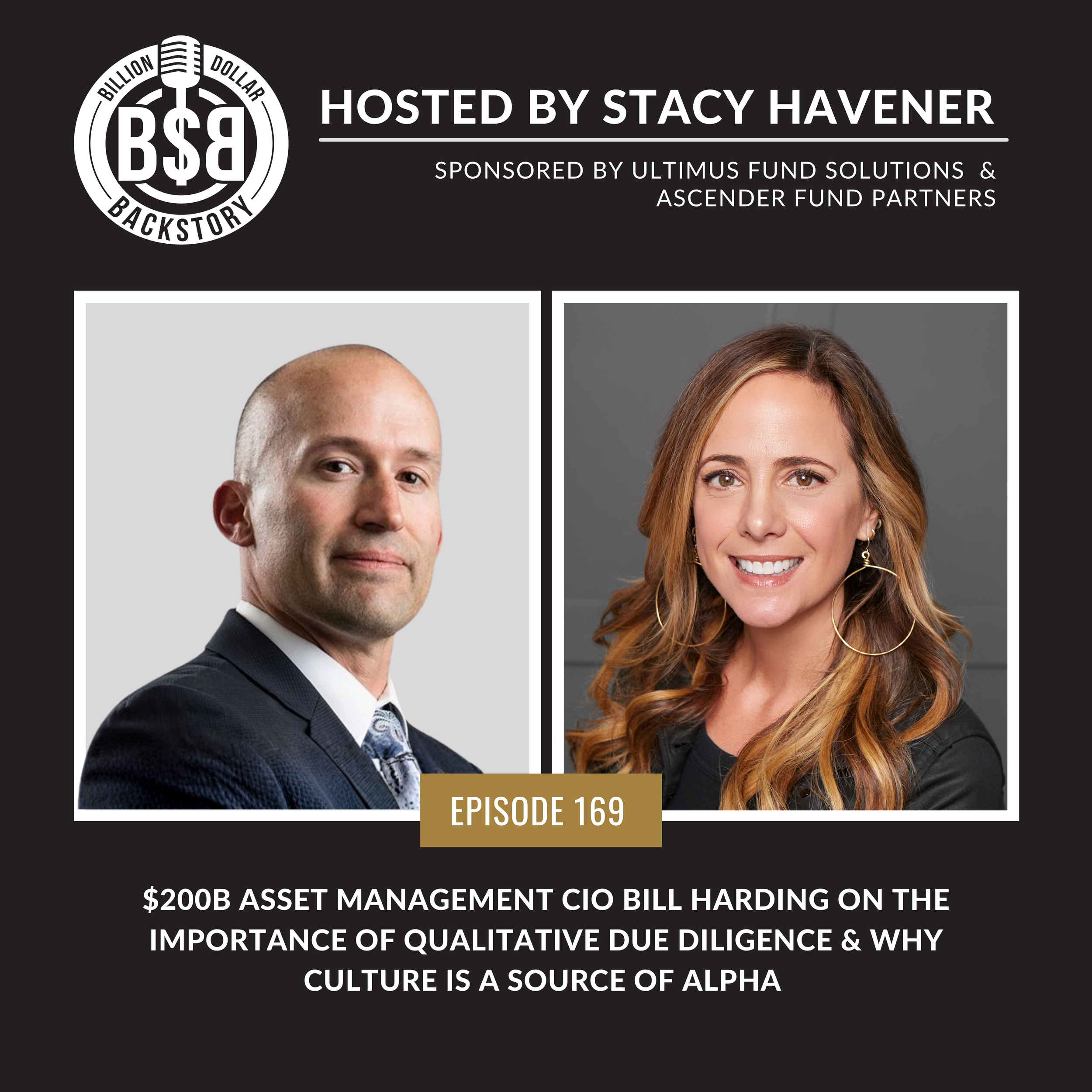
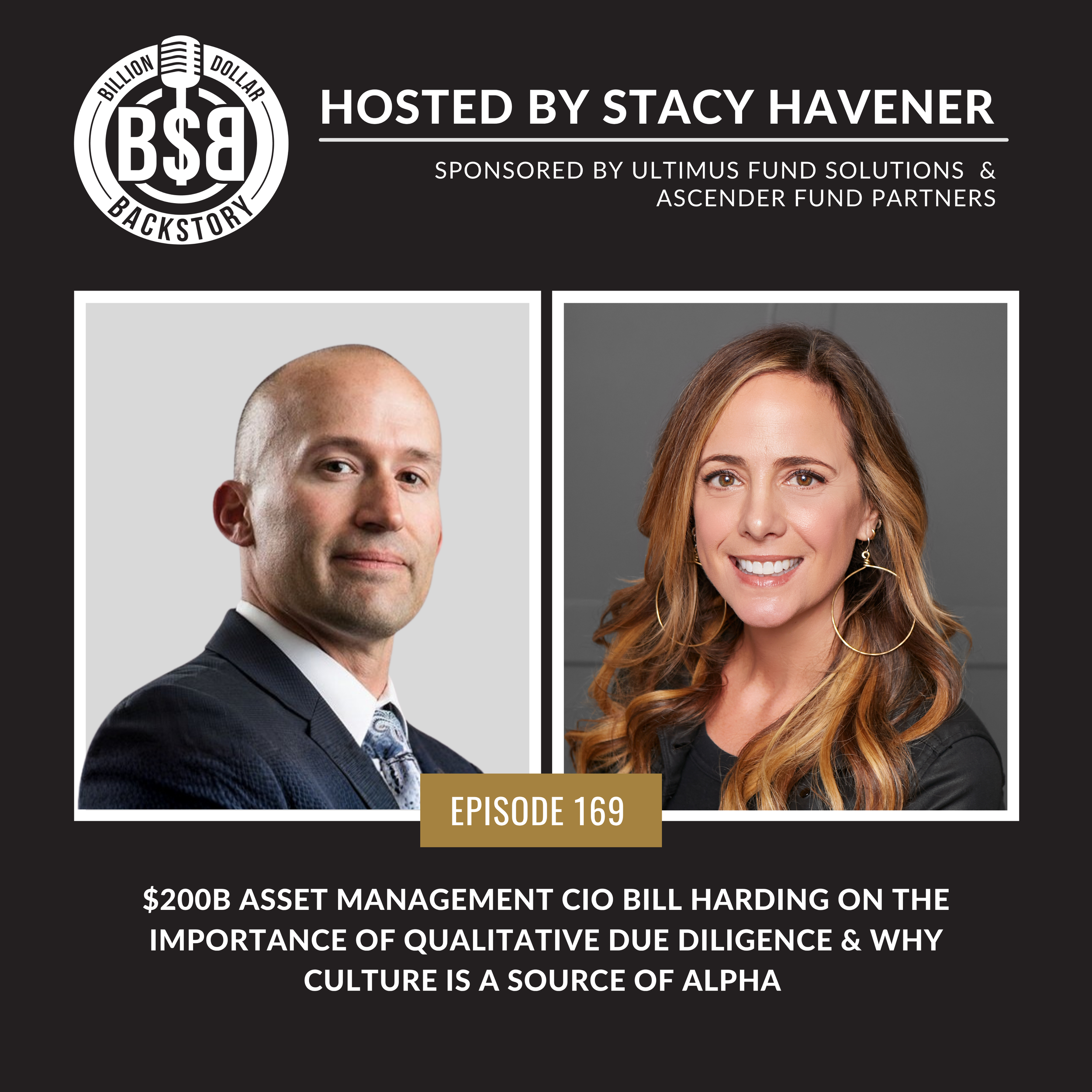
Episode 169: Encore: $200B Asset Management CIO Bill Harding on the Importance of Qualitative Due Diligence | Why Culture is a Source of Alpha | “Ask an Allocator” Session
Subscribe to Billion Dollar Backstory on Apple Podcasts, Google Podcasts, Spotify, or wherever you listen to podcasts.
This conversation was too good to leave in the archives.
In this encore of our Ask an Allocator series, Stacy sits down with Bill Harding, CIO of Jackson National, who oversees $200B in assets and $29.8B in directly managed fund-of-fund assets.
Bill gives us a look inside the mind of an allocator and shares what he’s actually paying attention to when evaluating fund managers, because past performance is only part of the story.
In this episode, Bill and Stacy discuss:
Bill’s backstory, from financial analyst at a cheese manufacturer to CIO at Jackson National
What fund managers need to get right when pitching a potential partnership
Why past performance alone isn’t enough to earn an allocator’s attention
Why Bill sees culture as a real source of alpha
The questions fund buyers are asking behind the scenes (and why the most important ones aren’t always quantitative)
If you’ve ever wondered what really matters on the allocator side of the table, this conversation gives you a pretty good look behind the curtain.
About Bill Harding:
Bill Harding, CFA, is Senior Vice President and Chief Investment Officer at Jackson National Asset Management (JNAM), where he leads asset allocation, portfolio construction, sub-adviser monitoring, and manager research.
He joined JNAM in 2012 after serving as Head of Manager Research for Morningstar's Investment Management division, and has more than 30 years of experience across JNAM, Morningstar, and Leprino Foods. He holds a B.S. from the University of Colorado, Boulder and an MBA from Loyola University Chicago.
Mentioned in This Episode:
Songs: Enter Sandman - Metallica
Books: On Fire by John O’Leary
TRANSCRIPT
Below is an AI-generated transcript and therefore it may contain errors.
[00:00:00] Stacy Havener: You know that moment at a concert when the lights go down, but the crowd won't stop clapping until the band comes back out for one more song? That's what this is. Welcome to Billion Dollar Backstory Encore episodes. An encore only happens because people liked what they heard the first time around and they want more.
[00:00:21] So today, we're doing exactly that, bringing back one of our favorite conversations just for you. Sit back, grab your popcorn, and enjoy.
[00:00:32] Hey, my name is Stacy Havener. I'm obsessed with startups, stories, and sales. Storytelling has fueled my success as a female founder in the toughest boys' club, Wall Street. I've raised over 8 billion that has led to 30 billion in follow-on assets for investment boutiques. You could say against the odds.
[00:00:52] Yeah, understatement. I share stories of the people behind the portfolios while teaching [00:01:00] you how to use story to shape outcomes. It's real talk here. Money, authenticity, growth, setbacks, sales, and marketing are all topics we discuss. Think of this as the capital raising class you wish you had in college, mixed with happy hour.
[00:01:17] Pull up a seat, grab your notebook, and get ready to be inspired and challenged while you learn. This is the Billion Dollar Backstory podcast.
[00:01:30] Bill, thank you so much for being here. This is really fun for me because I feel like I've known you, I don't know, is it 20 years? It might be.
[00:01:38] Bill Harding: We go back a ways. Yeah.
[00:01:39] Stacy Havener: Yeah,
[00:01:40] Bill Harding: back to my old Morningstar days, so
[00:01:41] Stacy Havener: yeah. It might be. Probably
[00:01:42] Bill Harding: about that long.
[00:01:43] Stacy Havener: Yeah. So it's an honor- 15, 20 ... to have you in the studio, and I'm kinda liking this.
[00:01:49] This is like, I'm calling this like little Ask the Allocator, Ask an Allocator series. But before we get to asking an allocator, we gotta start with my favorite thing, [00:02:00] which is backstory. So I want you to take us through, you mentioned Morningstar. I'm sure we'll pass through the, the hallowed halls of Morningstar in this journey with you.
[00:02:09] But did you always know you wanted to be in the investment world? Like kinda take us way back, the way back machine.
[00:02:15] Bill Harding: Yeah, the way back machine. Yeah, I always grew up knowing I wanted to be in manager research as a little kid. No, probably not, so And I will just kind of foreshadow that I'm probably gonna be the only allocator you talk to that had experience in a cheese plant.
[00:02:31] So we'll get to that momentarily. So, so I grew up on Long Island, middle class family. My father was an auto mechanic, owned an auto repair shop for many years, was kinda traditional stay-at-home mom. So one of the things that kinda led me on my journey was while we were growing up, we used to ski a little bit as a family, typically in Vermont.
[00:02:53] Hmm. And then one year in high school, I don't know, we were up in Vermont skiing, and I saw some sort of flyer [00:03:00] advertisement for Vail in Colorado, and kind of asked my parents about, "Well, you know, maybe we should go on a ski vacation out to Colorado." So we did. I fell in love with that area, and that kinda led me to going to college at University of Colorado Boulder, which was phenomenal.
[00:03:16] I had a great time there and enjoyed the mountains, and started off trying to be a computer science major. Okay. Realized after first semester, it probably wasn't the right fit for me, so transferred over to the business school and, uh, did get, uh, my degree in business with a, you know, focus in finance. So thinking about, I guess, uh, when I was about to graduate, a lot of the companies that were recruiting, uh, on campus were kind of your auditing type firms, some investment banks, et cetera.
[00:03:47] I didn't really know what I wanted to do, what kind of path in business or finance I wanted to go down. I just thought at the time, like I was still loving the mountains, kind of wanted to be in that Boulder, Denver area, so I was really just looking for job [00:04:00] openings. And one that I came across was for this financial analyst position at a privately owned company called Leprino Foods company.
[00:04:08] So this is where we start getting to the cheese story. So what piqued my interest about the role itself was it was pretty general, so it gave me exposure to, you know, a couple different areas within being a financial analyst. I re- still didn't really know what that meant, like just coming out of college.
[00:04:22] But Leprino was a manufacturer, still is, of mozzarella cheese used by all the big pizza chains. Wow. So Domino's, Papa Johns, Pizza Hut, et cetera. So they kinda had a niche. They were... They produced at low cost, had a very efficient process, and were very successful in that business. So Part of that role at Leprino Foods was some of it was kind of corporate finance, doing budgeting and lease first buy decisions on tractor trailers, things like that.
[00:04:52] But the other part that I realized was more interesting was analyzing some of the investments within their 401and profit-sharing [00:05:00] plans. Ah. So that's really, I guess, when I started to think more about focusing on investing as a career. And part of my roles that took me to the cheese plants was actually providing, you know, very basic education for the plant workers about why they should save in a 401plan and what investments mean and what's an equity fund versus bond fund.
[00:05:22] So that was kind of interesting, and especially since these cheese plants tend to be in the middle of nowhere where there's lots of cows and you have ample access to milk. So my favorite was, uh, Roswell, New Mexico. It was a good one. Yeah, so that kinda led me further down the investing path, and I'll tie this into Morningstar.
[00:05:41] Yeah. So when I was at Leprino Foods, we utilized some of the various, you know, Morningstar products. Mm-hmm. And if you go back a ways before the internet and even before the CD-ROM, people probably don't even know what CD-ROM is. There was this big thing that Morningstar called The Binder, the print publication-
[00:05:59] Stacy Havener: [00:06:00] Wow
[00:06:00] Bill Harding: of reports. So I remember just as part of my role in researching these mutual funds that we had in our 401plan there at Leprino, reading through the Morningstar analyst reports and so forth, and eventually after being at Leprino for about three years, realizing I wanted to focus more on investing and, and seeing those reports and learning about Morningstar, I was like, "Oh, this sounds like a great place to work."
[00:06:23] I remember at the time they had a, somebody had written a, a book about Morningstar and describing people rollerblading into the office- Oh my gosh ... in shorts and T-shirts. Like oh, this sounds great. Mm-hmm. You know, still wearing a shirt and tie to work, so So lo and behold, I actually saw a posting for a Morningstar analyst role.
[00:06:40] I had never actually been to Chicago before. So I did interviewed with them, eventually went out to Chicago for an in-person interview. And obviously people, being in Chicago, depends on when you visit, whether you wanna live there. So I was pretty fortunate. It was a very warm, [00:07:00] late April day when I visited.
[00:07:01] The river was beautiful and-
[00:07:03] Stacy Havener: Mm ...
[00:07:03] Bill Harding: sun was shining. And so it worked out, and it was a great start to my, I guess, real investment career with Morningstar there.
[00:07:11] Stacy Havener: What was the, the cheese plant is so fantastic, and by the way, high five on your storytelling skills 'cause you teed that up at the beginning of the story.
[00:07:21] That was magic. Yes. Great job. Very proud of you. Thank you. So what year did you join Morningstar?
[00:07:27] Was that in the '90s?
[00:07:29] Bill Harding: Yeah, so I joined Morningstar in 1999. Yep. So it was June 1999.
[00:07:34] Stacy Havener: And you were there for how long?
[00:07:35] Bill Harding: Uh, 13 years with Morningstar, yeah.
[00:07:36] Stacy Havener: So
[00:07:37] Bill Harding: what a
[00:07:37] Stacy Havener: journey.
[00:07:38] Bill Harding: Yeah, it was. It, I mean, obviously Morningstar's grown a lot, you know, over the years, and started off as a fund analyst and did that role for a few years before I moved into their investment management division a- and spent more time managing portfolios, picking mutual funds, and so forth.
[00:07:55] So that was kind of the probably bulk of my tenure there at Morningstar was in that [00:08:00] investment management division.
[00:08:01] Stacy Havener: And then so take us to today. So you're at Morningstar
[00:08:06] Bill Harding: for 13 years, and...? So I'm at Morningstar for 13 years, and I was contacted by a recruiter regarding a role at Jackson National. And at that time, I didn't really know much about Jackson National at all.
[00:08:20] I didn't know much about the variable annuity industry in which Jackson operates. But the role itself was intriguing to me. It was leading an investment team that was responsible for doing manager research, so- I decided to look into it, and the more I got to know, you know, the company, what the role was, the more interested I was in it.
[00:08:41] So decided while Morningstar was a great place to work for 13 years, the time was right for me just to make a change and to move over to Jackson, and I've been here for 11 and a half years now.
[00:08:54] Stacy Havener: That's nuts. I can't believe it's been 11 and a half years. Wow.
[00:08:59] Bill Harding: I know. As I [00:09:00] add all this up, I can't believe how old I'm getting, actually.
[00:09:03] Stacy Havener: Okay. Well, so yeah, no, we don't wanna take ourselves there. We'll feel bad, as I'm wearing a tie-dye shirt, which I don't even know what's going on there, but, you know. So I think maybe what I wanna do is for people who don't know Jackson, because I think, you know, when you first said, "I'm going to Jackson," it's like, that's an insurance company?
[00:09:22] Like, it just doesn't click naturally. Mm-hmm. So talk a little bit about, like you mentioned the variable annuities, you mentioned manager selection, like tie that all together for us.
[00:09:32] Bill Harding: Right. So Jackson primarily operates in the annu- annuity business, and there's all different types of annuities: fixed, indexed annuities, et cetera.
[00:09:40] But Jackson's bread and butter has been variable annuities. Now, they do also do some fixed and more recently have been also in the RILA or Registered Index Linked Annuity space as well. Uh, so we have some, you know, different types of products. But specific to what I work on with the variable annuities is [00:10:00] really it's a platform of we have 130 funds available for clients that invest in our various Jackson variable annuity products.
[00:10:09] And one of the differentiators for Jackson in the industry is investment freedom. A lot of the other variable annuity providers might limit their clients into what particular types of funds they can invest in, maybe limit their equity exposure or put them into managed volatility portfolios. And the reason they do this is, you know, because they don't wanna have to hedge the book- Mm-hmm
[00:10:32] and some of the exposures to ensure that the capital is there to meet the needs. So that's what I liked about Jackson is that investment freedom story, the broad lineup of funds they had available, and as well as ability to even improve upon that lineup of managers and to utilize my and team members' knowledge of the manager universe to really partner with what we think are some of the best-of-breed [00:11:00] managers across the various asset classes.
[00:11:03] To help maintain a competitive lineup and to really kind of power that investment freedom story. So it's one thing to have lots of options, over 100 funds, but we also wanna make sure that they're good funds- Mm-hmm ...
[00:11:14] Stacy Havener: that,
[00:11:14] Bill Harding: you know, are meeting client expectations and delivering types of returns and risks that we expect and that we want for our clients.
[00:11:22] Stacy Havener: I love the investment freedom piece. That's a great... And I'm sure it's, you know, on your materials. It's awesome. And I think what's interesting, so again, if I put myself in the shoes of the listener, they're like, "How are Stacy and Bill friends though?" Because wouldn't like Jackson National be investing in all the bigs?
[00:11:40] And, you know, wouldn't that be the easiest thing for Jackson to do is just like, you know, get the pages and look at the biggest fund shops and say, "Great, we'll just have BlackRock and Vanguard and all these things." So I'm gonna let you speak to that.
[00:11:53] Bill Harding: Yeah. So we invest in some of the bigs- Mm-hmm ... as well as some of the boutiques.
[00:11:58] Mm-hmm. And I would say, again, this has been [00:12:00] something that has evolved, you know, over the years, and especially since, since I joined. Again, knowing knowledge of some of the managers out there in the universe and the processes we've put in place to really do, you know, a diligent job of manager research and selection.
[00:12:14] I think that kinda led us down a path to being open to exploring some of the more boutiques out there as well. But yeah, certainly-
[00:12:20] Stacy Havener: Mm-hmm ...
[00:12:20] Bill Harding: you know, the bigs, we have exposure. We work with T. Rowe Price and BlackRock and JP Morgan and, and the like. But we also have, you know, a number of boutiques represented within our platform.
[00:12:31] And sometimes they tend to play more of a role. We, of the 130 funds, you know, we have some passive funds. We have a lot of actively managed. We have all f- different flavors, investment strategies. Many of them are single strategy where, you know, the, we hire one sub-advisor to manage the fund and their name's on the fund.
[00:12:49] But then we also have a, a suite of multi-managed funds where, I mean, those tend to be in more capacity constrained asset classes or things like alternatives, you know, [00:13:00] small growth, small value, midcap, et cetera. And we've kind of utilized more of the boutiques- Mm-hmm ... to play roles in those multi-manager funds 'cause, you know, one, I think that's kind of plays to their niche, their specialization.
[00:13:12] Totally. And I guess some of the benefits that you would have with a big of having kind of distribution support and, and helping the marketing things are less important for those multi-manager funds as well. So-
[00:13:23] Stacy Havener: Yeah ...
[00:13:24] Bill Harding: that's where we have tended to utilize more of the boutiques.
[00:13:27] Stacy Havener: Yeah. Great. Great backstory.
[00:13:30] Awesome job on the storytelling in general. Let's pull that storytelling thread a little bit forward, because I can imagine that you meet with a lot of managers. Fair, fair to say that- Yeah ... you meet with a lot. Probably
[00:13:42] Bill Harding: met with thousands, yeah. I should, I should tally it up
[00:13:45] Stacy Havener: sometime. But yeah. You should.
[00:13:47] You should. And so, you know, one of the things that is very challenging for managers to do is to articulate what makes them different- And I can imagine that being on the other [00:14:00] side of the table and meeting with these managers, you've heard a lot of people say, "Here's what makes us different," and maybe inside, not externally, like sort of rolled your eyes.
[00:14:09] So like talk to me about that. Like how are... You know, especially today when it just feels like there's so many funds and so much stuff and noise Like what's happening in those meetings, and how are managers able to really communicate their differentiation to you? Like what... Talk us through that.
[00:14:27] Bill Harding: Yeah, you're right.
[00:14:28] Sometimes I do kind of roll my eyes- ... or chuckle to myself when, you know, a manager comes in a- and claims their, their analyst team is really the only one doing, you know, as thorough company analysis and research and, and talking to suppliers and competitors. I'm like, uh, heard that from every other manager.
[00:14:46] Yeah. So what, that's really not differentiated at this point. But, you know, I think like you in this podcast, I love to start with the backstory- Yeah ... of the manager or whoever I'm meeting with and where they came from, and especially when it's a s- uh, maybe a [00:15:00] boutique or somebody starting their own firm or had moved from maybe a big firm to somewhere else.
[00:15:05] Just trying to understand that. And after that, I think it's really about the culture- Hmm ... that they're building at their firm. The, that's really what we try to focus on, and I think is, you know, an important source of differentiation is the culture and how the teams interact and what their incentives are, how they're aligned with shareholders, uh, just kind of what drives them to do what they do and, um, on a daily basis.
[00:15:34] So that's really what we try to get out of a lot of those initial meetings.
[00:15:38] Stacy Havener: Much more qualitative, everything you said there.
[00:15:40] Bill Harding: Oh, yeah. Certainly. Yeah. I think there's a lot of that qualitative. I mean, the quantitative comes down the line in future meetings, but again, a lot of, I think these days, a lot of that's the process is, again, there's less differentiation- Mm-hmm
[00:15:54] in some ways. It's just, I think, more behavioral differentiation, right? Hmm. I mean, [00:16:00] everyone's got access to a lot of the same information these days and resources and databases, spreadsheets, FactSet, Bloomberg, et cetera. I mean, you're assume everyone's got all that, right? So really what is, you know, how you're differentiated.
[00:16:14] Every once in a while there might be some way some people are looking at the data or so forth or doing their analysis that is slightly differentiated, but I think more becomes on the behavioral side and just how they manage their portfolio and make changes.
[00:16:31] Stacy Havener: Yeah. And the people. Yeah. And I've heard this from other allocators, and I wonder if you feel the same, that when you're in a meeting, you know, a manager comes to a meeting, and I think there's this disconnect between what th-the manager thinks that you want to hear or talk about and what the allocator actually wants to hear and talk about.
[00:16:53] You just articulated some of the stuff, like how you start a meeting, et cetera. And I think the manager comes in thinking, "Well, I've gotta come with like [00:17:00] data and charts, and here, let me point to my pitch deck and show you this." Mm-hmm. And I've heard allocators say, "I can get all that," to your point. Like, "I can get the data."
[00:17:10] And what really is valuable in a meeting are the things that I can't get from a software system or, you know. Do you agree with that? Like, bring me the stuff I can't get. I can get your data. I don't need to- Yeah ... I don't need you to read me the chart.
[00:17:26] Bill Harding: Right. Yeah, or maybe even ahead of the meeting you already have a look at- Yeah.
[00:17:30] some of that or... And, you know, I'm happy to have a pitch book, uh, you know, for reference, but, you know, please don't turn page by page through the pitch book. That just drives me crazy. But yeah, it's good to have in the meeting maybe just as a resource- Yep ... or if I want more background on, you know, specifics on, on the team or something like that.
[00:17:50] But the best meetings are ones where the pitch book is sitting there to the side. You maybe never open it or you open it once or twice just for reference, but you're having a [00:18:00] conversation, a dialogue with the people in the room. Again, you're learning about their culture, you're learning about how they do what they do, and they're telling you stories, right?
[00:18:09] Yeah. And they're providing you examples, right? Yes. It's not just going through the reverse pyramid slide of how- Yeah ... they select a security that everyone has in their deck. It's really, you know, tell me about the examples of things that you did well and, and what led you to those decisions. But also as important, and we'll ask if they don't bring it out themselves, tell us about the mistakes, right?
[00:18:28] Yes. Tell us, you know, the ones that went wrong, what you learned from that, and that's important, and you gotta be humble in this industry. And, uh- You know, even the best investors, obviously, you know, their bang average on any individual security, you know, s- selection is not gonna be perfect, right? Right.
[00:18:45] Everyone's got mistakes. Everyone's gonna have names that don't work out, and I think the key is to recognize that you will make mistakes and, and to try to learn from that. So we try to get those types of stories and try to get that dialogue during our meetings. [00:19:00]
[00:19:00] Stacy Havener: Is that ... On the mistake piece, because I agree with you, and some managers, I've actually had a client once who refused to answer the question, and I basically just wanted to like throw my, you know, pen up in the air- Yes.
[00:19:10] just be like, "We should just go. We should just leave." Mm-hmm. "You're never getting this." Why do you ask that question? I mean, I have, I think I know why, but just really like, why do you ask the question about the mistakes? What are you looking for?
[00:19:23] Bill Harding: So I think there's a couple things we can get out of that is, one, I think it speaks to, can speak to the culture- Mm-hmm
[00:19:30] can reinforce what that culture is or isn't. It could, you know, lead, you know, also provide, again, more insight into the behavioral aspects of that manager and how they think and, and how they trade securities. And ag- again, just getting into their personality and, you know, if we've been in meetings where, depending on how they address those mistakes, will the portfolio manager just kind of blame the analyst- Mm
[00:19:56] not take any responsibilities? That's, you know, that's kind of a [00:20:00] yellow to red flag. I really don't like to hear that when- ... at the end of the day their name is on the fund. They're the PM. They should ultimately take responsibility for every name that's in that portfolio. But w- we've had meetings where that's, that's been the case, and you can
[00:20:14] Or you were in meetings where, you know, you can actually see some of the tension between portfolio managers and analysts when they talk about a mistake, right? So that speaks to what is the culture at this firm. Is it truly collaborative or, or not really? Is it more kind of, uh- One or a few individuals are really have all the power and everyone else is kind of afraid of that person.
[00:20:38] That's not a healthy culture in our opinion. So I think those are some of the-
[00:20:42] Stacy Havener: Yeah ...
[00:20:43] Bill Harding: reasons we ask about the mistakes. Another question we like to ask, you know, not necessarily relative to mistakes is again, are there certain people that inspire that portfolio manager? Oh, yeah. What, again, got them into the industry?
[00:20:56] What, you know, what makes them tick, right? So I think that's also [00:21:00] kind of informative. We, you know, ask about if there's competitors they admire and so forth and, and who they kind of look to as, you know, peers, uh, just to, you know, try to get a sense for, again, get a little bit more into their personality and, um, what, what motivates them.
[00:21:19] Stacy Havener: Let's be real. No one wakes up and says, "I can't wait to build some operational infrastructure today." You're here to manage money, to build something that lights you up, not chase down reports across five systems and 15 service providers. That's where Ultimus Fund Solutions comes in. They're your ops dream team, consolidating all your middle and back office chaos into one clean, scalable setup.
[00:21:46] Registered funds, private funds, SMAs, all integrated. One team, one tech platform, one rock solid source of data. But here's the real differentiator: [00:22:00] service. I know that fund in a box sounds convenient. It's also a box. Know what you can't put in a box? A human who picks up the phone when you call and need help, real life people who know your name and your fund, and they care about getting it right.
[00:22:18] Ultimus was built on people doing business with people. You get institutional strength combined with boutique level service without getting stuck in a phone tree of doom. If you're ready to simplify, scale, and start working with a team that feels like an extension of yours, check out billiondollarbackstory.com/ultimus.
[00:22:40] That's U-L-T-I-M-U-S. You've got the investment strategy, the vision, the track record. Now it's time to upgrade the engine behind it all with Ultimus
[00:22:57] It's a great question to ask somebody [00:23:00] that, that particular one on mentors or who inspires you. In fact, that's one of the ways if somebody's stuck on their backstory or they-- I can tell they're feeling uncomfortable with it, I usually will ask that question, and you can just see their whole sort of vibe changes because they start talking about someone who inspires them.
[00:23:19] It's a great unlock. And I would imagine the competitor one is as well. Do you ever have managers say, "Oh, there's-- we don't have any competitors"?
[00:23:27] Bill Harding: Yeah. Or in a way, kind of respond kind of like that, like, "Oh, well, we, we don't really pay attention much to the competitors," or, or, you know, I think it's more off-putting when they kind of maybe take jabs at the competitors.
[00:23:43] Yes. And it's just, you know, that sometimes is, you know, something that we'll, we'll note and just try to understand-
[00:23:49] Stacy Havener: Yeah ...
[00:23:49] Bill Harding: that rationale.
[00:23:50] Stacy Havener: Well, speaks to the culture.
[00:23:52] Bill Harding: It's really bad if we actually work with those competitors as well. That's And that's something they should probably know before the meeting, right?
[00:23:57] So. Totally. Has happened,[00:24:00]
[00:24:02] Stacy Havener: actually. Oh, my God. It's surprising, but yeah. Awkward. Yeah. Yeah. Yeah. So that's great. What other questions... These are awesome questions. What other questions do you ask that we haven't talked about? I mean, you're mentioning analysts in the room, so is that something you like to see, like the dynamic of the team together?
[00:24:17] Bill Harding: Yeah. Uh, for sure. And, and sometimes we get that here in our office, but more often we get that when we go out and visit- Yeah ... you know, a company at their headquarters on site, so which, you know, we, we do make that an emphasis in our, our research, you know, before we ever hire a new manager, and then even ongoing with the current You know, funds and managers we work with will go out pretty much almost every year to most managers and do on-sites.
[00:24:43] And again, during that process, it's not just meeting with the portfolio managers, which we'll do, but it's also, you know, meeting with the analysts and just seeing how just people in the office interact. Yeah. How, you know, again, how do the, some of the people treat the receptionists or just [00:25:00] people at different levels of the organization.
[00:25:02] That speaks a lot to the culture, I think. When you can... You walk in and, you know, they're telling you about anyone that works in the office and what their background is, and just you can kind of sense that it's more like family-like- Yeah ... and more of a collegial atmosphere, and that's just gonna lead to greater employee retention and I think lead to greater productivity and hopefully, you know, better results for the clients ultimately.
[00:25:28] Stacy Havener: So good. And I- our mutual friend, Paul Black, talks a lot about, like, culture can be alpha, which is what you alluded to there.
[00:25:39] Bill Harding: Mm-hmm.
[00:25:39] Stacy Havener: And, you know, he talks about it more in terms of companies they're analyzing, but how interesting that you're applying that to the managers themselves. Very smart. Very smart.
[00:25:50] Okay, let's stay with this, 'cause my next question's ver- is related. There's this Kaya study, which I kind of pointed to a little bit earlier, [00:26:00] about the disconnect between what managers think allocators value in the due diligence process and what allocators actually value in the due diligence process, and the bulk of that is around qualitative versus quantitative.
[00:26:15] So the managers think allocators overweight quantitative, where the allocator actually says that qualitative is as important, if not more important, than quantitative. So with that backdrop, I've been kind of batting this question around for, like, a year plus, which is, are you buying a fund Or hiring humans
[00:26:38] Bill Harding: Well, certainly we're, we're hiring humans- Yeah
[00:26:40] I would say. Especially, again, if you're looking for actively managed strategies, you know, maybe if you're doing something in the passive space that's... Or you just want some very targeted niche exposure to a Bitcoin ETF, you're buying a fund. Yeah. But for, you know, investing in, you know, actively managed strategies, we're investing with the people, and that's why that qualitative is so [00:27:00] important.
[00:27:01] Now, I understand the quantitative. Look, at the end of the day, performance matters, right? We all, you know, want to achieve and deliver good results to our clients, so we want that, that performance. So the quantitative is important ultimately, but to me, that's just kind of the, the outcome- Yes ... of the process, of the people, of what we think are the sources of a competitive advantage that have led to that good past performance, right?
[00:27:25] 'Cause we all know it's, there's not a ton of persistence in our industry, and it's very hard for, you know, to have that, you know, continued success over time. So that's why, again, we try to focus more on the sources of a competitive advantage, which goes back to all the qualitative aspects or, you know, again, getting into the people and the process or...
[00:27:46] Uh, but of course we use quantitative tools in trying to even analyze that, right? So we can, you know, look at, you know, especially within the process, you know, we spend a lot of time looking at portfolio characteristics or factor [00:28:00] exposures, performance attribution. I mean, there's a lot of quantitative research that goes into trying to make that assessment of whether we think this is a sound, disciplined process that's led to, you know, good results over time, understanding why that is, and, you know, has it been applied consistently and so forth.
[00:28:16] So y- it, it definitely is a mix, but at the end of the day for us, we have to make a qualitative assessment.
[00:28:22] Stacy Havener: Yeah. I love the twist there about the quantitative research you're doing is trying to unpack the why of the results. Ooh, I love that. Mm-hmm. That's like Simon Sinek's Start With Why, the CFA version or something like that.
[00:28:39] So good. Talk about, we're sort of on the front half of due diligence here. Let's talk about the back half. Let's talk about now you've, you've hired a manager. What goes into... I think there's this short-termism like, oh, you know, investors, nobody wants to stay. They can't stomach the [00:29:00] downturns. You know, they just sell and move on to the next hot dot or whatnot.
[00:29:04] How do you think about that? How do you think about when a manager's underperforming? And how do you deal with them and talk with them about that?
[00:29:13] Bill Harding: Yeah. Unfortunately, it happens, and with a, you know, broad lineup of over 130 funds, there's always, you know, f- at least a few that are going through a rough patch of performance.
[00:29:22] And look, we, we do a lot of reporting, a lot of that, uh, is ultimately provided to an independent board of trustees that oversee the funds. So of course, they're focused on performance- Mm-hmm.
[00:29:33] Stacy Havener: Yeah ...
[00:29:33] Bill Harding: you know, every quarter and, you know, they're looking at the typical, you know, trailing one, three, five, you know, type of data points that, that the industry gets so focused on.
[00:29:42] And we try to provide a little bit more context to that. We have a, a proprietary performance ranking measurement, which is kind of a combination of multiple return-to-risk-adjusted metrics and-
[00:29:55] Stacy Havener: Hmm ...
[00:29:55] Bill Harding: looking over longer time periods. It goes up to, you know, 10 years or since [00:30:00] inception of a strategy. Now, of course, even that performance ranking can be influenced by, you know, really if you have an 18-month s- stretch of like meaningful, like big underperformance, that's gonna even, you know, bring down some of those longer term results and, and lead to a lower performance score, so.
[00:30:17] But of course then we wanna kind of keep that within the context of what the environment is. Has the, you know, portfolio manager's style been out of favor?
[00:30:27] Stacy Havener: Mm-hmm.
[00:30:27] Bill Harding: What led to that underperformance? And for us, we're willing to be patient with a manager if our qualitative assessment remains solid, right? If we still have that conviction in, in the team and their process and we just think like, look, they've kinda hit a rough patch here.
[00:30:44] The market's not rewarding their style. Uh, for whatever reasons, they're sticking to their knitting. They- that should hopefully lead to a rebound in performance, then, uh, uh, we'll see them through that. But of course, again, there's a lot of, uh, education [00:31:00] we have to provide to our board of why we're comfortable with that- Mm-hmm
[00:31:03] and, and how we're making that qualitative assessment so. That's where, again, running more of the detailed analytics, whether it's attribution or trying to understand the factor exposures and some of these other risk statistics maybe can help provide that context of, of why they aren't performing well.
[00:31:20] Maybe it's kind of within our expectations based on our view of what the manager does and how they run that portfolio. But then other times, yeah, I mean, sometimes it just, that underperformance persists and you're not really seeing any improvements. We'll probably get more concerned when you then start to see managers maybe overreact-
[00:31:41] and kind of, they end up getting whipsawed, right? They're trying to make up some ground and maybe deviating a little bit from their process, trading a little bit more frequently, and sometimes that doesn't work out, and to us, that's kind of more of a concern.
[00:31:55] Stacy Havener: That last point is powerful right there because I think managers need to hear [00:32:00] that.
[00:32:00] You're saying just if, you know, if you were a value manager and you just went through this, you know, getting kicked in the teeth for 10-plus years, don't all of a sudden trade more and start putting, you know, innovation names in your portfolio. That's more of a red flag- Mm-hmm ... than if you had just stayed in your lane, given the backdrop that you're in.
[00:32:22] Fair to say?
[00:32:23] Bill Harding: Correct. Yeah. Yeah.
[00:32:23] Stacy Havener: Yeah.
[00:32:24] Bill Harding: For sure.
[00:32:24] Stacy Havener: Yeah. What about authenticity? This is a tough one. This is a tough one for managers because, well, maybe for all of us in general as human beings, but certainly in the investment industry perhaps more so. There's this idea, I think we all s- you know, sort of grew up in this biz, that, you know, it's not about the people.
[00:32:49] Like, it's the firm and it's the process, and then it's, of course, the performance. And so you have these, these fund managers who, [00:33:00] you know, they all wanna look the same and have the pitch deck that has the universal funnel, and everyone's sort of saying the same stuff. It's really difficult for them to break out of that, and I wonder how you think about that, and I wonder how you think, you know, when you meet managers, if they're all just sort of cut from the same Brooks Brothers cloth.
[00:33:23] I don't know. Does anyone wear Brooks Brothers anymore? I don't even know.
[00:33:31] Bill Harding: Yeah.
[00:33:31] Stacy Havener: No, I'm not sure. You know? Like Nope. Now I'm really dating- Now they wear Patagonia, Patagonia vests. They, yeah. They moved on to- Now I'm really dating myself. Like, how do you... Like, do you want them to have a little bit of personality?
[00:33:38] Bill Harding: Yeah, I think so. And I, I do think, uh, I mean, there's probably still kinda some of that in the industry, and absolutely, I think we've identified a lot of managers that are kind of differentiated, that kind of are authentic.
[00:33:50] But- Yeah ... uh, certainly I think when you're just, you know, getting to know firms and think it is important for them, and I think it goes back to, like, some of the questions and why we a- [00:34:00] why we ask- Yeah ... those questions in the beginning is to get, kinda get at that, not just to go through their typical, you know, pitch book and cadence of, okay, I gotta tell these people these things in this order.
[00:34:12] No, let's kind of, again, not even use the pitch book and just kinda have a dialogue, and, and I think sometimes also helpful in that, those informal moments of a meeting. Mm. And that's why I kind of love that we're kind of back after COVID and, and back to doing in-person meetings 'cause, you know, I felt like a lot of those Zoom meetings that we were all doing are definitely more scripted and you don't have the ability for those informal interactions of when I'm just walking somebody through the hall into the conference room, or again, you have some of that just informal discussion about whatever topic, you know, your kids or activities you're into before and after the meeting, and then, you know, if we have the opportunity to do a lunch or- Mm-hmm
[00:34:54] a dinner or something like that. I think that just even helps- Get to that authenticity a little bit more [00:35:00] and get to know them as people, not just like talk business and talk shop all the time. Mm-hmm. I mean, uh, which is another little, you know, pet peeve, especially if we're like doing a dinner or a lunch.
[00:35:10] It's like, it doesn't have to be all work all the time, right? We'll get to the work stuff, but like let's, again, let's, you know, get to know each other as humans and as people. Let's learn a little bit more about each other. Then, you know, there'll be time to pitch me something later and... But the ones that just like right in, like, "I'll be working on with you."
[00:35:28] I'll say, "Hold on." It's
[00:35:29] Stacy Havener: okay. "
[00:35:29] Bill Harding: Let's-
[00:35:30] Stacy Havener: Why don't you talk about- ... we'll get there" ... your sharp ratio over salad? Like let's just-
[00:35:37] I love the idea that the informal moments in the meeting are valuable.
[00:35:45] Bill Harding: Yeah. Definitely could see that bec- uh, a- and going through COVID, you kind of recognize that, how valuable they could be.
[00:35:53] Stacy Havener: Mm-hmm.
[00:35:54] Bill Harding: And that's like sometimes, I, I mean, also, again, they're not scripted and-
[00:35:58] Stacy Havener: Yeah ...
[00:35:59] Bill Harding: they're willing to [00:36:00] tell you something that maybe didn't come up during the meeting, whether it's about a competitor or something else.
[00:36:05] Uh, you, sometimes you just get some interesting nuggets of information- Yeah ... in, in those types of just informal sessions.
[00:36:12] Stacy Havener: It's the moments in the meeting. Mm-hmm. The little moments. That's so good. How often... This has happened in later stage due diligence with some larger allocators, and I wonder if you do this, and I want managers to hear this, if you do approach conversations this way.
[00:36:29] You know, there's this idea that stories are sort of spin and, you know, a lot of, there's a lot of, you know, numbers not narrative, and I get it. I get why that's so objective and yet it's also very robotic and not human and not how people make decisions. I would say numbers and narrative together. I've been in meetings with allocators where they'll take the portfolio and they'll, like, pick a random name, and then they'll say to the fund manager, "Tell me about that random name."
[00:36:59] And it's like [00:37:00] every fund manager hates that. They get, they start sweating. They wanna know is that gonna happen beforehand. So A, do you do that?
[00:37:06] Bill Harding: Mm-hmm.
[00:37:07] Stacy Havener: And if you do that, why do you do that?
[00:37:12] Bill Harding: Well, I don't think we do that- Okay ... very often. Okay. But, you know, I think it depends on, on the strategy. It depends on lots of things.
[00:37:21] I mean, yeah, i- if you're talking to a manager that runs a 25-stock large growth portfolio, and they're all kind of meaningful positions, yeah, then I think, you know, asking them, you know, about a particular name is, is certainly, you know, fair game. If it's a, you know, portfolio of hundreds of securities and you're picking on, like, one that's five basis points- Mm-hmm
[00:37:41] like, the PM maybe should know why it's in the portfolio, but again, if they're not, you know, if it's intimately aware of that name or, you know, and- Yeah ... according to an analyst that covers it and, and follow up. But to us, I think we try to focus more on, like, what are the real drivers. Okay. Again, obviously you're looking at attribution reports, and [00:38:00] yeah, if there's a, a name that's been a significant, you know, contributor or detractor, you wanna definitely ask about that and know about that.
[00:38:07] But sometimes there could be outliers in a portfolio and, and you wanna know why they own that name. Why is this in here, yeah. I mean, maybe it doesn't really fit. Like, you look at on the surface and it's like I'm not really sure that this fits in a large cap growth portfolio. Let me ask about, you know, why this name is in the portfolio.
[00:38:21] I think, I think that's fair game.
[00:38:23] Stacy Havener: Me too.
[00:38:24] Bill Harding: So, uh, but yeah, we, we won't try to play gotcha or- That's I think what- ... gotcha games too often- Yeah ... or something like that. But also on the other hand, going back to spin, you know, I think we, I talked- Yeah ... we talked to our team a lot about that. Look, I mean, I, we get the industry and, like- There's always the potential for someone to try to spin you, and you could use a story or not use a story, right?
[00:38:43] There's gonna-- And ultimately you're just trying to unders- get to the truth and trying to, you know, understand what's really happening. And it, and it goes back to where I think you're-- feel better about not having that spin if, again, they're tying in stories about mistakes they've made-
[00:38:59] Stacy Havener: [00:39:00] Mm-hmm ...
[00:39:00] Bill Harding: and acting in, in a humble fashion a- and again, they seem more authentic, they seem like they're more open and transparent and candid, then, you know, then you're kinda like, "Okay, this-- I feel like I'm not really getting the spin here.
[00:39:12] This, this person is being candid with me." And, and, um, I think that's very important. And a lot of times we come away from meetings, we're like, "Wow, that was refreshing." That-
[00:39:20] Stacy Havener: Yeah ...
[00:39:21] Bill Harding: person was really candid. Like, I know some of the things they talked about were probably not comfortable for whatever reason, but you know, they did, and that scores a lot of points.
[00:39:30] And you just then have a greater level of trust with those individuals a- and with future meetings.
[00:39:37] Stacy Havener: The idea that you could spin with stats just popped into my head, too, 'cause you said, like, it doesn't have to always be stories. I mean, you can do a lot of custom benchmarking- Well- Bl-
[00:39:51] Bill Harding: yeah ... yeah, focused on cer- yeah, certain time periods- Yeah, yeah
[00:39:54] um, where you, you look better versus others or certain-- Oh, of course. Yeah, we see, you know, definitely have seen [00:40:00] that over, over the years.
[00:40:01] Stacy Havener: Yeah. A blended benchmark. What's your benchmark? Oh, it's blended. Mm-hmm. It's these three things that no one could ever find that we have to send you. That's great.
[00:40:15] The narrative in numbers is a big thing. It's a big thing. I think, I think that fund managers are generally not as comfortable using their words, so to speak. And so some of that bias to numbers is probably also sort of a self-selecting thing, like they're just more comfortable going there. I loved your comment that when you find a manager or team that's able to have those candid moments and maybe talk about things that aren't necessarily in their comfort zone, that that vulnerability scores points.
[00:40:52] Bill Harding: For sure it
[00:40:53] Stacy Havener: does. I'm restating that so all the listeners hear that loud and clear. It's louder for the people in the back [00:41:00] We talked about this a little and I wanna come back to it. The idea that a healthy ecosystem anywhere, but certainly in asset management, would have both sort of the bigs and the incumbents and the boutiques and sort of the emerging, kind of the next gen.
[00:41:23] And I think our industry's not particularly good at supporting that balance in the ecosystem. I would love to see more big shops kind of seed the next generation of asset managers like they do in Silicon Valley, right? If someone has an exit, that founder is very typically gonna be investing in the next generation of whatever new cool tech things are happening, and I don't think our industry is great at that.
[00:41:49] You even could hear some people say things like, "Oh, you know, the boutiques, the specialists, they're just gonna, they're gonna die." Uh, yeah, that it's just gonna be like four big firms. [00:42:00] And I wonder how, I wonder how you think about that. Do you still see a place for specialists?
[00:42:06] Bill Harding: I do. I think they, it's harder than maybe- Yeah
[00:42:09] it was 15, 20 years ago. There's just greater complexity in the industry, greater, you know, costs, regulatory issues, compliance things. And then obviously I think there's, you know, again, just the nature of the, the business and where the, how the dollars are flowing is maybe, again, a little bit more concentrated than it used to be.
[00:42:31] So I think it is tougher. I think it's tough for the middle ground, actually. Yeah.
[00:42:35] Stacy Havener: I think
[00:42:35] Bill Harding: that's where the, the kind of middle players, those firms that maybe are kinda stuck in, are they kind of a boutique or s-
[00:42:43] Stacy Havener: Mm ...
[00:42:43] Bill Harding: specializing in certain things? Or are they trying to be a big player? And I just don't know how many more bigs they're gonna be, right?
[00:42:51] And
[00:42:52] Stacy Havener: it's-
[00:42:52] Bill Harding: Mm-hmm. So I think it's the middle, the middle ground players, and you see them though, they're the ones that tend to, I guess, you see where there's [00:43:00] acquisitions or- Yeah ... mergers of companies tend to be those kind of middle players that haven't gotten big enough to truly compete at scale with, with the big players.
[00:43:10] But yet they're not differentiated enough to really- Yeah ... be, you know, driving alpha at the strategy level to gain access and be as successful as, you know, some of the boutiques we work with. Like, you know, you mentioned Paul Black- Yeah ... at WCM or, or GQG Partners. Mm-hmm. Again, they're, you know, boutiques that specialize in certain asset classes that have gotten, you know, very, you know, have been very successful in delivering great performance to clients and then kind of getting the assets to follow.
[00:43:33] But, yeah, to me it's the middle ground that's gonna be the biggest challenge.
[00:43:38] Stacy Havener: Great point. I spoke with Paul recently, and one of the things we were talking about is that he's one of the few... I mean, I guess they're, they're a boutique 'cause they're very specialized, but they're also quite large. And one of the things that he shared was, you know, they've been sort of doing lift-outs or taking spins and kind of plugging them into the [00:44:00] ecosystem at WCM.
[00:44:01] And I would just love to see more firms do that, right? Because to your point, Bill, like it's really difficult to stand up an investment boutique for all the reasons you mentioned, the cost, the regulatory, all the things, uh, distribution, all the things. And then you have firms who have all of that built And could create a really nice incubator or venture studio, I don't know, whatever cool name you wanna call it, but the investment management version, and I feel like that would be such an awesome addition to the ecosystem.
[00:44:38] Bill Harding: Yeah, I agree. I'm surprised there's not more. I mean, again, there's probably a few other firms that have kind of taken that multi-boutique approach- Yeah ... like Arson Partners. Oh,
[00:44:46] Stacy Havener: yeah.
[00:44:46] Bill Harding: You know, we work with, uh- Great point ... you know, Virtus has, you know, a number of different affiliates or, you know, some of the other firms like that that have, you know, rolled up some, some shops.
[00:44:55] But I agree, I think that's one way for, you know, these boutiques to, you know, to [00:45:00] do well and to thrive and to, you know, again, focus on the investments and then, you know, utilize, you know, a bigger relationship to, you know, help support them and take on a lot of those other business-related costs.
[00:45:11] Stacy Havener: Yeah. And really let them focus on what they do best, and special- Mm-hmm
[00:45:15] their specialty, their, the investment management's unique ability. I love that. Let's transition, if we can, to, I don't know, my version of Proust Questionnaire, which is really just a way to ask questions. Again, this is all about the people behind the portfolios, and you did a fabulous job on your backstory, but this is just, like, get a little bit more insight into Bill.
[00:45:36] And for everybody- Mm-hmm ... who's listening, like, give people something to talk about besides, you know, Sharpe ratio over salad, right? Like, let's talk about things as humans. So I'll start with maybe hopefully an easy-ish one. What book inspires you?
[00:45:52] Bill Harding: So a lot of the books I read are just kind of business biographies.
[00:45:56] Mm. I'm kind of a dork and a nerd. But there was one book I think about that I, [00:46:00] I have actually, you know, loaned or given copies to friends about, and it's non-investment related that was inspiring. That was, uh... It's actually one that I originally got from our friends at WCM, On Fire by John O'Leary. So he's a motivational speaker.
[00:46:16] Great story. So basically, when John was nine years old, there, there was an accident- Oh ... in his garage. He was basically burns across 100% of his body. So it's just a story of how not only did he survive that, but, you know, eventually, you know, thrived and, and, you know, it's a story of just living life to the fullest- Mm
[00:46:35] and, and being inspired, and also about how other people helped him through those times and, you know, and, and taught him things and just didn't just- pity him 'cause, you know- Mm ... in his situation, but was, you know, again, giving him ways to better himself. So he had a second book come out called In Awe as well, and now he's, I think has- In Awe?
[00:46:56] a podcast. Yeah, In Awe. Mm-hmm. Uh, which goes well. But yeah, [00:47:00] just that to me is, is kind of inspiring and I think when I, you know, initially read that book, my, one of my sons was also around nine years old, so it was just like- Oh ... thinking about like what would- Yeah ... if I was in that situation as a parent, how would, you know...
[00:47:12] And so definitely hit home and I just, you know, ended up, you know, just being very inspired by that particular book.
[00:47:19] Stacy Havener: Thank you for that. That is a new one. I've jotted both of those down. All right. And you said he has a podcast too, right?
[00:47:25] Bill Harding: Yes. Yeah, I think just, yeah, search Daniel O'Leary. I think it's- Okay
[00:47:28] something along the lines of inspired or an inspired life, yeah.
[00:47:31] Stacy Havener: Okay. Okay. So switching from books to places, what place inspires you? You've mentioned a couple places, so I wonder if we're gonna go back to some of them. What place inspires you? What's your happy place? A
[00:47:42] Bill Harding: place. My happy place is being on top of a ski mountain looking out over the, over the town and surrounding area.
[00:47:51] That's my happy place, and now I'm happy that my kids can enjoy that with me too, and we had a great spring break just, s- you know, [00:48:00] skiing together, so that's my happy place.
[00:48:02] Stacy Havener: Do you go back to Colorado or do you go somewhere else?
[00:48:04] Bill Harding: Uh, normally Colorado and Utah. Yeah. But, uh, starting next year, my oldest son will be attending University of Colorado, so- Ah
[00:48:12] I think I'll be back there quite a bit.
[00:48:14] Stacy Havener: Yay. And you're smiling. I can already see. Yeah. Yeah. I already see a lot more skiing next year. There is something special about- See some skiing in the future ... yeah, there's something... There's a quiet when you're on, like, when you're on the ski mountain, when you're on the chairlift, there's a quiet- Mm-hmm
[00:48:28] that you really, it's really pretty amazing. Yeah, I just
[00:48:31] Bill Harding: feel like that connection with nature-
[00:48:33] Stacy Havener: Yeah ...
[00:48:34] Bill Harding: and all is just, it's beautiful.
[00:48:34] Stacy Havener: Yes. Okay. Now we're switching gears again to you are going to give a presentation. You're at a stadium. It's a big... There's a lot of Bill fans in this stadium, and before you take the stage They're gonna play a song.
[00:48:54] It's like your hype song, your walkout anthem. What is it?
[00:48:57] Bill Harding: This is the easiest question of the [00:49:00] day. It's Enter Sandman by Metallica. And this is in honor of the great Mariano Rivera, former Yankees closer, best closer of all time, would play that when he entered into the game in the ninth inning, so that one's easy.
[00:49:13] Yeah. That one pumps me up.
[00:49:15] Stacy Havener: This is, like, my favorite, the so- I don't know why it makes me laugh so much, 'cause I'm so used to seeing all my friends, like, in the work environment, and then they come up with these songs and I'm like, "That is just-" "... not what I have guessed." So good. Love the s- the tie back to the Yankees and Mariano Rivera.
[00:49:30] That's fabulous. Okay. What profession other than your own would you like to attempt?
[00:49:36] Bill Harding: Well, let's see. The engineering didn't go well for me, so if I was gonna attempt another profession, I'm a pretty decent cook, so in a ideal world, maybe have a little, open up a little restaurant or something like that.
[00:49:49] Stacy Havener: Oh my gosh.
[00:49:49] Are you watching ... Did you watch The Bear?
[00:49:51] Bill Harding: Yes, I did watch The Bear. Yeah.
[00:49:53] Stacy Havener: Yes. Great show. Yes. Great show. This is great. Also, I mean, the thread of the, uh, the cheese plant [00:50:00] is kinda coming back, right? I mean, this is like-
[00:50:02] Bill Harding: Thread and-
[00:50:03] Stacy Havener: It's
[00:50:03] Bill Harding: just- ... even before the cheese plant, going back to Long Island, I was busboy in a little Italian restaurant and hung out in the kitchen, learned to cook a little bit.
[00:50:10] Stacy Havener: So cool. I love that. So is Italian is your cuisine of choice?
[00:50:15] Bill Harding: Yeah. You know, being a New Yorker you gotta-
[00:50:17] Stacy Havener: Yeah ...
[00:50:17] Bill Harding: appreciate good Italian food.
[00:50:19] Stacy Havener: So good. Okay. Uh, flip side, what profession would you not like to do?
[00:50:24] Bill Harding: Oh. Well, I would be a terrible politician so- Yes ... any- anything, like, related to politics I would probably not be good at.
[00:50:31] Stacy Havener: I may have to change this question- I'll pass that back ... 'cause a lot of people say that, understandably. Oh, do
[00:50:36] Bill Harding: they?
[00:50:37] Stacy Havener: Yeah. And I'm like, it's so true. Like- ... I'm gonna have to put
[00:50:41] Bill Harding: asterisks- At
[00:50:43] Stacy Havener: least there's some people out there that wanna do it, so yeah ... asterisks, uh, politics. You can't say politics. But it's true.
[00:50:47] It's ... Yeah. Sad. Sad state. Okay Last one. What do you want people to say about you after you've retired or left the industry?
[00:50:59] Bill Harding: [00:51:00] That, you know, I did my best to kind of focus on just doing the right thing for shareholders and investors and was a great team player. That's all I can hope for.
[00:51:10] Stacy Havener: Yeah. The teamwork has been a big theme of this conversation really, if you think about it.
[00:51:17] It's not- Mm-hmm ... maybe surprising to hear you say that given how you do your due diligence, how you think about analyzing managers, why you took the job at Nat- at, at Jackson National to lead this team. And I bet knowing you for as many years as I have, people are already saying that, Bill, so.
[00:51:37] Bill Harding: I hope so.
[00:51:37] Thank you.
[00:51:38] Stacy Havener: Yeah. Thanks for being here. It was awesome. Appreciate you. Appreciate you taking the time to talk to our listeners. High five.
[00:51:47] Bill Harding: Yeah. Thanks a lot, Stacey. Yeah. This was great.
[00:51:48] Stacy Havener: Okay. Have a
[00:51:48] Bill Harding: great day.
[00:51:49] Stacy Havener: You too.
[00:51:49] Bill Harding: All right. Bye.
[00:51:50] Stacy Havener: This podcast is for informational purposes only and should not be relied upon as a basis for investment decisions.
[00:51:56] The information is not an offer, solicitation, or recommendation of [00:52:00] any of the funds, services, or products, or to adopt any investment strategy. Investment values may fluctuate and past performance is not a guide to future performance. All opinions expressed by guests on the show are solely their own opinion and do not necessarily reflect those at their firm.
[00:52:15] Managers' appearance on the show does not constitute an endorsement by Stacey Havener or Havener Capital Partners.
Resources