
Episode 167: Encore: 8 Years in Manager Selection to $50B CIO: Kristof Gleich on What Makes Fund Managers Stand Out
Subscribe to Billion Dollar Backstory on Apple Podcasts, Google Podcasts, Spotify, or wherever you listen to podcasts.
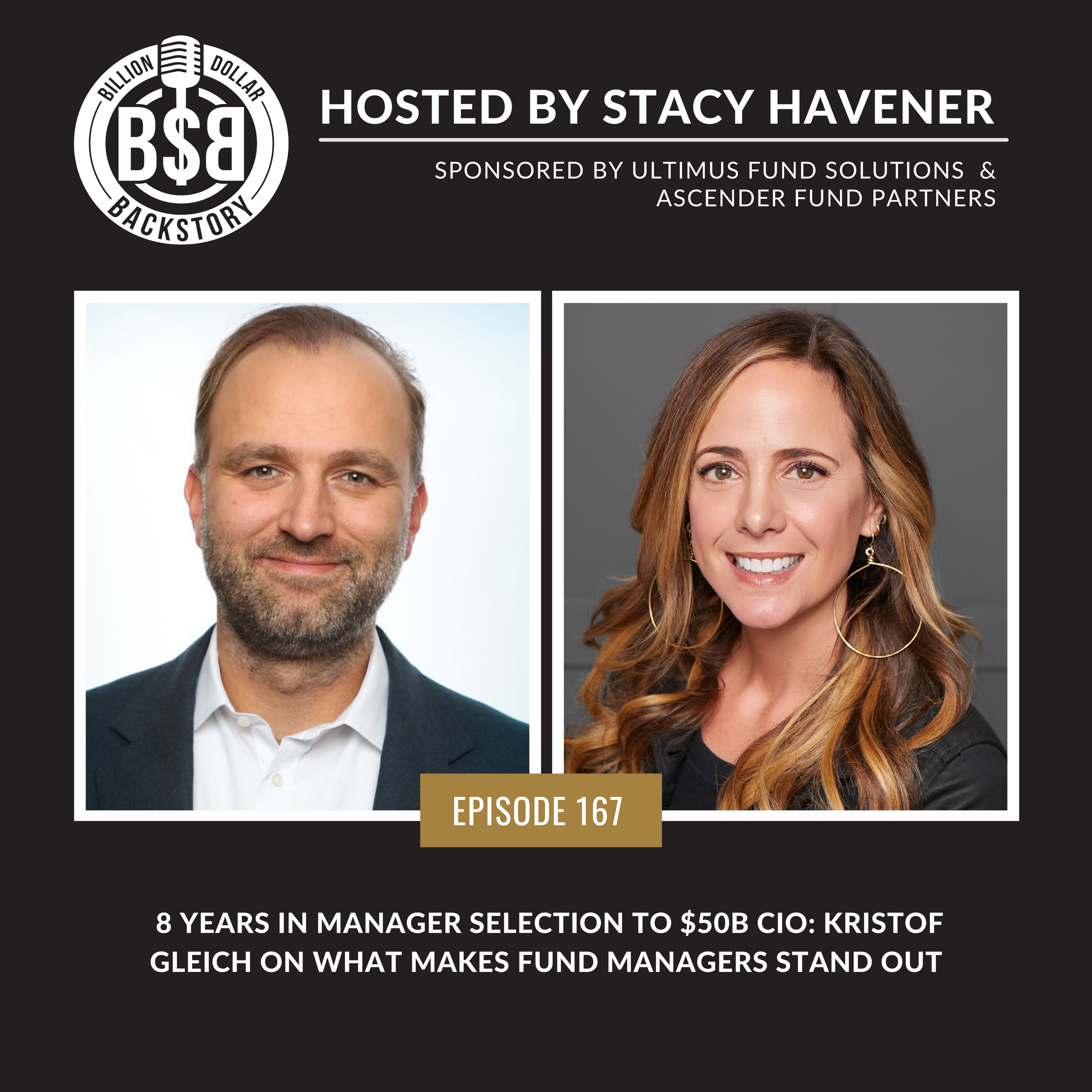
Allocators are drowning in manager emails.
Kristof Gleich would know.
Today, he’s President and CIO of $50B Harbor Capital. Before that, he spent eight years leading manager selection at JPMorgan, fielding pitches from managers trying to break through.
So, he's a good person to listen to when it comes to figuring out how to stand out and win over allocators.
In this Encore episode, Kristof and Stacy discuss:
Kristof’s path from physics to finance, how he went from studying physics to landing his first finance job at Goldman Sachs right after 9/11
What actually makes a fund manager stand out (hint: it’s not tweaking a model or slapping “contrarian” on your deck)
Why it pays to celebrate even the smallest wins as you grow your fund
Harbor Capital’s approach to backing emerging managers early (and why he believes more allocators should follow suit)
About Kristof Gleich:
Kristof Gleich joined Harbor in 2018 and was appointed CIO of Harbor Capital Advisors in 2020, with oversight of the firm’s investment, distribution, marketing, and executive functions. Before Harbor, he was a managing director and global head of manager selection at JPMorgan Chase. He holds a B.S. in Physics from the University of Bristol and is a CFA charterholder.
TRANSCRIPT
Below is an AI-generated transcript and therefore it may contain errors.
[00:00:00] You know that moment at a concert when the lights go down, but the crowd won't stop clapping until the band comes back out for one more song? That's what this is. Welcome to Billion Dollar Backstory Encore episodes. An encore only happens because people liked what they heard the first time around and they want more.
[00:00:21] So today, we're doing exactly that, bringing back one of our favorite conversations just for you. Sit back, grab your popcorn, and enjoy. When I think about my idealistic vision of the asset management landscape, it's very different than today. Today, it's a zero-sum game. The big fish win at all costs. They eat the little fish.
[00:00:46] In my vision, the big fish feed the little fish. Today's guest makes me believe that a healthy, vibrant ecosystem of generalists and specialists, [00:01:00] bigs and boutiques could be real. Meet Christophe Gleisch. He is the president and CIO of Harbor Capital Advisors, a $50 billion manager of boutique managers.
[00:01:16] Harbor specializes in boutiques, and they do it in a big way. While Christophe's current role is on the asset management side of the desk, he also spent over eight years on the allocator side as head of manager selection for a little shop you might know, J.P. Morgan. So today's convo is Christophe's backstory, it's advice from an allocator, and it's insights into a special future story that is ours to write.
[00:01:47] You are going to love this one. Meet my friend Christophe. Christophe, thank you so much for being in the studio with us today. This is a really cool episode. I mean, all the episodes are [00:02:00] cool, but what's super cool about having you here is that your journey touches on so many different parts and roles of our listeners, from allocator to boutique to manager of boutiques to all the things.
[00:02:17] Hey, my name is Stacy Havener. I'm obsessed with startups, stories, and sales. Storytelling has fueled my success as a female founder in the toughest boys' club, Wall Street. I've raised over 8 billion that has led to 30 billion in follow-on assets for investment boutiques, you could say against the odds.
[00:02:37] Yeah, understatement. I share stories of the people behind the portfolios while teaching you how to use story to shape outcomes. It's real talk here. Money, authenticity, growth, setbacks, sales and marketing are all topics we discuss. Think of this as the capital raising class you wish you had in college, [00:03:00] mixed with happy hour.
[00:03:02] Pull up a seat, grab your notebook, and get ready to be inspired and challenged while you learn. This is the Billion Dollar Backstory podcast.
[00:03:15] So thank you so much for joining us. Thanks for having me, Stacy. I hope I don't, I hope I don't disappoint. Okay, you won't. I mean, we haven't record, we haven't recorded it yet- No ... so hopefully it's gonna be a cool episode. Uh, I have so much faith in you. Okay. Okay, let's start with your backstory, my favorite part of the conversation.
[00:03:32] Mm-hmm. And I'm gonna give you sort of the, you know, this is a, a blank slate for you to talk about. What I'd love for you to touch on is, this is the hardest part by the way, some of the, the messy middle. Like on the journey, was there something along the way where, you know, it was tough, it was... It wasn't clear?
[00:03:56] Like sort of the messy parts of the story. Yeah, yeah. That's what I [00:04:00] want. All right. That's the good stuff. That's the popcorn. Okay, floor is yours, my friend. Okay. Wait, do you want me to go right back to the beginning? You can. Okay. Go right back. Like did you always know that you wanted to be sitting here in Chicago leading Harbor?
[00:04:15] Like was that your dream? Was that your vision? Def- definitely not. Okay, start there. All right. So I- I'll start with where I'm from. So I'm from the UK, born and raised, and I grew up in a... My family is originally from Poland, so my grandparents on both sides are Polish. Were Polish, sorry, they're no longer with us.
[00:04:40] And they had to flee Poland, um, during the w- the Second World War, and ended up as refugees in the UK. And so I was always kind of aware of being a little bit different in the UK. Mm-hmm. You know, sort of British born and, you know, born and bred, but very much like a different kind of background and a different culture and a [00:05:00] different heritage.
[00:05:01] So I guess that gave me sort of a, a slightly different beginning and a different sort of perspective and a different appreciation of certain things, which I still try and carry forward, uh, to today. Uh, what, where next? I studied physics at Bristol University. Um, so I guess I'm a little bit of a science geek.
[00:05:21] I never studied, I never studied finance. I never studied economics. Um, I, I wanted to kind of study what I found interesting, and I was always more like mathematically and scientifically kind of curious and inclined, AKA I was terrible at languages. So I studied physics, which I enjoyed, but I, I, I would've been a really bad physicist.
[00:05:48] And so as I- Why? ... kind of was... Because I wasn't smart enough. Like physic- like proper physicists are really smart. Okay. Fake physicists like me, n- you know, not, not so much. But [00:06:00] look, they taught me a lot of things. I, I, I did, I did enjoy it on the, on the whole. But then I suppose as I was going into my 20s, I had to think about what I wanted to do for a career, and I decided on finance.
[00:06:15] This is the early 2000s, and in... I was gonna go and move to London, and I joined... I was really lucky, looking back. I got a place on Goldman Sachs's graduate program. And I remember turning up, you know, bright eye, bushy tail, not really having the first clue about what I was about to get myself into. And, uh, but it was g- it was a great place to start, met a lot of smart people, learned a lot, and that was kind of what began my journey in the field of finance.
[00:06:46] So I love your honesty that you would've been a, a not so great physicist. But I... So I wanna pull that, not the not so great part forward. I wanna pull the physicist part forward- All right ... because my guess is that there's something from [00:07:00] that part of your journey that really informs this part. So I want you to keep going with the story, but I want you to have that thread in the back of your mind, 'cause I wanna talk about how that, how your training as a physicist actually shows up today.
[00:07:15] 'Cause I bet it does. Yeah, no, it, it, it definitely does, and it does in more ways than I guess I appreciated as a young, as a young man. Yeah. Right? And so, um, and then I'll get to the- Yeah ... some of the platform stuff as well in my, in my later 20s. So how does it present itself? So I'm very, like, curious. Like I, I like understanding how things work, why things are the way they are, and don't just take things at face value.
[00:07:43] Like understand from a first principles perspective how something might work. Now, that might be very different in physics from finance, but in finance and in my role allocating, you know, boot- looking for boutique managers, kind of understanding their, understanding their [00:08:00] backstory from a first principles perspective, why they think, why they believe the way that they do, why, why should something kind of like logically make sense?
[00:08:08] So sort of deconstructing problems. Mm. Um, intellectual curiosity- Mm-hmm ... as well is a big one, and I always talk to, you know, younger people about this. If, if there's one thing that I look for in anybody, okay, hard work aside, like that's kind of table stakes, but it's just that intellectual curiosity to, to click in, you know, go deeper and understand on another level and another level.
[00:08:34] And what I under- what I learned Through physics as well, is that our scientific understanding of the world is constantly changing and constantly evolving, and it's driven by the scientific process. But if you look at, like, the scientific model of the world 200 years ago versus today, like, it's totally different.
[00:08:55] Like, some of the stuff 200 years ago is still true, but a lot of it has been [00:09:00] developed upon further. So it's continuously changing, I suppose. And I think that is also happening in the world and in finance as well. And so I kind of never standing still, always looking to improve and, uh, you know, scientists were pretty in- an innovative and creative bunch as well.
[00:09:17] Yeah. So I... And I, I like sort of taking that and applying that in my own small way to finance. I love it. So go- So I did, I did, uh, Goldman Sachs, and I began my career right after 9/11, like about a week after 9/11. So that was a, a- obviously a shocking... And I wasn't in New York, I was in London. But just people are, I guess in a way, shaped by events- Yes
[00:09:42] that happen at the beginning of their career, and that was one that, uh, that tragedy s- you know, stood out, obviously stuck in my mind. But, uh, just for, for listeners, that's when I began, roughly began my career. And I changed jobs at Goldman after about [00:10:00] four, three years. I moved from the finance division into asset management.
[00:10:05] I hated finance. I've got many great colleagues here who I love, who work in finance. If any of them are listening, please don't take offense. But as bad a physicist I would've been, I would've been a worse accountant And so I found myself on this kind of track to accountancy at Goldman in the finance division, and I made a switch to asset management, and that's where I began my career as an investor, um, and began sort of selecting money managers for clients to invest in, institutional clients, private wealth clients, kind of all of the above.
[00:10:39] So that was kind of like a, a, a big break and a fork in the road- Mm-hmm ... um, that I kind of un- unwittingly or unknowingly sort of took this big fork in the road that I still, I guess, still kind of on today. Yeah. 'Cause that's where I began the sort of the craft of investing, and I love it, and I've been doing similar [00:11:00] things sort of since.
[00:11:01] And then so the little thing called the financial crisis happened in 2008, and I'd been at Goldman for about eight years. I thought I'd done pretty well. I'd got promoted. I got these titles. I think I was an executive director, and I'd always got good reviews. I was studying for my CFA, and I was always being told, like, "You know, what a great contributor you are."
[00:11:24] And then I came in one day, and I got fired. And- Oh, God. Yeah. And it's all right. I got... I can see you look shocked. I mean, yeah. No, I mean, I love that you're sharing this. Also because that would be, that would be such an... I mean, keep talking 'cause that's, that's rough to walk in and just realize this. Yeah.
[00:11:42] No, no, it wa- it, it, it, it was rough. And but look, the financial crisis happened- Yes ... and Gold- Right ... Goldman, Goldman Sachs, uh, you know, they're still going. They're still doing all right, I think. Yeah, they're okay. They, they've got, they've gotten over me, but- Yeah ... you know, hopefully they regret it or someone does.
[00:11:58] But so [00:12:00] they, they, um, you know, as happens in a thing like that, there's a big sort of cyclical pullback, cost-cutting, and- They, they decided to consolidate kind of what we did more in New York rather than London, which was kind of deemed as a satellite office. But it was definitely a painful lesson- Yeah ... to go through where you'd sort of been succeeding, you know, year after, or at least you thought you had.
[00:12:24] Yeah. And then to suddenly be told that you're, you don't have a job anymore, you're not allowed to come into work, and like your whole life and routine and everything is kind of disrupted. Yeah. Now, look, I acknowledge these are all first-world problems, but for me, that was a big shock. And, uh, you know, it taught me a f- a few things, and I, I suppose one of them was to like not be defined as a person only by what I do for work.
[00:12:48] Ah. Yeah. I wanna pause on that. Like, I really want people to let that sink in. Okay. Because that's huge. I gotta give credit to my wife. Okay, please do. No, no, she says that. I mean, [00:13:00] I'll give her credit. There you go, wifey- Yeah ... if you're listening. She, she says that as well. She's always like, you know, "Don't just be defined by who you are, you know, at work."
[00:13:07] And look, work's a big part of my life, and I love it. It's a big passion of mine, but there has to be sort of more beyond that, and that was, I, I suppose, a, a harsh lesson I learned during the financial crisis. So thank you for sharing that. No worries. And also, to that point about being defined by your work, I think it's true whether you're an employee or a founder, and I'm not even sure...
[00:13:34] Like, my gut says if you're a founder, perhaps you're, you have a propensity to be more defined by it because of all- Probably ... like, maybe, but, but I'm not sure. I'm not sure because as an employee, you're giving everything you have and so much loyalty to your employer that you... I could also see somebody make a case in the other direction.
[00:13:55] Either way, it's pretty shattering. Yeah. It's pretty shattering [00:14:00] to have that happen, and for anybody who's listening who's been fired or has left a job and felt defined by that role, maybe, like, what advice, like how did you bounce back from that? 'Cause now you're sitting here with this great job, so obviously, like, you're doing okay too.
[00:14:17] Goldman's doing fine, so are you. So how, how did you bounce back or how did you, like, steel yourself after that? So I guess j- as you were sort of talking, you made me think, like, what I didn't like about it the most was this notion of somebody else had control of my life. Mm. Like I wasn't- Yeah ... I wasn't the, my own, like, principal in my life.
[00:14:34] It was a bit of a agent sort of problem, I suppose. Yeah. And I, I never really thought about it until you just started talking. So that was, I, I guess, like, be, be in control of your own life as much as possible, and for me, I, I wasn't then, and that's, I, I suppose, what I didn't like about it. So I, I'm pragmatic- Mm-hmm
[00:14:53] as well as I, I think you Uh, my mother, I'll quote her, she had this saying, and [00:15:00] I- it's not original to her, but she's always-- she used to say to me if I was asking for something as a kid or whatever, she would say, "Kristoph, you know, beggars can't be choosers." Mm-hmm. And so I think I've translated that to there's preferences and constraints, and I always think in the world, every decision I make, like what are my constraints and what are my preferences?
[00:15:19] Understand your constraints first, and then focus on your preferences, and just be kind of matter of fact about that. So taking that framework, it was a financial crisis. I needed a job, and I got whatever job I could get as quickly as possible because I didn't want a long gap on my CV because long gaps on...
[00:15:37] Sorry, resume. Yeah. Long gaps on resumes don't look very good. And so I managed to, within a month or so, line up another job, which I'm very grateful for, and it was at a firm called Architas, which is part of AXA. Okay. And they were kind of like a, a boutique within AXA that does all of the manager research for their wealth- Oh
[00:15:57] and insurance stuff business. Okay. So [00:16:00] that was good, but it wasn't, it wasn't for me, and it was quite retail-y. It was quite 9:00 till 5:00, and it just, it was Very different from Goldman. And then so I, I hung out there for about 18 months, and it was quite helpful actually, 'cause during that 18-month period, I kind of met and then got married to my, like now wife and- Mm-hmm
[00:16:21] that never would've happened if I'd stayed at Goldman 'cause I'd have just been focused on, you know, working every single hour God sent. And so that was kind of a bit of a life lesson in that, that actually these good can come out of bad, right? So, you know, not to get too philosophical. And then having sworn I'd never go and work for another American bank ever again in my life-
[00:16:44] I join, I joined that little boutique firm called JP Morgan. Yeah. You know. Uh, and I worked- Startup. Startup vibes. Yeah. Yeah. That startup, yeah. So I joined... I worked at JP Morgan for about nine years I think it was. Initially in London, and then in New York, and that's how I got [00:17:00] over to the States. And JP Morgan was an awesome place.
[00:17:03] Is an awesome place. I love Jamie Dimon. I think he's one of, if not the best CEO in the world. And I, you know, I learned a lot there, and that was where I began to learn, get leadership opportunities and managing people and mentoring people, and that was something that I really enjoyed doing and apparently was okay at.
[00:17:23] And so I got promoted and did a, uh, move to New York and ran this big global team, uh, within wealth management where we were responsible for allocating, selecting, hiring, firing, you know, money managers from across the world on our platform. So that was pretty cool as well. Yeah. And so how many people were you managing there?
[00:17:45] Just, like was that a big team of- Yeah ... of researchers? Yeah. 65 people. Oh my gosh. That's- Yeah. It- Yeah. Yeah. Okay. So, so it was a big- That's big ... and it was glo- it was global, so it was, you know, North America, uh, LATAM, [00:18:00] EMEA, Asia, and, uh, yeah, it was cool. It was really good. And it-- we, you know, that being in that seat, everybody wants to meet with you.
[00:18:07] Oh, gosh. And I obviously thought, I obviously thought everyone wanted to meet with me 'cause I was charming, but- Of course ... it wasn't the case. No. It was everybody wanted to meet with me 'cause the, the name at the bottom of my business card, not the top. Uh, you know, JP Morgan, right? And, uh, but it was good.
[00:18:23] You got lots of exposure, and it was a, it was a great role and, you know, mana- managing a global team of, of different, you know, cast of characters. Um, yeah, it was great. It was great, and I've still got a lot of friends there. So how did you... Okay, keep going. Keep going. Like, I'm in. I've got the popcorn. Okay.
[00:18:40] So then- Okay. Yeah. All right. You're good. Right. So then JP Morgan, uh, so now I'm kind of 20 years into my career, and working for the, like Goldman or JP Morgan, like, it's really good, but it's really tough. Yeah. And, you know, going back to my s- I'd never like dreamed [00:19:00] growing up, dreaming of like I'm gonna work for these big, like American investment banks.
[00:19:05] And I think the be- easiest way to describe it is you, when you get to a certain level at those companies, you get two jobs. You get the job of managing the ecosystem of all of the internal stakeholders and how to navigate all of that, and then you have the job that you're actually hired to do. And it's just, it's really, it's really hard work.
[00:19:27] And I'm, look, I'm not- Yeah ... afraid of hard work, but I, I was getting away from what I loved doing. I was getting away from the markets, I was getting away from investing, and it was more about process management, um, regulatory compliance, risk management, people management, which I love. But at the end of the day, I wasn't as fulfilled at the end as I was, and I wanted a new challenge.
[00:19:52] And I'm not brave enough to be an entrepreneur. Um, but it's funny, circumstances [00:20:00] happen. This, this role, so I'm at Harbor Capital today. I'll quick bit- Mm-hmm ... on Harbor Capital. So we're an asset manager. We have just over... We have about 250 employees, which is, you know, a lot by sort- Mm-hmm ... of boutique standards.
[00:20:13] But J- JP Morgan had 255,000 employees, so- Yeah ... it's whatever- So relative ... I can't even. I, I- Yeah ... can't even do the math in my head. But- Yeah ... it, it's a small, it was a much smaller company, much more focused. And, uh, but it was a mutual fund company that needed to bring some outside talent or thinking or expertise in to, to help rethink the company, reshape the company, and put the company on a growth tr- uh, trajectory.
[00:20:42] Because what Harbor had was actively managed mutual funds and with a domestic orientation, and what the market didn't want was actively managed mutual funds with domestic orientation. And so it was a really g- a big challenge for me to leave the big comfort of [00:21:00] a, of a firm like JP Morgan, to leave the wealth management side and jump to the asset management side.
[00:21:06] Yeah. And now this was an industry that I'd had a lot of exposure to, you know, during the selecting managers, working with managers, launching products and, and so on and so forth, but I, I was just kind of excited about jumping to the other side of the table and, uh, becoming an asset manager. And so I've been here for six and a half years, and I live in Chicago, that's the background behind, uh, with my wife and three boys.
[00:21:32] So it's pretty cool. Wow. Love, love Chicago, love Harbor. So yeah, knock, knock on wood, pretty, pretty happy with, with life so far. It's so great. Thank you for sharing that. Thank you. Now, at the time... So qui- clarifying questions. Mm-hmm. When you joined Harbor, were they always sub-advised? Uh, yeah. So were they always sub-advised?
[00:21:50] Okay. Yeah, they were. So, so that's a key point that I want everyone listening to hear, because I already got permission from Christophe to have to go back [00:22:00] to his allocator days and get some advice and feedback and stories from there. But what I find interesting about your role is actually even though you hadn't been on the asset management side, in my opinion, your perspective is almost More valuable in some ways because you've been on the other side- Yeah
[00:22:22] and because you've been selecting managers. So we always talk about, you know, put yourself in the shoes of the people you serve. You were in those shoes. I was. I still kind of am in a way. Yeah. Yeah, yeah. And that's, so that's the other interesting point- In fact- ... you still kind of are Yeah. So talk more about that just in case people aren't familiar with Harbor.
[00:22:40] Just kind of talk about your business model a little bit. Okay, cool. So what we do, and quick, we, we used to be the pensions and investments department for the largest glass manufacturer in the world called Owens-Illinois or, um, OI Glass. Like, so if you, if you have one of those old school, um, Coca-Cola bottles, underneath it will say [00:23:00] OI.
[00:23:01] Oh, my gosh. That's OI Glass. That's it. So that's our, that's our origin story, and our-- We used to pick the managers for the defined benefit pension plan, and that's how we began investing in outside managers. Flash forward to 1986, as the industry went to, from defined benefit to defined contribution, we needed to launch mutual funds so the plan participants could allocate to those mutual funds in their 401.
[00:23:28] So we basically launched a bunch of mutual funds with third-party managers running them. So we kind of got into the sub-advisory business by accident. Yeah. Uh, but we had some great managers, and we grew and, you know, we can kind of g-go into that if, if, if you want. Mm-hmm. But that, that was our origin story.
[00:23:46] So what we do today is we, generally, we partner with boutique managers that we think have a secret sauce or a specialize- specialization, sorry, if I can speak, that they [00:24:00] can generate alpha, they can generate strong, you know, risk-adjusted returns. Um, and we hire those managers, not as an employee of Harbor, but to run a fund for us.
[00:24:11] Historically, it was mutual funds, but now it's really ETFs exclusively. And so we've made a big bet on active ETFs and the growth of active ETFs. And so then those managers, those boutique specialized managers, do the day-to-day security selection, and then we help distribute and grow, you know, invest with those managers.
[00:24:33] And we like to do it at the more boutique end of the market. 'Cause I, you know, we believe that if you want different outcomes from the market, if you wanna deliver active outcomes, you've gotta be- think differently. To think differently, you've gotta think independently, and you tend to get more of those behaviors happening in kind of independent boutique firms than big monolithic firms that try and do everything.
[00:24:58] Yeah. And so that's, [00:25:00] that's what we, we try and bet on the s- on the, I guess, the small guy or gal, uh, rather than the, the big one. Well, you know, that's music to my ears- I know ... and everyone listening. High five specialists. So I have to ask about the active ETF thing, 'cause that's- Yeah ... a big b- that's a big bet.
[00:25:16] Yeah. It is. So what was the r- so, like did you sunset the whole mutual fund business? No, no, no. So we've got, we've still got our mutual fund. You've still got it. Okay. Our mutual f- yeah, we've still got our mutual fund business. Because that's big business, yeah. It, it is, and it's still a c- still a big business for us, but I think it's important to be wherever you are, be somewhere tr- you've gotta strive for growth.
[00:25:37] Mm-hmm. You ha- you have to, like, you have to growth... Uh, sorry. You have to aim for growth, and that doesn't mean... Growth doesn't mean, like, just grow AUM 'cause you wanna earn more fees, and you're greedy, and you wanna earn more money or anything- Yeah ... like that. I mean, just having a growth mindset means looking forward to the future.
[00:25:54] It means trying to improve. It means just trying to get better every single day [00:26:00] is kind of a growth mindset. And if you do that well in business or an industry, that then manifests itself through, you know, growth, like economic growth, AUM growth, whatever, whatever it is. And so when I joined, we were a mutual fund company.
[00:26:16] We had some great managers. Mm. We had some great performance, but we weren't in the vehicle or the format that the consumer or investor wanted anymore. Mm. And so if we didn't change, we were, we were gonna be an ex-growth company, and I think if you acknowledge your destiny of becoming ex-growth- Yeah
[00:26:36] everything goes into a downward spiral. Like, you, you can't attract talent, you can't keep talent, and it just... So we had to sort of think about, how do we become a growth company again? And, you know, for us at the time, and still is today, active ETFs are gonna play a huge part of that. And I... Look, the analogy I'll give is just, you know, [00:27:00] we live in a world of, um, like in terms of entertainment streaming today.
[00:27:04] Mm-hmm. Yep. You know, if we were stuck in the old world, it's like selling DVDs. And the new world is streaming. And so for us, you know- So you don't wanna be Blockbuster. No, you don't. Apparently there's still one Blockbuster left. There's a, there's a Netflix documentary- Yeah ... on that, which is pretty good.
[00:27:23] But no, so the, the more serious point is if I think about- What is our content equivalent? Yeah It's the managers, it's the alpha, it's the performance, it's the outcomes that they can kind of drive. How clients want to consume that content, whether it's a separately managed account, a CIT, a mutual fund, an ETF.
[00:27:42] So we wanted to become sort of vehicle agnostic rather than just a mutual fund company. Uh, and that was a big moment, and, uh, that's actually, that bet's paid off pretty well so far. So we now, we now have more ETFs than we do mutual funds, despite the fact we've been in ETFs for just over three [00:28:00] years and we've been doing mutual funds for 40 years.
[00:28:04] Wait, you have more actual vehicles or more AUM or both? No, more vehicles. More vehicles. More vehicles- Yeah, yeah ... but not more AUM. No. What's the... And so the AUM is, the bulk of it is still in the funds? Yeah. So about- Yeah ... about, about 70% of our assets today are in kind of traditional single sub-advised mutual funds.
[00:28:23] Mm-hmm. And about 30% is in, uh, the newer stuff like ETFs that we, that we've been doing. Okay. So I have a question. This is obviously not a prepared question, so if you hate this, you can tell me you hate it and we don't have to talk about it. To that last point- Yeah ... so you have some peers who do something very similar with one big difference.
[00:28:44] Right. Stakes. Taking stakes- So let me- ... in managers? So taking stakes. So when, what you just said right there where you're like, "Oh, you know, if you've got this great manager and you don't- Mm-hmm ... wanna let the vehicle get in the way," do you ever take a stake in a [00:29:00] manager or is that just, like have you thought about that?
[00:29:02] Is that not the business model? I'm just curious 'cause you're so right, and by the way, I've lived this too. Yeah. So we, we... Look, we've done it. We have done it, but it's not- Okay ... it's not a core part of our business. Yeah. It's when you start to take stakes in managers and you begin to, I guess, veer away from the independence of those managers- Yeah
[00:29:28] it starts to complicate. Mm-hmm. So our, our model... And look, the, we, we have, uh, one very minority stake in one of our managers who's done well, and we've got a great relationship with them, but it's not something that we've leaned into. It's just, it's, it's difficult and it- It's a difficult business, yeah
[00:29:45] we've, we've found it, it- complicates more than it actually aligns. So- Oh, interesting ... you know, never, never say never, but it's not something that, uh, I would see us doing in the next year or two. Okay. So instead, so when [00:30:00] you're vetting these managers- Mm-hmm ... what are you real- I know, okay, we, we've established they're a boutique.
[00:30:06] Mm-hmm. We've established they have an, an edge or a specialty. Mm-hmm. What are you... Like, how are... What are you looking for? So you meet them, let's say they have that. Yeah, yeah, yeah. Right? They have that. Now what are you looking for? And I wanna talk more about the qualitative, less about the quantitative.
[00:30:21] Obviously, be good at your job, so there we go. Yeah. Table stakes. So like- Like generate alpha, but like what else are you looking for? So I'll tell you, I'll tell you what we're not looking for. Okay, that's fine too. Yes. We're not looking for an upside-down triangle with an investment universe at the top.
[00:30:38] And a, and a port- Me neither. And a port folio at the bottom. And, um, I do, I still do... Anyone that can get really enthusiastic about that, I'm sort of, a piece of my soul dies and leaves my body every time. So I... Look, we're looking for, um, original, like, thinkers. Okay. Um, we're looking for people that are [00:31:00] Mission-driven in, like, they're so kind of obsessed with what they're doing, and they have so much belief.
[00:31:05] They're sort of, they're betting their livelihood- Mm. Um, on it as well. And yeah, for, look, for us, there has to be something diff- very different and differentiated that's difficult to replicate- Mm-hmm ... that the likes of, you know, Vanguard or BlackRock or iShares can't just, you know, Vanguard or iShare- Yeah
[00:31:25] it away. And so that sort of, you know, the geeky term is alpha, right? When you think about returns, there are, you know, different premiums that exist, risk premiums, factor premiums, and then there's that thing called skill leftover or alpha. So we do really, we do look quantitatively at, you know, return streams, and we do really try and disaggregate what, where returns are coming from, what is skill-oriented, uh, versus what is just, you know, factors and things like that [00:32:00] repackaged, which you can just buy for next to nothing, you know, in a factory ETF.
[00:32:04] So philosophically, we do hold ourselves accountable to like, you know, looking a lot at the quant. And then once you see something that looks like it's alpha- Yeah ... you then, you're right. You have to spend an awful lot of time kind of qualitatively understanding, like, what's contributing to that edge that they have.
[00:32:27] And I generally, I think there's three sort of types of edge that people have. There's number one is, like, an interpretational or research edge, which is just where individuals or teams are just really good at, like, long-term research, and they're able to take, like, an elongated longer time horizon, and they're able to spot, you know, secular growth at a better rate than the market can.
[00:32:50] That's sort of your, like, a traditional sort of fundamental research. Then there's a sort of, I think really interesting at the moment, y- you can-- the second edge is sort of a data or [00:33:00] technology edge. Mm. Mm-hmm. You can get an informational advantage again, a legal one, by the way, because when Reg FD came in, in- Yeah
[00:33:08] 2000, you know, active management got, um, got much harder because it became fairer. And by the way, that was totally the right thing to do because if you think before Reg FD, active managers were probably just stealing alpha from- ... uninformed retail investors without, like, they were legally doing it. But if you think about the mental sort of construct, that's what was happening.
[00:33:31] And so- It became harder to generate alpha, but now with data and technology, you can, via mosaic theory, I think get a, an informational edge again, if you do it very, very well and you invest a lot of money into different data feeds and into technology systems that can kinda synthesize all of that data.
[00:33:55] So that's the second one, so we've got some of those as well. And then the third one is, um, [00:34:00] I, I would describe as like a process edge or process discipline, which doesn't sound like the most exciting, but sometimes investing's really difficult and really lonely. Like take being a value investor. Ah. If you wanna, if you wanna be a value investor, you better make sure you're really disciplined to your process, and that you hammer yourself to the mast, and you ignore the call of the growth sirens.
[00:34:26] And over the long run you can generate alpha. Uh, but if you start to deviate or give up on yourself, then it's all gonna erode. So I feel sorry for those PMs because it's a really lonely- I know, it is ... place to be. But tho- those, so those are the sort of three categories, and then it's trying to like unpick which, what, what are we looking at here, who's doing what.
[00:34:48] I'll give you just a couple of examples. So- Yeah ... I, I, we work with a firm out of London called BlueCove, and they do scientific or systematic fixed income investing. [00:35:00] And they run like three different funds for us, and they're still very much a boutique, but they began life- About probably six years ago now, and we-- I was very early when we met with them.
[00:35:11] I knew the founders from my previous life in, in London. Uh, but they had a vision that now was the right time to disrupt fixed income investing, and actually you can take a technology and data-oriented approach to fixed income that's very complementary to discretionary fixed income, and actually you can generate really strong high-quality returns by doing so.
[00:35:37] Uh, but nobody, nobody was doing it. And so it was sort of to try and understand like, well, why is nobody doing it? What's changed? Why can you do it now? And in that perspective, they had no, like, live track record. You had to sort of think about this from a, a first principles perspective, and then partnering and ultimately going through that underwriting process, and then being [00:36:00] there kind of day one more or less.
[00:36:01] Yeah. And then just seeing the field begin to establish itself, beginning to grow, get more attention, and most importantly, to see the returns and actually the sort of hypothesis that you had or we had begin to realize itself through really strong returns. I love it. That's sort of what gets m- gives me goosebumps about the job- Yes
[00:36:23] is when you, when you see something like that early, it's original, it's different, and then you execute upon it, you lean into that kind of unknowable future, 'cause that's what investing is, it's investing in the unknown, but sort of trying to discount it. And now we have this, you know, wonderful partner, and we have these s- um, ETFs that have a really strong track record with BlueCove, and it-- I just, I take a lot of gratification seeing them realize their vision and hopefully playing a small part in helping them do it.
[00:36:55] Yeah. I love that, and I, I very much vibe with that whole [00:37:00] riff that you had there. I have s- I have questions. Go on. So first, I love the three types of, of, of differentiators or edge. Mm-hmm. That was really cool. Mm-hmm. I also like what you said about BlueCove, which was like, there's a philosophical edge that shows up in the three that you just- Yeah
[00:37:20] outlined, because one of the things that's hard for managers sometimes to tap into is like, what do you believe that your peers don't believe either, right? Like there's-- your peers believe something to be true and you don't. Yeah. That is in and of itself a differentiator, and then that is going to express itself in some of, in some way of those three differentiators that you outlined, right?
[00:37:45] So I loved the philosophical piece that you said about BlueCove. Yeah. I-- look, I think the, the hardest- For any active manager, you have to be-- you have to get two things right. You have to be d- you have to think diff- you have to be different from everybody else. [00:38:00] Mm-hmm. And you have to be right. Yeah. And- No big deal.
[00:38:04] No big deal there. That's easy. But-- and not, obviously not all the time, but I think that's sort of another way of saying that your, your point, you've gotta... I don't find enough money managers, like internalize kind of what they're doing, the why, like what it really is, and they need to do a better job of tell that story, tell the narrative- Yeah
[00:38:26] um, in a, you know, in an authen-authentic way. I agree. Well, yes. That-- I mean, hello, that's my entire business. So yes to that. Let's be real. No one wakes up and says, "I can't wait to build some operational infrastructure today." You're here to manage money, to build something that lights you up, not chase down reports across 5 systems and 15 service providers.
[00:38:50] That's where Ultimus Fund Solutions comes in. They're your ops dream team, consolidating all your middle and back office chaos into one [00:39:00] clean, scalable setup. Registered funds, private funds, SMAs, all integrated. One team, one tech platform, one rock solid source of data. But here's the real differentiator: service.
[00:39:17] I know that fund in a box sounds convenient. It's also a box. Know what you can't put in a box? A human who picks up the phone when you call and need help, real life people who know your name and your fund, and they care about getting it right. Ultimus was built on people doing business with people. You get institutional strength combined with boutique level service without getting stuck in a phone tree of doom.
[00:39:45] If you're ready to simplify, scale, and start working with a team that feels like an extension of yours, check out billiondollarbackstory.com/ultimus. That's [00:40:00] U-L-T-I-M-U-S. You've got the investment strategy, the vision, the track record. Now it's time to upgrade the engine behind it all with Ultimus It's interesting 'cause now I'm, whatever, I'm just piling on.
[00:40:15] But- Mm-hmm ... because you could have somebody that says, "Oh, I'm a value investor, and my process is really different." Yeah. "And instead of the triangle, we use an octagon or something." Right? Right. And so it's like, that's not enough. So I think that's where it's like the difference also has to be big enough to matter.
[00:40:36] In other words, you can't just say like, "Everyone else looks at this one thing and I look at this one other small thing differently." It's not enough. Like, you gotta go all in on the different. You gotta be- Yeah, I agree ... high stakes different. And but you've gotta be able to like... Uh, one of our value managers who's- Yeah
[00:40:53] a great g- great guy, like he describes his portfolio as like the tree, right? Okay. And this is his portfolio, and he's [00:41:00] never run a quant screen in, in his life, and he never will. Does that mean I think quant screens are a bad idea? No, absolutely not. Right. We've got managers, they work really, really well. We have another value manager, quant screens is an integral to their process.
[00:41:11] There you go. So then this manager describes their portfolio as like this tree, and the roots is like this network, and the more that they kind of focus on the tree, the more the roots grow, and then the more the, the roots are taking them to other companies and other ideas- Yeah. Cool ... but actually all of their port- all of their idea generation comes from their portfolio holding companies, and just going deeper and deeper and deeper into their portfolio companies and learning more and more and more.
[00:41:38] And I think that's a really cool way of expressing it. I think it's so cool. And to me it's like, okay, that- I get that ... that makes a lot of sense to me. But that's not them saying, you know, "We don't focus on price to book." Yeah. Thank you. "We focus on price to cash flow." Like- Yeah. 'Cause it's not different enough, okay?
[00:41:53] Like it's- Yeah, exactly. Yeah. Exactly. But you have to be good as well. You have to then be able to generate return. Yeah, you have... So that's like, that's a given. You gotta be good or no one [00:42:00] cares. Um- All right. Now my other question about the Blue Cove story, I have two, is so it sounds like you were there day one.
[00:42:09] Mm-hmm. Early. Yeah. So tell me about that. Like, are you willing to, to partner with a manager? Uh, is there an asset level at which you're like, "Can't do it"? No. No. We, we, we'll partner... We, we know periodically we've spoken to managers that have before they've left- Yeah. Okay ... and they kind of, you know- That's fun, isn't it?
[00:42:27] sound, sound. I lo- I love that. So look- Me too ... for us, the earlier the better. Okay. Um, as long as there's no kind of like non-compete stuff that we get involved in, but for us, like the earlier the better. In my old role, um, I... And in the sort of gatekeeping community- Yeah ... at large, I think there's more of a tendency to wait for three years, which I think is a shame because I think if you see an idea or an opportunity and you believe in it and you have investment conviction and you underwrite it, you can make some really good returns by leaning in and taking a bit of career [00:43:00] risk.
[00:43:00] And one of the things that I think I did quite well at JP Morgan, uh, less at Goldman because I was younger, but I just as I sort of matured and became more confident as a person, is backing managers like earlier in their life cycle or realizing there was a, a marriage of what was happening at the macro level and what this manager was able to do, and putting those two things together and, you know, the, the sum of the whole...
[00:43:25] Sorry, the whole being greater than the sum of the parts. And so I would... I, I hope more people can do that because if you're always waiting for three years or 100 million or 500 million AUM, it just creates barriers to entry for young, not younger by age, but younger companies- Yes ... more entrepreneurial companies, and it gets in the way of the innovation process.
[00:43:49] Now, not all innovation is good, but I just think having a sort of a flexible mindset around that And so I always, I always tried to have that [00:44:00] as much as I could, even inside a big organization- Yeah, which is not easy ... like JP Morgan that had lots of- Yeah ... controls and risks. But, um, they, they were actually pretty good at that.
[00:44:10] And, and that's why I brought that forward. Then of course, at Harbor we don't... Was it, you know, necessity is the mother of all invention. Yeah. We, we are not a f- we cannot wait for, like, five years for a boutique manager to say, "Hey, you know, look at my..." We gotta get in earlier. And that's what I love about what we, what we do is we, we can lean in and we wanna find these boutiques early.
[00:44:32] Um, so yeah, that's what we do. Yeah. So, you know, I love that, and I agree with that. In fact, there's a, there's a podcast, I'll send you the link after and we'll put it in the show notes, but there's a podcast that I love. I've, I listen to it, like, at least once a year, this episode. And it's about tech- Rather than the whole podcast, which is just one, this specific episode- This, this one episode.
[00:44:55] I mean, it's a very, it's a very well-known podcast- Yeah ... so it's very good. But this one [00:45:00] episode I just keep coming back to because it's about a woman who's, who was basically trying to facilitate another Silicon Valley, but outside of the US. Yeah. And she riffs on this idea that a h- a healthy ecosystem, an in- healthy industry ecosystem, as the big firms get bigger- Yeah
[00:45:26] so think of, of as the big fish get bigger- Yeah ... they would actually feed the, the small fish. Mm-hmm. In an unhealthy ecosystem, the big fish just eat the big fish or want to kill the big fish. They just want them out. And e- every time I listen to this episode, and, and if you think about it, so one more point before I tie it to asset management.
[00:45:46] Mm-hmm. Every time I, when I listen to it, you think about, like, all the founders that have been successful in tech, all big generalization. They make all their money, and then what do they do with it? They invest it in the next generation of [00:46:00] founders who are doing the next cool things. And then guess what?
[00:46:02] They make a whole bunch more money, right? So they realize that this ecosystem is not only important, but- profitable, right? Absolutely. Then you take it to asset management and it's just everybody kill each other. Yeah, you're right. I mean, it's like, what are we doing? Where are the firms? Now, this is where I'm tying it to you.
[00:46:23] So it's very refreshing for me to hear that there are firms like Harbor- Yeah ... and at JP Morgan, even when you were there, maybe still, where it's like we're willing to take, you know, put capital at risk with a startup or an emerging manager or a boutique because that's actually what you need to have in a healthy ecosystem.
[00:46:46] Absolutely. Yeah, I, I couldn't agree more. And so that's, you know, that's why we, we'd like sponsoring and then partnering with managers. And then at the flip side as well, you know, our longest-standing manager that we've [00:47:00] worked with, we've wo- we've had an SMA with that manager for 52 years. Oh my gosh. Which- That's so cool
[00:47:05] yeah. Yeah. And so if you think about the, the wealth that that original account has created for the clients, uh, it's amazing. But, so sometimes, like, so we-- I guess the way I think of our business, sort of a portfolio of different partners and relationships- Yeah ... that we have. Some of them are very early stage and are growing, and some of them- Oh, I like that
[00:47:26] um, yeah, and some of them are much more mature. And it's, I guess, you know, in life it's good to have a sort of a balance across all of them to have that, a healthy ecosystem. So good. I wanna switch gears to the allocator, to the, to your allocator days. Yes. The glory days. The glory days, yeah. Yeah. Because I, I'm guessing this doesn't happen as much anymore, but one of the things I enjoy talking with my allocator friends about is just the emails and, like, all-- You, you alluded to this before, like, everyone wants to meet with you.
[00:47:57] Every fund house, every [00:48:00] asset management company wants to meet with you. When you're at JP Morgan, you're an allocator, you've got that title, you've got cash. Mm-hmm. And I wanna give some advice because the emails that you must have received, I mean, I've seen some of them, I've heard, I know 'cause I've had to edit them for clients.
[00:48:19] I mean, they're pretty bad. Yeah. They're pretty bad. They're pretty bad. So what advice do you have for a boutique who wants to meet with a Harbor or an allocator or JP Morgan, whomever it is? Like, how should they go about- doing that when you don't know them from All right, I'll give you an easy one. Okay.
[00:48:40] I get probably between, I get between- You still get them? No, no, so I get between 6 and 800 emails a day in my inbox. And how many ha- how many hand, like, delivered notes- Ooh ... do I get sent a day? Mm, may- maybe one a week, [00:49:00] maybe one every couple of weeks. So there's your answer. So good. Like, I, by the way, I don't read 6 to 800 emails a day.
[00:49:07] I have like my- Does any- no one can. You can't. No, they can't. Exactly. So you end up, like, creating these shortcuts and heuristics. So the chances are, like, I probably won't even read the email. Right. But if you wanted to, I guess, try and have something catchy in the title, in the, the subject title. Um, but just I think sort of go, go old school and traditional.
[00:49:28] Yeah. And it's much better to have a more targeted, like, oh, okay, I'm gonna, I'm gonna target these 10 people with a, a handwritten note for 10 people than try and send an email to 1,000 people. You'll have a much-- You'll have-- Not only will you have a better hit rate, you'll actually have more responses. And so I don't know.
[00:49:50] I don't know how scalable that is though. I love that. It's not for everybody, but for me per- Yeah, but does it need to be scalable? Yeah. I mean, here's the thing, like to your point, um, and I just did [00:50:00] a post on LinkedIn about this today. I think there's this misconception that in order to have a good or even great business, you need to have massive quantity of investors.
[00:50:11] No, you don't. You need to- You don't ... you need to find a few fans to start with. That's right. And then you need to build around them. But hey, look, it's hard, right? It's easy to say just find a few, but like, okay, well how- Right. Everyone's like- Do you start with a lot- Yeah ... and then hope? But yeah, you're right.
[00:50:26] You just, there's no, there's no such thing as like too small or no, no small win is small enough not to celebrate when you're at the beginning of a journey. You know, whether it's a $50,000 investment from somebody into a fund or you just- Oh ... you gotta, you gotta ring the bell, celebrate everything, and then you start to, you know, get some more positive momentum and things build on themselves a little bit more.
[00:50:51] So I'd say e- for m- for me, emails are not a great way of doing it. So I, I love investors that [00:51:00] take the time to write. I wish I did this more myself, but take the time to write down what they're thinking- Mm ... and commit and memorialize that and save it on their website, you know? So I can go and say, "What were they doing in Q3 2017?"
[00:51:17] Yeah. "Oh, I'm gonna go and have a look." It just, it creates such a treasure trove of history so that when five years later or seven years later you are talking to someone, that quarterly investment letter that you wrote seven years ago that you thought no one read, well, maybe no one did read it, but that one person might now be reading it, and it's helping them You know, connect the dots and build conviction.
[00:51:41] And I just-- So I th- I think those are really good. They don't have to be, you know, 10 pages long. You know, but just two t- two pages, something like that. Just- Yeah ... memorializing what you're thinking and why. I think, I think those are... Don't think they're used enough. But I always read people, you know, Howard Marks, he's such a good writer.
[00:51:58] Um- Oh, so good. [00:52:00] You know- Yeah ... we had a client once. They, it was a hedge fund, which of course, you know, they never, they don't share anything with anyone. It's so secretive. But this particular, this particular founder did write these letters. And so when they were spinning up a new fund that I was helping them with, somehow I caught a glimpse of, of something and I'm like, "What's, what's this?"
[00:52:18] And I'd get this sort of workbook-looking thing And it was exactly what you said. It was actually a, a collection of letters from various sort of inflection points in the market over the years- Yeah ... that they had pulled together and put into this, like, workbook, like just sort of- Yeah ... not a fancy hardcover book, just this thing.
[00:52:38] And I said, "Give me all of those. How many of those do you have?" They're like, "You want these? These are, like, in the founder's garage." I said, "Get them. Get them all and give them to me." Because I'm like, "This is gold." That, that's a, that's a good, um... That's a really good idea, and I... You made me think. So even if I think they've got...
[00:52:56] Even if you've got notebooks in your garage, like- Yeah ... and you've got, like, notebooks about a [00:53:00] company meeting that you did before a company became known, and you had, like, just something jotted down, like a thought or whatever it was, like, take a photo of it. Totally. Photocopy it. Stick it up, like, in a library.
[00:53:12] I remember, um, who's the Fidelity guy that runs the Contra Fund? Will- Oh, um, I know who you mean. Yes. Will Downing or something like- Yes ... I, we, maybe we can correct this in the notes. Yeah. I... He showed me his notebook when I was in Boston, and the notebook he showed me, pulled it out of his desk drawer, was from, like, the li- the late '80s, and it was- Yeah, so cool
[00:53:35] his first meeting with Starbucks. Oh, how cool is that? And it was what he... And it had in his hand, like, what he had written about Starbucks. And I was like, "Holy shit." Sorry, to use my language. Yeah, that's okay. I was like, that, that's really, um... Yeah, left a deep impression on me, so it made me... Anyway. Yeah. I, it's- Good idea, is what I'm saying.
[00:53:52] No, it's, it's true. Well, you... It was your idea, and I think, I think the point is, for people listening, do the [00:54:00] things that don't scale. Yeah. Do the things that don't scale. Who cares? Yeah. Just do them. You don't actually need scale as much as you think you do to have a really great business. Yeah. That's well said.
[00:54:09] Yeah. All right. I wanna switch gears. I have some questions for you to help us get to know you a little better, though you've been very candid and I've loved, I've loved this conversation. I could talk to you forever. Great. I wanna do one more question- All right ... and I'm trying to think what it should be.
[00:54:26] I feel like it should still be a little bit... Well, I mean, you're still kind of in the allocator seat. Mm-hmm. But I think one of the things that's h- difficult for people, and maybe I'll ask you to share, um, how you've squared this on your journey- Mm-hmm ... because you've worked at very big places, is, um, it is the idea that we have to be a certain thing or person, like fit a mold.
[00:54:51] Wear the Patagonia vest, get the, you know, get the right suit. I don't know, right? There's like the... And say the right, say the things, [00:55:00] throw out the NPT stats in the meeting, and follow this is what you do, this is how you're successful. And I w- I would love to hear how you've- thought about that, evolved on that in your career?
[00:55:12] 'Cause I think it's something that's really difficult for people in our industry to do. Yeah. I, I don't know, I don't know, I don't know what, uh, what, what to say. Uh, so look, I, I've got three kids. Thr- you know, my eldest is 12, my twins are 8, and, you know, you sort of see living through them at school, like, there's this painful sort of, um, desire to conform and not- Mm
[00:55:40] be different. Mm-hmm. Right? It start, it starts at school, and I think it probably starts because if you're different, you get teased or you get bullied. And so just in our DNA, it's kind of like a, a survival gene- Yes ... is you learn this kind of you've got to conform to normality. And then I think you kind of carry that [00:56:00] forward into your adult years as well.
[00:56:02] And then what people don't realize is it's the actually the differences that you have that stand you apart in life. And I don't know when, I don't know when that crossover happens. For me, it was definitely in my 30s, not my 20s. Mm-hmm. I think my 20s... I think in your 20s, you sort of, you probably have to conform a little bit.
[00:56:20] Yeah. I agree with you. Because you can't just sort of- ... turn up day one at work and be like, you know. Oh, okay. Uh, you know what I mean? It would just be, be like, "Who is this person?" Like, "What are they doing?" So, so there is, so there's this sort of a, a, a balance between conforming and confidence and maturity that you can grow into yourself, and then the more that you kind of grow into yourself, the more comfortable you can be.
[00:56:48] And then you get to a point, I think, that suddenly the more comfortable you are, the better you are, and the more people respect you. And so I don't know if that's in any way helpful, but for me, that began to happen, [00:57:00] like, in my mid-30s probably. Yeah. And probably coincided, you know, things like marriage and kids, and just- Yeah
[00:57:06] you've suddenly got experience in your career, and you just get a bit more confidence. But what I would say to my children now is, like, don't s- well, not that they'd listen to me. I should say the opposite. But it's like don't sweat the differences. In fact, like lean into them. Yeah. And it's those idiosyncrasies that you have that's gonna like...
[00:57:24] You're gonna be so grateful for them when you're older. And my m- I remember my mum used to say it to me as well growing up. I'd always be like, "Shut up, Mum. Whatever." Yeah. "You don't know what you're talking about." Of course. But actually she was right. Is right. So yeah, and I, uh, it's hard to pin down exactly what it is.
[00:57:41] You know, it's if- It's un- like, life can be a bit unfair, right? If you were in an investment meeting, let's say like, let's say we'll go to Blackstone, the big- Mm-hmm ... like I was just watching Jonathan Gray, who I li- I think is brilliant as well, his, the quarterly update. Imagine if you're in a, a Blackstone investment meeting and [00:58:00] you're a 21-year-old analyst, and then you've got Jonathan Gray sat at the end of the table.
[00:58:05] Should the 21-year-old analyst can say exactly the words with exactly the tone of Jonathan Gray, and it's not, not only will it not land in the same way, it could have completely the counter effect of like- Ah, yes ... who do you think you are? So I think there's, there's a point in life where you sort of start to make that crossover.
[00:58:23] But I don't know, what do you think? That was great. I don't, I don't know either, but I, I, I agree with everything you said, so I'm gonna keep going with it- Okay ... because I, I agree. And I, I did really... Like, I look back at decisions and things I did in my 20s and I'm like, "Oh, I, I can't believe I, I did that."
[00:58:41] Yeah. Like, like they said, "Don't wear your hair..." I wore my hair in a low ponytail. Yeah. I didn't wear makeup. I bought suit jackets from Brooks Brothers in the boys section so that I could look a certain... And like, I would never do that now, and that like hurts my soul to think about now. But I, I think I [00:59:00] had to do it then because I was 21 and, you know.
[00:59:04] Um, I'll tell you what, actually, what, there's somebody, the, the head of asset management, uh, at JP Morgan, um, person called Mary Erdoes, who's still there, super senior. She once said something, and I think she must have said it in a group setting, but she said like, "Dress for the job that you want, not the one that you have."
[00:59:22] Mm. Which I kind of thought in a corporate kind of way was quite a cool bit of advice. Yeah. And it was in, and I took it sort of as partly as literally but partly as a metaphor as well of like just generally the way that you kind of- Yeah ... carry yourself. And so when I heard her say that, I did actually invest money into like having a good suit and making sure that you- That's, that's a good thing
[00:59:42] and I think that's a good thing to do. Yeah. And I made my... I'm not wearing a suit now, but if I was, there would be a pocket square. Oh, I like that. And so that became like, like- Like a little- I don't love wearing ties, but I love like- Yeah ... I hate wearing a suit without a pocket square. And I don't know. So, but then- That's good.
[00:59:57] That's a good little personal branding [01:00:00] thing. Yeah. Yeah. I like that. But, uh, now let's, I have one more thought on this that I'm curious to see how this sits for you. So I agree. Then you hit this point. For me, it was, I had my daughter when I was 40. So when I turned 40- Mm-hmm ... I was like, "Oh, I can do anything, and I, and I shall."
[01:00:16] So like I had this very like very confident, lot of strength, um, after that experience. And- I think there's a little bit of if you've done all the things that we've just described, you fit in, you've, you've dressed the part, you've done the things, and then you don't switch, like you don't lean in at some point in your 30s, 40s, you don't start to own the, your differences, that to me is a red f- like, not a red flag, but that's like, that's, that's a sadness for me.
[01:00:53] Yeah, I agree with that. Just, right? Like, because- No, I would, yeah ... now you're in a place, you've, you've done the things, you're, you've, you've [01:01:00] had the experiences and the success. You can be who you are, and you're still acting like you're the 20-year-old at the table with the CEO- Yeah ... and you're afraid to say something.
[01:01:08] Yeah. I, I totally agree with that. And look, I think one of the, one of the things at Harbour is we try and, we want everybody to be the most, like, authentic and genuine version of themselves. Yeah. Um, and I think if, if you are, the more comfortable that you can feel with being who you are, the more value that you can bring, and the more productive, and just the better you're gonna be, the happier you're gonna be.
[01:01:29] So we do definitely spend, um... I think about that a lot. But I think- Yeah ... you're absolutely right. I just think, like, it's the perfect word, it's sad if you can't- Yeah ... yeah. Like, at some point you gotta, you gotta be brave enough to, to... You've d- you've earned it. Yeah, exactly. You've put in the time. Okay, so let's end with a couple questions.
[01:01:48] I, I mean, if you haven't prepped, this is gonna be great, actually. So I'm gonna start with one that it could be easy or it could be really not easy. But what is not your favorite book? But [01:02:00] what book inspires you? What's a book that inspires you? So you know what? I, I need to look... I did have a quick look at these questions- Good, I'm glad-
[01:02:07] before podcast- ... 'cause this- ... 'cause otherwise I- ... this will be tough. Yeah Yeah. Well, otherwise I don't wanna be caught on the spot. So I will tell you, I'll give you a slightly different answer. Yeah. I'm gonna give you an author. Yes. And, and look, this nothing business related, like Ro- That's perfect ... Ro- Roald Dahl.
[01:02:22] Oh. And he... Oh my God, the amount of amazing books that he has written for, you know, Charlie and the Chocolate Factory, Ma- Matilda- Ah ... Fantastic Mr. Fox, The Twits. I lo- That doesn't get enough. I love The Twits. It's one of my favorite book. But I r- I'm reading them to my, my boys second time around, uh, with the twins at the moment.
[01:02:42] And I just think there's, I don't know, just like good storytelling. It's just, it's magic. It is magic. It's the closest thing to magic that we can get, and how many amazing books and amazing stories, and the gift that he's gonna give for generate for hundreds and [01:03:00] hundreds of years. Ah. They're amazing. So there's, there's my- I love that a- I...
[01:03:05] So I, s- sidebar, tangent. I went to see Matilda when we were in London last. Oh, yeah? And I mean, well, first of all, I love that story. Yeah. And to see it live and the songs- Yeah ... and just the emotion of it. I said to my family after, I, "If I lived here, I would literally go see Matilda every week." Like, I love it that much.
[01:03:27] I know all the songs. Like, it's just so... I very much am a plus one on that. Okay. Good. We're switching from books to places. Yeah. What place inspires you? What's your happy place? All right. So the place that inspires me probably, you probably haven't heard of this place. It's a place called Selhurst Park.
[01:03:47] Okay. And it's the h- it's the home of Crystal Palace Football Club. And I'm, I'm a massive soccer fan. Okay. And I- There is nowhere else on [01:04:00] Earth that, like physical place that gets me as excited, gets the emotions running as highly. It just makes me feel alive in a different way that I can't anywhere else in the world.
[01:04:13] So I know it might be like, oh my God, a sports stadium, but yeah, I used to go there with my dad all- I get it. I used to go there with my dad- Aw ... all the time. I took my boys just so I went back for Christmas, um, to a game, and my dad was there as well, so the whole multi... Just it's an electric- Ah ... place and, and an evening game.
[01:04:32] Uh, it just, yeah, it's, it's amazing. But my, my happy place is Hampton Bays in Long Island. Oh, okay. Uh, so yeah. So not too, not too far, not too far from you. We spend a bit of time out there every summer, and it's just, it's super chilled and, um, just get to relax with, with my family and go fishing and go to the beach- I love that
[01:04:51] and things like that, and I love it. So that's, that's the one that inspired me in my- Those are
[01:04:57] two fantastic- Yeah ... fantastic answers. [01:05:00] And obviously being a soccer player, I absolutely get the electricity of a stadium, although I've never seen a game- Oh my God, you have to go ... outside of the US. Oh, yeah. No, I think I saw one in Italy, but that's it. I've never seen one in the UK. Yeah, Italy's pretty, Italy's pretty good.
[01:05:15] Yeah. But there's something about the Premier League- Yeah ... which is growing now in popularity. It's amazing what's happened in the last 10 years with the popularity. We've got the World Cup coming next year, which I'm really excited about. But yeah, there's something just electric about those moments in soccer, which I just don't think are rivaled in any other sport.
[01:05:35] Yeah. Sorry. But I- Sorry. Sorry. But But I'm, I'm with you, so that's okay. Yeah. All right. Well, staying with the stadium theme, let's pretend you're at the stadium, you're giving a talk. Mm-hmm. You're about to take the stage. What song do they play? What's your, what's your walkout anthem? What song hypes you up?
[01:05:56] Well, I don't know if it's a hype. Uh, it's a song. So Ma- [01:06:00] okay, "Masterplan" by Oasis. Okay. Okay. It's one of my, one of my favorite songs. I guess it's a less of a hype up song, but I love it because I love Oasis. Yep. And it's 2025, and they're back together. Oh. And I think- I didn't know that. Yeah, they did. They got...
[01:06:17] They announced they got back together in, so... And they're gonna be touring this year. I'm actually gonna go and see them twice, once in Manchester, which is their hometown, and then they're coming through Chicago, so I'm taking my, my wife- Oh my gosh ... and my boy. Yeah, so... And I like "Masterplan" because it, it was originally a B-side song.
[01:06:33] It wasn't deemed to be, like, good enough for the- Mm-hmm ... for the, for the main album. Um, and actually it's become, with the passage of time, one of their best, most famous songs, and it's, uh, it's a song about, um, embracing the vagaries and uncertainties of life as well. Oh. So it's, it's good. So good. I'm gonna play that when we hang up.
[01:06:51] Yeah. It's a good, yeah, it's a good one, "Masterplan." I, I'm, I'm here for that. Um- But it's not high energy. You'll probably be like, "Eh, really, this one?" But I love it. That's okay. Look, I... So [01:07:00] here's my... I, I've done enough of these podcasts now. I think people choose their walkout anthem one of two ways, typically.
[01:07:07] O- the first way is, like, the beat and the, and the fact that, like, their energy goes up when the song is on, right? Like a more physicality- Yeah ... sort of thing to it. But then there's another group that picks the song for more, like, nostalgic or lyrical reasons. Yeah. And so it sounds like you're in the la- in the latter camp.
[01:07:26] Yeah. Yeah. Absolutely. Okay. Which I think is... I, I love it. All right, now, what profession other than your own would you like to attempt? I thought about becoming a doctor once, and sort of even applied for medical school. But I went into finance. But I suppose, look, if it was a dream, like sports management.
[01:07:46] Yeah. Like going in, like so, you know, I'd, I'd love to, I'd love to do that. You know, it's a lot of the same... I think a lot of why athletes win, why sports teams win, there's a lot of parallels between finance as well, [01:08:00] and s- or at least I see them that way. Mm-hmm. And so, yeah, it would be, it would be great to, to have a go at that one day.
[01:08:06] Some Moneyball vibes. Yeah, de- oh, definitely. Yeah. Def- yeah, definitely. Yeah, right? Definitely. Okay. That's a great, that's a great book as well, actually. Money- Isn't that such a great book? I, I, yeah, really good one. It was... The Brad Pitt movie was just out not too long ago, and I was like, "God, this movie's so good.
[01:08:18] I've forgotten how g-..." This is just a great- Yeah, the movie's good as well. I'm glad I read the book first though, as always. Yes, I agree. Yeah. He's a fantastic writer. Okay, flip side, what profession would you not like to do? A social media influencer. And look, I try, I see you're on LinkedIn, I'm on LinkedIn, and I, like, I get it.
[01:08:41] I mostly enjoy it. But to have my whole- Oh ... domain predicated on being famous for being famous, oh, I just- Oh, no. There's a lot of... I don't know if you've read this book. There's a lot of fourth turning in that. Oh, that's a good one as well. Uh, yeah. The fourth. Yeah. So he just released another version of that, The Fourth Turning.
[01:08:59] [01:09:00] Yeah. Yeah. But yeah. I mean, there's a lot of turnings wrapped up in that, but yeah, that- That's a good book. That's, that's another... Two good books, actually. Cult classic, right? Yeah. So, and, but yeah, so being, being, being an, a fin- uh, an influencer. Look, I'm not on TikTok, I'm not on Twitter, I'm not on Instagram, I'm on LinkedIn.
[01:09:20] Yeah. But, but they told me- That's my platform of choice ... if they count me at work I have to be. Well, you, it's a good place to be. Yeah. Um, okay, last question, and this is hopefully not anytime soon, but what do you want people to say about you after you've retired or left the industry? I mean, that I was a good guy, that people, you know, I, I, A, I'd like people to r- I hope I deliver value for clients, right?
[01:09:45] At the end of the day- Mm-hmm ... that's what we're here for. And I hope there would be a recognition that, you know what? The industry was better with this person in it rather than without them. And I would like, I would like people to sort of remember me as [01:10:00] a good mentor as well. I've always, I've always enjoyed that.
[01:10:03] Good people person. Uh, I always try and be decent and kind to people. A good sense of humor. Like, I li- I, if I don't laugh multiple times a day at work, it's not a good day. Mm. But I try, I try and inject... I know we're in a serious profession, but I just try and inject humor into the day-to-day of what we do.
[01:10:23] And at the same time, not afraid to make tough decisions, uh, which are hard. I don't like doing them, but to be successful, I think sort of, I don't know, some, some version of all of the above. Yeah. But if people just said he was all right, I'd be okay. He's a good guy. Yeah. Yeah. Oh, him? Yeah, he was great. I'll, I'll be, I'll be watching that.
[01:10:40] Listen, I- they're gonna say all of that, and I think they'd add that you are a real champion of boutiques, and there's not that many of us left. So I am really grateful for the time with you. Really grateful for the time. Thank you. Thank you for being here. That... You're a very good interviewer. That was- Oh
[01:10:58] that was a lot, that was, uh, that was a lot of [01:11:00] fun. Oh, I'm so glad to hear that. Thank you. That means the world to me. And if people wanna connect with you, obviously I know where they should go. Not TikTok, not Twitter, not... Maybe LinkedIn. Okay. Maybe LinkedIn. Yeah. Uh- Or, or send you, or send you a handwritten- Floor, floor, 34th floor Yes.
[01:11:15] 111 South
[01:11:19] Wacker, Chicago. There you go. 60606- ... is the ZIP Code. And, uh, LinkedIn as well, or Chri- christoph.gleisch@harbormcapital.com. Okay. Thank you so much,
[01:11:33] Christoph. All right. Thank you. This podcast is for informational purposes only and should not be relied upon as a basis for investment decisions. The information is not an offer, solicitation, or recommendation of any of the funds, services, or products, or to adopt any investment strategy. Investment values may fluctuate, and past performance is not a guide to future performance.
[01:11:54] All opinions expressed by guests on the show are solely their own opinion and do not necessarily reflect those at [01:12:00] their firm. Managers' appearance on the show does not constitute an endorsement by Stacy Havener or Havener Capital Partners.
Resources