
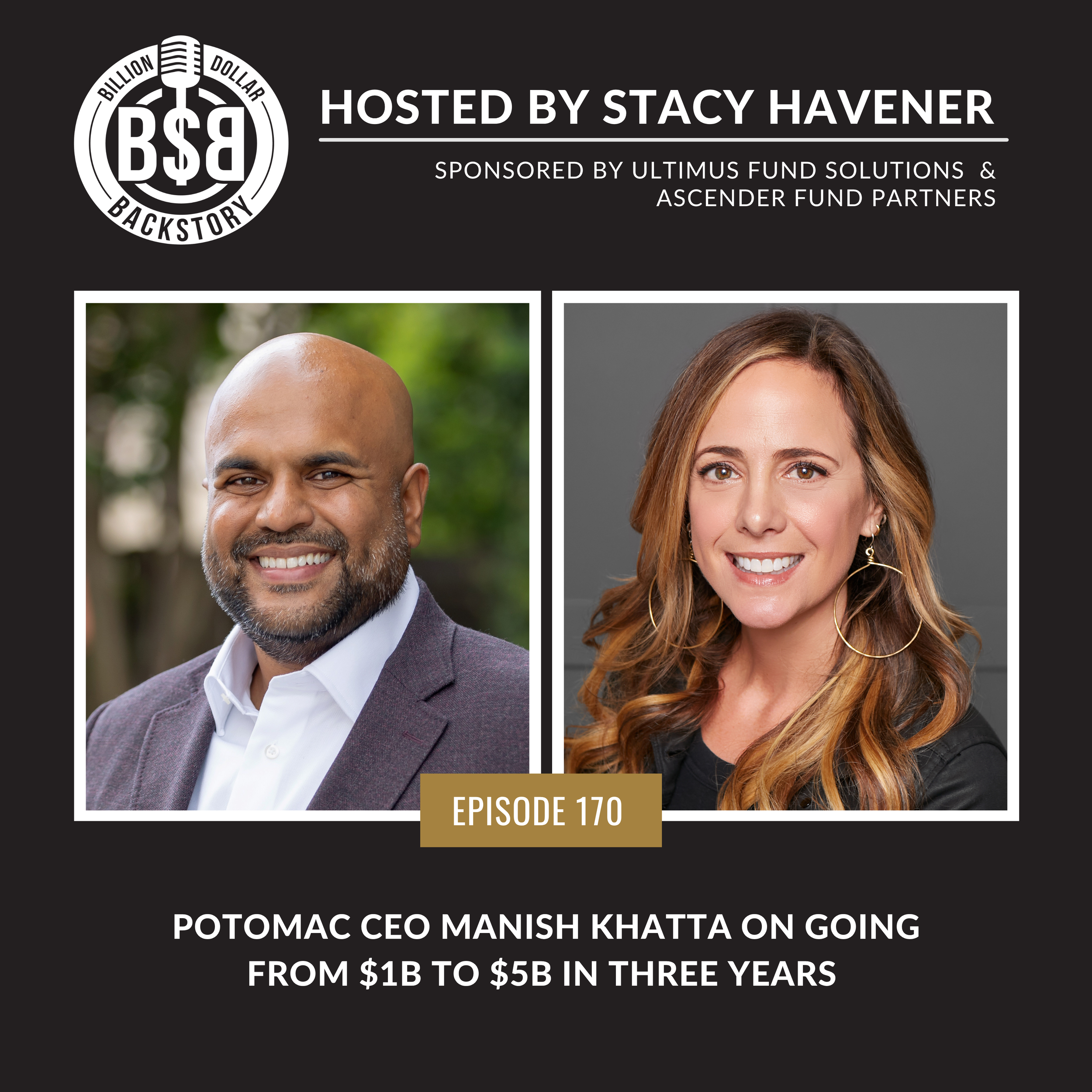
Episode 170: Potomac CEO Manish Khatta on Going From $1B to $5B in Three Years | Why Scaling the Team Is Harder Than Scaling the Assets | What Most Fund Managers Get Wrong About Marketing
Subscribe to Billion Dollar Backstory on Apple Podcasts, Google Podcasts, Spotify, or wherever you listen to podcasts.
"The key to business is biting off more than you can chew, then figuring out how to chew it."
Manish Khatta has been running that play for a while now.
Last time he was on the pod, back in 2023, Potomac had just crossed $1B and he was pretty sure they were only getting started.
Three years later? They're past $5B.
And the lessons got a whole lot bigger with it.
Manish is back for a next-chapter conversation about what happens after the growth starts working. When the revenue finally catches up. When hiring gets harder than raising assets. And when the job starts asking you to stop being the operator and actually become the CEO.
In this episode, Manish and Stacy get into:
Why hiring and stepping into the CEO mindset is infinitely harder than raising assets
The question Manish asks advisors who say they “can’t grow”
How firms can actually build relationships and land meetings on social media
His new marketing strategy (and why he doesn’t believe in chasing concrete ROI)
Why caring what other people think is the biggest roadblock to creating good content
A pretty wild 2027 announcement Potomac gets to share for the first time
About Manish Khatta:
Manish Khatta is a quant who has spent his entire career creating and refining technical trading strategies. A lifelong Potomac employee since 2002, he programmed the initial work behind Potomac's mechanical trading systems and now runs the firm as CEO and CIO, where he's known for driving innovation across investments, technology, and brand growth.He's also a father of four and spends his free time playing tennis and being on the water.
Mentioned in This Episode:
TRANSCRIPT
Below is an AI-generated transcript and therefore it may contain errors.
[00:00:00] Stacy Havener: Today's guest needs no introduction. You've probably seen his content. You've probably heard him speak. He's edgy and brave and crushing it. And today, he's sharing his insights and lessons learned with us. Manish Katta, CEO of Potomac, is back for a next chapter episode. Three years ago, Manish joined this podcast just after crossing a billion dollars in assets.
[00:00:26] Today, the firm has raced past 5 billion. The income has finally caught up with the growth, and the lessons are as real as the people living them. We talk about what most advisors and asset managers get wrong about marketing. We talk about the importance of speed and the challenges in hiring. Manish also makes an announcement on the pod about a new initiative in 2027 and the importance of events in real [00:01:00] life.
[00:01:01] Sometimes I ask myself, "What would Manish do on my own entrepreneurial journey?" I think it through, and then I usually walk it back about a few hundred yards, but I am always better for that exercise, and I am always better for my time spent with my friend Manish. He's a gift, and I hope you enjoy this episode.
[00:01:25] Without further ado, here's Manish. Hey, my name is Stacy Havener. I'm obsessed with startups, stories, and sales. Storytelling has fueled my success as a female founder in the toughest boys' club, Wall Street. I've raised over 8 billion that has led to 30 billion in follow-on assets for investment boutiques.
[00:01:48] You could say against the odds. Yeah, understatement. I share stories of the people behind the portfolios while teaching you how to use story to shape [00:02:00] outcomes. It's real talk here. Money, authenticity, growth, setbacks, sales, and marketing are all topics we discuss. Think of this as the capital-raising class you wish you had in college, mixed with happy hour.
[00:02:15] Pull up a seat, grab your notebook, and get ready to be inspired and challenged while you learn. This is the Billion Dollar Backstory Podcast.
[00:02:30] So listen, it's awesome to have you in my studio as I'm flashing back to when I was in your studio, which I commandeered.
[00:02:36] Manish Khatta: Yeah. I'll do
[00:02:37] Stacy Havener: the same. So all the, all the studios are apparently my studio. And I actually couldn't believe that the last time we talked was 2023. Although when I see the videos, I believe it 'cause we look like children.
[00:02:52] Manish Khatta: And I was at home-
[00:02:53] Stacy Havener: Yeah ... in my home office. And my hair was really dark.
[00:02:56] Manish Khatta: Yeah.
[00:02:56] Stacy Havener: And you had a hat on.
[00:02:58] Manish Khatta: Yeah.
[00:02:59] Stacy Havener: So lots [00:03:00] changed. Things have changed.
[00:03:01] Manish Khatta: Yeah. Things have changed. Lots changed. Things
[00:03:02] Stacy Havener: have changed. So, so thank you for coming back, and give us the update, but before you do, like set the stage. So that was what?
[00:03:07] August '23 we last recorded?
[00:03:10] Manish Khatta: Yep. Yep. August 10, '23. And,
[00:03:12] Stacy Havener: and assets were, you had crossed a billion, I know that.
[00:03:15] Manish Khatta: Yeah. We were just, we were, the, the year before that we were about 600 million, and coming into the podcast we were just on this tear. And so it was great for us. I was totally excited to get on and say, and finally be able to join the billion-
[00:03:31] uh, dollar story, right? Yeah. Uh, 'cause I wouldn't have been invited a couple months earlier. So, uh, we were excited. We were at 1.25 and things were going so well and, uh, I was looking forward to doing that podcast because we were just, just rocking and rolling. And since then it's, it's been even more exponential.
[00:03:46] Obviously you gotta pinch yourself once in a while. It's been three years and we're 5 billion plus at this point.
[00:03:52] Stacy Havener: And I know you have incredibly lofty goals and success. You know, sort of what does done or [00:04:00] what does good look like for you is, is much larger than where we are Now. But I hope you do stop and measure backwards, and really think about how far you've come as a leader, how far the team has come, how far the firm has come.
[00:04:18] I mean, it's really incredible.
[00:04:21] Manish Khatta: It is. And even, like, you know, when it comes to investment products, people... Let's say someone calls you and says, "Ah, the last month or two has been horrible." We always tell them, you know, when in doubt, zoom out when it comes to- Right ... investments, right? Uh-huh. Because you, you do have to look at that bigger picture.
[00:04:35] But it is hard to also take that advice for your business as well. Oh, mm-hmm. Right? You get caught up in the L10, the issues of the quarter, of the week- Mm-hmm ... et cetera. And, uh, it is, it's hard as a business owner to take a step back and just look at where you were six months ago, nine months ago- Yeah ... n- let alone three years ago.
[00:04:52] But that's, that's part of... Look, I tell everyone there is no manual for any of this. I know. Right? You [00:05:00] grow a business, you, you change, you pivot, you try to do the best you can for people. Uh, but you, you learn new things as you go along and, and how to deal with different circumstances. And I, I wish there was a manual, but there isn't.
[00:05:12] Yeah. And so you just have to roll with the punches.
[00:05:15] Stacy Havener: Yeah, I like what you say. You know, I'm a work in progress, which I very much identify with as well. And I think we all should be, because, you know, there's no resting on our laurels. There's no sort of doing things 'cause this is the way we've always done them.
[00:05:29] And the markets change, technology changes, marketing landscapes change, and we have to be willing to adapt So what do we wanna call this chapter we're in? What do we call this chapter, this current one?
[00:05:44] Manish Khatta: Yeah. So this is a great conversation because I always- ... sit down with people and I, and I tell them, "You know, in our business there's, there's fee lag."
[00:05:52] And when you're exponentially growing, people look at you and say you're a three, four, five billion dollar firm. But it takes 12 to [00:06:00] 18 months- Mm-hmm ... for the fees to catch up to your AUM. And so now, you know, we've crossed five billion, but you know, we've-- our average AUM over the past two years has been high.
[00:06:11] And so the, the income coffers are now catching up. And so what that means for me in terms of the stage we're in is I'm, I'm in that private equity stage, but the money's coming from our own checking account, right? Right. Um, and so it's... And again, some of it comes back to me 'cause I'm the driving force behind the company.
[00:06:31] I own 90% of the company. So where I want to go essentially is where we're going to go. So at 46, with the income coffers filled up, it's time to just step on the gas pedal. And now we have the checkbook to sort of enforce our will- Mm-hmm ... when we wanna do certain projects. And there's no greater feeling because you're-- the ability to just execute at scale- Yeah
[00:06:55] and at speed with the financial backing and no debt, [00:07:00] it's just a perfect storm to, to start getting, getting real serious. So what we've done in the past three years is really nothing to what we're gonna do in the next three.
[00:07:08] Stacy Havener: Yeah. And I wanna keep this in mind actually, because one of the things I don't want people to take away from this conversation- Is, oh, well, sure, it's easy for Maneesh to sit there in the fancy studio with the teleprompter and the video team 'cause he's got all this money, and he can do all these things.
[00:07:25] Yeah,
[00:07:26] Manish Khatta: I, I think that's human nature, right? Yeah. We always, we always diminish the suc- success of others based on our own shortcomings. Um, again, I- let's take a situation right now. So at the end of summer, I started, uh, I hired a trainer to start getting in shape. And sure, it's an expensive trainer 'cause I can afford it.
[00:07:45] I'm on a meal plan from a meal delivery service 'cause I can afford it. And so it's easy for people to say, "Oh, it must be nice," or, "Oh, that's why." Yeah. But I'm still going over there, you know, three times a week- ... wanting to throw up and, and punch him in the face, right? And [00:08:00] so- ... the, the work is still there. And so I don't really get mad at people anymore when they say that- Yeah
[00:08:05] kind of stuff because I think it really, it reflects on them more than, more than us. Because it's always the, you know, like the, the, the, the actor has so much time on their hands, that's why they're in shape. It's part of their job- Right ... and all that bullshit. That's right. Like look, it's, you can't evade the work.
[00:08:20] Like, no matter what, you still gotta put the work in. And so, um, yeah, I think that's important. Yeah, we have a studio, but I have receipts as well, and I have receipts from when it was a, a, a Zoom camera and two people. You know, I was in the clubhouse of our pool condo setup and, and Jeff was in his RV, uh, and that's how we started.
[00:08:42] And so it's- And that's- You know ...
[00:08:43] Stacy Havener: that's the thing. That's the thing. It's not like you just started doing this. You've been doing- Correct. Yeah ... you've been doing this. The, the means are different now But the execution, the hard work, that's always been there. And so I [00:09:00] really do, you know, for people listening, yes, the chapter that Maneesh is in right now and that Potomac is in right now is different.
[00:09:08] But keep in mind that this is a, it's a bootstrapped business. You know, you had to grind it out. You were creating content with your phone and in a pool house, you know, and all these things that I don't want people to forget the origin of your story and of the work. It does- the work's still there.
[00:09:28] Manish Khatta: Don't, don't-- They won't forget because we have receipts and we put the receipts out.
[00:09:32] Yeah. So the, they, they won't forget. And if they do forget, I'll be the first one to show them.
[00:09:36] Stacy Havener: Just remind them.
[00:09:37] Manish Khatta: Yeah.
[00:09:38] Stacy Havener: Okay. So let's, let's stay in this new chapter. So what-- A lot has changed. Assets have changed. Obviously, the income coffers have changed. What else has gotten... Like, what are the positives?
[00:09:50] What's gotten better since we last talked? And then I wanna do the, the opposite of that question, which is what's been more challenging than you expected?
[00:09:58] Manish Khatta: The speed at which [00:10:00] we can move as a company is just phenomenal, and part of that is, in my opinion, the RTO. Uh, I think proximity matters for- Mm ... a lot of people.
[00:10:11] Uh, I think proximity matters to how fast you can move projects through. And e-even people who come to our firm from other companies that are well-run and, and fast-moving companies will sit down with me six months into it and say, "I, I'm just-- How fast you guys move is, is unreal." And, uh, I think that's a big deal.
[00:10:32] We, we set our goals. We set aggressive goals. I'm a big believer in setting unreasonable timelines and then- Yeah ... hitting them, right? The, the quote I always use is, you know, "The key to business is biting off more than you can chew and then figuring out how the fuck to chew it."
[00:10:48] Stacy Havener: Yeah.
[00:10:49] Manish Khatta: So, um, and, and we do that a lot, and it's uncomfortable for people who are not used to that speed.
[00:10:54] But I will say we are moving so much faster than ever before because of the [00:11:00] talent level that we've increased across the board, because of the money now that we have, and also the fact that I think, you know, RTO allows us to really be cohesive and- Yeah ... and move things quicker.
[00:11:10] Stacy Havener: So leadership question on this one.
[00:11:12] Does every decision have to be approved by you?
[00:11:17] Manish Khatta: No. I set the tone, I set the strategy at the high level, and then, uh, I've intentionally spent the last nine to 12 months pulling myself out of as many processes as possible because i- I've learned from ownership mistakes of the past in other companies where you become the bottleneck- Yes
[00:11:36] and you don't even realize it until it's too late. Yes. Uh, and I just wanna make sure that I'm, I'm not the bottleneck. And to move fast, you have to give people latitude and, and 80/20. Like you're... Fine, make a couple mistakes. Mm-hmm. That's right. Uh, and quoting you, you can make a different decision tomorrow.
[00:11:51] Stacy Havener: That's right. And I think that's... It's like move fast and break things, right? Wasn't that like... Didn't Google have that as a mantra at one point when they just first started? Or [00:12:00] Facebook or someone? Facebook. Yeah.
[00:12:01] Manish Khatta: Facebook, yeah.
[00:12:01] Stacy Havener: Yeah. And so, like, that's gonna happen when you move fast. And so, and you're scary.
[00:12:09] If you were my boss, I'd be slightly scared. And so, I mean, how do you let people know, like it's okay to break stuff?
[00:12:15] Manish Khatta: That's also a work in progress- Yeah ... because we have gotten feedback from employees that they sometimes are, are nervous and can't do their best work because they're afraid of making mistakes.
[00:12:24] Stacy Havener: Yeah.
[00:12:25] Manish Khatta: And that's, that's something that we have to improve. I, I, I don't want people to have that feeling. Yes, you should be accountable and be-
[00:12:32] Stacy Havener: Yes ...
[00:12:32] Manish Khatta: you know, a little nervous to, to do the best job possible, but you shouldn't be afraid to move fast enough, uh, that, that some mistakes happen. And that's a work in progress with my leadership team as well, with their, uh, department to- Yeah
[00:12:46] to just move. Just move. And it's across the board. Uh, of course, we manage money. There's compliance. There's things- Yes ... that you cannot move fast and break things. But in terms of projects and, and getting different things out the door, what's that quote again? S- uh, [00:13:00] money loves speed.
[00:13:01] Stacy Havener: Yeah. Yeah. And, and I think this is a good lesson for all of us, by the way, whether you're a founder, CEO, or just like leading a team, um, somehow figuring out in your style how to communicate to people that it is okay to try things.
[00:13:18] One of the questions I love, because I think, like if I'm in the office, I notice that I become a crutch because they could try something or they could make a decision, but they could also just ask me my point of view, and then they could feel a lot better about moving forward. And so one of the things I've tried to do is say, if somebody comes to me with a question or a problem or an issue or whatever, is what would you do?
[00:13:43] Just so they can say it, and then if I agree, I'm like, "Yes." So that they start- Go do it ... to build that confidence of- Yeah ... okay, I was on the right path, I should've just done it. But yeah, it's, it's difficult. It's not,
[00:13:55] Manish Khatta: it's not easy because listen, I think in my mind that I [00:14:00] can do everything better than everyone else.
[00:14:03] And I'll live with that. That's a trait that I have.
[00:14:05] Stacy Havener: Yeah.
[00:14:06] Manish Khatta: Uh, and is it true? I s- I, I think it is, but at the same time, that's not conducive to growing a business. No. And so I, I have to pull myself out of things. Yeah. Um, and a great example is earlier this week we did a webinar on one of our new SMAs called Focus Growth, and afterwards Christopher's like, "Hey, any feedback on the webinar?"
[00:14:25] And I'm like, "What webinar? I didn't register nor did I watch whatever the hell you guys just did." Uh, and, and then his response was, "My, my, you've come a long way."
[00:14:35] Stacy Havener: Uh- That's amazing ... 'cause
[00:14:35] Manish Khatta: I, I, I would've babysat that whole thing- Yeah ... from the slide creation, I would've been in on the webinar. And, and you just can't.
[00:14:42] You can't. You, you gotta- Yeah ... you gotta re- disrupt yourself and remove yourself as a bottleneck.
[00:14:47] Stacy Havener: I love that. Okay, flip side of this convo, what has been more challenging than you expected?
[00:14:53] Manish Khatta: Hiring, hiring, hiring. Hiring. I mean, I, I just always thought that, you know, that should be the easy [00:15:00] part, and getting business should be the hard part.
[00:15:02] Uh- Mm ... I'm swimming in business. Uh, hiring is incredibly difficult.
[00:15:08] Stacy Havener: Yeah.
[00:15:08] Manish Khatta: Um, salaries have gone up, so you try to keep up with that. Uh, RTO is not popular for some people. Some people love it. It's just a very polarizing topic, and so that, that hinders you. And then also we're in office, right? We-- So you can't, you're limiting your, your, your pool.
[00:15:26] And so hiring has been difficult. And, and even more so, I wish people would understand the position that, that I'm in, right? Mm. And what I mean by that is the-- every interview that I sit in on, which by the way, I pulled myself last week. I no longer do these anymore. Good.
[00:15:41] Stacy Havener: I'm glad. Um- That's good ...
[00:15:43] Manish Khatta: I tell people like, "Listen, w- we are building the plane while we're flying it."
[00:15:48] And the downside to that is sometimes we don't have the 10-step manual ready for every new employee, or an SOP for everything that you do on a- Right ... day-to-day basis. And [00:16:00] that's just part of growing and being with a growing company. And so g- getting that instilled with people, like, you know-- And now we're just very in your face about it.
[00:16:09] Like, look, we, we go hard, we pivot hard, we change. If you're coming from a really large company, it is just going to be very difficult for you, right? Uh, and we've noticed that with some of the local companies we hire from and, and interview from. I mean, look, T. Rowe Price right up the street, you know. Huge, huge company.
[00:16:24] And you get people in here that make a good amount of money to sit around and push 10 buttons. I know. And anything out of that comfort zone, their head explodes. And it's not that there's anything wrong with them as people- They're just not a good fit for what we're doing. That's it.
[00:16:40] Stacy Havener: I think that's a really important lesson.
[00:16:42] I have found this the same thing, by the way, that there is something in the DNA of somebody who loves working in a big company where they have one job that they just can do on, on repeat. That doesn't always tend to translate to a more entrepreneurial environment. But I think it's important for people to really [00:17:00] hear what you just said, which is it's not that anyone is a bad person or a bad company.
[00:17:07] Like, it's-- there's nothing broken here. It's just not the right fit. And we have to be brave enough as employees and as employers to sort of own that. It's like, "You're great."
[00:17:20] Manish Khatta: Right person, right seat, right?
[00:17:21] Stacy Havener: Yeah. You're just... It's just not the right fit for us, but you're awesome, right? And likewise, like, Fidelma's a great company, but it's not the right place for me.
[00:17:29] That I think- Why not? ... takes a lot of- For you personally? ... a lot of courage.
[00:17:32] Manish Khatta: No. You would be great here.
[00:17:33] Stacy Havener: I would be great. If you had a Newport office, I'd be even better.
[00:17:39] Manish Khatta: Stay tuned.
[00:17:40] Stacy Havener: Stay tuned. Let's be real. No one wakes up and says, "I can't wait to build some operational infrastructure today." You're here to manage money, to build something that lights you up, not chase down reports across five systems and 15 service providers.
[00:17:57] That's where Ultimus Fund Solutions [00:18:00] comes in. They're your ops dream team, consolidating all your middle and back office chaos into one clean, scalable setup. Registered funds, private funds, SMAs, all integrated. One team, one tech platform, one rock solid source of data. But here's the real differentiator: service.
[00:18:24] I know that fund in a box sounds convenient. It's also a box. Know what you can't put in a box? A human who picks up the phone when you call and need help, real life people who know your name and your fund, and they care about getting it right. Ultimus was built on people doing business with people. You get institutional strength combined with boutique-level service without getting stuck in a phone tree of doom.
[00:18:52] If you're ready to simplify, scale, and start working with a team that feels like an extension of yours, check out [00:19:00] billiondollarbackstory.com/ultimus. That's U-L-T-I-M-U-S. You've got the investment strategy, the vision, the track record. Now it's time to upgrade the engine behind it all with Ultimus All right. I'm gonna go to this one because I like surprises.
[00:19:23] What has surprised you most? What didn't you expect on this chapter?
[00:19:29] Manish Khatta: Um, I, I think it, it, it's, it's back to, to the hiring part. I, I did not, I did not expect it to be this difficult-
[00:19:39] Stacy Havener: Mm ...
[00:19:39] Manish Khatta: to bring in talent. And even though we are now, you know, upping salary and offering more and doing, doing the things needed to bring in the top talent, um, I just didn't think it would be this difficult.
[00:19:52] I- is it because we just haven't had a recession for years and people are- Mm ... are happy? I think that's part of it. Um, that's part of it. I do [00:20:00] recognize that we live in a, in an area that has a high cost of living. But I don't know, I feel like everywhere is a high cost of living at this point, right? I mean, it's- It's true
[00:20:07] is there a low cost of living place? Maybe. Maybe places in Mi- Mississippi that no one wants to fucking live to begin with, right? Right. Uh, that's probably why it's low. Um, sh- no, no shade at Mississippi. Don't, don't-
[00:20:18] Stacy Havener: Mississippi's great ...
[00:20:18] Manish Khatta: no, no hate, no hate messages. Yeah. Um, yeah, it's just, it, it, the people part of it, like, you know, when you're a small business and you're growing, you're just so focused on growing the clients, growing the assets- Mm
[00:20:30] creating great products, figuring out what your clients need, right? And, and you're so worried about that aspect, you know, you, you tend to miss that there's a whole other part of it which is your own staff, right? And treating them like an investment rather than replaceable parts is, is a huge thing that you have to be focused on.
[00:20:50] But those come in stages as well, right? Like, you know, when you're small and growing, you can't compete for the best of the best based on where you are. So the, the stages of the [00:21:00] talent you acquire and hire also go along with the stages of your business. And so it just comes back to that missing manual.
[00:21:08] Like, you know- Yeah ... uh, here's a great example. You hire someone, let's say, in our case, 12 to 18 months ago. And that person is, at that time, perfect for the role we're trying to fill. And then you raise $2 billion in 18 months Which is, I don't know, what, what's the average- A lot ... AR is a lot, right? Uh, I
[00:21:26] Stacy Havener: mean, that's a lot.
[00:21:27] That's fast.
[00:21:28] Manish Khatta: You're a different firm at that point. Yeah,
[00:21:29] Stacy Havener: you
[00:21:30] Manish Khatta: are. And so, you know, you're-- And then, you know, you're, "What do we need now? What do we need for- Right ... the next three to five years?" And it's, it's been very challeng- It's been a learning experience. I think we're getting really good at it. We're getting better.
[00:21:41] Um, we still have a lot to improve on and, and I'm dedicated to it because I do feel like this, as, as much of a hard ass as I come across as, this is people, and our people- Yeah ... matter more than anything, and we need to make sure- Yeah ... that structure is in place, that they can, you know, be compensated to what, what their, their level is, that they can grow, [00:22:00] and that we do our best to take care of them.
[00:22:02] And, and that's- Yeah ... that's my promise to, to myself here in the next couple years, to really nail that part of the business.
[00:22:06] Stacy Havener: I love it. And listen, I, I think an underappreciated benefit of creating content is hiring. An under-- Like, really, I really believe this because if you're listening right now, I did not ask Maneesh this, I'm just gonna say it, because if, if, if I were listening to this and I, you know, I consume everything Potomac creates.
[00:22:27] I think Maneesh is amazing, I think Christopher is amazing, and I would love to work there. I would send you an email and I would say, "Listen, I don't know what jobs you have. I don't know if I'm the right fit for any of these jobs, but I would love to be a part of what you're building." And to me, like, that is 80% of it, somebody who just wants to be there.
[00:22:48] And, and content has a way, as we, we talk about a lot, of attracting and repelling, and we mostly think about that in terms of clients, to your point, but it also [00:23:00] does that for teammates. The people who are at Potomac right now, when they see you guys create content, they're like, "H- hell yeah. That's where I work."
[00:23:11] Manish Khatta: Yeah. Yeah, Christopher told me there was an interview yesterday where the guy had watched every Who Are You and had all these great- Yeah ... you know, insightful questions and was really impressed, and it just made the conversation a lot easier 'cause you already know who we are coming into the conversation.
[00:23:24] That's right. Which is the exact same playbook for clients
[00:23:28] Stacy Havener: It works externally and internally. So let's use that- Yep ... as a transition to, since you're a repeat guest and we've done the backstory, so if you haven't listened to that first episode, you should do it. B- and also watch the video 'cause you'll get a nice chuckle when you look at Manish here in the current chapter verse previous chapter, and probably me too.
[00:23:48] Um, but I'd like to talk about, like, current obsessions or like s- like what is... What's your brain swirling on right now? And we're friends, so we talk [00:24:00] offline, we text, we... And so I, I know kind of what we're talking about, but I'm gonna let you kind of set the table. You know, what are you thinking about right now?
[00:24:09] What's your side hustle, if you will?
[00:24:11] Manish Khatta: Yeah. I still think that this, our industry, and when I say our industry, it is asset management, financial advisors, right? Mm-hmm. That's level set on what I'm talking about.
[00:24:20] Stacy Havener: Yep.
[00:24:20] Manish Khatta: I think that they still do not understand the basic concepts of marketing. And no matter how many times we talk to people, consult with people, the result is always the same.
[00:24:34] And, and the way I, I like to look at this is the true funnel setup, right? So if you have top of funnel content- Mm-hmm ... which is that brand building, who you are as a person, what you believe, the rest of the industry goes right to the bottom of the funnel and immediately starts saying, "Here is what I do.
[00:24:54] Here's what I charge. Sign up here to become my client." Then they do this for a couple years, and they're like, [00:25:00] "Why am I not growing?"
[00:25:01] Stacy Havener: Yeah.
[00:25:01] Manish Khatta: And over and over, I, I, I try to sit down... 'Cause I do, actually, I love, I love building businesses, and I actually spend a inordinate amount of time with smaller RIAs who just wanna talk.
[00:25:13] And I don't care. I don't charge them for it. I just get on the phone and I tell them, I say, "Listen, forget about everything you've ever learned when it comes to marketing from any marketing company in our industry." I say, "Just start with top of funnel brand building."
[00:25:26] Stacy Havener: Yes.
[00:25:26] Manish Khatta: And they look at you like you have three heads.
[00:25:30] They're like, "What? What do I talk about?" I'm like, "All right. Let's back up and, and let's, let's say that we're at a bar."
[00:25:36] Stacy Havener: Mm-hmm.
[00:25:37] Manish Khatta: You're a guy, and I'm a good-looking, balding Indian girl. Um, and you're, you're walking up to me, and your only job is to get to know me, ask me out on a date. How would you approach that conversation?
[00:25:49] And they start talking, "Well, you know, introduce myself, number one. You know, talk about what I like to do, where I'm from, hobbies, things like that." I said, "Then why did we forget the social part of [00:26:00] social media- Yeah ... and jump right into sign here to become a client?"
[00:26:04] Stacy Havener: Yeah.
[00:26:05] Manish Khatta: It's just weird how our brains translate real-life interactions with people to now I'm going to sell you something.
[00:26:12] And I've just been-- Now that we've proven the concept out, 'cause in the first couple years I screamed this, and probably people were like, "Whatever, dude," like, uh, cool. Um, but have we not proven this concept out over the past three to five years?
[00:26:26] Stacy Havener: I'd say yes. I'd say you have the receipts on that too.
[00:26:30] Manish Khatta: So that's what's on my mind.
[00:26:32] I'm, I'm talking to pe- I, I wanna, I wanna figure out a way to get through to people with this. Yeah. And, and I struggle with that.
[00:26:39] Stacy Havener: I have a theory. It's totally a made-up theory. It's an anecdotal theory, um, that I, I haven't thought about in a long time, but you're, you're making me think about it again. Which is we think talking about who we are as people, what we believe, kinda what we're into, our [00:27:00] hobbies and things, should be really easy.
[00:27:02] Well, A, because we do it. Yeah. So we've, we've worked through the vulnerability issues around it. But also just sort of intellectually, you're like, well, that should be easy. You know it. You know who you are, you know what you like, you know what you're into and all these things. Here's my theory. If I talk about my product or service and you say, "No, thank you," I'm like, "That's fine."
[00:27:29] You said no to my product or service. If I talk about who I am and what I believe and what's important to me, and you say no, that hits different Because you're saying no to me
[00:27:48] Manish Khatta: Can we segue that into what I think is the biggest roadblock-
[00:27:52] Stacy Havener: Yeah, please ...
[00:27:52] Manish Khatta: for top of funnel branding? Is caring what other people think.
[00:27:56] Stacy Havener: Yes.
[00:27:58] Manish Khatta: And so [00:28:00] I am, part of my keynote for our Remix Conference, which is our annual conference for advisors, is a video that, uh, Shayna Sisil put out from Orion. And back in the day, she was the gatekeeper for Orion Communities and OPS, which is where we wanted to put our strategies on. And they denied us two straight times before we finally got in.
[00:28:21] And on the second time they denied us, she gave me a list of things which were all valid, AUM, number of employees, things like that. The last one was, I don't know if it was off the record or not, I wanna ask her one day. She said- Mm-hmm ... "You know, you guys really need to improve some of your comms. Like, do you have a compliance officer that's checking some of the stuff you put out?"
[00:28:40] And I said, "Why?" She said, "If you wanna be taken seriously in this industry, you know, yeah, some of those things need to be buttoned up 'cause larger institutions won't appreciate that." Right. And I told her, I said it a little differently, but I said, you know, "Go pound sand."
[00:28:55] Stacy Havener: Mm-hmm.
[00:28:56] Manish Khatta: Um, because, you know, I've been taught this [00:29:00] certain way of doing things for years, and I just, I don't care.
[00:29:03] I'm gonna, we're gonna do things our way, the Potomac way. I'm gonna be who we are. And I think people caring what other people think is- Yeah ... the biggest impediment to them making content because they're just so concerned. That's right. Like, is the lighting, is my makeup- Yeah ... how's the audio? Yeah. And, and, and then they, then they stop.
[00:29:21] Stacy Havener: Yeah. They let perfect get in the way of good, A. And B, I think you're 100% right, and actually, this was something I wanted to talk with you about, so we'll just do it here, which is, is related to this, but a slight nuance. Yes, people care about what other people think, and people want to say what they think other people want to hear, with this little addition: to get business done.
[00:29:54] So the amount of people who think it's not [00:30:00] institutional enough Or the allocator doesn't want to hear what I think while I'm walking on a beach in Newport, Rhode Island. Yet those same people are the ones who hit me up and say, "Where are your walk and talk videos? 'Cause I love them." But then when it's their turn, they're like, "No, no one want...
[00:30:19] It's not institutional."
[00:30:21] Manish Khatta: Mm-hmm.
[00:30:22] Stacy Havener: How do you respond to that? 'Cause that is in the way. They're like, "No, that's not what allocators want." It's exactly what Orion said to you. That is their biggest fear.
[00:30:31] Manish Khatta: Yeah. And I, I think you, you have to be okay losing opportunities and relationships because of the stuff that comes out of your mouth, but the transparency and the trust that you gain with the clients that do sign up is invaluable.
[00:30:46] Um, and we, we have... Listen, we've been kicked off platforms, um, we've been, uh, closed off to opportunities 100% related to the stuff that comes out of my mouth, and I'm okay with that because of the trust that we've created with our [00:31:00] clients, because they know when I say something, I am going to do it. They know that when we say something as a firm, we'll stand behind that, and you just have to be okay with it.
[00:31:09] And, and so it's the same, same thing for advisors and other asset managers. Uh, you, you just can't care about what people think. Now, do I regret some of the stuff That has come out of my mouth? I, I would say yeah, maybe a little bit. Maybe some of the stuff I probably ha- shouldn't have. Uh, but, uh, but again, uh, you just, uh, I just don't, I just don't care.
[00:31:31] You know? Yeah. I'm gonna do the best by my team and my clients and, and our, our products, and, and you just let it go. And this is, this is the, the biggest roadblock. People just- It
[00:31:40] Stacy Havener: is ...
[00:31:41] Manish Khatta: they, they, they're, they're just too self-conscious about what other people think, and no one is thinking about you. No
[00:31:48] Stacy Havener: one care, 'cause you know what they care about?
[00:31:50] Manish Khatta: Themselves.
[00:31:51] Stacy Havener: That's right. And that is actually a behavioral phenomenon called the spotlight effect, which basically says we think everyone cares about us, our hair, [00:32:00] whatever, and they don't. Like, no one actually gives a shit. No. They care about themselves. And so, like, we need to get over ourselves a little bit.
[00:32:12] I also, you know, going back to what you said about the things that we say or the content we create could potentially close off an opportunity or a client. In a weird way, though, isn't that like right people, right seat? Because if they didn't-- You are who you are. And so if they became a client, and you were like, "Oh my gosh, yes, I got them as a client," and now you're talking and you're doing your thing, and they're like, "We don't really want you saying those things.
[00:32:40] We don't like that." And you're like, "Well, but this is who I am, though." That's the problem, is that when we try to change or sacrifice our authenticity to get a deal done, is that really a good deal?
[00:32:51] Manish Khatta: Yeah. Yeah, I just don't-- I guess I just don't even think about it, right? Like it doesn't- Right ... cross my mind.
[00:32:56] It's just, you just, you just live your life and, and- Exactly ... you do, you do [00:33:00] what you think is right. Um, and you know, we just live by whatever our core values are, and, and one of those is transparency. And, and so some people will like it, some people won't.
[00:33:09] Stacy Havener: And that's, and that's... I, I hope more people, you know, work through the fear, embrace the courage that's needed to do it because it really is a game changer.
[00:33:19] Um, something that I find really interesting, you know, as your friend and, and fellow business owner, entrepreneur, is that you are a quant, and quants don't typically, like, vibe on marketing or say things like you're saying. And quants really like numbers, and yet one of the things that I've heard you say multiple times to me, to our listeners on the podcast, to the industry, is that ROI on marketing and branding w- is not something to be so hyper-focused on.
[00:33:56] So as a quant, how did you get-- Did you start out trying to [00:34:00] measure it and eventually just say no, or did you always embrace this idea that eyes on brand shouldn't have a number attached to it?
[00:34:08] Manish Khatta: No, I, I mean, it, like anything, you start out attaching a number to everything, right? Because that's what left brain people do.
[00:34:15] Mm-hmm. And so I'm the third owner of Potomac. There are two people before me, and I learned a lot of good things from them, and I also learned a lot of bad things from them. And when I took over the business, we got punched in the face with some asset declines, business wasn't going great, and, you know, you just have these conversations with yourself where it's like, "What else can go wrong?"
[00:34:37] Um, and, uh, and, and we just, we started going down the path. And I, I do have to give credit to, to, uh, Gary Vee because I, I followed him in the early days and, and he's a big proponent from that startup culture of, of branding first and, and not worrying about the rest. And it took me a good year- Okay ... to get out of the funk of let's [00:35:00] create this lead campaign, and it didn't generate any leads.
[00:35:03] It sucks. Get s- get rid of it. It, it, it's not easy. It, it took a little bit for me to just say, "Why don't we just commit to head down brand top of funnel only?" And then you hope that down the line as you create fans and create that traction that, you know, the clients will come around to it. Um, so it's a little bit of luck, it's a little bit of patience, but absolutely not.
[00:35:26] You didn't come out the womb like this thinking this is the best way to go. Yeah. We, I absolutely tied everything to how much spend you're gonna make and, and things like that. I, I will say this, one of the things that were really helpful for me early on is not tying a certain number in terms of an expense to a campaign.
[00:35:42] I would tie a overall chart of account number to the marketing department. So, so the point being is rather than saying, "I'm gonna spend $5,000 on this specific campaign-" Mm-hmm ... how many leads come out of it? I'm gonna spend $20,000 on just marketing in general.
[00:35:57] Stacy Havener: Mm.
[00:35:58] Manish Khatta: And, and, and it forced me to [00:36:00] walk away from- I like that
[00:36:01] trying to tie every single lead to that one campaign.
[00:36:04] Stacy Havener: So almost like-- Because I also, I also think there's a time element here. Everyone's time horizon for everything has decreased, and so if, for instance, you said, "I'm gonna-- I'm willing to commit X budget to marketing for the year." Even a year is short, but let's just say that would be an improvement over, I mean, do all, do all asset managers even have a line item for marketing?
[00:36:30] That's another topic. Probably not, yeah. Right. But if you just said, "I'm willing to spend 100 grand this year on marketing, and it, and, and I'm not gonna measure every little thing," like you said, I feel like it would get you up out of the weeds and just say, "All right. We've got this money. We're gonna do all this stuff, and then we'll sit down in 12 months and say, 'Have we grown?
[00:36:50] Have our clients talked about...'" I mean, there has to be a feedback loop at some point by which you say that was a good spend. So how do we square that for people? [00:37:00]
[00:37:00] Manish Khatta: Well, it's, it's just AB testing, right? So I, I just, the way I looked at it is, and, and this is actually an, a really important part of this conversation.
[00:37:07] When I talk to people right now and, and they ask for my advice, the first thing I ask them is, "Show me your financials-
[00:37:15] Stacy Havener: Mm-hmm ...
[00:37:15] Manish Khatta: and then tell me how low you're willing to take your margins." Because what I wanna get out of them is where's the commitment, right?
[00:37:23] Stacy Havener: Yeah.
[00:37:24] Manish Khatta: Uh, in the early days of Potomac, I paid myself enough salary to survive.
[00:37:30] Now, I'm not talking about living in the street and eating ramen noodle survive. Let's be real. You know me. But enough to survive and pay my bills and live a decent life, and everything else was allocated to the business. And so it's important to first have that self-awareness conversation with, "Okay, how much am I actually willing to put in?"
[00:37:50] Because there are overwhelmingly, when I meet with advisors, they're, they're running 70% margins telling me they can't grow. Insane. And well, no shit. You're not growing because you're not [00:38:00] spending enough money. How much are you willing to bring that down? And if they're not willing to bring it down to 30 to 40%, then I, the conversation's over.
[00:38:08] You can't, I can't help you. Um, so you have to have that commitment that I am going to spend this money, and then we are going to use everything as a real-life AB test. But if you allocate that, who cares what happens? Right. Right? You are, you, in your mind, you've already spent it.
[00:38:22] Stacy Havener: Yeah.
[00:38:23] Manish Khatta: So now you can start AB testing, all right, what is my reach?
[00:38:26] What are the views? What are the comments? Like, where- what's generating that buzz? And then you can double down on those efforts. But, but step number one is figuring out where it's going. And, and the reason why this was really important is that prior ownership treated it like almost every other advisor where it's like, "Okay, here's a couple grand for this one campaign.
[00:38:45] Prove it works."
[00:38:46] Stacy Havener: Yeah.
[00:38:47] Manish Khatta: That's, that's not how this works.
[00:38:48] Stacy Havener: No. It takes longer. I mean, the due diligence cycle for somebody to decide to invest with you is not five minutes. It could be a year. And [00:39:00] so yeah, there's like a mismatch between timing of things.
[00:39:04] Manish Khatta: Well, that's, that's what's funny is because if someone came to us and used our products and in three to six months said, "Yeah, it's really not working for me," the first thing you would say is, "What the fuck is wrong with you?"
[00:39:15] Like, this is- That's, yeah ... right? Like this is a long-term product and yada- Yeah ... yada, yada. But you don't feel the same way about your own efforts- Yeah ... in your business, right? Um- Yeah ... and, and that's, that's, that's the important part.
[00:39:26] Stacy Havener: I agree with you, and I also think as you were talking about chart of accounts, I was thinking, yeah, I think a lot of people view marketing as an expense line, which of course as a, an entrepreneur, you wanna control expenses and, and try to reduce expenses.
[00:39:41] But I think perhaps also part of this mindset shift is that it's an investment in your growth. You have to spend money to grow. It's like this idea that like, "Oh, I'm really good at what I do, so I'll just sit here and people will find me." On what planet?
[00:39:57] Manish Khatta: Yeah. It's accidental growth. It's, it's the market- [00:40:00] Yeah
[00:40:00] it's referrals. Listen, it's, it's easy to sit back and, and not do anything when the market's been up 10, 15%, right?
[00:40:06] Stacy Havener: Yeah.
[00:40:06] Manish Khatta: Um, and it's this accidental growth concept, and it's... One day, one day I'll, I'll try to get through to more people about how- Yeah ... to set this up, but we'll see.
[00:40:14] Stacy Havener: Okay. Well, let's move to the next chapter, 'cause we did previous chapter, current chapter.
[00:40:20] I wanna talk about where you're going. And I know, again, you have lots of ideas and lots of things you're thinking about. So what does this look like? What are you building towards now?
[00:40:30] Manish Khatta: So what becomes interesting about when you look at a firm and you say, "Oh my God, Potomac has gone from 140 to 5 billion in a little over five years That becomes a product in itself, right?
[00:40:42] What I mean by that is how did you do that, right?
[00:40:45] Stacy Havener: Mm-hmm.
[00:40:46] Manish Khatta: What did you do to, to... for that to happen? And so Potomac Fund Management, the, the core itself. So what I'm going through in the next couple of months is a, is a F-reorg where I will create a holding company. Potomac Fund Management will be a part of a, of a [00:41:00] larger family of companies.
[00:41:01] 'Cause Potomac Fund Management itself is, is... I don't... It, it's essentially on autopilot, right? Mm-hmm. There's, there's not much I can do to move the needle, right? There's only so many places that we need an agreement with that we haven't got. There's only so many new campaigns and stuff that you can really move the leader.
[00:41:17] It- it's on autopilot. And so I love building businesses, and so I wanna now, you know, step hard on where else do we add value. From a marketing perspective, we obviously are top-notch, right? I, in my opinion, at least. Mm-hmm. And so how can we, you know, staff up the marketing department as if it's its own company that will benefit Potomac- Love that idea.
[00:41:38] Mm-hmm ... but also go out and get larger brand deals with asset managers and, and fintech. So that's something that we're looking, um, that, that will spin out here soon.
[00:41:46] Stacy Havener: Mm-hmm.
[00:41:47] Manish Khatta: Also, uh, uh, from a hedge fund perspective, right? Uh, so if you back up a second, the best products, the best solutions come from the, your own issues that you're, you're dealing with, right?
[00:41:57] Always. And so, you know, from a [00:42:00] personal level, like, you know, I, I have all my money in our mutual funds, which is great. I love them. They, they, they work for me, but there's inherent limitations in the '40 Act structure. There's inherent limitations on certain platforms that you wanna put your products on.
[00:42:13] So, you know, I wanted to put money into more of a hedge fund structure where the limits are a little bit freer, right, in terms of what you can pick as products and, and how you can manage money is a little bit, uh, less restrictive. Um, and so again, other people have said, "Hey, that's a great idea. I would-- I'd be interested in that."
[00:42:31] And so we're gonna roll out a, a, a hedge fund that allows, uh, that investment philosophy to, to bear fruit. And so as you can see, it's, in my mind, we've built the machine.
[00:42:42] Stacy Havener: Mm-hmm.
[00:42:42] Manish Khatta: Uh, and now there's all these different tentacles that can feed and share resources from that machine. Um, I don't have to build 75 different companies.
[00:42:52] They can all be offshoots of what Potomac has done- Yeah ... uh, and, and where we shine. So that's, that's where my head's at. I just... I, you know, I, [00:43:00] I, I wanna be able to do other things and, and I, I think I finally have the people in place, and my mentality is in a better spot where I can kinda walk away from some aspects of the, the core business and, and spend some time in other places.
[00:43:13] Stacy Havener: It's that self-managing company idea, which is what we all want to create as entrepreneurs, like a business that can run without us. But then as entrepreneurs That's also sort of not in our nature to just be cool to coast. Like, we like the-- I mean, we're a glutton for punishment, I guess. We like the idea of starting new things, of that scrappy, those early days of getting in there and kind of being in the weeds and building and, like, trying, oh, experimenting this workout.
[00:43:47] That was a horrible idea. I can't do that again. And so y- what you don't wanna do is go, and we've had conversations about this, mostly me being like calling you as a therapist, but, like, what you don't wanna do is go take a business [00:44:00] that's working great, and because you're an entrepreneur, going in and fuck it up because you're bored.
[00:44:06] Manish Khatta: Yeah. Yeah. Uh, look, we-- just before we sat down, they were talking about some sales script, and someone had some ideas on what to add and what to take away, and I sat there, and I looked at him, and I said, "I, I have absolutely zero interest in this conversation. Like, I just... I, I'm leaving, and you guys figure it out."
[00:44:23] And, and so I, I'm finding myself saying that more and more, right? I, I'm walking around my own company saying, "I don't, I don't care about that. I don't care about that. I don't care about that." And so I think I'm finally moving from an operator-
[00:44:37] Stacy Havener: Yes ...
[00:44:38] Manish Khatta: to a CEO. Um- Yes.
[00:44:40] Stacy Havener: That's
[00:44:40] Manish Khatta: great ... because look, I mean, three, four years ago, you know, I was CEO, but that's just a title, right?
[00:44:45] Uh, when you earn that title is when you stop becoming that operator and more just, you know, setting strategic vision, backing away and, and letting your people run with it from there. And, and I'm finally at that point. We have a couple key hires that will push me, you know, above and [00:45:00] beyond, uh, that, that are still in the pipeline, but I'm, I'm oh so close.
[00:45:03] I can feel it.
[00:45:04] Stacy Havener: Yeah. Oh, that's so exciting. You know, one thing we didn't talk about that might be cool to mention here is just some of the events that you do.
[00:45:14] Manish Khatta: Yeah.
[00:45:15] Stacy Havener: I mean, you have Potomac University, you have Remix, your conference. Like, talk about why, because those are expensive, and oh my gosh, is that a ton of work.
[00:45:27] Manish Khatta: Yeah, it's huge. And I think with investments and also events and real life and marketing, I'm a big believer in the, in the barbell approach. I think in the middle is where you go to die in a lot of, uh, cases. And so on one side, we have this video- Mm-hmm ... podcast set up. Uh, and I think on the other side, especially with AI, I think on the other side of that is real life.
[00:45:50] Yeah. Shaking people's hands, getting to know them as a person and, oh, sharing a meal. I think that's gonna be more and more important. And again, especially with AI, the amount of time that [00:46:00] people are just walking around like zombies staring at their phone. Oh, right. Uh, being able to press on the events and in person, I, I think is huge.
[00:46:06] So we wanted to double down on both sides of that spectrum. We are staffing up ridiculously on the studio side, on the production side, and then also now on the event side to, to bring people in. Um, and part of that is something that is cool that had just got released, uh, recently where we were a part of the Jolt Marketing Conference, which you're well aware of, right?
[00:46:29] Mm-hmm. It's, uh, run by Snappy. It's great. Yeah. And they did it, they did it off and on for a couple years. And they approached us, and this is a testament to, to us as an asset manager, right? Uh, they approached us and wanted to, uh, have us co-host Jolt next year. And, uh- Wow. Yeah. And at first, we were-- Again, it was sort of a, a, a pinch yourself moment because we were like, "Uh, what, what, what just happened," right?
[00:46:52] Stacy Havener: Yeah.
[00:46:53] Manish Khatta: Um, you know, and, and we agreed to, to do that. And so that, that is, you know, again, doubling down on our beliefs for [00:47:00] marketing and also that, that face-to-face aspect of, of the business. I-- It, it has, it has come full circle from us as a fully remote firm that- Yeah ... poo-pooed everything in person, you know, for years, to now from the office and to the events.
[00:47:15] We're just big believers in getting back to humanity.
[00:47:19] Stacy Havener: Agreed. And I think it is a testament to you as a company and as a marketing firm that a marketing firm would want to co-host a conference together. That's crazy. What an amazing compliment. And I wanna ask a couple questions about that in a second, but I wanna also kind of double down on your barbell approach because I think the underestimated part of digital is that the end game, in my opinion, is to go from URL to IRL, right?
[00:47:55] So we're here and we're doing this, but ultimately, I want to be with you in [00:48:00] real life. And, and if we do the URL part well, then when we see each other, it's gonna be not like the first time we're meeting in real life, but like friends, old friends getting together because so much has happened on the digital side.
[00:48:17] One of the best things I ever hear is, "I feel like I already know you." That to me is just music to my ears because I know that our content is doing its job So I think that IRL, in real life, is the thing that we ultimately want, but it gets, to your point, underestimated or just brushed aside completely.
[00:48:39] Manish Khatta: It, it's, it's so important, and so you know we have the, the suite at Commander Stadium and-
[00:48:45] Stacy Havener: Mm-hmm ...
[00:48:45] Manish Khatta: which you're gonna come down to this year. Oh, yeah. I had a guy come to a game once, and he pulled me aside, and I love when people do this 'cause they, they never share these thoughts with you. And, and he said, "You know, I had my kid with me, and, you know, on one hand I'm loving him, you know, [00:49:00] uh, hugging him, cheering the team with him.
[00:49:02] On the other hand, I got in his ass a little bit because people walked in and he didn't at first get up and say hello- Mm ... and shake their hands." And I'm a big believer in that. I m- all my kids will, if you do that, you are going to get slapped aside the head. Like, you have to say hello, you have to talk to people.
[00:49:16] Stacy Havener: Yeah.
[00:49:17] Manish Khatta: You have to, you know, welcome them your, to your home, et cetera. And he pulled me aside and he said, "You know, you can really tell a lot about people in these type of situations- Mm ... where on one hand, you know, you're a loving father, on the other hand, you're quick to snatch him up if he doesn't do things appropriately."
[00:49:32] Um, you just, that, that type, that personality trait or that, that, that, you can never communicate that digitally, right?
[00:49:40] Stacy Havener: No.
[00:49:40] Manish Khatta: And there's all these little cues and nuances of who we are as people that are just communicated in person. It's the only way to do it. And, and being able to do that, we- we're gonna completely double down on that.
[00:49:53] Again, Potomac University is a monthly event next year. Um- Wow ... our Remix conference is gonna be upwards of [00:50:00] 350 advisors, and we're gonna continue to, to invest in that and, and add new events where we can put our clients in front of us as leadership, but also our staff.
[00:50:09] Stacy Havener: Yeah.
[00:50:10] Manish Khatta: Touring the office, meeting the people in the production studio, meeting the people opening accounts.
[00:50:15] That stuff matters more than it ever has.
[00:50:18] Stacy Havener: Yeah. And also having clients together.
[00:50:23] Manish Khatta: Meeting each other, right? Yeah. Meet- fans meeting fans in a way, right? Yes. Yeah.
[00:50:26] Stacy Havener: Yeah.
[00:50:26] Manish Khatta: Yep.
[00:50:27] Stacy Havener: Because you have a shared affinity, right? It's that old Set- Like, Seth Godin has this saying, like, "People like us do things like this.
[00:50:34] People like us say things like this." That is how community is built. Yeah. That's that tribe concept. And
[00:50:40] Manish Khatta: also, it's just fun. Like, I-
[00:50:42] Stacy Havener: It is fun ... I,
[00:50:43] Manish Khatta: I'm so... Like, I got so tired of staring at this stupid fucking webcam. And like, you know, when can we talk? And, you know, and this digital campaigns, and I'm just like, it's just, it's fun to meet people and talk to them- Yeah
[00:50:57] and have a meal with them. It's just-
[00:50:59] Stacy Havener: [00:51:00] Yeah ...
[00:51:00] Manish Khatta: we- I think COVID, in a lot of ways, fried our brains to thinking what normal is. It is not normal to sit at home in your pajamas and- Oh my God ... stare at your fucking computer all day. It's not. It's normal- No ... to get out and meet people and have lunches and walk around and learn about each other, and it, I think it makes you a better person, uh, a better leader, and a better business at the end of the day if you can press on that RIL part of life.
[00:51:26] Stacy Havener: Yeah. Right? And, and, oh, let's just go back to a fitness thing for a second. Have you ever... 'Cause I'm sure they're having you track steps. But-
[00:51:34] Manish Khatta: Yeah ...
[00:51:34] Stacy Havener: like, on the days when I'm doing this, I will look at my steps and be like, "What a slug. I haven't even moved." Yeah.
[00:51:41] Manish Khatta: Pathetic.
[00:51:41] Stacy Havener: Yeah. It's pathetic. Yeah. It's not how we're designed.
[00:51:44] Like, we are designed to be moving and walking and talking and doing things. So I am so with you. One quick question on Joel. So, like, what's the deal? The Jolt remix, like the joint thing. Like what's the vibe? What's it about? How do we, like, how [00:52:00] can people be on the, the list to know more?
[00:52:03] Manish Khatta: Well, as you know, uh, w- everyone will hear about it, uh, uh- Oh,
[00:52:07] Stacy Havener: well, of course
[00:52:08] Manish Khatta: loud and clear. What am I saying? Right? Yeah. And so, um, no, well, the, all, all the press and, and everything will start coming out, um- Okay ... you know, uh, probably about a week before this, this, uh, this podcast hits. And yeah, I think, I think from Robert's perspective, who's the, the owner of- Mm-hmm ... Snappy, we had a conversation a couple years ago and, and I had told him, I said, "You know, it's important if this conference is going to have longevity, that it's not just about consultants who tell people how to market."
[00:52:35] Stacy Havener: Mm. "
[00:52:36] Manish Khatta: It's about people who have actually put up numbers doing what they say to do." Because you cannot have a long-term successful conference with just a bunch of consultants who are selling you something. Um, now, for him to take that feedback as a marketing company that sells marketing services and then turn around and invite us speaks volumes about him- Yeah
[00:52:58] as a person, because he [00:53:00] understands, yes, his tool is great and plays a role, but it's also part of a larger set of tools, one of which is branding, uh- Mm-hmm ... top-of-funnel type, um, uh, marketing efforts. And, and so, you know, we're gonna marry those two, right? In a way, where Potomac is this top-of-funnel expert, you know, how do we deliver that?
[00:53:22] And as you create that brand following, then there's more middle-of-funnel, bottom-of-funnel where tools like Snappy come into play, right? And so I think we're trying to marry those two concepts- Awesome ... to- together and, and put on a, a really good, good event.
[00:53:36] Stacy Havener: I hope I get to go to it.
[00:53:37] Manish Khatta: I think you will.
[00:53:40] Stacy Havener: Okay. I, I had a whole bunch of questions for rapid fire, but I wanna be conscious of time.
[00:53:44] So there's one that I wanna ask you- Yeah ... 'cause you told me you had a good story.
[00:53:49] Manish Khatta: Yeah. Yeah.
[00:53:51] Stacy Havener: What was your first job? When you were like a kid/college, and a life lesson you learned from it.
[00:53:59] Manish Khatta: Yeah. I [00:54:00] was a, a valet parker at a local country club, Indian Springs Country Club. And, uh, I took the Tuesday morning shift, and I would always volunteer for that shift.
[00:54:09] And that shift had a bunch of older ladies that would play cards every Tuesday from 11:00 to 2:30. Love it. And no one wanted it, because it was a bunch of what they called old birds that would tip you $2 tops to go get their car. And I said, "You know what?" I wanted it because two things. I could study, 'cause you had to be there a couple hours early and, you know, I knew how many people were gonna come.
[00:54:30] And what I did is I would go and pick up a pack of cigarettes and little bottles of vodka for all of the old birds, 'cause I knew what they smoked. They all smoked back then. Those are the good old days.
[00:54:41] Stacy Havener: Yeah.
[00:54:41] Manish Khatta: Um, and I knew what time they would come out. They all came out at the same time, staggered. Like, some people had to go home early.
[00:54:48] I kn- I got to know them, and I would make sure that their cars were pulled up, that a pack of smokes were in their center console, and two little bottles of vodka were in the cupholder. And I made more money [00:55:00] during that shift than any other valet made- No ... at any other shift at that country club, including the top-end parties with, you know, local millionaires.
[00:55:11] And the lesson that that showed me early on is that if you take care of people- Mm ... the world has a very weird way of rewarding those who do
[00:55:23] Stacy Havener: That's amazing. And also is there's like a lesson in there too about, about the underestimated part, right? Like, the idea that what you assume, where you would assume you would find the cash is not always where it is, right?
[00:55:40] You saw an- But also the- Yeah, right ...
[00:55:42] Manish Khatta: not just that, Stacey, the, the spending money part, right? Yeah. I went out and spent my own money to get this- Oh, that's
[00:55:47] Stacy Havener: a great lesson ...
[00:55:48] Manish Khatta: ahead of, with no expectations.
[00:55:51] Stacy Havener: Yeah.
[00:55:51] Manish Khatta: Um, I just over the first couple shifts realized, okay, they definitely- Aw ... like smoking. Um, everyone likes a nice cold car to come out of in the [00:56:00] middle of summer- Yeah
[00:56:00] because this was a summertime thing, and they would come out smashed, you know, after their card game. Ah. And I'm like, "Okay, well, let's give it a shot." Yeah. Um, and uh, yeah, it's just the, that was probably one of the biggest lessons from a business standpoint as to, to how to, how to treat people.
[00:56:16] Stacy Havener: How to treat people and how to give without expectation which is that whole behavioral concept of reciprocity which is way more powerful than people think.
[00:56:26] I am shocked when we tell pe- when we teach our clients that and we say, "You know, just give without expectation and it doesn't have to be anything big, right? It could just be a small thing." And people struggle massively with figuring out how to be kind. Even just like give someone a compliment. That is a give.
[00:56:46] Your words, your, your words are flowers and they, they matter to people and I feel like we've lost that art. It's part of kind of the in real life thing. It's, it's-
[00:56:55] Manish Khatta: It is ... gone. Also from a content perspective like you're not, you're giving [00:57:00] away content, you're doing webinars, you're putting all this time and effort The expectation should not be how many clients did I get from that video, right?
[00:57:08] It's the same concept. Yeah. You are giving away, you know, things, whether it's content or even gifts and stuff, whatever it may be. Mm-hmm. The point is giving things without expecting anything in return. Yeah, that's
[00:57:19] Stacy Havener: right.
[00:57:20] Manish Khatta: Um, I, I think that's, that was definitely the takeaway for me.
[00:57:23] Stacy Havener: Yeah. Well, thank you for giving your time to us and for coming back to the Billion Dollar Backstory podcast.
[00:57:29] If people want to follow along, I feel like I don't even have to ask because you will be out there for them, but what's the best way for them to consume the great content that you are creating?
[00:57:42] Manish Khatta: Yeah, for sure. Potomac.com is our website. Uh, Potomac Studios on YouTube will have a bunch of the, uh, the content, and also just Manish Katta at LinkedIn if you wanna follow me there.
[00:57:53] Uh, that's where I make all the important company announcements. There
[00:57:56] Stacy Havener: you go.
[00:57:57] Manish Khatta: And shit posting, so, um, [00:58:00] so.
[00:58:00] Stacy Havener: Thank you, my friend. Thank you. It's always a joy to be with you. Okay, talk with you soon. This podcast is for informational purposes only and should not be relied upon as a basis for investment decisions.
[00:58:10] The information is not an offer, solicitation, or recommendation of any of the funds, services, or products, or to adopt any investment strategy. Investment values may fluctuate, and past performance is not a guide to future performance. All opinions expressed by guests on the show are solely their own opinion and do not necessarily reflect those at their firm.
[00:58:30] Managers' appearance on the show does not constitute an endorsement by Stacy Havener or Havener Capital Partners.
Resources