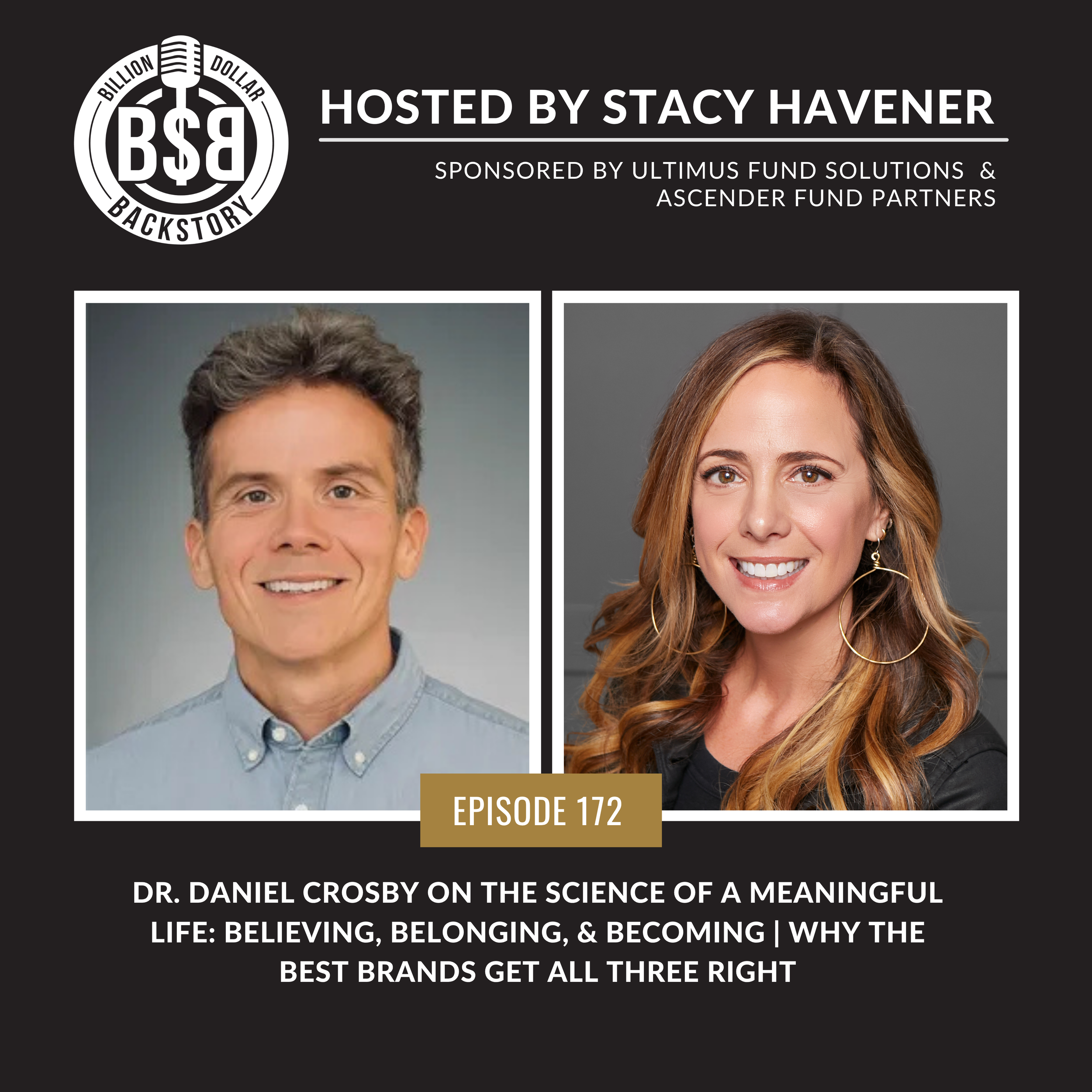
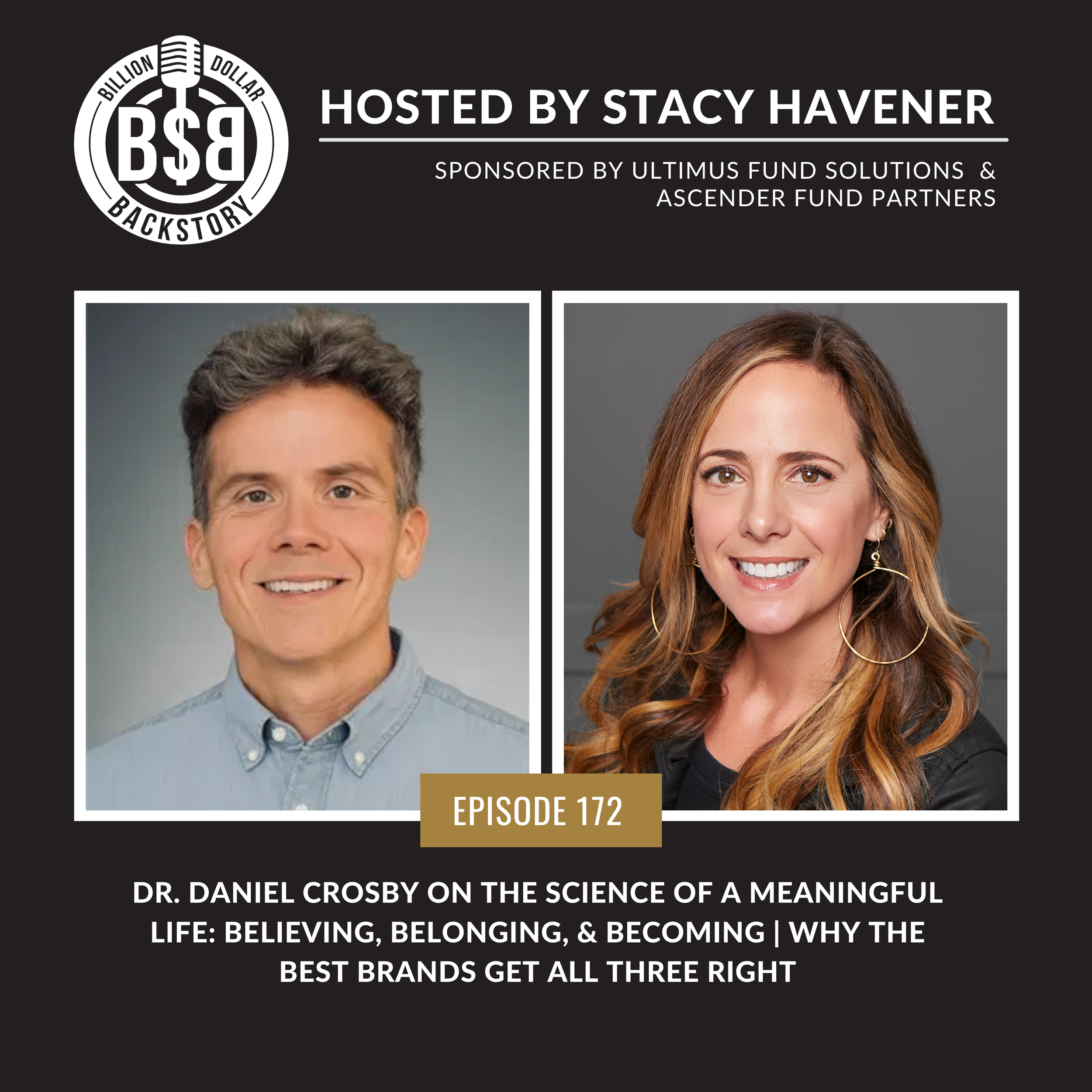
Episode 172: Dr. Daniel Crosby on the Science of a Meaningful Life | Believing, Belonging, Becoming | Why the Best Brands Get All Three Right
Subscribe to Billion Dollar Backstory on Apple Podcasts, Google Podcasts, Spotify, or wherever you listen to podcasts.
Real quick: what’s the meaning of life?
Okay, It's not exactly a quick question. And you probably don’t have an answer ready to go.
But the good news? You don’t need to book a yoga retreat in Bali to figure it out.
Turns out, what makes life feel meaningful might be a whole lot less mysterious than we make it.
Dr. Daniel Crosby just turned in a manuscript exploring what makes our lives feel meaningful.
And after digging into the research, he found himself coming back to three things: believing, belonging, and becoming.
Which has more to do with building a brand and earning trust than you’d expect.
Today, Daniel is back with Stacy Havener to connect the dots between what makes a life meaningful and what makes people, brands, and relationships stand out.
Listen in to hear:
➤ The three Bs that give our lives meaning
➤ Why the best brands in this industry are already doing all three, whether they realize it or not
➤ Why sending someone your fact sheet doesn’t count as a meaningful give
➤ The Gallup question that can tell you a whole lot about whether someone’s going to stick around at work (and no, it’s not about raises or offering random incentives)
➤ What Daniel calls “emotional graying"
➤ Why playing it safe is the worst thing you can do if you’re looking to build a meaningful life and/or a successful business
The scientist and the storyteller are back for another conversation that’s fascinating and surprisingly practical.
And despite the very gray office Daniel’s calling in from, he makes a pretty good case for being anything but.
About Dr. Daniel Crosby:
Dr. Daniel Crosby is a psychologist, behavioral finance expert, and New York Times bestselling author who helps organizations understand the intersection of mind and markets.
He’s a father of three, fanatical St. Louis Cardinals fan, and amateur hot sauce chef.
TRANSCRIPT
Below is an AI-generated transcript and therefore it may contain errors.
[00:00:00] Stacy Havener: My Be-fi bestie, Dr. Daniel Crosby, is back on the Billion Dollar Backstory podcast. He just turned in a manuscript on finding meaning and purpose in life, and he found it's far less mysterious than it sounds. It comes down to three things: believing, belonging, and becoming. We take that framework straight into the work we do, why relationships feel harder to build even though we have more ways to connect than ever, and the science behind Havener's Give/Ask framework.
[00:00:30] We also get into something he calls emotional graying and why playing it safe might be the riskiest move of all. The scientist and the storyteller are back. He's brilliant, he's funny, and despite his nondescript gray office that is the setting for our chat, he is anything but gray. Say hello again to my friend, Dr.
[00:00:53] Daniel Crosby
[00:00:59] Hey, my [00:01:00] name is Stacy Havener. I'm obsessed with startups, stories, and sales. Storytelling has fueled my success as a female founder in the toughest boys' club, Wall Street. I've raised over 8 billion that has led to 30 billion in follow-on assets for investment boutiques. You could say against the odds.
[00:01:19] Yeah, understatement. I share stories of the people behind the portfolios while teaching you how to use story to shape outcomes. It's real talk here. Money, authenticity, growth, setbacks, sales, and marketing are all topics we discuss. Think of this as the capital raising class you wish you had in college, mixed with happy hour.
[00:01:44] Pull up a seat, grab your notebook, and get ready to be inspired and challenged while you learn. This is the Billion Dollar Backstory podcast.
[00:01:57] I'd like to welcome my [00:02:00] drab, gray scientist friend from his laboratory in Utah to the Billion Dollar Backstory podcast, where it is sunny. It's always sunny in the Billion Dollar Backstory podcast studio. Welcome- Hi ... Dr. Daniel Crosby.
[00:02:17] Dr. Daniel Crosby: Well, it's great to be here under the warm glow of these, of these lights.
[00:02:24] By this nondescript filing cabinet- ... in this gray room. In this gray room. It's great, it's great to be with you.
[00:02:32] Stacy Havener: The inspiration for, what is this? It's gotta be our fifth or sixth podcast episode together. You know what number
[00:02:39] Dr. Daniel Crosby: it is?
[00:02:40] Stacy Havener: What?
[00:02:40] Dr. Daniel Crosby: You know what number it is? It's not enough.
[00:02:42] Stacy Havener: Oh, see? Then you say something like that and my heart explodes.
[00:02:47] It's number not enough. Yeah. It's number not enough conversation with Daniel Crosby. This episode inspired by, I will say for me, the inspiration of this [00:03:00] scientist and the storyteller episode is the Curiosity Shop with Brene Brown and Adam Grant.
[00:03:07] Dr. Daniel Crosby: Wow.
[00:03:08] Stacy Havener: Which I love their whole vibe together, and you know, that's who, that's who I'm channeling for us today.
[00:03:15] Dr. Daniel Crosby: Am I Adam Grant in this scenario?
[00:03:18] Stacy Havener: Uh, you're kind of, yeah. You're Adam Grant in this scenario, and I'm, you know, the poor gal's version of Brene Brown who didn't get a PhD in anything but street. Wow. I got a PhD in street.
[00:03:32] Dr. Daniel Crosby: Wow. They're giving those out in the ocean state, I hear.
[00:03:38] Stacy Havener: Okay. So here's where I wanna start.
[00:03:41] First, I wanna start with what you're working on right now, what you're curious about right now, and where you're spending your time. And then I would like to share with you what I'm curious about, and also called the bees that are in the proverbial bonnet for me, so you can make sense of that. [00:04:00]
[00:04:00] Dr. Daniel Crosby: Yeah. So the big news on mine is that I just turned in a manuscript about finding meaning and purpose in life, right?
[00:04:06] So that's what I've been interested in for the last little while. My first foray into that was of course with "The Soul of Wealth," where I wrote this book about money and meaning and like, you know, just my curiosity was around why so many of the very wealthy people I worked with hadn't kind of put it all together and why they weren't as happy as I think the outside world might have supposed they would be.
[00:04:29] And then that just led me further and further down this meaning path and, you know, I just think we're in this world now where, I mean, Viktor Frankl called it, you know, people today have the means to live but no meaning to live for. We're just living, you know? Mic drop,
[00:04:46] Stacy Havener: Viktor. Ooh.
[00:04:47] Dr. Daniel Crosby: Mic drop.
[00:04:47] Stacy Havener: Yeah. Oh. I mean, also kind of a big topic.
[00:04:52] Dr. Daniel Crosby: Yeah. So the- Yes ... the reactions to this have been kinda hysterical, and you're giving me another great one right now. [00:05:00]
[00:05:01] Stacy Havener: This is huge.
[00:05:03] Dr. Daniel Crosby: Where, you know, where I'm at a party or whatever, I'm always at a social ga- Yeah. You know me, Stacey. Always at a cocktail party. But, you know, you'll be, you'll be somewhere and people will say, "Oh, what are you working on?"
[00:05:14] You go, "Well, I'm working on a book on finding meaning and purpose in life." And people kind of go like, "Okay, dude." You know? Like... A- and look, on, on the one hand, I get it, but when I dug in, there's actually a lot of practical science to it. There's more meat on that bone than I think a lot of people would expect.
[00:05:35] Stacy Havener: Me- okay, so meaning, no pun intended, meaning that we can reverse engineer or develop like a proven path, proven, air quotes, to finding meaning? Like it's not as esoteric as we maybe think when we hear it, like how will I ever find it?
[00:05:55] Dr. Daniel Crosby: Yeah. No, it's not esoteric at all. Take the air quotes right away.
[00:05:59] Stacy Havener: [00:06:00] Okay, I will.
[00:06:00] Dr. Daniel Crosby: Take them back. They're gone.
[00:06:01] Stacy Havener: Okay.
[00:06:02] Dr. Daniel Crosby: Um, so here you have bees in your bonnet. I do. I have bees for meaning. Believing, belonging, becoming. That's it. When I dug into the- Ooh ... when I dug into the research, it was like, there's, there's really three things who have, uh, for people who have lives that are filled with purpose, they have three things: believing, belonging, and becoming.
[00:06:24] Stacy Havener: Okay. Unpack those. Like, what's the, what are the, like, sub-bullets?
[00:06:29] Dr. Daniel Crosby: Okay. So believing, um, people who rate their lives as being full of purpose have a moral compass. The world is, uh, extremely confusing, and so people who rate their lives as meaningful have, yeah, a moral compass, whether it be spirituality, religion, philosophy, some sort of moral code they've, they've adopted that is a guide to them that answers life's big [00:07:00] questions.
[00:07:00] You know, why do bad things happen to good people? Like- Hmm ... how should I spend this, you know, indeterminate amount of time here? So you, you know, we need a handbook of some sort, however tentative. I'm not here to tell you which handbook is right, but I am here to tell you that you need a playbook for life.
[00:07:22] That's believing. You need to, you need some sort of moral compass, some sort of thing to make sense of the world. Uh, the belonging piece is your tribe. This is your- Yeah ... people. You know? Nat King Cole, right? The greatest thing you'll ever learn is just to love and be loved in return. Like, we have to be giving love.
[00:07:45] We have to be receiving love. This is the one that is the most predictive of all, is the quality of your relationships dramatically, uh, impacts the quality of the meaning of your life. And then the last one, becoming, [00:08:00] we're made to progress. You can, you know, this go- going back to the rich folks I, I surveyed and studied when writing "The Soul of Wealth," sometimes when you get to the top of the proverbial mountain, the reason that you're sad is, like, where do you go from here?
[00:08:17] Hmm. You know, when you, when you sell your company for whatever, nine, 10 figures, and you have ascended the mountaintop that the rest of us are trying to get to the top of, it's like, who do you become now?
[00:08:32] Stacy Havener: Yeah. You
[00:08:32] Dr. Daniel Crosby: know? Who, who do you become now? So those are the three things. Hmm. We need, we need a rule book, we need a tribe, and we need a sense of where we're going, and we wanna be better today than we were yesterday.
[00:08:45] And if you get those three things right, I mean, you know, easier said, but, uh, you're a long way towards having a great life.
[00:08:52] Stacy Havener: Fascinating. And what I love about it is when you first said, "I've been..." You know, so my side hustle here [00:09:00] is, you know, working on the meaning, like how to find meaning in life, which does feel really big.
[00:09:06] But when you break it down, the things that help create that, while also big, are actually rather simple. They're not complex in terms of I don't hear those things and go, "Well, then I can't ever do that."
[00:09:22] Dr. Daniel Crosby: Right. Right. It's nice to kinda get your arms around it too. Yeah. Isn't it? Go, okay- Yeah ... well, you know, how should I, how should I spend today?
[00:09:31] How should I spend this year? Yes. Well, let's make sure the people that matter to me know that they matter. Mm-hmm.
[00:09:37] Stacy Havener: Um,
[00:09:38] Dr. Daniel Crosby: let's try and get a little bit better every day, and let's be a good person, right? And but, but, you know, like, like most things in life, whether it's good nutrition or good investing-
[00:09:48] Stacy Havener: Yeah
[00:09:49] Dr. Daniel Crosby: it's kind of simple but not easy, right? Like it's easy- Yes, I
[00:09:52] Stacy Havener: think that's it. I think
[00:09:53] Dr. Daniel Crosby: that's it ... yeah, like you can hear these three things and go, "Yeah, that makes sense." Um, but then, you know, [00:10:00] getting your kid to love you when you're- ... you know-
[00:10:04] Stacy Havener: Yeah ...
[00:10:04] Dr. Daniel Crosby: trying to have a hard conversation with them is not, you know.
[00:10:07] Stacy Havener: Not, it's not easy.
[00:10:08] Dr. Daniel Crosby: Not easy.
[00:10:08] Stacy Havener: No, I think that's right, and I think it also, that three-part framework helps us say, "Okay, of which of these things is the one that I maybe wanna focus on right now? Or where, where do I feel I need the most attention?" And weirdly, your Bs dovetail with my Bs.
[00:10:30] Dr. Daniel Crosby: Let's,
[00:10:31] Stacy Havener: let's show- Let's, let's explore that dovetail
[00:10:33] let's show our Bs. Let's show our Bs. Let's, let's, let's get the Bs out of the bonnet.
[00:10:36] Dr. Daniel Crosby: Yeah.
[00:10:37] Stacy Havener: All right. Because that second B of belonging-
[00:10:42] Dr. Daniel Crosby: Mm-hmm ...
[00:10:43] Stacy Havener: is something I've been thinking a lot about, and I'm going to I hope this isn't a stretch, 'cause I don't think it is. I know sales is a, a weird word for a lot of people, but when you're in the business of growing a business, you know, [00:11:00] everyone talks about relationships.
[00:11:02] Oh yeah, no, I'm really relationship driven and oriented, and relationships are everything. And yet what I've noticed is... Look, that's a lot of easy to say. Mm. Right? What I've noticed is, well, I've noticed a couple things, but one of the things is that those relationships now more than ever seem more difficult to create when we have even more tools and more ways to create them, and somehow we're getting worse at it.
[00:11:38] Dr. Daniel Crosby: Mm. So-
[00:11:39] Stacy Havener: Why is that happening?
[00:11:40] Dr. Daniel Crosby: So say more, like do you think that AI
[00:11:43] Stacy Havener: is
[00:11:43] Dr. Daniel Crosby: driving us
[00:11:44] Stacy Havener: apart from- So I, you know, I don't know. That's why you're the scientist. I mean, I can tell you what I'm seeing at the street- Yeah ... which is, so let me give you an example. So we have this framework that we teach clients, and it's called give ask.
[00:11:57] Mm-hmm. And this is probably gonna require, uh, [00:12:00] you to take us to school on the whole influence and reciprocity thing. But we have this give ask framework, and it's very simple in nature, which says that before you ask for anything, you should give, we recommend three times before you ask. Okay? Mm. So if you're asking for a meeting, you should give three times before you ask for that meeting, would be a great example.
[00:12:27] And so we teach this framework to clients, and this is the framework they struggle with the most. They cannot figure out a give. They'll say, "Well, I gave them my fact sheet." So I'm gonna leave you-- So I wanna keep unpacking this, but before we do, can you first kind of maybe walk it back and explain the theory behind this give-ask framework, and then we'll take it to the relationship piece when we get there, because that's what we're trying to [00:13:00] capture, is how people connect.
[00:13:02] Dr. Daniel Crosby: Yeah, absolutely. So, I mean, the person who did the foundational research on this was Robert Cialdini. He talks about these six pillars of influence. Basically, if you're trying to get someone to do what you want them to do, and like, if you distill it down, what is sales but that?
[00:13:21] Stacy Havener: Right.
[00:13:21] Dr. Daniel Crosby: Like, you're, you're, you're trying to...
[00:13:23] I mean, w- honestly, what is everything but that?
[00:13:27] Stacy Havener: Yeah.
[00:13:27] Dr. Daniel Crosby: You know, um, being a parent, you're trying to influence the next generation to make good choices on route to becoming fully actualized and independent adults. You know, being a leader in your organization- Yeah ... you're trying to influence people to pull in a common direction.
[00:13:46] Selling something, you're trying to influence people to part with their dollars in, in exchange for your goods and services. So like, everything is influence, and he says the most powerful of these six pillars is [00:14:00] something called reciprocity, which is this idea that we have mental debits and credits in our heads about who owes us one and who we owe one.
[00:14:12] Stacy Havener: Mm-hmm.
[00:14:12] Dr. Daniel Crosby: Um, people and even animals are super tuned into fairness. We're going a little far afield here, but it's kind of fascinating. Okay.
[00:14:24] Stacy Havener: Yeah, I love it
[00:14:25] Dr. Daniel Crosby: So it's like they've, they've done research, you know, put two chimps next to each other, right? Um, you give each one one grape, and they're thrilled.
[00:14:36] They're both very happy, right? They can see what's happening, what the other one's getting. But you give one two grapes, and you give the other one five grapes, and the one that got the two grapes will freak out and start rattling the cage and throwing a fit. And it's like, well, hey buddy, you were happy with one grape just a minute ago.
[00:14:55] You should be, you know- You
[00:14:57] Stacy Havener: should be thrilled with two.
[00:14:58] Dr. Daniel Crosby: Yeah, you should be thrilled with [00:15:00] two. But it's not the absolute- Yeah ... amount, it's the relative amount, and it's the fairness, right? I mean, that's like our, our common adherence to fairness-
[00:15:13] Stacy Havener: Hmm ...
[00:15:13] Dr. Daniel Crosby: is one of the things that makes society run.
[00:15:17] Stacy Havener: Yeah.
[00:15:17] Dr. Daniel Crosby: You know, our, our mutual belief in fairness.
[00:15:20] And so that's what reciprocity is all about. Because if, if Stacey does three nice things for me, I start to get a little anxious. I'm like, "Oh gosh, like I got- Yeah ... I, uh, I can't have this imbalance." And so then when you ask me for a meeting, I'm like, "Okay, yes." 'Cause it lets some of the, you know- Yeah ... it lets some of the imbalance out.
[00:15:42] It
[00:15:42] Stacy Havener: levels the... Yeah. Which all sounds kind of manipulative, but that's not the intention of influence in general, because the spirit of the give, so this now kind of goes back to why giving someone a fact sheet does not count So the spirit of the [00:16:00] give, the way we teach it, is that you give something that means something to the person who's receiving it, and you do so without expectation of receiving anything in return.
[00:16:10] Dr. Daniel Crosby: Mm-hmm. Correct.
[00:16:12] Stacy Havener: Right?
[00:16:13] Dr. Daniel Crosby: Well, and you know what, where people misapprehend this give too is it doesn't have to be expensive. Yes. It doesn't have to be technical. Yes. It doesn't have to be anything. I mean, Stacy complimented my haircut before this. I'm gonna eat off that. I'm gonna eat off- All day ... that compliment 10 days.
[00:16:35] Yeah. 10 days we'll be snacking on that compliment. No, but I mean, that's just a- That's it ... that's a free... It took you- Gift ... two seconds. It, you know, nothing work-related, nothing technical, but that's a give, right?
[00:16:50] Stacy Havener: So thank you. Yes. This is what- Yeah ... we try to say. Yeah. So we, we teach and we give these examples: a kind word.
[00:16:57] Uh, for instance, I, I did a [00:17:00] podcast earlier with someone who's a big heavy metal fan, and I know another person in finance who's a big heavy metal fan, so I'm gonna make an introduction because they should be friends, like they both love heavy metal and that's cool. And so these small acts of kindness that allow someone to receive that kindness and also to sort of get to know you, that you're showing up and you're just doing nice things, which is another topic I wanna talk about.
[00:17:25] But before we get... Because it's also unexpected, and I think it weirds some people out, but that's not the point. You still have to do it. Mm-hmm. But the, but the weird thing on the belonging and this meaning is that it is so difficult, and I'm not talking about just one client, across the board for people to do the gives.
[00:17:46] They can't think of things. They don't wanna do it. They... When we'll say, "Okay, like sh- give me an example of someone you wanna have a meeting with," and we'll go onto their like LinkedIn or, you know, we'll look at stuff and we'll say, "Hey, well, what if you did this?" [00:18:00] And it's like I don't wanna do that. You know, just some nicety.
[00:18:03] Like they mention they have a dog, like I, I, I mean, I don't know, like say, "Do you have a dog? You do?" Like find a way to, you know, "Hey, I was reading your profile. You have a German shepherd? Me too." Like I, I don't know, any little small thing, and they really can't get there.
[00:18:20] Dr. Daniel Crosby: I feel like people are overthinking this, and I, I love some of the examples you've given.
[00:18:25] Okay, so a compliment is reliable-
[00:18:28] Stacy Havener: Mm-hmm ...
[00:18:28] Dr. Daniel Crosby: right? An article or a, a song or whatever, you know- Yeah ... a movie they might like, a recommendation, I mean that's- A
[00:18:36] Stacy Havener: podcast.
[00:18:37] Dr. Daniel Crosby: Yeah. That's such a gift. Like think about when you listen to a really great podcast and you share that with someone and they listen to it and they go, "Oh my gosh, that was great."
[00:18:46] Stacy Havener: Yeah.
[00:18:46] Dr. Daniel Crosby: And that answered some questions, right? So a recommendation is that, a compliment is that, an introduction. You know, I introduced recently a couple of friends, took me 90 seconds- Right ... to introduce two [00:19:00] people I really like. They've gone off and started their own podcast together now. Amazing. And like how valuable is that?
[00:19:08] Yeah. You know, the other thing, we're gonna give people too many frameworks today, but the way that we evaluate people broadly, if you just- Yeah ... wanted to think about like how we evaluate people broadly, we evaluate people across two dimensions. One is warmth and one is competence, right? Mm. So basically, are they kind and are they competent?
[00:19:31] And when you do something like send an article that helps them i- in their business or helps them in their personal life, when you make an introduction to a fellow trusted colleague, I mean, those things are warmth and competence-
[00:19:45] Stacy Havener: Yes.
[00:19:45] Dr. Daniel Crosby: That's great ... at the same time, right?
[00:19:47] Stacy Havener: Yeah.
[00:19:47] Dr. Daniel Crosby: Because if someone is kind but not competent, they're like kind of a golden retriever- Right
[00:19:53] dummy. Like, you know, like you may like them, but you may like them, but you're not gonna do business with [00:20:00] them.
[00:20:00] Stacy Havener: Yeah.
[00:20:00] Dr. Daniel Crosby: But if someone is competent but not kind, that's a, that's an enemy, right? Like that's a- Yeah ... threat. We don't want talented people who have it out for us.
[00:20:09] Stacy Havener: Yeah.
[00:20:09] Dr. Daniel Crosby: So, so like anything you can do to display both kindness and business acumen is such a win, and I think that-
[00:20:19] Stacy Havener: Yeah
[00:20:20] Dr. Daniel Crosby: a lot of the things you've mentioned fall in that category.
[00:20:23] Stacy Havener: And so to, to stay with this, so they really struggle with this. So that's like-- And also sometimes I find myself saying, and then I realize maybe it's not great advice, and this is so I, I probably have to work on it, but I'll be like, "Okay, so it's like how you would make a friend."
[00:20:39] Dr. Daniel Crosby: Hmm.
[00:20:40] Stacy Havener: You know, do that, right? So if you were back in fourth grade and you were on the playground and you were gonna make a friend, what would you do? You'd probably walk up and you'd say something nice like, "Wow, that looks really fun what you guys are doing. Can I play?" Like, or whatever. Like- You know, "Gosh, I really love your dress," or I don't know, you would give them-- You would do [00:21:00] the same root fundamental things of making that connection and make, and starting that relationship and working towards this idea of belonging, and it just feels like we've either forgotten how to do that on some level or the vulnerability required of doing that is too much.
[00:21:19] Dr. Daniel Crosby: Yeah. Okay. So that, that is where I think you've, you've nailed it. Okay? So first of all, I gotta share a stat with you. Yeah. Recent re- recent research shows that the modal number, right? So mode being the most frequently occurring number of friends that the average adult male has is zero.
[00:21:44] Stacy Havener: No.
[00:21:45] Dr. Daniel Crosby: So that's not the average, right?
[00:21:47] Because, you know, that's not, the, the average is not zero. But when you tally it up, the most frequently occurring number is zero friends. So first of all- That's
[00:21:57] Stacy Havener: heartbreaking ...
[00:21:58] Dr. Daniel Crosby: no, it's so heartbreaking, and [00:22:00] that's why I'm trying to do this work that I'm trying to do This work on meaning,
[00:22:02] Stacy Havener: yeah.
[00:22:03] Dr. Daniel Crosby: Yeah. But what you've said is exactly right.
[00:22:06] So, you know, take it back, you know, we moved to Utah two months ago. I have a 10-year-old who's trying-- Well, I have three kids- Yeah ... but especially a 10-year-old who's, who's trying to make new friends. And so you, you, we're in the thick of going through this with her, and we're, we're teaching her what you just talked about.
[00:22:24] But in every instance, it's an act of vulnerability- Yeah ... to go up to that person and say, "Hey, do you wanna talk?" Or, "Do you wanna play?" Or, "Do you wanna get to know me?" Or, "Hey, nice shoes." Or, you know- Yeah ... whatever it may be, because there's the chance that, that people will turn their back on you or not reciprocate that.
[00:22:43] Yeah. But the way that if you think about the way that friendship and any relationship gets built, it's by an opening act of vulnerability-
[00:22:54] Stacy Havener: Yeah ...
[00:22:54] Dr. Daniel Crosby: with an ongoing reciprocal vulnerability, right? Mm-hmm. Because think, you [00:23:00] know, the first time I met you, what did we talk about? Finance stuff, right? Yeah. Like, talk about industry stuff.
[00:23:06] Now we talk about kids and life, and you, you go a layer down, but you have to do that incrementally and slowly, and you have to just hope that the other person will take care of that disclosure, and that's not always a given. So it really is an act of courage and vulnerability to do what I think you're asking your clients to do, which is, I think- Yeah
[00:23:30] where it gets tough. People are
[00:23:31] Stacy Havener: scared. I think that's right. And so this leads me to the other thing, and then we can move on to other, other Bs. Um, which is, so for example, and your boomer comment that you said to me in the green room is coming back around here, but that's okay. I'm, I'm confident in who I am and what my age is.
[00:23:50] So while I pick up my, this thing on a leash, one of the things I say to people is, "Pick up the phone and call someone."
[00:23:59] Dr. Daniel Crosby: Mm-hmm.
[00:23:59] Stacy Havener: [00:24:00] Like, so if a client has a meeting with someone and it goes really well, and maybe their champion wasn't in the room, I say, "Well, pick up the phone and call the champion and just, like, thank them for their help or whatever."
[00:24:12] So the first thing they'll say to me is, "Well, they're not gonna answer the phone." And then my response is, "That's not the point."
[00:24:18] Dr. Daniel Crosby: Doesn't matter, yeah.
[00:24:19] Stacy Havener: It doesn't matter. Yeah. The point is that they are going to know that you called and said thank you. Thank you to me is such a great gift By the way. Okay, so they're gonna know.
[00:24:31] So then it'll be like, then I'll say, you know, "Did you do that?" "Yes, I did that, but they didn't call me back." To which I say again, "But that's not the point." Yeah. So does it still work if the person doesn't respond back?
[00:24:44] Dr. Daniel Crosby: Yeah, so here's what's fascinating is new trends create new opportunities, right? So we know now that calling someone on the phone wasn't what it was when, when we were kids.
[00:24:57] Mm-hmm. Like people are, you know, [00:25:00] people are more likely to screen a call. People are more likely to let it go to voicemail. You know, it's, it's considered old-fashioned or whatever. But, but that is to your advantage- Yes ... because that means your outreach stands out, right?
[00:25:15] Stacy Havener: Yeah.
[00:25:16] Dr. Daniel Crosby: Think about when you get a handwritten letter from someone, like, oh my goodness.
[00:25:22] And I mean, even in the age of AI slop today, Stacey, I saw three on LinkedIn yesterday. I saw three anti-AI rants that were quite conspicuously written by AI.
[00:25:37] Stacy Havener: No, come on. Yes. That, that, that is a s- that can't be.
[00:25:41] Dr. Daniel Crosby: It, it is. It, it, it- It was ... occurred yesterday. Yeah.
[00:25:44] Stacy Havener: Ugh.
[00:25:44] Dr. Daniel Crosby: You know, sitting in my hotel in Toronto, bored, scrolling LinkedIn, and I'm like, oh my gosh.
[00:25:50] And so, you know, in the age of no phone calls, the phone call becomes transcendent. In the age of the text, you know, you [00:26:00] stand out when you write the handwritten letter. In the age of the AI slop manufactured opinion, your real opinion becomes that much more- Yeah,
[00:26:10] Stacy Havener: agreed ...
[00:26:11] Dr. Daniel Crosby: impactful. So I think rather than bemoan these changes, it just presents an opportunity for people who are just a touch thoughtful to really stand out.
[00:26:21] Stacy Havener: Yeah. And so what's the lesson? What's the takeaway for people? Just, just do it? I mean, not to steal Nike's, like, whole thing, but like, just do... You have to... I mean, if I, if I think back to when we met, I, I believe I, out of the blue, sent you a note on LinkedIn and said, "I saw you speak on a stage two years ago.
[00:26:41] You were amazing, and the most amazing thing, besides the fact that you are, you are you and behavioral science and you're brilliant, was that you made me laugh." Mm-hmm. And I remember the response. You did write me back, and you said, "This is the nicest connection request I've ever received on LinkedIn." And so [00:27:00] now there's also the reality that you didn't write me back, but it wouldn't have changed that I did really feel that, having watched you speak at the Schwab conference all those years ago.
[00:27:10] Mm-hmm. And so would my feelings have been hurt? Not the right word, but sure. But I still would've felt good that I gave you a kindness, and maybe someday down the road when we saw each other at a conference, you'd remember that.
[00:27:25] Dr. Daniel Crosby: Sure.
[00:27:25] Stacy Havener: Yeah. How do you get someone to be brave enough? How do you practice that belonging?
[00:27:32] Dr. Daniel Crosby: Yeah. So I think there's two things here. The first is to realize that it can be smaller than you think I think a lot of times when we talk about- Yeah, that's true ... you know, we, we talk about these, th- these three points of contact that you, that you preach to your folks, people think it has to be a sporting event or a steak dinner or something.
[00:27:52] Like literally, no. It can be any of these tiny things that we've talked about. So sort of, um- Making it
[00:27:58] Stacy Havener: smaller ...
[00:27:59] Dr. Daniel Crosby: [00:28:00] yeah. Turn, turn down your expectations a little bit. So probably less expense and more bravery-
[00:28:06] Stacy Havener: Yeah ... you
[00:28:07] Dr. Daniel Crosby: know, is, is, is the formula. And, and then I love what you said too, which is, you know, if you're confident and you're authentic, it doesn't hurt you.
[00:28:19] Like if you had said those nice things to me, and I for completely normal and rational reasons just missed it 'cause I was- Yeah ... traveling or... I mean, how many times have we not returned a text? Totally. So many times. Or a call. Yeah. To people we genuinely hold in high regard, it's just life got in the way, you were busy with family or whatever.
[00:28:41] But you can say, "Look, there's no harm." Like best case, Crosby sees this, we do a bunch of podcasts together and become friends. Yep. Worst case, I said something kind to someone who genuinely made my hour better and that was true.
[00:28:55] Stacy Havener: Yeah.
[00:28:55] Dr. Daniel Crosby: And so I think if you operate with that sort of authenticity and [00:29:00] kindness, I think it's when people operate from this manipulative mindset that it becomes-
[00:29:05] Stacy Havener: Yes
[00:29:06] Dr. Daniel Crosby: you know, it's like,
[00:29:07] Stacy Havener: oh- I do think you're right.
[00:29:09] Dr. Daniel Crosby: It's like, oh, I was trying to get something and then I didn't get it.
[00:29:12] Stacy Havener: Yeah. You know? Yeah, yeah. Yeah, that's right.
[00:29:14] Dr. Daniel Crosby: Don't be that,
[00:29:15] Stacy Havener: don't be that person. Don't be that person. Let's be real. No one wakes up and says, "I can't wait to build some operational infrastructure today."
[00:29:24] You're here to manage money, to build something that lights you up, not chase down reports across five systems and 15 service providers. That's where Ultimus Fund Solutions comes in. They're your ops dream team, consolidating all your middle and back office chaos into one clean, scalable setup. Registered funds, private funds, SMAs, all integrated.
[00:29:50] One team, one tech platform, one rock solid source of data. But here's the real differentiator: service. [00:30:00] I know that fund in a box sounds convenient. It's also a box. Know what you can't put in a box? A human who picks up the phone when you call and need help. Real-life people who know your name and your fund, and they care about getting it right.
[00:30:16] Ultimus was built on people doing business with people. You get institutional strength combined with boutique-level service without getting stuck in a phone tree of doom. If you're ready to simplify, scale, and start working with a team that feels like an extension of yours, check out billiondollarbackstory.com/ultimus.
[00:30:39] That's U-L-T-I-M-U-S. You've got the investment strategy, the vision, the track record. Now it's time to upgrade the engine behind it all with Ultimus So now I'm gonna come back to your work for a second on the belonging bit, because we're [00:31:00] talking here about work relationships primarily. Does that count?
[00:31:05] Count not the right word, but does that, does that factor into your B of belonging? Like where does work friendship, work relationships kind of fit in? Or is this primarily on like, hey, where people find meaning is when they have deep and rich personal
[00:31:23] Dr. Daniel Crosby: relationships? Yeah. So what I love about this is that it absolutely applies to work, and it absolutely applies to your work in sales and marketing too, so let's talk about both of these.
[00:31:34] So first of all, Gallup has a, a survey whereby they can, with some degree, high degree of accuracy, pinpoint how likely someone is to turn over, right? They call it the Q12. Hmm. It's a 12 question survey, very simple. The single best predictor of someone's longevity in the workplace is their answer to one of these [00:32:00] 12 questions, which is, "Do I have a best friend at work?"
[00:32:04] Stacy Havener: Oh my God. For real? Yes. Oh, that gives me chills.
[00:32:08] Dr. Daniel Crosby: Yeah. So do, do I have a best friend at work is the single best predictor of how likely someone is to stay, and think about all the little gimmicky-
[00:32:17] Stacy Havener: Yeah ...
[00:32:18] Dr. Daniel Crosby: crap we do, and the incentive programs and the wringing our hands about pay and benefits and a million things.
[00:32:26] Like, we are fundamentally relational creatures, and, like, do I have a best friend at work is the single best predictor.
[00:32:32] Stacy Havener: Wow.
[00:32:33] Dr. Daniel Crosby: Think about these three Bs, though. Like, when we look at the best brands in our space- Mm-hmm ... and I bet, I bet you and I would have a remarkably high degree of consensus-
[00:32:47] Stacy Havener: Mm-hmm
[00:32:47] Dr. Daniel Crosby: around-
[00:32:48] Stacy Havener: Mm.
[00:32:48] Dr. Daniel Crosby: Um, I'm trying to think. So, I mean, Rit- Rit- Ritholtz, right?
[00:32:54] Stacy Havener: Uh-huh.
[00:32:55] Dr. Daniel Crosby: Ritholtz, uh, I'm gonna say Maneesh and his crew. Oh my
[00:32:59] Stacy Havener: gosh. [00:33:00]
[00:33:00] Dr. Daniel Crosby: Yeah, Potomac. Like, the people who really do it well understand all of these three Bs, right?
[00:33:08] Stacy Havener: Yeah.
[00:33:08] Dr. Daniel Crosby: They're believing. Well, talk about Potomac. I know that's a- Oh my
[00:33:11] Stacy Havener: gosh
[00:33:12] mutual- I mean,
[00:33:12] Dr. Daniel Crosby: yeah ... m- mutual friend, right? Believing. You think they have a code for how they move through the world, right? From the way they market, which is kind of bombastic and in your face, to the way- Mm-hmm ... that they dress, to everything else, like, they have a rule book, right?
[00:33:30] Stacy Havener: Yep.
[00:33:30] Dr. Daniel Crosby: Belonging. Look at Future Proof, that just happened.
[00:33:34] That beast gets bigger every year-
[00:33:36] Stacy Havener: Yeah ...
[00:33:36] Dr. Daniel Crosby: because the Ritholtz crew has created this sense of, you know, anyone, uh, you know, anyone- Community ... anyone is here- Yeah ... and you're gonna meet your friends, and it's gonna be community, and it's like part cool kids club, part family reunion. And then becoming, right?
[00:33:53] Like, all of these folks have, you know, Potomac University. We're gonna help you get better at being who you are. Yeah. So [00:34:00] I feel like the best brands, Stacy-
[00:34:03] Stacy Havener: That's so interesting ...
[00:34:04] Dr. Daniel Crosby: everything is commoditized. I know. Everything is commoditized. And, you know, the best brands get these things right. They have a code by which they live, they create a sense of community, and they make people better than when they found them.
[00:34:20] Yeah.
[00:34:21] Stacy Havener: And like,
[00:34:21] Dr. Daniel Crosby: if your brand can do those three things, it's just a, a cheat code.
[00:34:26] Stacy Havener: That's such a great p- do you talk about that in the book, or is it mostly just in personal, like, as a person, here's how to create meaning? 'Cause that's brilliant. That's
[00:34:35] Dr. Daniel Crosby: gotta be- There's a whole section about, there's a whole section about the workplace.
[00:34:38] I haven't come at it from a marketing perspective. That's so
[00:34:41] Stacy Havener: brilliant.
[00:34:41] Dr. Daniel Crosby: That's gonna be, that's gonna be our book.
[00:34:43] Stacy Havener: Okay. That's gonna be our book. Okay, good. I love that. I love that. All right. I got another bee in my bonnet.
[00:34:49] Dr. Daniel Crosby: Let's go.
[00:34:50] Stacy Havener: Okay.
[00:34:52] Dr. Daniel Crosby: Get it out.
[00:34:52] Stacy Havener: Okay. This is the one that you said was boomer... I, I think your exact words were, "This is some, like, AI boomer slop," or something.
[00:34:59] I [00:35:00] don't even know what you said to me in the green room. It wasn't kind to people. Um, so it kinda relates to what we've been talking about on, like, doing the work. But it's interesting 'cause the podcast I had before this, I was chatting with a asset owner in the UK, the largest asset owner in the UK, and they said, "You know, on our website we have our philosophy, like the things we look for in, in managers that we work with, um, the managers who we currently have in the portfolio, like that's out there.
[00:35:33] Anybody who spends a few minutes of time can find out a lot about us- Mm-hmm ... on the worldwide web and be better informed when they approach us." This is also, by the way, true for every business in the year of our Lord 2026, and yet how many people are willing to do that work? [00:36:00] Very few. And so what I said to you in the green room that sparked your unkind words back to me, um, was, "It just feels like people are getting lazier."
[00:36:11] Now lazy might not be the right word, but why, why aren't people willing to do that work? It's like we can't be bothered to spend the 15 minutes to do some work on the people that we want to have a relationship with.
[00:36:30] Dr. Daniel Crosby: Yeah. So I think there's probab- we'll see if we, we'll see if we agree here.
[00:36:35] Stacy Havener: Okay.
[00:36:35] Dr. Daniel Crosby: I think there's a certain class of attitude that is perpetual.
[00:36:43] I think the, the, the finest example I can give of this is every middle-aged generation for the last many hundreds of years-
[00:36:55] Stacy Havener: Mm-hmm ...
[00:36:55] Dr. Daniel Crosby: has thought that the generation below them [00:37:00] was lazy screw-ups, right? And then they grow up, they get a job, they start paying taxes. So like everyone's kind of idealistic, and then they grow up and they buy a minivan and they move to the suburbs.
[00:37:16] And they, and they vote for- They have a gray
[00:37:18] Stacy Havener: office.
[00:37:19] Dr. Daniel Crosby: They vote for Republicans. They get a gray office. No, so I think, I think there's a, there's an element of this. Yeah. I think that if you had asked people 200 years ago, "Don't you think people today are just lazier than they used to be?" I think that basically throughout-
[00:37:37] Stacy Havener: Everyone.
[00:37:38] Yeah ...
[00:37:38] Dr. Daniel Crosby: everyone through every epoch of time would say yes.
[00:37:42] Stacy Havener: Mm-hmm.
[00:37:43] Dr. Daniel Crosby: Like things used to be better, right? That's what we call rosy retrospection. We just have this sort of preference for the, the past, right? We sort of ha- we're nostalgic about the past. So I think there's like an, an element of that. Now, where I do think there's some truth to it is, [00:38:00] I do think that because of technology and other things, we live in a fast twitch- Hmm
[00:38:06] fast gratification, fast edit type environment. You know, we know that people demand quicker edits and shorter shows than they used to watch. We know that people read less than they used to do. Like this is all factual, and I think that that, uh, seeps into things like not doing appropriate due diligence when you're going out for a job or, you know- Hmm
[00:38:32] or you're trying to influence someone. So I do think, I do think both of those things are true. We've become accustomed to this sort of, you know, 140 character microwave speed society in many facets of our life. And also, I think probably for as long as there have been people, we have sort of romanticized the past and in sort of unfortunate ways.
[00:38:56] Stacy Havener: Yeah. Well, okay, so we don't disagree- [00:39:00]
[00:39:00] Dr. Daniel Crosby: Yeah ...
[00:39:00] Stacy Havener: entirely because my laziness comment did not have a generational bent to it.
[00:39:08] Dr. Daniel Crosby: Uh-huh.
[00:39:08] Stacy Havener: I- it's actually, it's not a younger generation that's not doing it, it's people my age who are also trying to grow their business. So it's kind of like, I think it's more, I think hearing you break that down, it's more the latter than the former.
[00:39:27] Dr. Daniel Crosby: Yeah. Yeah.
[00:39:27] Stacy Havener: And, and so my question, like, so that just seems not helpful as the sales and marketing person. Um, if you want to grow your business and you want to establish a relationship with someone, not doing the work to understand who they are before you hit go on your email blast to 1,000 cold prospects, that's the, this is like a broken thing.
[00:39:55] But I also kind of going back to your work right now, like [00:40:00] I feel brokenness in what we're talking about f- on the meaning front too.
[00:40:06] Dr. Daniel Crosby: Yeah. So l- let me see if I can... This is some like black belt level psychology stuff. But let me see if, let me see if I can articulate- Yeah ... what I'm thinking of here, which is that I feel like sometimes people sandbag their effort, they half-ass something.
[00:40:23] Stacy Havener: Hmm.
[00:40:24] Dr. Daniel Crosby: We'll go back to the vulnerability piece.
[00:40:27] Stacy Havener: Mm.
[00:40:27] Dr. Daniel Crosby: Like how many times have you seen someone half-ass whatever it may be, and then when it doesn't work out, they can go- Hmm ... "Well," but you know. Yeah. I, I, w- whether explicitly or implicitly, "Well, but I didn't really try."
[00:40:43] Stacy Havener: Yeah.
[00:40:44] Dr. Daniel Crosby: You know? So like I'm not a failure.
[00:40:46] If I had done all I could- Right ... I'm sure it would've worked, you know, but, but I'm not a failure. There's a self-protective element- Hmm ... to moving through the world in a sort of lackadaisical way. [00:41:00] Um- Hmm ... when I was a therapist, I kind of i- in my own head, the, the, you're- you'll laugh because of, well, my clothes and my hair and my office.
[00:41:11] But I, I used to call this emotional graying, right? Like-
[00:41:16] Stacy Havener: Yeah ...
[00:41:16] Dr. Daniel Crosby: where people would just try and exist in this limbo, right? Like, "Well, if I never really fall in love, I'll never really get my heart broken," right? Oh, God.
[00:41:26] Stacy Havener: Yeah.
[00:41:26] Dr. Daniel Crosby: If, if I nev- you know, if I never really, um, pour my heart out, I'll never get my heart broken.
[00:41:31] If I never really give my all, I'll never, you know, be upset.
[00:41:36] Stacy Havener: Yeah.
[00:41:36] Dr. Daniel Crosby: You know, if I never, if I'm never out in the driveway taking 2,000 jumpers a day, I won't be sad when I get cut from the basketball team. So let me kinda do the least possible. So I think this emotional graying- Whoa ... is, is something we, we all, we all are guilty of- Hmm
[00:41:55] in really subtle ways that are self-protective.
[00:41:59] Stacy Havener: How does [00:42:00] that relate to meaning? Because in your work of how to find meaning in life, I mean, if you're stuck in emotional graying- Mm-hmm ... that seems like a really difficult place from which to find meaning.
[00:42:15] Dr. Daniel Crosby: Oh, yeah. It's terrible. I mean, think of, think of each of these three Bs, right?
[00:42:21] Mm-hmm. So believing. Now again- I don't think that I-- this isn't a commercial for organized religion in any means, but the fastest growing religious group in the US is the non-religious. And that's a complicated thing, and organized religion has certainly done plenty to shoot itself in the foot. But there's also an element of this, of like, "Hey, if I just sort of am vaguely trying to be a good c- person," then you n- it, it's hard to run afoul of vaguely trying to be an okay person, right?
[00:42:57] But if I'm a, a stoic [00:43:00] or a Catholic- Hmm ... or a Buddhist, or, you know, whatever, if I make a commitment, then I can run afoul of that commitment, okay? Think about love- Hmm ... right? I mean, having a child, having a spouse, my goodness. Like, that is so- Yeah ... high stakes, you know? That's just, what do they say about parenting?
[00:43:20] It's just your heart running around- Oh, bro. Yeah ... outside, right? So, you know, um, becoming, trying to be better than you were today, it's so much easier in some respects to just kinda chill and- Yeah ... and maintain. But so yeah, I think that's one of the lessons of each of these three Bs takes risk and it takes commitment.
[00:43:40] And anytime there's commitment, there's room for hypocrisy and failure and, you know, running afoul of your goals and your values. But there's also room for growth and joy and happiness and fulfillment, and you can't have the one without the other.
[00:43:56] Stacy Havener: I think that's my big takeaway here, is [00:44:00] whether we're on the search for meaning-
[00:44:02] Dr. Daniel Crosby: Mm-hmm
[00:44:02] Stacy Havener: well, and it's probably both. We're on the search for meaning, and if we are entrepreneurs or involved in any sort of commercial endeavors, we're on the search for growth. Um, and you're not going to get what you want unless you're willing to put yourself out there. Mm-hmm. You know, this whole, like, fast twitch, everything happens quickly, AI, AI everything, like we're losing, I don't even know if you could say that's the science, but we're losing the art of living and working, and we're, we're losing the art of engaging as people.
[00:44:37] And I just find that to be very sad and frustrating- Yeah ... as someone who's trying to help these people grow.
[00:44:43] Dr. Daniel Crosby: Yeah. Well, and what's, what I, what I love about this work, though, is that I, I love it one, one key unlocks many doors, right? And I think that whether you're talking about your relational life or your entrepreneurial life [00:45:00] or, you know, your fitness or whatever, like, everything that you want is on the other side of- Mm-hmm
[00:45:06] courage and vulnerability.
[00:45:08] Stacy Havener: Yeah.
[00:45:08] Dr. Daniel Crosby: Right? And that's, that's cool to me if you can take that first step.
[00:45:13] Stacy Havener: When does this book come out? 'Cause I feel like I need to send it to all my clients immediately.
[00:45:18] Dr. Daniel Crosby: Well, I, I look forward to your bulk order, um- It'll be-
[00:45:24] Stacy Havener: Is the cover gray?
[00:45:25] Dr. Daniel Crosby: The cover is a mousy gray in honor of my hair.
[00:45:29] Uh.
[00:45:31] Stacy Havener: It's more your backdrop.
[00:45:33] Dr. Daniel Crosby: Yeah. We're
[00:45:33] Stacy Havener: gonna have to share, like-
[00:45:35] Dr. Daniel Crosby: Yeah. Believe it ...
[00:45:36] Stacy Havener: can you put the guitars up there?
[00:45:38] Dr. Daniel Crosby: I, you know, the guitars are at home, uh, and they're up at home, but, you know, I'm in the office today. We'll- don't worry, I'm gonna get my wife and, uh, my wife on the case. She is- Yeah ... she's got juice.
[00:45:49] She- I will let her, I will express your displeasure to her and we'll be, we'll be right on it.
[00:45:54] Stacy Havener: Well, and I just think it's sort of the theme of this podcast was, like, how to avoid [00:46:00] the graying, no pun intended on hair.
[00:46:03] Dr. Daniel Crosby: Well, I
[00:46:04] Stacy Havener: just want- But just, yeah, the emotional bit of it, and just the, that lackadaisical everything.
[00:46:10] Like, what a waste. What a shame.
[00:46:12] Dr. Daniel Crosby: I'm the, I'm the before, you're the after. So that's the, that's the, that's the, that's the lesson people should take home from this.
[00:46:20] Stacy Havener: How can people get this book, or do they have to wait? Oh-
[00:46:23] Dr. Daniel Crosby: We all have to wait ... it's like a year. I mean, it's like probably 13 months out. Okay. So just enjoy a great conversation with, with Stacy right now, and then-
[00:46:30] Stacy Havener: Yeah
[00:46:31] you
[00:46:31] Dr. Daniel Crosby: know- And you ... follow me, follow me on LinkedIn and watch this space.
[00:46:34] Stacy Havener: Yeah. Yeah. I will say, last thing, I know you have to hop. Your LinkedIn has changed. Do, would you like me to elaborate?
[00:46:41] Dr. Daniel Crosby: Yeah, I would love that. Yeah, I would love
[00:46:43] Stacy Havener: that. Okay. So your LinkedIn has changed for the better.
[00:46:47] Dr. Daniel Crosby: Yeah.
[00:46:47] Stacy Havener: Um, but I notice you have a different style now So you're doing, I don't know if it's a newsletter or what those posts are.
[00:46:55] Are you, like, writing somewhere and posting and then there's, like, a snippet, but then there's, like, an article [00:47:00] underneath?
[00:47:00] Dr. Daniel Crosby: Yeah. I mean, I'm writing longer, I'm writing- Yeah ... longer form stuff, and it's more meaning-based. I mean, it's more on this. I ran out of ways to say you should be patient and diversify.
[00:47:13] And so I started, I just, I don't know, I don't know how else to say it. I wrote two books effectively saying, in many words, "Be patient and diversify."
[00:47:24] Stacy Havener: Yeah.
[00:47:25] Dr. Daniel Crosby: And then it was time to have a new conversation. A
[00:47:27] Stacy Havener: new conversation.
[00:47:28] Dr. Daniel Crosby: Yeah.
[00:47:28] Stacy Havener: So what's gonna happen to the podcast? That will Standard Deviation say, are we deviating from the mean to go into the meaning?
[00:47:36] Dr. Daniel Crosby: Whoa.
[00:47:37] Stacy Havener: Whoa.
[00:47:38] Dr. Daniel Crosby: I see what you did there. Um, yeah. So who knows? Standard Deviations has been, has, you know, meandered through, I think, almost eight years now, and, uh, it's just, it's fun. I've never- It is fun ... uh, approached it to maximize it from a business standpoint. It's always just been kind of a weird little test kitchen for [00:48:00] my ideas, and-
[00:48:01] Stacy Havener: Mm-hmm
[00:48:01] Dr. Daniel Crosby: people have, people have happened to respond to that, and that's been gratifying. I, I would assume it will continue to be a weird little test kitchen for my ideas.
[00:48:09] Stacy Havener: I love that. And are you gonna do the disappearing episodes when the book comes out again?
[00:48:15] Dr. Daniel Crosby: Yeah. Have
[00:48:15] Stacy Havener: you-
[00:48:15] Dr. Daniel Crosby: Maybe. Yeah. That was fun. That
[00:48:17] Stacy Havener: was- That was fun.
[00:48:17] That was a good experiment.
[00:48:19] Dr. Daniel Crosby: Yeah. It was a good experiment.
[00:48:20] Stacy Havener: Yeah. Thank you so much as always. I enjoy our conversations immensely. You're brilliant, you're fun, you're anything but gray. Um, follow my friend and B5 bestie, Dr. Daniel Crosby, on LinkedIn. Thank you so much for being here.
[00:48:37] Dr. Daniel Crosby: Always a joy. Thank you.
[00:48:38] Stacy Havener: This podcast is for informational purposes only and should not be relied upon as a basis for investment decisions. The information is not an offer, solicitation, or recommendation of any of the funds, services, or products, or to adopt any investment strategy. Investment values may fluctuate, and past performance is not a guide to future performance.
[00:48:58] All opinions expressed by guests on [00:49:00] the show are solely their own opinion and do not necessarily reflect those at their firm. Managers' appearance on the show does not constitute an endorsement by Stacy Havener or Havener Capital Partners.
Resources