
Subscribe to Billion Dollar Backstory on Apple Podcasts, Google Podcasts, Spotify, or wherever you listen to podcasts.
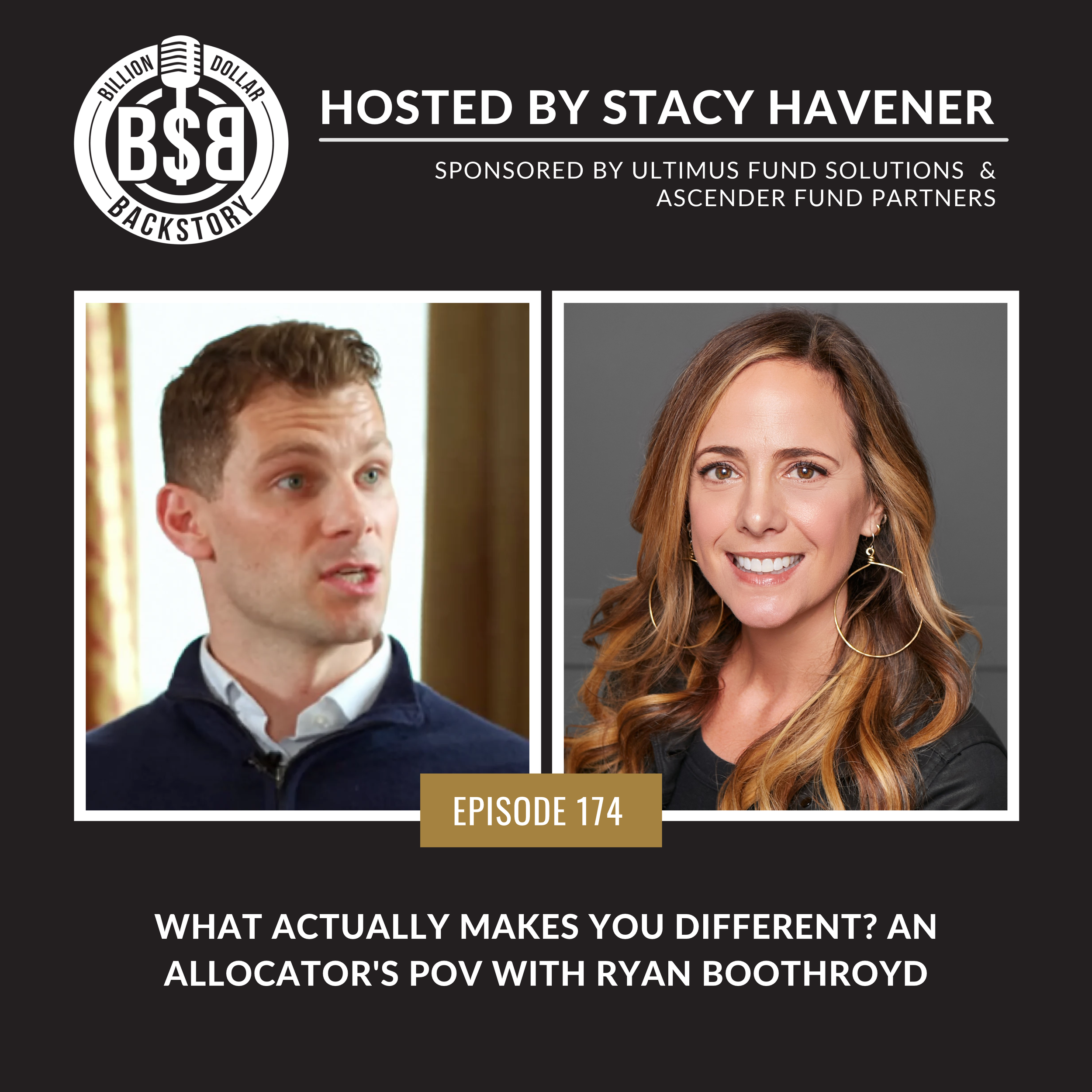
If you’re pitching an allocator who’s already seen 35 decks that look just like yours, what’s going to make them remember you?
Ryan Boothroyd put out a tender for a global equity manager and got 120 responses. Similar AUM, track records, investment teams, fees. According to Ryan, you could’ve shuffled those presentations around and the PMs probably wouldn’t have noticed.
Ryan is Head of External Management at Border to Coast Pensions Partnership, the UK’s largest pensions asset owner, with about £120 billion in collective assets. He joins Stacy Havener to get into what actually makes a manager stand out when everyone looks pretty darn good on paper.
Listen in to hear:
➤ The pitch Ryan hears over and over again that tells him almost nothing about what makes you different
➤ Where your firm’s real edge might come from (hint: it’s probably not what you’re leading with)
➤ The advantage boutique managers have that some of them are actually hiding
➤ Ryan gets 50 thought pieces a week and reads maybe one or two. What makes yours worth opening?
➤ What he looks for in your pitch deck, including one slide almost nobody includes
➤ Stacy’s trick for getting managers to finally explain what makes them different (even if she has to make them a little mad)
➤ The operational due diligence red flags that could take you out of the running, even with a great investment team
More About Ryan Boothroyd:
Ryan is responsible for external manager relationships at Border to Coast Pensions Partnership, one of Europe’s largest asset owners. His team directly manages more than £20 billion in externally managed public market investments, spanning global equities, multi-asset credit and other asset classes. Ryan joined Border to Coast in 2018 as one of the founding members of the investment team and has played a key role in building the organisation from a standing start into a £120 billion asset owner. Prior to this, he worked in multi-asset investing roles at Legal & General Investment Management and Janus Henderson Investors. Ryan lives in North Yorkshire with his wife, two children and their Shiba Inu. Outside work, you'll usually find him reading, camping or drinking more coffee than is probably advisable.
TRANSCRIPT
Below is an AI-generated transcript and therefore it may contain errors.
[00:00:00] Stacy Havener: think anyone walks into school and announces that they want to work in pensions. Ryan Boothroyd certainly didn't. He wanted to be an architect, but the seven years of university talked him out of it. And so the investment world gained a portfolio manager who also happens to write like a storyteller.
[00:00:18] Communication is actually at the core of Ryan's work. Yes, he is an investment professional who oversees the pensions of about two million local authority workers across the UK with roughly 120 billion in assets. He often works with elected committee members who are not investment professionals. That makes clear communication part of the job, because without it, there is no trust.
[00:00:42] In his role, he sits across from many asset managers. He's seen the good and the bad of their communications. He understands why different beats better, what a pitch deck should really do, and why the parts of a business that actually get you hired [00:01:00] are often the ones asset managers don't talk about. So grab a pen because you'll definitely want to take notes.
[00:01:08] This one's a gem. Meet my friend, Ryan. Hey, my name is Stacy Havener. I'm obsessed with startups, stories, and sales. Storytelling has fueled my success as a female founder in the toughest boys club, Wall Street. I've raised over 8 billion that has led to 30 billion in follow-on assets for investment boutiques.
[00:01:32] You could say against the odds. Yeah, understatement. I share stories of the people behind the portfolios while teaching you how to use story to shape outcomes. It's real talk here. Money, authenticity, growth, setbacks, sales and marketing are all topics we discuss. Think of this as the capital raising class you wish you had in college, mixed with happy hour.
[00:01:59] Pull up a [00:02:00] seat, grab your notebook, and get ready to be inspired and challenged while you learn. This is the Billion Dollar Backstory Podcast.
[00:02:14] Ryan, thank you so much for being here. I've had the pleasure of enjoying a lovely coffee with you in London, and this is the first time you're coming into the studio. It's an honor.
[00:02:26] Ryan Boothroyd: Thanks. Glad to be here
[00:02:28] Stacy Havener: So let's start with my favorite thing, which is story, backstory in particular, because we all have one.
[00:02:36] And in this industry, it's also kind of the thing no one really talks about, like the people behind the portfolios. So I'd love to hear more about your journey. Did you always know you wanted to be sitting here in the pension space or, so what did you wanna be when you grew up?
[00:02:54] Ryan Boothroyd: I, I'm not sure anyone goes, uh-
[00:02:56] goes into a school and says, "I wanna be in the pension space," right? [00:03:00] Um, I, I wanted to be an architect for quite a
[00:03:02] Stacy Havener: long time. Ooh.
[00:03:03] Ryan Boothroyd: And then, uh, I looked at it and I thought, "Hmm, seven years at university, uh, I'm not sure I can deal with that. Maybe I'll find something else." Um, but yeah. So I had a relatively standard, like, standard background.
[00:03:14] Like, uh, I don't think there's anything particularly out of the ordinary. I had a lot of sort of a real positive, you know, childhood family, et cetera, et cetera. Yeah. Which is great. Did a lot of music, a lot of kind of creative stuff. Um, so probably the, the, the, maybe the surprise, uh-
[00:03:29] Stacy Havener: Yeah ...
[00:03:30] Ryan Boothroyd: was that they didn't go in a more creative direction, I suppose.
[00:03:34] It's kind of writing and I suppose that's where the architecture came from as well. Mm. Um, but I, I decided relatively early on that I wanted to get into kind of like investment circles. So started doing economics at school, started reading the books, you know, that everyone kind of talks about. Started liking the sort of part quantitative, part psychological blend.
[00:03:53] Stacy Havener: Mm-hmm.
[00:03:53] Ryan Boothroyd: And it kind of led me down that route. And then I, I did this. Then it, it was pretty standard from there. It was university internship and then kind [00:04:00] of rolled into a fresh face as a graduate into London and, uh, kind of into an investment manager in context and went from there.
[00:04:06] Stacy Havener: Did you always work on the buy side, so to speak, or did you ever have a stint on the sell side?
[00:04:11] Ryan Boothroyd: No, always buy side. The
[00:04:12] Stacy Havener: dark side.
[00:04:13] Ryan Boothroyd: Um, the dark side. You know, I've done- ... um, I've worked in two asset managers. So I've worked on- Ah ... the commercial side and I've worked- Okay ... with two asset owners. So I've done a bit of both. Like I've seen both sides of it, which I think
[00:04:22] Stacy Havener: is helpful actually. Oh, that's interesting.
[00:04:24] Yeah, that's very interesting. And the creativity and the sort of artistic side of you, I don't know. If you don't follow Ryan on LinkedIn, you should. I think you're one of the most thoughtful writers in our space. And I also think part of it is in the way you communicate. It does have a lot of that creative, that artistic.
[00:04:45] You're a good writer.
[00:04:46] Ryan Boothroyd: Yeah. I mean, the frustrating thing was I realized I write a bit like AI and then AI came along and, uh, I've had to kind of reshape like some of my writing style.
[00:04:55] Stacy Havener: Yeah.
[00:04:55] Ryan Boothroyd: Um, because people kept saying, "You writing that with AI?" And I was like, "No, I think it's just the way that I write." No, it's always something [00:05:00] I've enjoyed.
[00:05:00] Like I think generally, like if I look at my career, I'm a perfectly good portfolio manager and perfectly good analyst, but it's the communication of, of those- Ah ... ideas which has been the, the differentiator, right? So like whenever I speak to my junior guys, I'm like, "You should sort of identify the thing that you're kind of uniquely good at versus your peers and kind of-" Yeah
[00:05:18] "lean into it." Like that's like a good general piece of career advice. And for me it's been like being able to communicate effectively. So whether it's, you know- In a kind of more creative way or actually through, you know, in a, in investment context, like being able to spell out complex things to-
[00:05:33] Stacy Havener: Mm-hmm ...
[00:05:34] Ryan Boothroyd: a variety of audiences, I suppose.
[00:05:36] Sounds a bit cliché, but that's kind of been the sort of one of the main areas of focus for me career-wise.
[00:05:40] Stacy Havener: Well, and I think that's even more important in the seat that you're in. Like, tell us a little bit about your current role, because you have a lot of constituents in the ecosystem that you're in- Yeah
[00:05:51] and not all of them have the same level of investment expertise. So talk a little bit about your current role, and then let's keep that thread going on the communication piece.
[00:05:59] Ryan Boothroyd: [00:06:00] Yeah. So, so we manage basically the, uh, defined benefit pensions for about 2 million local authority workers in the UK. So we're the UK's largest asset owner as it stands today.
[00:06:10] It's about 120 billion. But we are held to account basically by local authorities, so it'd be the equivalent of almost a state level, maybe even a sub-state level in the US.
[00:06:20] Stacy Havener: Mm-hmm. Mm-hmm.
[00:06:20] Ryan Boothroyd: Uh, and the, the pension committee's at that stage where I have to spend a lot of time going out and speaking to them.
[00:06:26] They are elected members essentially, so they're not finance professionals, they're not investment professionals. This might be someone who's worked in the local council, it might be someone who's been, you know, kind of worked in an administrative department in a school. Um, they're not typically investment experts, and so they have a lot of power and there's an important oversight role for them, but there is a skill to being able to translate some pretty complicated portfolios.
[00:06:53] If you look at some of the, you know, some of the kind of less liquid parts of our credit portfolio, for example, there's some pretty complex stuff in there, you know, that, that's kind of [00:07:00] pushing the edge of my understanding when I get into it with the PMs.
[00:07:02] Stacy Havener: Mm. Mm, yeah.
[00:07:02] Ryan Boothroyd: And so taking that out and then spelling that out for someone who might be, like, a trade union representative in a way that they can then conduct effective oversight, that's quite hard.
[00:07:10] And I think what I've seen pretty consistently throughout my career is often the most technical experienced PMs are not necessarily the best people to roll out in that scenario. Um- Yeah ... because you can actually lose a lot of trust if you get into the technical stuff quickly, because people kind of glaze over.
[00:07:29] They don't feel- Yeah ... like they're being taken along for the ride. And so that-
[00:07:32] Stacy Havener: Yeah ...
[00:07:33] Ryan Boothroyd: as you know, in this industry, like, trust is, is absolutely paramount, and if you don't have that connection with people, then you're, you, you know, you're never gonna win a mandate, you're never gonna retain capital, you're never gonna get through a difficult period of performance.
[00:07:44] So, you know, building that I think has been pretty critical and, and, and one of the big skills there is, is about stripping things back And keeping things high level and using analogies and just making it as, as plain and straightforward as you can.
[00:07:57] Stacy Havener: So that was gonna be one of my questions, because I [00:08:00] think there's gonna be a lot of nodding on yes, agreed.
[00:08:03] And even, like, I have a, a friend in London who's a family office, and they have the same setup, different constituents again, but sometimes they're talking to a patriarch or a matriarch of a family who doesn't have the same level of investment expertise or, you know, a trusted advisor to the family who doesn't.
[00:08:25] And so they struggle with, like, what do we do, especially when they bring the investment team in, how do we help them communicate more effectively? And so the how is a little bit of an art, and if you have multiple people that you're presenting to, you kind of are like, "How am I gonna meet everyone where they are?"
[00:08:40] So the analogy is great. So when you're talking about analogies, you're saying... So do you start, like, here's the investment case in a simplified way, and then take it to an analogy and make the analogy more practical, more accessible? I
[00:08:55] Ryan Boothroyd: think it's, it starts- Yeah ... even before this is the investment case.
[00:08:58] Okay. I think it's like this [00:09:00] is the role of this thing in your portfolio.
[00:09:01] Stacy Havener: Ah, yeah, yeah. So
[00:09:02] Ryan Boothroyd: it's like- Mm-hmm ... this is what you are trying to achieve at the macro level. Mm-hmm. Yep. To achieve that, you need to have X, Y, and Z as part of the portfolio.
[00:09:08] Stacy Havener: Yep.
[00:09:09] Ryan Boothroyd: For example, you need a source of growth, you need a source of income, you need some diversification.
[00:09:13] And then you can get into the more specifics from there. Mm.
[00:09:16] Stacy Havener: Mm-hmm.
[00:09:17] Ryan Boothroyd: Um, and yeah, w- what I found helpful with, you know, making analogies is being able to... You've got to balance being patronizing-
[00:09:26] Stacy Havener: Yeah ...
[00:09:26] Ryan Boothroyd: and giving them the right level of detail, right? Because- Yeah ... what you don't wanna do is come across as saying, you know, as treating them almost like a someone who's not your equal, because they have- Yeah
[00:09:36] ultimately they have the power in the relationship, and they are providing the oversight. So there is a, there is a skill to getting that, that balance right.
[00:09:42] Stacy Havener: Mm-hmm. So
[00:09:43] Ryan Boothroyd: picking... You know, you, you can't, um, you can't assume away all of the technical stuff, and if you make it too simplistic-
[00:09:50] Stacy Havener: Mm ... I
[00:09:50] Ryan Boothroyd: think sometimes you lose people from the other side.
[00:09:53] Um- Mm-hmm ... and so I think there's that narrow pathway, and I think the best way that you can do that is to kind of layer it. So if you start with something [00:10:00] relatively straightforward and foundational, you can then start to kind of drip in a little bit more technical stuff over time.
[00:10:04] Stacy Havener: Mm-hmm.
[00:10:05] Ryan Boothroyd: And by the time you get five, 10, 15 minutes in, you've kind of actually built slowly quite a strong foundation of knowledge, and then you can get into the more technical stuff.
[00:10:12] Stacy Havener: Yeah.
[00:10:12] Ryan Boothroyd: Oh, I like that. So then that's the way that I've tend to find it, find it to work. You kind of... It's a kind of slow building process. If you just go in, you know, straight away and have a very simplistic analogy, you'll find that people just be like, "You know, I'm not a child. Um, you know, I'm, I'm I'm providing a serious, you know, serious form of oversight here."
[00:10:29] Stacy Havener: Right.
[00:10:29] Ryan Boothroyd: Um, but actually if you, um, if you give them the benefit of being able to come along for the journey, you know, actually kind of build that out, I think you tend to find that it works a lot better.
[00:10:38] Stacy Havener: Yeah. Now I wanna take this to the other side. So this is when sort of you're talking with your clients.
[00:10:47] How about when asset managers come in to speak with you? You know, we're talking about the art of communication and how important that is as a skill set, and I would argue it is probably the [00:11:00] weakest skill set In our industry on the asset management side especially, maybe it's better on the wealth side and, and kind of on more of the client-facing sides, but in the investment space it tends to be really tough.
[00:11:11] And I think it's also really undervalued.
[00:11:15] Ryan Boothroyd: Yeah.
[00:11:16] Stacy Havener: Like they call it a soft skill. It's like a br- like I don't need to do that. It's performance is what matters. It's, it's, you know, do I have the chops? Do I have the investment expertise? So when a manager comes in to talk with you, like how, what, what, what do you find in the communication there?
[00:11:33] Like what are some things that are challenging? What are some things they could work on, et cetera?
[00:11:38] Ryan Boothroyd: Yeah, I mean, I, I wrote a post a while ago saying that I think over the next 10 years investment managers should, should spend as much on relationship people as they should on PMs.
[00:11:45] Stacy Havener: Mm-hmm.
[00:11:46] Ryan Boothroyd: Because the, the PM side is more likely to be commoditized than the relationship side in the world- Hmm
[00:11:50] we're moving into, to be honest. Um, in, in terms of communication, I think the, the consistent frustration I have is the inability of people to [00:12:00] articulate a true and differentiated approach. It kind of astounds me how often people present an approach which is like just en- entirely generic- ... but is like from their perspective seen as like revolutionary.
[00:12:13] It's like you can't come into a meeting and say like, "We have better analysts than other people." Right. "And like we buy good quality companies at cheap prices," and like that is your sales pitch. 'Cause it's like, well, yeah, so does everyone. Like you think- 100% ... everyone doesn't have like five Harvard MBAs like kicking around?
[00:12:30] Or like- Yeah ... you know, 300 years of, uh, co- cumulative experience- Collective, yeah ... you know, that, that kind of stuff. Yeah. Uh, so it's like I, I think the critical thing is, you know, we are paying, particularly our size, you know, we're paying millions of pounds a year for these mandates generally in
[00:12:43] Stacy Havener: fees.
[00:12:44] Ryan Boothroyd: Mm-hmm. And so it's like if you're gonna take a million, millions of pounds a year from someone, you need to have a pretty crystal clear idea of why you have a extremely strong pathway to outperformance versus- Yeah ... the market or versus your peers. And I honestly as a, you know, as a fund [00:13:00] manager, having been a fund manager in a commercial environment, if you don't believe that you have a genuine edge-
[00:13:06] Stacy Havener: Mm-hmm
[00:13:07] Ryan Boothroyd: I don't know how you get out of bed in the morning.
[00:13:09] Stacy Havener: Yeah.
[00:13:09] Ryan Boothroyd: You know, you, you know, th- there has to be some kind of thesis. You have to have enough introspection to say, "What is it about- Mm-hmm ... my particular approach-
[00:13:20] Stacy Havener: Mm-hmm ...
[00:13:20] Ryan Boothroyd: to this asset class or this type of investment strategy that means I have an advantage versus other people?"
[00:13:25] And so the way this tends to work really well is someone has been through some sort of career experience where they have realized that they look at the world differently in some
[00:13:34] Stacy Havener: area.
[00:13:35] Ryan Boothroyd: Yes. Yes. Or they see some kind of inefficiency that other people don't.
[00:13:38] Stacy Havener: Yes.
[00:13:39] Ryan Boothroyd: And sometimes it's because they've had a really random experience.
[00:13:41] They got shoved in some random bond team for a while.
[00:13:43] Stacy Havener: Yeah.
[00:13:44] Ryan Boothroyd: They were covering someone's maternity leave or something.
[00:13:46] Stacy Havener: Yeah. And
[00:13:47] Ryan Boothroyd: all of a sudden they've realized there's a particular type of the market that, particular part of the market that people, you know, consistently misvalue for some reason.
[00:13:53] Stacy Havener: Yeah.
[00:13:54] Ryan Boothroyd: And so once you've had that realization, okay, if I can consistently exploit this over time, there's excess return [00:14:00] here And then you go and build your entire process around exploiting that. You get the right data sources in place, you have screens that are specifically designed to bring that out. You are finding analysts who've also had similar realizations from whatever weird place it might be that-
[00:14:14] Stacy Havener: Yeah
[00:14:15] Ryan Boothroyd: you know, those kind of guys are available. So I think that realization, when it's done well, is the key. So when, when someone-- If I think about some of our managers now- Mm-hmm ... the ones who I have the most conviction in are the ones who've come to me often with a slightly weird idea.
[00:14:31] Stacy Havener: Yeah.
[00:14:31] Ryan Boothroyd: They say like, "Look, there's this particular part," and I'm thinking...
[00:14:34] I'm talking about bonds because this is a particular manager I'm thinking of. And they'll say, "There's a, this particular type of bond that people do not value correctly for this reason. We have seen it consistently over the past-" Mm-hmm. "... X years. Here's some data on it." So we've built an entire approach which is designed to find those bonds and get them into the portfolio, so you're getting a better risk-adjusted return than anyone else following a standard index approach.
[00:14:57] Yeah. And we've hired other people who've had [00:15:00] similar insight or are specialists in these types of bonds. We've got special relationships with certain market makers- Mm-hmm ... that we know produce them, you know, all that kind of stuff.
[00:15:07] Stacy Havener: Yes.
[00:15:07] Ryan Boothroyd: And then all of a sudden it's like, okay, we have a thesis here. We have a reason- Yes
[00:15:11] that you should outperform. It's not generic, you know, because the market is relatively efficient for the most part, right? So the assumption shouldn't just be that a few smart people outperform. That's not the way this works, right? You need some kind of way of looking at this, and that's gonna increase over time as we get- I agree
[00:15:25] more and more AI, more and more commoditization. You know, every piece of publicly available information is gonna be scrutinized to the Nth degree. So that unique perspective, like that is absolutely critical, and I don't think enough people are thoughtful enough about that, in my experience. Yeah.
[00:15:42] Stacy Havener: I-- That was awesome.
[00:15:44] I agree with you, and I think there's all this pressure on better. There's like a mindset that the way we're gonna get into this portfolio is because we're better than who they're using or who they're evaluating. And [00:16:00] really, if we let go of the better and we embrace the different, that whole idea of different is better than better, then it does a lot of things.
[00:16:09] First of all, it forces us to then, okay, if that's the game, it's different, not better, then how do I communicate and understand myself what the differences are? And it also creates an environment of it's not a zero-sum game.
[00:16:29] Ryan Boothroyd: Yeah, exactly
[00:16:29] Stacy Havener: In other words, like I can be in the portfolio, my team, my strategy can be in the portfolio alongside other things, and we could be a really good complement.
[00:16:39] And so that to me, that work is so foundational. And you know what? I have had a bee in my bonnet on this, so I'm glad we're talking 'cause now I have someone to articulate this to. So it's interesting. We have this program we do, um, that's like all of our projects start with story, and in that conversation, there's three things we work on: [00:17:00] who you're speaking to, like who's your target market, those foundational stories, and what makes you different.
[00:17:07] Okay? And so we, we kind of like pulled that out of our bigger projects and we offer it as a standalone thing. And so I was just talking with Dustin, who you know, and we were going through this and he was saying, "Yeah, you know, there's like a whole bunch of people over here who this is not a high priority for them because what they really need is sales."
[00:17:29] And so I left and I said, "Okay, so they really need sales." Well, the way you get sales is you get good at this. In other words, you could have 100 meetings, and if your story and your differentiators are shit, you're not gonna get any sales.
[00:17:45] Ryan Boothroyd: Yeah, 100%.
[00:17:46] Stacy Havener: Right? And so they don't-- They just think it's like a nice to have or someday maybe I'll do that, when really it's like, no, this is the thing.
[00:17:54] You don't get off the schneid without it. You're not gonna close deals.
[00:17:59] Ryan Boothroyd: The, the, the, like the [00:18:00] other end of the spectrum, which is just as much of an issue, is the idea that like performance alone is fine. Yeah. Like if you just perform, then that will be fine, but it's not, right? Because when you think about how an institutional process works, performance is a small component because performance, you know, we've all heard the disclaimer, you know, past- Yeah
[00:18:19] performance doesn't equal future performance. Um, and if anything, if your performance has been too good for a period of time, there's a degree of skepticism because you say, well- Agreed ... you're getting it at the wrong time, et cetera, et cetera. So like you really have to be in a narrow window with performance, and it's typically a pretty small weight.
[00:18:34] It's like a hygiene factor, but like-
[00:18:36] Stacy Havener: Yeah ...
[00:18:37] Ryan Boothroyd: the, so the, the, the, uh, you know, the equivalent to what you're saying is that, you know, people who say, "Well, this is just all about sales." But at the same time, it's not just all about returns. It's ab- you know, you've got to, you've got to give us a reason why those returns are sustainable and understandable over time and why they- Right
[00:18:52] you know, 'cause we're typically hiring people for a very specific job. It might be slightly different if you're doing a very broad type of- Sure ... portfolio [00:19:00] management and you're the only thing in the portfolio. Generally, we've got four or five of a giv- you know, managers of a given asset class, and they're typically focusing on different areas, and we want them to stick to those areas, and we want them to have a pretty consistent philosophy for why that, you know, they're well-placed to exploit, you know, the market in that particular space.
[00:19:17] And so if you don't do enough work on articulating your specific focus and why you, you know, can consistently be effective in that space over time, you're never gonna get through that sort of process because- Mm-hmm ... we can't have any sort of confidence that, you know- That's right ... you're gonna stay in your lane, for example.
[00:19:37] Stacy Havener: That's right. And so I, I really hope people-- I mean, you, you do a great job on your LinkedIn posts. We have other friends of ours that, you know, try to communicate and be helpful to asset managers on here's the work that needs to be done, and I hope more firms Take this, what is your edge? What is your different?
[00:19:57] Why should anyone care? What is [00:20:00] driving the returns, not just what are the returns? And really spend the time to do that work. I think there's also a fear. There's a fear, and I have, I have a couple credit managers that your story reminded me of, where there's sometimes, like, this elephant in the room or thing that maybe is, like, a little different or weird, like you said, and they feel bad about that thing.
[00:20:25] Like, they think if you find that thing and start looking at it, you're gonna be like, "Yuck, that's not for me. I don't want that." And so because of that, they try to just paint everything with this very vanilla brush. Like, "Don't look at the weird stuff. You know, we are just like everybody else. Doesn't that give you a lot of comfort?"
[00:20:43] When in actuality, it wor- it works against them.
[00:20:47] Ryan Boothroyd: Yeah. Well, well think about it this way, right? Like, let's go back to our, like, e-com 101.
[00:20:51] Stacy Havener: Yeah.
[00:20:51] Ryan Boothroyd: Like, if you, if you've got, like, perfect competition in a marketplace, like, it, it's gonna come down to, to basically price and some sort of [00:21:00] differentiating factors.
[00:21:00] So if you're saying we, we're gonna, we're gonna get rid of our differentiating factors- You know, you're gonna-- you know, you're not gonna out-BlackRock BlackRock, you know? Yeah. Like they're gonna do it for two basis points, you know? So like if, if you're just saying, "We're the same as these guys," it's like, well you're the same as those guys, but they've got three times more analysts and they're gonna do it for a third of the price.
[00:21:17] So good luck, you know. Um, if you're one of the big names, like, and you're competing on scale and, you know, you have vast amount of resource and it's a, it's a scale game, then you probably can get away with being pretty generic because y- that's not where you're competing. Right. But for the vast majority of managers, and I'm talking like anyone out of like the top five-plus managers-
[00:21:36] Stacy Havener: I agree
[00:21:37] Ryan Boothroyd: you know, you've gotta have some sort of differentiating factor, and that might mean that you don't win certain pitches, but you're much more likely to win some, right? That you can- Ah, 100% ... you can, you can come close in lots and never win, or you can win, you know, 20%.
[00:21:52] Stacy Havener: Yeah.
[00:21:52] Ryan Boothroyd: And winning 20% with a client that actually values you and understands what you're doing, that's like, it's way more valuable, right, from that perspective.
[00:21:58] Um-
[00:21:59] Stacy Havener: Agreed. [00:22:00]
[00:22:00] Ryan Boothroyd: Yeah. The other thing, you know, just, just to give you a bit of like feel for like how this works in like an institutional context, 'cause I know you speak to a wide variety of different people. If I go and put a tender out for a global equity manager- ... I'm gonna get 120 responses at least.
[00:22:14] They're all gonna have a billion in the strategy. They're all gonna have 10 years of track record. They're all gonna have 10, 15 people working on the team. They're all gonna do it for like, you know, a handful of basis points. So my job is to sift through all of that, and the team's job. And so when you think about that, going back to your point around hiding your differences, how are you ever gonna get out of that pile, right?
[00:22:38] If I just look through and just see the same variation, and, and you do see this. Honestly, there, there are times where you could cut up people's presentations and swap them-
[00:22:45] Stacy Havener: Just... Yeah ...
[00:22:45] Ryan Boothroyd: and the PMs wouldn't know because they're so similar, right?
[00:22:48] Stacy Havener: Yeah.
[00:22:48] Ryan Boothroyd: Ugh. And like, you know, what, what chance do you have of getting out of that pile?
[00:22:51] Um, z- you know, zero. It's randomness and maybe the odd bit of luck. And so having something a little bit more distinctive, yeah, it can be a [00:23:00] risk and there will be some, some, you know, potential prospects-
[00:23:02] Stacy Havener: Who don't
[00:23:02] Ryan Boothroyd: like it ... that don't like it.
[00:23:03] Stacy Havener: Yeah.
[00:23:03] Ryan Boothroyd: And they'll kick you out. But those prospects are gonna hire one of the top five largest asset managers anyway,
[00:23:09] Stacy Havener: you know?
[00:23:10] Exactly.
[00:23:10] Ryan Boothroyd: So you were never in the frame. So you, you've
[00:23:13] Stacy Havener: got very little- It, it was never yours to lose.
[00:23:15] Ryan Boothroyd: Yeah, exactly.
[00:23:16] Stacy Havener: So I think that is such a powerful reminder, and it does take some bravery and it does s- take some courage. You know, one of the w- when we do these interviews with managers to help them uncover their differentiators, it's so interesting to me because when we first ask them just like, "Okay, what are your differentiators?"
[00:23:36] And as I'm sure you can imagine, the responses sound like everyone else. And even when we ask more questions, it's still pretty generic. And the thing that gets them to get there Is when they get pissed off. If I f- see, like 'cause it's on a Zoom typically, if I see someone's getting a little like, if I say, "Tell me something your peers do or believe that you [00:24:00] don't," and I can see they're starting to get a little worked up, I just poke the bear on that.
[00:24:05] Because ultimately they're gonna stop trying to tell me what they think I wanna hear, and they're gonna say what actually is different. And once we get to that point, I'm like that right there, and they're like, "But I was... What?" And I'm like, "That's it And they're like, "Oh, I don't, I wouldn't..." You know, really?
[00:24:22] Like they can't believe. But it, because they're, the veneer is so thick of like do this, say this, don't talk about this over here. You have to like crack through that. It's really tough. It's tough
[00:24:37] Ryan Boothroyd: for them. But it's also, it's also where like smaller and medium-sized managers have an advantage because they're, they're not gonna get sterilized in the same way-
[00:24:44] Stacy Havener: Yeah
[00:24:45] Ryan Boothroyd: you would in a large corporate, right? You don't have like... But you know, I go to meetings at, you know, big asset managers for a pitch and there's like 12 people on the other side of the table. Like it's, it's just not, you know, it's, it's, it's so removed from like a sort of [00:25:00] authentic communication strategy-
[00:25:01] right? Like it's just a totally, you know, it's totally, you know, corporate speak at that point. So if you're a smaller manager, you don't have to deal with that stuff. You, you're not gonna get kind of-
[00:25:09] Stacy Havener: Yeah ...
[00:25:09] Ryan Boothroyd: you know, sanitized in the same sort of way. You can afford to be a little bit more authentic. And so when you go out and have that conversation, it's just so much more powerful.
[00:25:18] You know, a good example is think about thought pieces, right?
[00:25:21] Stacy Havener: Mm-hmm.
[00:25:21] Ryan Boothroyd: Uh, how many thought pieces do I get a week? I probably get 50- Oh,
[00:25:24] Stacy Havener: I can't know. ...
[00:25:24] Ryan Boothroyd: at least. Uh, yeah, maybe more. How many do I read? Maybe one or two.
[00:25:28] Stacy Havener: Yeah.
[00:25:29] Ryan Boothroyd: You think I'm reading like, you know, X, Y, Z generic macro commentary or like, you know, active versus passive?
[00:25:37] It's like no, of course I'm not gonna read that. That's not interesting or, you know. But like the sort of stuff I am gonna read is never gonna get through like compliance at like-
[00:25:45] Stacy Havener: Yeah ...
[00:25:45] Ryan Boothroyd: a large asset management, right? Because they're gonna be like, "What the hell is this? You're actually expressing a view."
[00:25:50] "Mate, we can't express views. Like we don't do that."
[00:25:52] Stacy Havener: Don't have conviction.
[00:25:53] Ryan Boothroyd: Yeah, exactly. Yeah. You know, even if you have conviction in the portfolios, you're not allowed to express it externally. And, and so the ones that [00:26:00] you read are the ones where you're like, whoa, that's a bit of a weird thing that I've never-
[00:26:03] Stacy Havener: Yeah
[00:26:03] thought
[00:26:03] Ryan Boothroyd: about reading before, you know? Here's why X, Y, Z reminds me of, you know, A, B, C and it's like- Yes ... oh, that's a weird connection. Never really thought about that before. You know, they're the interesting things and that is why... You see, 'cause I get a lot of questions when I do this sort of stuff about like, oh, you, you know, you review a lot of AUM, you know, boutiques just to kind of, you know, out of the question.
[00:26:21] And it's like, no, they're not. It's horses for courses, you know, they'll, they'll be-
[00:26:25] Stacy Havener: Yeah ...
[00:26:25] Ryan Boothroyd: they'll be appropriate in the right place. But also the, there was almost a perception that you're at like a huge strategic disadvantage, but I think there's, there's plenty of areas where you're at a huge advantage if you're a smaller manager-
[00:26:35] Stacy Havener: Yeah
[00:26:36] Ryan Boothroyd: because you, you can break free from the kind of shackles of like- Yes ... corporate life, you know, and actually express a view. I mean, you have to balance it, right?
[00:26:44] Stacy Havener: Yes.
[00:26:44] Ryan Boothroyd: It's gotta be, you know, credibility is ultimately what it's about. So authenticity, yes, but not at the expense of credibility.
[00:26:51] Stacy Havener: Oh, I love
[00:26:51] Ryan Boothroyd: that line.
[00:26:51] 'Cause sometimes you can push it too far, right?
[00:26:53] Stacy Havener: Yeah. Be
[00:26:53] Ryan Boothroyd: like very authentic can sometimes be a little bit too authentic-
[00:26:56] Stacy Havener: Yeah ...
[00:26:56] Ryan Boothroyd: if it's in the wrong way. That's right. So it's gotta be credible. Yeah. But like,
[00:26:59] Stacy Havener: you
[00:26:59] Ryan Boothroyd: know, [00:27:00] being able to show some actual personality, you know, is a good thing. And, and you think, gotta think as well about like our stakeholders who you'll eventually get rolled out to at some point if you, you know, if you're one of our managers.
[00:27:10] Like, they don't wanna see X, Y, Z polished person with a pocket square and an expensive watch, right? They wanna see someone who's kind of interesting to them, who's kind of-
[00:27:19] Stacy Havener: Yeah ...
[00:27:19] Ryan Boothroyd: got a bit of a story or, you know, a bit of a, you know, a, an, a differentiated view or is willing to say something. 'Cause the worst thing is, you know, you go to a conference or a meeting and you just kinda get like generic consensus view, and it's kinda like, "Guys, I've heard this like 10 times.
[00:27:33] Like, but that's, I can see on Bloomberg every day," you know? Just, you know, have a, have an interesting view. And as I mentioned before, you've gotta, you gotta temper it sometimes.
[00:27:42] Stacy Havener: Yeah.
[00:27:43] Ryan Boothroyd: Yeah. The, you, it's so easy to just get lost in tending to the mean. Uh, and it, it's just, it's a, you know, it's a death sentence from like a, a kind of business perspective.
[00:27:53] It,
[00:27:53] Stacy Havener: it really is. It's so true. And that kinda goes back to the same thing on like embrace your [00:28:00] weird, because if you're a boutique, if you're not one of the bigs, there's this feeling of, well, I have to pretend or act like I am them, right? Yeah. Or I feel bad because I don't have like a swath of economists and all these layers of product people and chart people and all these things, and like I don't wanna really talk about that because it's gonna be a knock on me.
[00:28:29] Where the flip side is, as is often the case, the things we think are our weaknesses are often our strengths in disguise. And so yeah, you don't have layers. Guess what that means? If Ryan has a question, he can call you.
[00:28:42] Ryan Boothroyd: Yeah.
[00:28:43] Stacy Havener: Like on a phone number that goes to you. Yeah.
[00:28:46] Ryan Boothroyd: I tell you who I get the most interesting stuff from.
[00:28:49] Who? And it's not alwa- it's not always like stuff that I wanna forward on for various reasons. But like, so we have a, we have a, um, a China boutique in- Mm. ... the east of Shanghai, [00:29:00] right? And those guys just have a totally different way. They see like the world in a totally different way to us, right? Because- Oh, that's
[00:29:04] Stacy Havener: cool.
[00:29:04] Ryan Boothroyd: Yeah ... they're, they're just immersed in a totally different like culture. And so like I get a monthly letter from the PM and like his view on like geopolitics or like what's going on in the world is always interesting because he's just like- Yeah ... he's not immersed in like, you know, the same media as everyone else- Yes
[00:29:19] Stacy Havener: and
[00:29:20] Ryan Boothroyd: the same kind of customs and, you know, he has clients that are from... You know, he's not just got a, a set of large European pension schemes as clients, right? He's got a, a really wide range of clients, and he's quite authentic, and it's a small manager. So like th- that, that stuff is... I read it every single time, whereas like- That's awesome
[00:29:33] there are several managers that like I'll never even bother reading their updates because- Right ... I just think, well, it's, you know, it's, it's just sort of generic-
[00:29:39] Stacy Havener: Yeah ...
[00:29:40] Ryan Boothroyd: verbiage, um, that's been kind of through,
[00:29:42] Stacy Havener: uh- I think commentary is a great place to let some of this out. Let's be real. No one wakes up and says, "I can't wait to build some operational infrastructure today."
[00:29:52] You're here to manage money, to build something that lights you up, not chase down reports across five systems and [00:30:00] 15 service providers. That's where Ultimus Fund Solutions comes in. They're your ops dream team, consolidating all your middle and back office chaos into one clean, scalable setup. Registered funds, private funds, SMAs, all integrated.
[00:30:19] One team, one tech platform, one rock solid source of data. But here's the real differentiator: service. I know that fund in a box sounds convenient. It's also a box. Know what you can't put in a box? A human who picks up the phone when you call and need help Real-life people who know your name and your fund, and they care about getting it right.
[00:30:44] Ultimus was built on people doing business with people. You get institutional strength combined with boutique-level service without getting stuck in a phone tree of doom. If you're ready to simplify, scale, and start working [00:31:00] with a team that feels like an extension of yours, check out billiondollarbackstory.com/ultimus.
[00:31:07] That's U-L-T-I-M-U-S. You've got the investment strategy, the vision, the track record. Now it's time to upgrade the engine behind it all with Ultimus You know, I have a question 'cause you mentioned mid-size managers, and this is something I've been thinking about a lot because that's kind of purgatory right now it feels like.
[00:31:33] You know, you have the spectrum of boutique to big, and then you have this, like, middle zone, and the spectrum is just becoming more and more bifurcated, right? I think if you're a boutique and you specialize in something, that's an advantage. I think if you're big and you don't specialize, you're just good at lots of things and you can do it at a very, very reasonable price, fine.
[00:31:57] But the middle, what's your perspective on [00:32:00] what's happening to those, that middle ground? Are they at risk of just-
[00:32:05] Ryan Boothroyd: I think we need to separate it a little bit. So-
[00:32:07] Stacy Havener: Okay, let's do it ...
[00:32:08] Ryan Boothroyd: the conflation that often people make is that the mid-size manager is the sort of manager that's not offering a lot of value.
[00:32:14] Okay. So they are running a load of active equity which has underperformed the benchmark for 10 years and you're gonna pay a percent for it. Or they're, you know, they're doing generic fixed income with, like, very little differentiation. Okay. Like, I don't have a lot of, I don't have a lot of time for that as a- No
[00:32:31] as a strategy. But like I, that, that is a problem, right? Because you are gonna get competed on cost from one end, you're gonna probably get competed on alpha from another end. Yeah. You're like... But the, the, the, the core issue is not your size. The core issue is that you're not offering value.
[00:32:47] Stacy Havener: Yes.
[00:32:47] Ryan Boothroyd: I think if you're a mid-size manager where you have a range of quite quirky and interesting strategies that have got good performance or, um, a, are really kind of competing in a very specific way or have captured a [00:33:00] specific kind of inefficiency in some way, you can absolutely be a mid-size manager.
[00:33:03] You know, you can be 80 to 100 billion whatever and, and have a... But it's perfectly viable. Like you don't, it's not like it's, uh, not viable to run a business like that. Of course it is. I think the, yeah, the, the key is, has been, is, is whether or not you're offering value. I think the other thing has been in some instances I can think of, you've had managers that have grown the cost base-
[00:33:26] Stacy Havener: Hmm
[00:33:26] Ryan Boothroyd: too quickly. So you've got a lot of mid-size managers and the reason they're not viable is not because they're not bringing in money, it's because the profitability of the business is not great. Yeah. And it's because they've got, they've got bloated, right? Mm-hmm. They've allowed things to just... You know, I was looking at one manager the other day.
[00:33:41] I was like, how does this manager got nearly 2,000 staff Like it's insane. Like the AUM's similar to Borders Coast and we've got 250 staff. I know it's not quite the same, but like- Yeah, but still ... there's a big difference between 250 and 2,000, right? And so like making sure you've got the right like cost structure in those.
[00:33:57] You know, if you, if you're lean as a business and well run [00:34:00] and you've got interesting strategies doing interesting things, you can be a mid-size manager I think isn't a problem at all. I think the issue we have is there's been a lot of kind of, you know, big generic managers that have not really added a huge amount of value and, you know, haven't really had any differentiating factors.
[00:34:14] And as a result, they've just had consistent outflows and-
[00:34:17] Stacy Havener: Mm-hmm ...
[00:34:18] Ryan Boothroyd: it's become profitability. You know, profitability's become a problem. But I don't think being mid-size alone is- Is the
[00:34:24] Stacy Havener: issue ...
[00:34:24] Ryan Boothroyd: is, is an issue, right? It's a broader- Yeah ... issue typically. Because you can get great-- You can get huge managers that are, are not viable businesses.
[00:34:31] You can get tiny managers that aren't, right?
[00:34:32] Stacy Havener: 100%.
[00:34:33] Ryan Boothroyd: It's, it's really a broader... I think it's a broader question.
[00:34:35] Stacy Havener: It is, and it, it... I love this. And also it's a challenge, I think, to those mid-size managers to say, what game are you trying to play? Yeah. So I think a lot of them reach a certain size and they say, "Oh, well, we're playing the BlackRock game."
[00:34:50] Ryan Boothroyd: Yeah.
[00:34:51] Stacy Havener: And that's-
[00:34:52] Ryan Boothroyd: I, I think the, the- That's a
[00:34:53] Stacy Havener: disservice ...
[00:34:55] Ryan Boothroyd: there are very few institutions that can compete in that space in a big way. And [00:35:00] so if I was speaking to the CEO of that type of organization You've gotta have a very strong thesis for why you think you can get into that space and compete in a big way.
[00:35:09] Because the compounding alone means that catching those big guys is huge. You have a 10% market year, those guys have added another 100 billion to-
[00:35:17] Stacy Havener: Yeah ...
[00:35:17] Ryan Boothroyd: their AUM. So it's like you've really gotta think it through. I think the, the probably the more sensible approach in that space is for them to more, more take a more honest look at the fund range and say, "What do we need to get rid of?"
[00:35:28] Stacy Havener: Yes.
[00:35:29] Ryan Boothroyd: Like, "What do we need to prune in this space?" And that probably feels pretty grim, right? Because if you're
[00:35:33] Stacy Havener: a- Yeah ...
[00:35:33] Ryan Boothroyd: if you're the CEO of an asset manager, you're like, what you like to kind of brandish when you walk into a cocktail party with all your fellow CEOs is your AUM, right? Like, that's the-
[00:35:41] Stacy Havener: Yeah
[00:35:42] Ryan Boothroyd: that's the big thing. But, you know, your, your profitability's much more, uh, interesting than the AUM alone, right? And so, you know, and, and the long-term viability of the business. And if that means you have to kind of, you know, chop and change a little bit, I think that's fine. Also, picking up the odd interesting team from somewhere else.
[00:35:58] You know, it's not the case, necessarily the case that you [00:36:00] wanna... I think the, the, the real thing that stresses me out is, like, two mid-size generic managers merging and assuming that that means they're a great, like, large manager. So you're
[00:36:08] Stacy Havener: just like- And that's happening ...
[00:36:09] Ryan Boothroyd: you're just a stodgier- Oh ... less focused mid-size manager, right?
[00:36:14] Like, it's just that is not, yeah. That is, that doesn't fill me with
[00:36:18] Stacy Havener: joy when I see that. No. Oh, gosh, no. I agree with you. I agree with you. I think it's a tough spot to be in. Um, you know, I, I loved your comment on profitability because I also think, again, regardless of asset size, there is a perception that due diligence doesn't include the business itself.
[00:36:39] Ryan Boothroyd: Definitely not.
[00:36:39] Stacy Havener: Yeah, that's not true.
[00:36:41] Ryan Boothroyd: Particularly if you're a smaller manager.
[00:36:42] Stacy Havener: Yes. '
[00:36:43] Ryan Boothroyd: Cause you, you, you know, if we particularly, you know, we have this, when we make a, you know, our average allocation is, is probably 500 to a billion. Mm-hmm. Um, and if you're then all of a sudden a third of someone's revenue, that's a problem.
[00:36:57] If they are only in one space and that [00:37:00] space is very volatile, so their revenue can fluctuate massively year on year, and so you can-- you get two, two bad years on their own, it's like there's viability questions over the, you know, going concern of the business. That's a problem, right? So yeah, I mean, we...
[00:37:13] the, the way that we tend to do it is we'll have the investment due diligence phase first, and then there's a, there's a whole other operational due diligence phase.
[00:37:22] Stacy Havener: Yeah.
[00:37:22] Ryan Boothroyd: And a lot of that stuff is as important. And I mean, this is the this is what I was thinking when you were talking about, you know, about BlackRock or whatever.
[00:37:29] There are some ways that it's good to emulate large asset managers, like having good quality internal controls- Mm-hmm ... and risk mechanisms. Don't put your wife on the board. You know, I, I laugh, but we've-- I've seen it. Don't put your wife on the board. You know, have a separate- ... have a separation of compliance from the investment team, you know.
[00:37:49] Stacy Havener: Yeah- The, the basics- ... don't make your head trader- Yeah ... the CCO. Yeah.
[00:37:51] Ryan Boothroyd: Yeah. Yeah, exactly. Yeah. Don't do that stuff. And, and from that perspective, that is when you do wanna emulate, you know-
[00:37:56] Stacy Havener: Yes ...
[00:37:57] Ryan Boothroyd: bigger organizations because they do that stuff for a reason and, you [00:38:00] know, they're very highly regulated, et cetera, et cetera.
[00:38:02] But that stuff comes up, you know, and it comes up and it can stop you getting hired. We've had instances where great investment organizations have fallen down because they haven't done enough on everything else. And- Yeah ... the, a real, a real danger of this is when you've spun out and started your own firm-
[00:38:20] Stacy Havener: Yeah
[00:38:20] Ryan Boothroyd: and you wanna be everything. You're the CEO, you're the lead portfolio manager, you're the CIO. You know, you're doing all of the pitch. You're shutting down your other employees when they're trying to speak in the pitch.
[00:38:32] Stacy Havener: Oh,
[00:38:32] Ryan Boothroyd: gosh. You know, it's just like, it's the, it's the XYZ person show, and you really need to think about that.
[00:38:39] It's really hard because the types of people who spin out and start their own asset management businesses are, like, highly invested in it working. Yeah. But also, if it looks like one person is running the entire show, and if anything happens to them- Mm-hmm ... the whole thing collapses, that's tough as well.
[00:38:54] Stacy Havener: Yeah.
[00:38:55] Ryan Boothroyd: Right? So a lot of that stuff doesn't get a huge amount of [00:39:00] attention because people are rightly focused on the portfolio and getting the investment returns. But there's a whole wider thing that need- Yeah ... that, that just like a set of hygiene factors, particularly if you're going for like bigger mandates that-
[00:39:11] Stacy Havener: Yeah
[00:39:12] Ryan Boothroyd: is gonna get a lot of scrutiny. 'Cause if we have to restructure a portfolio- That's gonna cost us like 10, 20, $30 million, right? In trading costs and everything else. So if we're going into a situation where there's a pretty significant kind of potential risk from a personnel perspective or a business perspective, that's gonna be a massive red flag.
[00:39:31] You know, 'cause I-- when I look at it, I'm thinking, "Well, that's a cost down the road."
[00:39:34] Stacy Havener: Yeah. And I, uh, and I think your, your spin-out or kind of the newer firm, regardless of size even, what your plan is to build that business matters.
[00:39:48] Ryan Boothroyd: Yeah, 100%.
[00:39:49] Stacy Havener: You know? Like I was on a board of a firm that spun out, it should've been a great success story, but to your point, they kinda came out and they were like, "We're gonna launch four strategies," like day one.
[00:39:59] Ryan Boothroyd: [00:40:00] Yeah, no, don't do that.
[00:40:01] Stacy Havener: It-- Right. And so, a-and they're like, "Well, what, why, why does anyone care?" And it's like, because look at-- You just started. You have this many people. Like now you have four strategies? And so they don't think about some of these business components that matter. So I think that's very good advice.
[00:40:19] I want to ask you, I printed out one of your LinkedIn posts. Um, again, I already said I love your LinkedIn. People need to follow you on LinkedIn. Okay. So this one is about what makes a good pitch deck, and you gave some great advice here that all asset managers should read. Can you... I have this here. I can ask specific questions, but I'll just give you the, the floor on, you know, what makes a good pitch deck, in your opinion?
[00:40:50] Like, if you had just, like, three, one to three things that you could say, "Hey, here's what you really need to focus on."
[00:40:57] Ryan Boothroyd: Yeah. I mean, I think-- I'm trying to remember the exact things [00:41:00] that I wrote, but I think the, um, the lack of ambiguity is big.
[00:41:04] Stacy Havener: Yes, that's one.
[00:41:04] Ryan Boothroyd: So, like, don't assume that I'm gonna pick up the nuance in your investment strategy.
[00:41:09] Yeah. Tell me what the, the differentiating thing is.
[00:41:11] Stacy Havener: Just tell me.
[00:41:12] Ryan Boothroyd: Yeah. Yeah. You know? Because I'm gonna read, like, 50 of these, and I'm probably losing- Yeah ... the will to live by, like, number five. Um, so, like, don't assume that we know. Just, like, be explicit about it. Have a structure that is aligned to the way that this is gonna be scored or reviewed.
[00:41:28] So I should be able to follow the entire process from start to finish through the deck, in an ideal world. Um, use a good case study. Like, you'd be amazed how-
[00:41:38] Stacy Havener: Yes ...
[00:41:39] Ryan Boothroyd: few people do this. It's like, show me how a stock has gone from position A-
[00:41:43] Stacy Havener: Yes ...
[00:41:44] Ryan Boothroyd: all the way through to the portfolio. Like, why did you find it?
[00:41:47] How did it come through the screen? What did you do? Did you do X, Y- Yes ... Z, et cetera. What is in the portfolio? How big is it? Et cetera. When did it get sold? You know, that, that... There are very few people who do that well, but it's, it's, it's the obvious slide. You've gotta have that slide in there- I agree ... as far as I'm concerned, right?
[00:41:59] Because [00:42:00] it's gonna, it's gonna contextualize the whole thing. Because what are we looking for when we do this stuff? We are looking for... Well, we've, we've talked a lot about the edge stuff, so I'm not gonna get into that. Yeah. That's kind of- Yeah, that's in here ... that's kind of table stakes.
[00:42:10] Stacy Havener: Yep. Yep.
[00:42:10] Ryan Boothroyd: But, like, we are then looking for how you have built a robust process such that- That's r-
[00:42:15] you can realize the value- Yes ... that that edge creates, right? And we need to see some sort of consideration of it, and it can be... And it's sometimes way too generic. Like, if it's just like, "We have a screen, the analyst looks at it." "It goes in the portfolio 3%." Like, that's like- That is very common. That's like 75% of all clients'
[00:42:31] Stacy Havener: decks.
[00:42:32] That's like this f- inverted funnel-
[00:42:33] Ryan Boothroyd: Yeah, yeah, the funnel. Everyone
[00:42:34] Stacy Havener: has a
[00:42:34] Ryan Boothroyd: funnel,
[00:42:34] Stacy Havener: yeah ... and then we-- Oh, yeah, everyone has that. Yeah.
[00:42:36] Ryan Boothroyd: It's like, wow, you screened on, on return on equity and
[00:42:38] Stacy Havener: margins. Well, good. Okay, that's helpful. Love that. Great. Mm-hmm.
[00:42:41] Ryan Boothroyd: Awesome. Uh, th- you know, great, you know. Uh, so it's like having that kind of consistent structure I think is, is, yeah, is pretty key.
[00:42:48] And then also you need to f- you need to tailor it depending on how it's being used. So there are
[00:42:53] Stacy Havener: times- Hmm. Tell me more about that. I noticed that in here. Yeah ...
[00:42:56] Ryan Boothroyd: there are times in a process where we will use a pitch deck as an initial screening [00:43:00] mechanism, and we'll say- Oh ... you can submit a 10-page screen-- uh, a 10-page pitch deck before you get to RFP stage.
[00:43:06] So what are we doing with that? We are using that as a concise, relatively quick way to understand the strategy. That is not something that needs to be presented. It's not something that you would stand in, on a stage and give. That is essentially a much more informative, much more... You've got a lot more liberty to like include information in- Yeah
[00:43:27] that type of context. If you're going and doing a conference and it's a pitch- Right ... you know, as a, it's a manager pitch, that's gonna look very different. And I know that seems obvious, but what you often find is that there's one set of slides for the fund-
[00:43:40] Stacy Havener: Mm-hmm ...
[00:43:40] Ryan Boothroyd: that lives in SharePoint, and whenever you get asked to share a pic d- pitch deck, you just get the slides and you send the slides, right?
[00:43:47] You need to be tweaking it pretty much every time-
[00:43:50] Stacy Havener: Hmm ...
[00:43:51] Ryan Boothroyd: to some degree. Because when you're-- Let, let's take an example, right? You're applying for something with us. We have typically put out a lot of stuff historically about, you know, [00:44:00] documentation that we'll use, like scoring mechanisms, things we look for in managers.
[00:44:03] You can look at our existing managers.
[00:44:05] Stacy Havener: Yeah. You
[00:44:05] Ryan Boothroyd: can think about our policies on our website, responsible investment, all this kind of stuff, right? That's gonna look different to you submitting to a Swedish pension fund. You might say they're both big European pension funds. What's the difference? Well, they've got a totally different way of thinking about X, Y, Z.
[00:44:21] They might have a totally different manager lineup. They have different things that they like to look at. It doesn't need to be a wholesale rewrite, but there's definitely value in some, some marginal tweaking, and it's so obvious when you read it if it's just the generic one. And I've seen this in, I've seen this in practice- Yeah
[00:44:35] in asset managers, because the way it works in bigger asset managers is there's like a selection of slides that have been compliance approved-
[00:44:42] Stacy Havener: Mm-hmm ... and
[00:44:43] Ryan Boothroyd: they live in like a database.
[00:44:44] Stacy Havener: Yeah.
[00:44:45] Ryan Boothroyd: And so you say, "Oh, I need a 10-page pitch deck." So you're getting like one, two, three, four, five, six, generate, boom, done.
[00:44:49] Compliance approved, off it goes. Send it out. But it's like, yeah, well that's the gener- they're the generic slides. Like they're, they're the ones you've been using for five years probably, and you've- Yeah ... not really kind of tweaked, and they're not, they're not bespoke in [00:45:00] any way. So what I was trying to get at with that is that actually, like there's not one pitch deck, right?
[00:45:05] There's different versions of it depending on what it's doing, who it's for, et cetera, et cetera.
[00:45:09] Stacy Havener: I, I, this is-- I'm gonna be thinking about this because I totally get what you're saying, and you're right, and at the same time, there's a part of me that's like, I don't like the multiple pitch deck idea. But here's what I d-- So here's what I, I have to...
[00:45:26] This is my homework. I have to think about this- Yeah ... 'cause you're really challenging me here. Um, what I think is interesting about that process from a behavioral science perspective is almost like when you're trying to h- like find someone for your team and you say, "Yes, please send this, and also title it this," right?
[00:45:45] Like you give them some specific thing that you want them to do, and then you see who actually does said thing. So like for example, if you say, "I want a 10-page pitch deck," and someone sends you their generic off-the-shelf 45-page pitch deck, in my [00:46:00] mind that's like a you're out. Yeah. You just like totally, like you're gone.
[00:46:04] And so I do think in something like this, and for a firm like yours and the, the size of mandates that you do, it's almost like there are certain prospects where they are sort of forcing you, their due diligence process involves bespoke or custom work. And for that, like take the time. I think one of the things that's frustrating me lately, another bee in my bonnet that I've been thinking about on my walks is like, have we all just gotten so darn lazy?
[00:46:35] Like even when you said you can go on our website and you can see managers we've hired, what's important to us, what our philosophy is, things we like, all of that stuff. How many people do you think actually do that work?
[00:46:47] Ryan Boothroyd: I'll let you zero. Maybe, maybe two. And it's like guys- But like what are we doing?
[00:46:51] it's like, well, if we win this, you're gonna get paid £2 million a year for the next 10 years. It's like you could probably send your analyst for half an hour to like have a look around. [00:47:00] You'd be amazed how many managers I speak to and they still don't know like who's managing the equivalent mandate for us now.
[00:47:07] And it's like, what, like, like do you know, like like with AI and everything else. Yeah. It's like, come on. Like it's like it's basic stuff. And I mean, I'm not trying, you know, I'm not trying to be like egocentric here, but it's just, it's just like good... It's just good, you know, if you were gonna go and pitch any kind of business to someone, you surely you want an understanding of like, you know, what they like and they don't like, et cetera, et cetera.
[00:47:29] So I mean, I mean to your point, I think if you're, if you're sending a very high level elevator pitch style deck-
[00:47:36] Stacy Havener: Yeah ...
[00:47:36] Ryan Boothroyd: and, and a lot of the core slides, you know, it's perfectly fine for them to be similar, right?
[00:47:40] Stacy Havener: Yeah.
[00:47:41] Ryan Boothroyd: Or the same. Like if you've got a very specific way of articulating the process, you've spent a lot of time and effort on it and it works for you-
[00:47:45] Stacy Havener: Yeah
[00:47:46] Ryan Boothroyd: I think that's fine. It's more like typically the things that you are then sliding in to sort of package that up or, you know, for example, it'd be quite common or if you've got similar clients to us-
[00:47:56] Stacy Havener: Mm-hmm ... for example.
[00:47:57] Ryan Boothroyd: Yeah. You, you know, you might work with a peer somewhere [00:48:00] and you-
[00:48:00] Stacy Havener: Yeah ...
[00:48:00] Ryan Boothroyd: uh, are gonna provide them a say reference 'cause we'll ask for references when you do this
[00:48:04] sort
[00:48:04] Ryan Boothroyd: of stuff.
[00:48:04] Yeah. Then like having a slide which is like how we work with, you know, these types of clients.
[00:48:10] Stacy Havener: I love that idea. 'Cause
[00:48:11] Ryan Boothroyd: it's like, there's like a social proof, right? It's like, so I know that this person can deal with a large European pension scheme and all the stuff we're gonna ask for, which is gonna be really annoying because I don't know if XYZ manager can deal with that stuff because, you know, they might not have, you know, we've got a lot of, we're quite demanding when it comes to things like reporting, et cetera, et cetera.
[00:48:28] So yeah. That's a
[00:48:30] Stacy Havener: great suggestion. I think, I think there's, there's just like
[00:48:31] Ryan Boothroyd: small bits like that.
[00:48:32] Stacy Havener: Yeah. Those are great suggestions. I have loved this conversation. You know what I love most about these types of conversations is we had a set of stuff we wanted to talk about and I don't know, maybe we started there and then we just- Yeah.
[00:48:45] kind of went into all the directions and it was, those are my favorite. So thank you. Yeah. This has been such a great conversation. I wanna end with a couple more questions just about you. Um, okay. So- Are you ready? They're not like [00:49:00] fast fire, but they're kind of-ish.
[00:49:01] Ryan Boothroyd: Okay. Let's do it.
[00:49:02] Stacy Havener: Okay. What book inspires you?
[00:49:05] Does not have to be a business book, but it can.
[00:49:08] Ryan Boothroyd: Yeah, no bus- no business book. So David Brooks, who writes for New York Times.
[00:49:11] Stacy Havener: How-
[00:49:12] Ryan Boothroyd: How to Know a Person.
[00:49:13] Stacy Havener: Yes, I have that book on my shelf.
[00:49:15] Ryan Boothroyd: That's a great, it's a great book.
[00:49:16] Stacy Havener: Okay.
[00:49:16] Ryan Boothroyd: Uh, you will think about your relationships with your friends and family very differently when you-
[00:49:20] Stacy Havener: Wow
[00:49:21] Ryan Boothroyd: and just members of the public when you read that book. Yeah, I really enjoy it.
[00:49:23] Stacy Havener: Okay, I'm bringing that with me this weekend.
[00:49:26] Ryan Boothroyd: It's a good one.
[00:49:27] Stacy Havener: Plane. Yeah, I'm gonna read that.
[00:49:28] Ryan Boothroyd: Very easy to read as well.
[00:49:29] Stacy Havener: Okay, great. Okay, going from books to places, what place inspires you?
[00:49:36] Ryan Boothroyd: Uh, I'm a, I'm a mountain guy. I like being in the mountains.
[00:49:39] Stacy Havener: Mm.
[00:49:39] Ryan Boothroyd: Uh, in the Alps, you know, summer or winter. I did, I did, uh, summer Austria a couple years ago, and it was just, yeah, it was just awesome. You know, you kind of can't really beat the scenery, the fresh air, everything else. Yes.
[00:49:51] Stacy Havener: Yeah.
[00:49:52] Ryan Boothroyd: It's great.
[00:49:52] Stacy Havener: The perspective. I think there is something about, like- Yeah ... being able to see far, which when you're in
[00:49:58] Ryan Boothroyd: the city- There's something about being-
[00:49:59] Stacy Havener: Yeah
[00:49:59] Ryan Boothroyd: very small [00:50:00] as well.
[00:50:00] Stacy Havener: Yeah.
[00:50:01] Ryan Boothroyd: And, you know-
[00:50:01] Stacy Havener: Yeah ...
[00:50:02] Ryan Boothroyd: kind of inconsequential and thinking actually-
[00:50:03] Stacy Havener: Yeah. Yeah, I love that too. Yeah. Different perspective. I, I have that feeling when I look at the ocean and, like, it's just so vast and you're like, "Gosh, this is just..." It, it helps you dream, I think. Um, okay, a fun one.
[00:50:16] Maybe you're giving a talk in Wembley, um, and you've a stadium full of fans. You are taking the stage. What's your walkout anthem?
[00:50:26] Ryan Boothroyd: Uh, so I'm, I'm a big heavy metal fan, so I'm gonna go- Yes ... I'm gonna go with some Metallica maybe. I think I'm gonna go Enter Sandman by Metallica. Um- Yeah.
[00:50:35] Stacy Havener: Oh,
[00:50:36] Ryan Boothroyd: what
[00:50:36] Stacy Havener: a classic ... for
[00:50:37] Ryan Boothroyd: the, for the dads.
[00:50:37] It's
[00:50:37] Stacy Havener: so good.
[00:50:38] Ryan Boothroyd: Yeah. Yeah. Exactly. Uh, yeah. I think that, uh, mix it up a little bit.
[00:50:43] Stacy Havener: Oh my gosh, I love... It's so interesting what people listen to. I find that just, like, m- musical taste is, it's good.
[00:50:51] Ryan Boothroyd: Yeah, I get a lot of, uh- It's good. Okay ... I get a lot of weird looks with, uh, some of my music tastes generally.
[00:50:56] Stacy Havener: It's so good though. It's so interesting. Okay. What [00:51:00] profession other than your own would you like to attempt?
[00:51:04] Ryan Boothroyd: Uh, I'd like to write a science fiction book
[00:51:07] Stacy Havener: Okay. That was not what I was expecting, but you are a great writer, so I do see that. There's
[00:51:14] one
[00:51:14] Ryan Boothroyd: in there somewhere. There's one in there somewhere.
[00:51:15] Stacy Havener: Yes.
[00:51:16] Ryan Boothroyd: When I have time when I don't have- This is
[00:51:17] Stacy Havener: so good. Okay ...
[00:51:18] Ryan Boothroyd: two little kids.
[00:51:19] Stacy Havener: What profession would you not like to do?
[00:51:22] Ryan Boothroyd: Uh, anything to do with dri- driving. So I'm, I get travel sick- Oh, no ... which frustrates the hell out of me because, like, these people who can just, like, go on a road trip for eight hours and read a book, like-
[00:51:31] Stacy Havener: Yeah.
[00:51:31] Oh ...
[00:51:31] Ryan Boothroyd: it's crazy. I have to, like, sit staring perfectly forwards.
[00:51:34] Stacy Havener: Oh, I'm sorry. That sound- So like- What about boats? Same?
[00:51:37] Ryan Boothroyd: Oh, yeah. Oh, yeah, even worse. Um, so yeah, anything that involves large, large amounts of transport. We can do planes, we can do trains.
[00:51:44] Stacy Havener: I was just gonna ask about planes.
[00:51:45] Ryan Boothroyd: Planes and trains
[00:51:46] Stacy Havener: are okay.
[00:51:46] So plane is your... Planes and trains, but cars and boats-
[00:51:49] Ryan Boothroyd: Yeah, no cars and boats. Definitely no boats.
[00:51:52] Stacy Havener: Ah. This is why it's good that you're in the city. You just walk.
[00:51:55] Ryan Boothroyd: Yeah, exactly.
[00:51:56] Stacy Havener: Yeah. Okay.
[00:51:57] Ryan Boothroyd: I live on an island, which is a bit of a downside when you don't like boats, but... [00:52:00]
[00:52:00] Stacy Havener: Yeah, that is. And of course, I was trying to get you to come to Block Island.
[00:52:03] You were, you should've been like, "No, I'm not getting on a boat, but thank you for the offer."
[00:52:07] Ryan Boothroyd: I thought about it. I honestly
[00:52:08] Stacy Havener: did. Yeah. I mean, it is lovely. Open invitation. Um, okay, last but not least, and this is a long ways away from now, what do you want people to say about you after you've retired or left the industry?
[00:52:21] Ryan Boothroyd: You, you reflecting on this whole conversation, I'd like to think that they reflect, you know, people thought that I at least attempted to think outside the box a little bit- Mm ... and push some, like, interesting ideas. I think there's- Mm-hmm ... there's a lot of, you know, a lot of people just kind of go to work and it's very focused and linear, and they just kind of, that is their thing, and that's perfectly fine.
[00:52:42] But I, you know, I find that a little bit restricting, so I like to try and, you know, think a bit bigger. And I think that's one of the things I've enjoyed about doing a little bit more of the LinkedIn stuff. I've started to kind of, you know, dabble in the odd bit of, like, slight futurism with some of this stuff and just, like, thinking about-
[00:52:57] Stacy Havener: Ooh,
[00:52:57] Ryan Boothroyd: yeah
[00:52:58] five, 10 years' time. Uh, I'm doing a [00:53:00] keynote at a conference next week, which is kind of that sort of vibe, kind of like thinking, you know, the next decade or whatever. And so, like, I'd like to, yeah, I suppose being seen as someone who is kind of insightful and thought a little bit, you know, more creatively outside the box would be good.
[00:53:13] Stacy Havener: Isn't it funny how it all comes for full circle? Yeah. Because when you started the conversation, you said, you know, "I had all this creativity and music and art and all this stuff," and, and in a weird way, how those things still show up for us regardless of what path you've taken. You can
[00:53:27] Ryan Boothroyd: channel it, right?
[00:53:28] You can channel it.
[00:53:29] Stacy Havener: Yeah.
[00:53:29] Ryan Boothroyd: And, and you can come out in unexpected places. Um-
[00:53:32] Stacy Havener: Yeah ...
[00:53:32] Ryan Boothroyd: I think there's, there's a bit of a misconception sometimes that if you work in a technical field, you can't be creative, but I think that's-
[00:53:37] Stacy Havener: Yeah ...
[00:53:38] Ryan Boothroyd: absolutely wrong.
[00:53:39] Stacy Havener: And I think it, it also ties to what you were saying about embracing kind of you're different and you're weird and the thing that, that makes you unique and, and you have that.
[00:53:48] You have that. And even the science fiction book, like, it's all so cohesive to me. Thank you for this, Ryan. That is so great. I look forward to hearing about your, um, [00:54:00] keynote. And if people wanna connect or follow along, we talked about LinkedIn. Is that the best place?
[00:54:05] Ryan Boothroyd: Yeah, yeah, that's the best place. For sure.
[00:54:06] Stacy Havener: Okay. Wonderful. Thank you so much for being here.
[00:54:09] Ryan Boothroyd: Thanks for having me.
[00:54:11] Stacy Havener: This podcast is for informational purposes only and should not be relied upon as a basis for investment decisions. The information is not an offer, solicitation, or recommendation of any of the funds, services, or products, or to adopt any investment strategy.
[00:54:25] Investment values may fluctuate, and past performance is not a guide to future performance. All opinions expressed by guests on the show are solely their own opinion and do not necessarily reflect those at their firm. Managers' appearance on the show does not constitute an endorsement by Stacy Havener or Havener Capital Partners.


Resources