
Subscribe to Billion Dollar Backstory on Apple Podcasts, Google Podcasts, Spotify, or wherever you listen to podcasts.
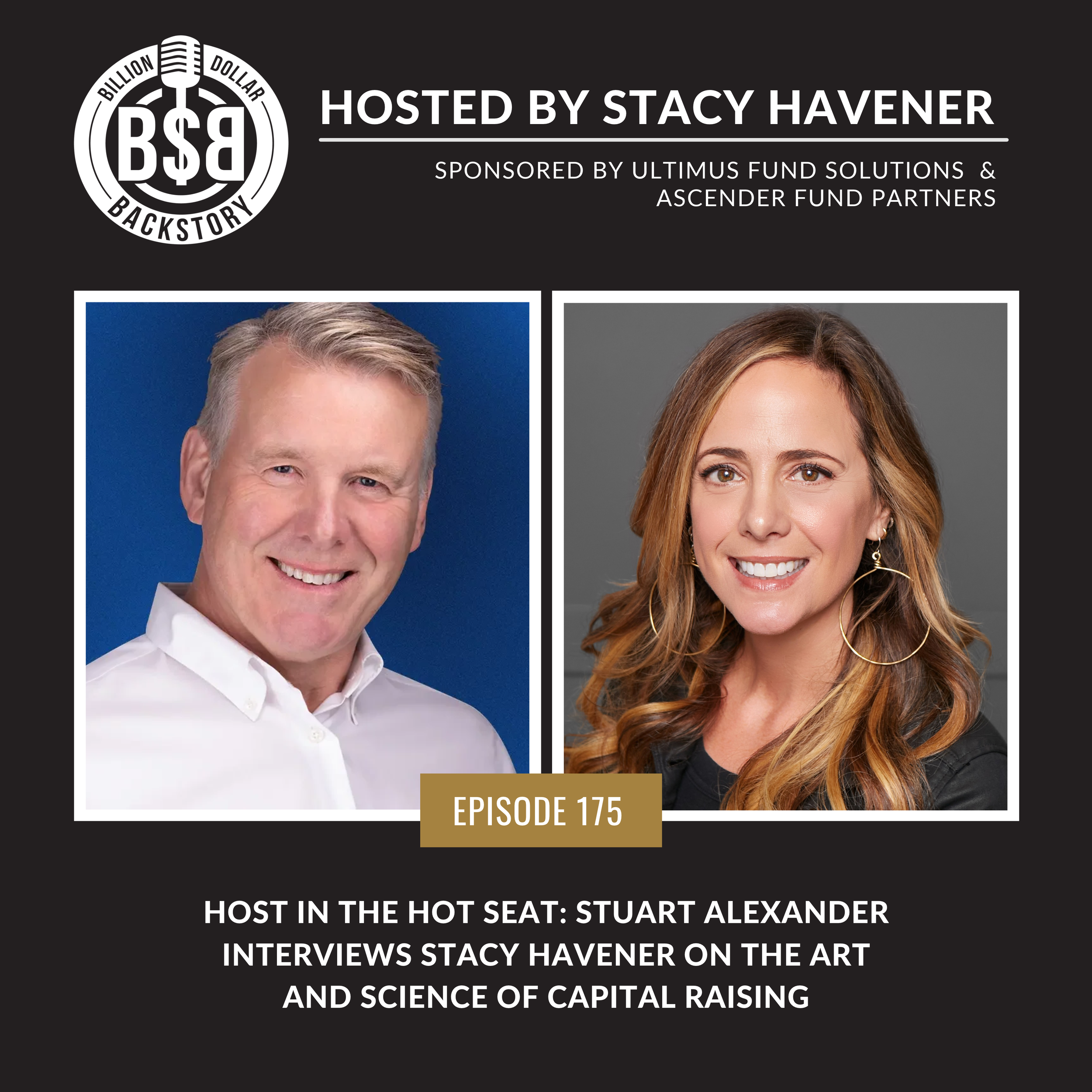
Usually, Stacy Havener is the one asking the questions.
Not this time.
Stuart Alexander of Ascender Fund Partners recently put Stacy in the hot seat, and the conversation was too good not to share with our Billion Dollar Backstory listeners.
Because if you've ever wondered why getting that first allocator meeting is so freaking hard (or why a meeting that went great never turned into a second one), Stacy has some thoughts.
After raising more than $8 billion for investment boutiques, she's learned a thing or two about what actually gets people to pay attention, trust you, and eventually invest.
And a lot of it comes back to three things: storytelling, behavioral science, and personal brand.
In this episode, Stacy gets into how those three things show up in the real world, from getting your foot in the door to making the most of the meetings you actually land.
Listen in to hear:
Why Stacy believes in “give, give, give, ask” (and what most fund managers get backwards)
Why your salesperson shouldn't just introduce the PM and then sit there taking notes
What the real goal of your first allocator meeting should be
Why your pitch deck should be a prop, not the center of the universe
How to get an allocator talking first, and why that changes the whole conversation
Why you can't take a company logo out for coffee (and what that means for your LinkedIn strategy)
The simple test Stacy uses to figure out whether your differentiators actually make you different
Why your messaging should repel some prospects, not just attract everyone
What the 12–18 month sales cycle means for your fundraising expectations
About Stuart Alexander:
Stuart Alexander is the CEO of Ascender Fund Partners and a longtime leader in fund distribution. He has spent decades in the funds industry, working with some of Europe’s largest asset managers and helping firms navigate the challenges of distribution and growth.
In 2009, Stuart founded GemCap, which later merged with MC Square to form Ascender Fund Partners.
Outside of work, he’s a mountain climber, gardener, beekeeper, and environmentalist.
Mentioned in This Episode:
Jab, Jab, Jab, Right Hook: How to Tell Your Story in a Noisy Social World — Gary Vaynerchuk
Robert Cialdini’s Principle of Reciprocity
TRANSCRIPT
Below is an AI-generated transcript and therefore it may contain errors.
[00:00:00] Mary Mack: Everyone, Mary Mack here, and we're flipping the script a little. Instead of asking the questions, Stacy is answering them. She recently joined Stewart Alexander of Ascender Fund Partners to talk about the art and science of capital raising and what it really takes to stand out in a crowded industry.
[00:00:18] Honestly, it was too good not to share with our Billion Dollar Backstory listeners, so we hope you enjoy today's new episode.
[00:00:27] Stacy Havener: Hey, my name is Stacy Havener. I'm obsessed with startups, stories, and sales. Storytelling has fueled my success as a female founder in the toughest boys' club, Wall Street. I've raised over 8 billion that has led to 30 billion in follow-on assets for investment boutiques.
[00:00:45] You could say against the odds. Yeah, understatement. I share stories of the people behind the portfolios while teaching you how to use story to shape outcomes. It's real talk here. Money, [00:01:00] authenticity, growth, setbacks, sales, and marketing are all topics we discuss. Think of this as the capital raising class you wish you had in college, mixed with happy hour.
[00:01:12] Pull up a seat, grab your notebook, and get ready to be inspired and challenged while you learn. This is the Billion Dollar Backstory podcast.
[00:01:26] Stuart Alexander: Hello, and welcome to another edition of the Ascenda Academy. It is as my absolute pleasure to invite a dear friend, Stacy Havener of Havener Capital. Good morning, how are you?
[00:01:37] Stacy Havener: Good morning. Thank you so much for being here. Thank you for having the heatwave pause- ... while I, uh, could enjoy some lovely London weather and time with dear friends like you, Stuart.
[00:01:47] Thank you.
[00:01:48] Stuart Alexander: Well, and you also coincide with the World Cup.
[00:01:51] Stacy Havener: Ah, yes.
[00:01:52] Stuart Alexander: And we sit here the morning after the night before when England scraped through against the, uh, [00:02:00] DRC, Democratic Republic of Congo, and you put a, a little competent country called Bosnia to the sword- Yes ... two-nil. Well done.
[00:02:08] Stacy Havener: Oh, thank you. And listen, uh, when I'm here...
[00:02:11] Look, I'm cheering for the US, of course.
[00:02:13] Stuart Alexander: Mm.
[00:02:14] Stacy Havener: But I'm also very much cheering for England. And I have to say, uh, we needed to do better.
[00:02:20] Stuart Alexander: We need to do a lot-
[00:02:21] Stacy Havener: We need to do better ...
[00:02:22] Stuart Alexander: we, room for improvement. I think it's, I think it was a, a C+ last night. Yeah.
[00:02:26] Stacy Havener: But we made it, so that's what... I mean, look, that's what matters.
[00:02:29] Stuart Alexander: Well-
[00:02:30] Stacy Havener: But, um-
[00:02:31] Stuart Alexander: Exact- Well, uh, uh, those who know you- Yeah ... will know that you're a soccer mum, aren't you? And a soccer- Uh ... a sort of, uh-
[00:02:37] Stacy Havener: Yes, I played soccer ... you've played soccer, yeah. I did play soccer in college and university. Um, and I- Are
[00:02:43] Stuart Alexander: you training? Are you coaching now or
[00:02:45] Stacy Havener: is it- You know, I, I did coach- Do you have time?
[00:02:47] No. I did coach my... Interestingly, my high school soccer coach is how I got into this business- Right ... and maybe we can talk about that. But he, his day job was he was a fund manager. This is in the- Mm ... late '90s, running a [00:03:00] billion dollars of small cap equity. And when I joined his firm, in addition to working together to build a fund business, I also coached with him.
[00:03:10] So he coached, um- Uh, a girls' youth team that was a feeder for Yale. Okay. And that was really fun, but I have not coached since, and I have a nine-year-old daughter who's not currently playing soccer, but we're just gonna put that to the side for a minute. I...
[00:03:25] Stuart Alexander: Okay. Yeah Well, that, that, you- You need to work on that.
[00:03:28] I... Now, those who follow you, and I'm su- I'm sure a lot of our listeners will, will, will follow you, will know you, and I first saw you walking down a beach. Th- Yes ... Newport Beach?
[00:03:39] Stacy Havener: So, you know, this is a, this is a bit of a, um, a conversation point because there are two beaches. There are two Newport Beaches.
[00:03:48] Stuart Alexander: Right. One is in-
[00:03:49] Stacy Havener: They are on- ... California ... opposite sides of the coast. Yeah. Yes, exactly. So- Yeah, my
[00:03:52] Stuart Alexander: cousin lives at the other one. Yeah.
[00:03:53] Stacy Havener: So I am in... So there's Newport Beach, California. I am not there. I, I lived in San Diego for a few years, but I [00:04:00] have returned home to the East Coast. I am in Newport, Rhode Island.
[00:04:03] Right And the beach that I am on, for anyone who knows Newport, uh, First Beach is less than a mile from my house, and that's where I'm walking, and that's where I'm doing those videos. It is so funny to me that that is what resonates with people. I have been stopped in airports- Okay ... in the UK. Once I was on a plane going on holiday to Jamaica, and someone popped up as I walked by and said, "Oh, you're the gal from the be- who walks on the beach on LinkedIn."
[00:04:30] And I... It's just...
[00:04:32] Stuart Alexander: Well, as someone who comes from a, a very famous tourist area in the north of England, Blackpool, I think if I walked down the beach and did what you do, I'd probably get blown into the S- ... into the Irish Sea. Uh, so all, all credit, but, you know, I've been in fund distribution for f- 40 years.
[00:04:47] Stacy Havener: Mm-hmm.
[00:04:48] Stuart Alexander: I've learned so much in the last four years following you. Oh,
[00:04:51] Stacy Havener: that's so kind
[00:04:52] Stuart Alexander: of you to say. I have to say, it, it, it's an absolute credit to what you've done. And we're-
[00:04:55] Stacy Havener: Thank
[00:04:55] Stuart Alexander: you ... and we're gonna dive into it- Yes ... uh, in, into this- I'd love
[00:04:58] Stacy Havener: to ...
[00:04:58] Stuart Alexander: if we may. Um, [00:05:00] just but before we do
[00:05:00] Stacy Havener: that-
[00:05:01] Stuart Alexander: Yeah ... just a little bit of background about Havoc Capital itself- Sure.
[00:05:03] Stacy Havener: Of course ...
[00:05:04] Stuart Alexander: if we may- Yes ... and what you do and how you do it.
[00:05:06] Stacy Havener: Yep. Um, so thank you. That was very nice of you to say. It means a lot to me because you are an expert in distribution yourself. So as I mentioned, I, I, uh, I didn't plan on being in Wall Street. I actually wanted to be a college professor of literature.
[00:05:23] So I'm a poet, I'm a storyteller, uh, but I was also paying my way through university, and I was gonna have to pay my way through grad school to get my PhD. My high school soccer coach was a fund manager- Mm ... and he knew my situation. I was going to university locally, so he was coming to my games to support us.
[00:05:42] And he offered me a job, and he said, "You know, you can come here. I'm running a billion dollars of small cap equity." This is the late '90s. I... Very institutional business. "I wanna launch a fund, and maybe you could help me do that." And I was like, "Coach, that sounds great. Uh, just FYI, like I don't know anything about the fund [00:06:00] business.
[00:06:00] My dad's a math teacher. That's about as far as I'm gonna get." But I joined and, and the plan was work for a few years and then go on about my way. Um, but as it turns out, uh, uh, you know, there... In a wo- in a world full of men who love numbers, I guess- Mm ... there was a place for a girl who loves words. Because not only did we launch the fund, after that was done, he handed me a, basically a list, and said, "Okay, now the next thing is raise money.
[00:06:27] Here's a list. Here's a phone." And we raised 500 million in two years off of a million-dollar base.
[00:06:34] Stuart Alexander: Blown
[00:06:34] Stacy Havener: away. Um, and the way... It, it took me a long time to unpack this, by the way, but at the heart of it was connecting people with each other, and the best way to do that is through the power of story.
[00:06:47] Mary Mack: Mm.
[00:06:47] Stacy Havener: So over the years, as I, I went on to raise multiple billions for, you know, emerging managers, specialist boutiques, new funds, you know, firms on paper that shouldn't be [00:07:00] winning, uh, shouldn't be succeeding, I, I had to actually step back and codify, what is it that I'm doing?
[00:07:06] Mm. Because it... I'm doing it repeatedly, but it was sort of unknown to me. It was very below the surface. And there's really three things: the art of storytelling, which I mentioned, the science of human behavior, which is why people buy-
[00:07:20] Stuart Alexander: Mm-hmm ...
[00:07:20] Stacy Havener: and the power of personal brand. And that's the blueprint that we use at Havner to help investment boutiques grow.
[00:07:29] Similar to you- The bulk of my career, the front half, was raising money.
[00:07:35] Stuart Alexander: Mm.
[00:07:35] Stacy Havener: This half is more consulting, advising, and training teams to use that blueprint to grow their business.
[00:07:43] Stuart Alexander: Yeah. When I first started in the industry-
[00:07:46] Stacy Havener: Mm ...
[00:07:46] Stuart Alexander: back in, in '86-
[00:07:47] Stacy Havener: Yes ...
[00:07:48] Stuart Alexander: I had six competitors. Fidelity weren't even here in the UK.
[00:07:53] Stacy Havener: Isn't
[00:07:53] Stuart Alexander: that wild? It was a tiny, tiny market.
[00:07:55] Stacy Havener: Yeah.
[00:07:56] Stuart Alexander: It was a breeze to get in front of fund selectors, although- Yeah ... they didn't really [00:08:00] call 'em fund selectors in those days. The challenge today is of another level.
[00:08:05] Stacy Havener: Yes, it is.
[00:08:05] Stuart Alexander: And I, and, and I think that you, you, you talk about, um, uh, the, the qualitative versus the quantitive-
[00:08:13] Stacy Havener: Yes
[00:08:13] Stuart Alexander: which I think is so important. And we were talking- Yeah ... just before we, when we started recording about, you know, it, it's a race to the bottom if you just talk about numbers.
[00:08:21] Stacy Havener: That's right.
[00:08:23] Stuart Alexander: If you're starting out today as a, as a f- a fund distribution person- Mm-hmm ... how do you get in front of people? Yes.
[00:08:30] What, what's... I mean, it's, this is quite a long answer to what, probably- Yeah ... a quite a long question, but it's very, it's very challenging to get in front of people- It is ... with, with emails and- Yes ... again, I know fund selectors who've got 22,000 un- o- unopened emails.
[00:08:44] Stacy Havener: Yes. Can you imagine?
[00:08:45] Stuart Alexander: So, and half of them are from me.
[00:08:47] Um, so how do, you know, how does a, a, a f- a fund distribution expert or beginner- Yes ... get into a, into in front of selectors? It's
[00:08:55] Stacy Havener: a great question, and it has gotten more challenging and [00:09:00] noisier-
[00:09:00] Stuart Alexander: Yep ...
[00:09:01] Stacy Havener: as you alluded. So I think this goes back to the crux of people do business with people, even in the investment industry.
[00:09:10] It's just universally true. What happens to us often in the investment space is because we have a lot of very, very intelligent people in this industry, we think that it's more complicated than it really is.
[00:09:26] Stuart Alexander: Mm.
[00:09:27] Stacy Havener: It's complexity bias. So again, to go to the human behavior, the behavioral science piece, we are wired to think things that are complicated work better, are more successful, et cetera.
[00:09:39] So how do you get in the door in a noisy world? Um, show up as a person first. Because before someone chooses you, they need to know you, they need to like you, and they need to trust you. And really, AI can't do that. Mm-hmm. An email can't [00:10:00] really do that. Um, and so how do we get a meeting with someone where we're not pitching first, we're showing up as a person first?
[00:10:13] And the luncheon that we were both at- Mm ... this week, I talked about something called give, give, give, ask. Love it. Which is one of our- Absolutely ... frameworks, and it's so basic. Mm. And if it- it's a, it's a riff on Gary Vee, who has- Mm ... a, a, a framework that's similar except it's jab, jab, jab, hook, and I just don't understand why we're punching our prospects in the face.
[00:10:37] So, so I don't like that one. I
[00:10:39] can
[00:10:39] Stuart Alexander: name a few who are not doing
[00:10:40] Stacy Havener: that.
[00:10:40] Stuart Alexander: Yeah. But that's another
[00:10:41] Stacy Havener: story. But the give, give, give, ask- Yeah ... is a great way for people to get in the door, and it basically says, it plays us off of, um, Robert Cialdini's principle of reciprocity. Mm-hmm. Which, which basically says when you do something nice, [00:11:00] as a human, it feels good to receive that- Mm-hmm
[00:11:03] kindness. And if we give without expectation- And we show up as people, and we earn the right to the meeting as a person first. Then we can, when we ask for the meeting, it's kind of a no-brainer. If we're friends and I come to London, and I say, "Stewart, I'm in London. Do you wanna meet for coffee?" You're, "Yes, of course."
[00:11:30] But if you don't know me from anyone- Yeah ... and I hit you up and say, "Stewart, do you wanna meet for coffee?" There's a whole bunch of stuff I have to try to do in that one email. I have to get you to know who I am, like me, trust me, think it's a good use of time. Mm. And that is just an un... It's just a, it's a, the lift is too heavy.
[00:11:48] Stuart Alexander: But unfortunately, we do see it on LinkedIn, and I'm sure you're- Yeah ... no different to me. I get constant in- inboxes. Oh, it's
[00:11:54] Stacy Havener: awful. Pitch slaps.
[00:11:56] Stuart Alexander: Yeah, lead gen and all- Yeah ... those. It's just- It's
[00:11:58] Stacy Havener: horrible ...
[00:11:58] Stuart Alexander: awful
[00:11:59] Stacy Havener: to- It's an [00:12:00] instant disconnect- Yeah ... for me, by the way. If I connect with you and the next thing you do is pitch me in the DMs, we're- we're over.
[00:12:05] Yeah. Like, that's over.
[00:12:06] Stuart Alexander: They're not even bother researching you. But-
[00:12:08] Stacy Havener: That's half the problem ... it, yeah. It's like, it's not even. And so, but think about that. So let's extrapolate that to how that allocator feels.
[00:12:16] Stuart Alexander: Mm.
[00:12:16] Stacy Havener: Emails from us, unsolicited emails from fund managers or distribution teams that show up in an inbox, that are a pitch, that are five paragraphs long with 18 attachments, nobody has time for it.
[00:12:29] No. They don't have time for it, nor do they care, because they don't know you.
[00:12:33] Stuart Alexander: Mm.
[00:12:34] Stacy Havener: And so that, I know it sounds basic and simple, but I really think showing up as a person first and making a friend-
[00:12:41] Stuart Alexander: Mm-hmm ...
[00:12:41] Stacy Havener: then figure out if there's business to be done together. But we're flipping that. We're doing it the r- in the wrong order.
[00:12:48] Stuart Alexander: Right. You, you touched on something which I, which I totally get, which is the, the personality.
[00:12:53] Stacy Havener: Yeah.
[00:12:54] Stuart Alexander: And ab- and having salespeople with personality. Fund [00:13:00] managers. They're
[00:13:00] Stacy Havener: a- Yes ...
[00:13:00] Stuart Alexander: they're a different breed.
[00:13:01] Stacy Havener: Yes, they are. W-
[00:13:03] Stuart Alexander: what are you looking for when you're working with- Yeah ... a fund manager? Are you, are you looking for personality?
[00:13:07] I, I, I listened to- Yeah ... uh, uh, your podcast with, with Guy, uh-
[00:13:12] Stacy Havener: Yes ...
[00:13:12] Stuart Alexander: From To Coast, which I, I thought was very, very good, by
[00:13:14] Stacy Havener: the way. Thank you. That was a
[00:13:15] Stuart Alexander: great one. Thoroughly recommend a, a good listen to- Yeah ... the To Go To podcasts are very good. But Stacy, y- your, yours, um, you talked, uh, I think it was about a, a fund manager smiling.
[00:13:25] Stacy Havener: Yes.
[00:13:26] Stuart Alexander: And, you know, should they smile?
[00:13:27] Stacy Havener: Should they smile? Well, I mean, what do you think?
[00:13:29] Stuart Alexander: Well, uh, absolutely.
[00:13:31] Stacy Havener: Right.
[00:13:31] Stuart Alexander: Can they walk and talk at the same time, though?
[00:13:33] Stacy Havener: Well, so here's the thing. There is a knock on fund managers that is, they are, um, they have big egos. They're, uh, you know, all, all the negative things that go with that.
[00:13:49] And, and look, I've met fund managers who have big egos and are jerks and all the things. But, but more often than not- What is [00:14:00] happening when we sense that they're quiet, they're standoffish, it's that they're out of their comfort zone.
[00:14:08] Stuart Alexander: Mm-hmm.
[00:14:09] Stacy Havener: When you put a fund manager in a meeting, or ask them to do a podcast, or ask them to take the stage, that is not their unique ability.
[00:14:19] Sure. And guess what? They're human. Mm-hmm. And they're nervous, and they're uncomfortable. And we have this unfair expectation on them that they should show up and show off, and they don't know how. And so much of my success, weirdly, is, has ... Like, my biggest successes were with some personalities that would have been the most challenging for someone to market.
[00:14:47] In fact, one of them, the fund manager, had a lot of challenges. And he was, um, he was autistic, he was legally blind, uh, there w- he was just ... It, it was very difficult to [00:15:00] follow him in a meeting. And so when I took on this mandate, they said, "You can't have him in meetings. He's just ... You can't. Now-" Wow. "... he's the founder, and he's a brilliant mind, a beautiful mind."
[00:15:10] Stuart Alexander: Mm.
[00:15:11] Stacy Havener: And I said, "I disagree. The trick with him is, is to put him in a position to shine." If you ask someone like that to come into a meeting and go through a 15-step risk management process, how is it gonna go? Horribly.
[00:15:27] Stuart Alexander: Mm.
[00:15:28] Stacy Havener: But if, if I'm able to pull that allocator aside and say, "Here's what's gonna happen.
[00:15:33] This person's gonna come in at the end, and here's the deal with this person, and he's amazing, or she's amazing, and we're just gonna let them go, and I have no idea what's gonna happen, but it's gonna be awesome. We just have to give them the space to do it," then when that person walks in and they are everything we sort of eye roll about a fund
[00:15:53] They're over here, they're tangenting, they're laughing at their own jokes we can't even follow. They're doing math in their head- Mm ... and sort of calc- like calculator [00:16:00] talk. Mm. Then you're kinda like, "It's charming. It's them. It's authentic. It's a sign of their brilliance."
[00:16:06] Stuart Alexander: Mm.
[00:16:06] Stacy Havener: So I feel like it's a, it's almost an expectation mismanagement.
[00:16:12] Stuart Alexander: Mm.
[00:16:12] Stacy Havener: There are people who are ver-- there are fund managers who are very good at sales and marketing, but that is not common.
[00:16:18] Stuart Alexander: That, that's the rare one. There, there are... I, I've worked with a couple of those people. Yeah. But equally, like 90%, you have to, you have to work with them. And, and again, something that I heard you talk about before, which is from a s- from the sales perspective-
[00:16:31] Stacy Havener: Yes
[00:16:32] Stuart Alexander: the salesperson has to manage that meeting- Oh ... and bring the fund manager with them, and bring the allocator- Yes ... to the table.
[00:16:41] Stacy Havener: Yes.
[00:16:42] Stuart Alexander: Are there some, are there some easy lessons? I mean- Yeah ... we've talked about making it easy.
[00:16:46] Stacy Havener: Yes.
[00:16:47] Stuart Alexander: But are there some easy lessons that a salesperson- Sure ... should do with, when it comes
[00:16:50] Stacy Havener: to working with an allocator?
[00:16:51] Yes, I think so. So the first, it's a great point, and I really, I feel this is also one of the secrets to my success, but it's sort of a, again, it's a [00:17:00] basic. So on one hand, you have the meeting where the salesperson and the fund manager come in, and the allocator's there, and the salesperson says, "Stuart, you know, this is Bob, and here we are."
[00:17:11] And-
[00:17:12] Stuart Alexander: Yeah, yeah.
[00:17:13] Stacy Havener: They don't say anything.
[00:17:14] Stuart Alexander: Yeah. No added value.
[00:17:15] Stacy Havener: No.
[00:17:16] Stuart Alexander: No.
[00:17:17] Stacy Havener: The, and the perception there is that the job of the salesperson was to set the meeting and then stop talking.
[00:17:23] Stuart Alexander: Mm-hmm.
[00:17:24] Stacy Havener: And I think that's an incredible disservice, partly because of what we just talked about, about fund managers not being in their unique ability- Mm
[00:17:30] where this is actually the genius zone of the salesperson if you allow them to lean into it. So there has to be trust between fund manager and salesperson. In my opinion, that relationship is one of the most underrated relationships in an asset management firm.
[00:17:48] Stuart Alexander: Totally agree.
[00:17:50] Stacy Havener: So if the fund manager is not, is doesn't trust or give the, the salesperson the ability to lead the meeting, well, that's, w- you [00:18:00] know, we're not gonna get off the schneid on that one.
[00:18:01] So the f- but the salesperson before the meeting can make sure that you're on the same page with that fund manager. So one of the things we do is we have a meeting prep template. It's one page.
[00:18:15] Stuart Alexander: Okay.
[00:18:16] Stacy Havener: This meeting prep template is basically like a Cliff Note or cheat sheet for that fund manager, and it says, "Here's who we're meeting.
[00:18:24] Here's kind of what you need to know about them as a person- Mm-hmm ... and about the conversation so far. Here's the goal of the meeting," which is not typically to get a check, right? Especially a first meeting has one goal: get a second meeting.
[00:18:39] Stuart Alexander: Yep.
[00:18:40] Stacy Havener: Right? So we outline the goal. We outline what we think we, you know, the, based on our conversations with this allocator, what they wanna go over, where we think there might be challenges, where they might be struggling, what's in their way.
[00:18:54] We give that to the fund manager. Now, here's where the, the rubber [00:19:00] meets the road. If I email you that, I have no idea if you looked at it, and you're the fund manager, I'm the salesperson. So if we're in the car, we're taking a taxi, we're going to the meeting, guess what I'm gonna do? Print it and put it in your face and say, "Okay, Stewart, we need to look at this."
[00:19:16] Stuart Alexander: Yeah. Let's discuss this.
[00:19:17] Stacy Havener: Let's look at this.
[00:19:18] Stuart Alexander: Mm-hmm.
[00:19:18] Stacy Havener: And what it does is over time, as those meetings are successful, the fund manager starts relying on you as a salesperson and on those meeting preps.
[00:19:30] Stuart Alexander: Mm-hmm.
[00:19:30] Stacy Havener: And it becomes almost like being on stage together.
[00:19:34] Stuart Alexander: Mm-hmm.
[00:19:35] Stacy Havener: Because they then learn that you're, got their back.
[00:19:38] You're not gonna let them go on a tangent or go, you know, say something wrong. You're going to stop them from doing that. You're in control of the meeting. You're making sure the allocator's getting their questions answered. Mm-hmm. That synergy is what you want to work toward, but you just have to sort of baby step-
[00:19:59] Stuart Alexander: [00:20:00] Yeah
[00:20:00] Stacy Havener: towards it, if that makes sense.
[00:20:02] Stuart Alexander: Let's be clear, though. We're, we're, the, the salesperson isn't replacing the fund manager.
[00:20:06] Stacy Havener: Not at all.
[00:20:06] Stuart Alexander: You know, they're not a CFA charterholder. No, they're
[00:20:08] Stacy Havener: like Jimmy Fallon.
[00:20:09] Stuart Alexander: Yeah.
[00:20:09] Stacy Havener: You're the Jimmy Fallon-
[00:20:10] Stuart Alexander: Yeah ...
[00:20:10] Stacy Havener: of the meeting.
[00:20:11] Stuart Alexander: We, we have Jonathan- Do you
[00:20:13] Stacy Havener: have Jimmy Fallon?
[00:20:13] Stuart Alexander: Well, we have Jonathan Ross or- Okay, you're that
[00:20:15] or, or, um, the Irish guy who- ... I can't remember his name. But the, again, my own background back in the day- Yeah ... I used to, if, if it was a difficult question, we'd go, "Well, another glass of wine?" Uh, or as one of the sales guys always said, "More cheese?"
[00:20:33] Stacy Havener: Yeah.
[00:20:33] Stuart Alexander: Uh, 'cause it, it, we weren't trained to understand- That's right
[00:20:36] all the fund managers. We did the classic walk in, "Hi, fund manager. Fund allo- The- ... and then just sit there. Make a few notes.
[00:20:44] Stacy Havener: Yeah.
[00:20:44] Stuart Alexander: And I know that's something you-
[00:20:46] Stacy Havener: I do. I love a good notebook ... you're talking about with your notes. Yep.
[00:20:48] Stuart Alexander: But today, the sales guys have really got to not just understand the story- Yeah
[00:20:54] and we'll talk about storytelling in a moment, but understand what the end game is. Yes. I mean, there's, there's always a [00:21:00] goal to a meeting. You think- That's
[00:21:01] Stacy Havener: right ...
[00:21:01] Stuart Alexander: the, the, the first goal is to get the second meeting.
[00:21:04] Stacy Havener: Yeah.
[00:21:04] Stuart Alexander: Um- But do you find that a lot of salespeople fail to understand that the, the, the p- the process, don't understand their position in that, in that system?
[00:21:14] Stacy Havener: Yes, I think so, and that's, that's, that's... It's a dis- it's a great point because it's a disservice to them because the industry has not taught this.
[00:21:24] Stuart Alexander: Mm. Right.
[00:21:26] Stacy Havener: And so it's an unlearning and a relearning.
[00:21:29] Stuart Alexander: Well, there's very little sales training in the investment management
[00:21:32] Stacy Havener: world. Yeah. Well, do you remember this one?
[00:21:33] The stand and deliver training?
[00:21:35] Stuart Alexander: Yeah.
[00:21:35] Stacy Havener: Yeah. Yeah. I mean, no one d- no, no one wants that. No. An allocator doesn't wanna be pitched to or talked at, or walk through your 75 slides. Well- What a snore. Let's be real. No one wakes up and says, "I can't wait to build some operational infrastructure today." You're here to manage money, to build something that lights you up, not chase down reports across [00:22:00] five systems and 15 service providers.
[00:22:03] That's where Ultimus Fund Solutions comes in. They're your ops dream team, consolidating all your middle and back office chaos into one clean, scalable setup. Registered funds, private funds, SMAs, all integrated. One team, one tech platform, one rock solid source of data. But here's the real differentiator: service.
[00:22:30] I know that fund in a box sounds convenient. It's also a box. Know what you can't put in a box? A human who picks up the phone when you call and need help. Real life people who know your name and your fund, and they care about getting it right. Ultimus was built on people doing business with people. You get institutional strength combined with boutique level service, without getting stuck in a phone tree of doom.
[00:22:58] If you're ready to simplify, [00:23:00] scale, and start working with a team that feels like an extension of yours, check out billiondollarbackstory.com/ultimus. That's U-L-T-I-M-U-S. You've got the investment strategy, the vision, the track record. Now it's time to upgrade the engine behind it all with Ultimus.
[00:23:24] Stuart Alexander: Well, that actually, that's a very good s- s- segue into another thing whi- which you talk about, which absolutely resonates with me-
[00:23:31] Stacy Havener: Yeah
[00:23:31] Stuart Alexander: is the ditch the pitch. The ditch the
[00:23:33] Stacy Havener: pitch, yeah.
[00:23:34] Stuart Alexander: And the deck.
[00:23:36] Stacy Havener: Oh.
[00:23:36] Stuart Alexander: Uh, and m- my own, I remember some years ago working for a large house here in London, and I forgot... I was head of distribution. My head of institution was with me. We were heading over to Northern Trust in- Mm-hmm ... Canary Wharf. I said, "By the way, uh, let's have a quick look at the deck."
[00:23:52] Stacy Havener: Yeah.
[00:23:52] Stuart Alexander: He threw me the Yellow Pages.
[00:23:55] Stacy Havener: I'm
[00:23:55] Stuart Alexander: sorry. It was about 300 pages. It's horrible. And I said, "We've got 45 minutes. How the hell are [00:24:00] we gonna do this?" And I learned a valuable lesson. One, one is to before you go, check the deck.
[00:24:03] Stacy Havener: Yeah.
[00:24:04] Stuart Alexander: And then secondly, we didn't... He said, "Well, we're only, we're only gonna look at page 16 and 24 and so..."
[00:24:09] And I said, "Well, why have we got the other deck, b- pages?" Yeah. The lesson there, and I think it's something that, again, resonates for yourself, which is actually don't look at the deck.
[00:24:18] Stacy Havener: Mm-mm.
[00:24:19] Stuart Alexander: Let's have a conversation.
[00:24:20] Stacy Havener: That's right.
[00:24:21] Stuart Alexander: You talk about storytelling.
[00:24:23] Stacy Havener: Yes.
[00:24:23] Stuart Alexander: From your... What do you mean by that? Yeah.
[00:24:27] Stacy Havener: What's your
[00:24:27] Stuart Alexander: storytelling, uh, heritage in this?
[00:24:29] Stacy Havener: Yeah. Yes. So it's a great point, and, and it's not that the pitch deck is not important, by the way. Yeah. It's just resetting the level of its importance and when to use it and how.
[00:24:43] Stuart Alexander: Mm-hmm.
[00:24:44] Stacy Havener: That's really what it is. You still need it.
[00:24:46] Stuart Alexander: Yeah.
[00:24:46] Stacy Havener: It's a prop. I think what happens for most fund managers is it's not a prop, it's the center of the entire universe of that meeting.
[00:24:54] Stuart Alexander: Mm-hmm.
[00:24:54] Stacy Havener: Not a... Right? It's not a prop- Yeah ... it's everything. So ditch the pitch is, [00:25:00] is basically about flipping the script on how those meetings have typically been done.
[00:25:04] Stuart Alexander: Right.
[00:25:04] Stacy Havener: And storytelling's a big part of it. So to go back to human behavior and behavioral science for a minute, this stat always sort of blows everyone away.
[00:25:16] Um, but behavioral science tells us that a prospect thinks a meeting is a good meeting when they speak 70% of the time. Yeah. In an hour meeting, that means the prospect would speak for 42 minutes. I have never b- I've done a lot of meetings, as I know you have. Mm-hmm. I've never been in a meeting where s- where the prospect spoke for 42.
[00:25:39] Have you? No. No. So however, directionally, I think this is a good North Star. If we can get it to 50/50-
[00:25:50] Stuart Alexander: Mm-hmm ...
[00:25:50] Stacy Havener: that's better than what it typically is, which is, like, 90/10 in favor of the fund manager.
[00:25:57] Stuart Alexander: Yeah.
[00:25:58] Stacy Havener: And the easiest way to get [00:26:00] the prospect on the board, if that's a scoreboard of time-
[00:26:04] Stuart Alexander: Mm-hmm ...
[00:26:04] Stacy Havener: is at the beginning.
[00:26:07] Stuart Alexander: Okay.
[00:26:07] Stacy Havener: Okay? Mm-hmm. And so typically, the old way of doing a pitch meeting is that, you know, the salesperson glad hands, da, da, da, and here's this, and here's, here's who everyone is. And then the pitch starts.
[00:26:21] Stuart Alexander: Yeah.
[00:26:21] Stacy Havener: Really. And the new way is, as you said, it's to have a conversation, not a presentation. Mm-hmm.
[00:26:28] And, and so my preferred way of doing that is to ask the allocator to tell us about them. If they're the founder, it's a great time to have them do the founder's journey. Mm-hmm. If they're not the founder, it's a great time to have them talk about the, the origin of the firm, um, what makes them different, who they serve, and then getting all the way down to, okay, and what, what's going on right now in this asset class, and what are you guys thinking about?
[00:26:59] Stuart Alexander: Hmm.
[00:26:59] Stacy Havener: You [00:27:00] know, what's the investment committee talking about? Are
[00:27:01] Stuart Alexander: these the why, why, whys I've heard you talk about before?
[00:27:03] Stacy Havener: These... No, this is slightly different. This is more getting the... It, so it does two things. It, it gets the pro- it gets the prospect talking, gets the allocator talking.
[00:27:14] Stuart Alexander: Mm-hmm. Mm-hmm.
[00:27:15] Stacy Havener: Um, it also allows us, as the fund management side, to put ourselves in their shoes more.
[00:27:26] And it gives that fund manager context around whatever they're going to say. So let's say I'm Jimmy Fallon, 'cause I'm running the meeting. Mm-hmm. So I'm asking these questions. By the way, I've already talked to the allocator before this. This is not a surprise to them.
[00:27:41] Stuart Alexander: Right.
[00:27:41] Stacy Havener: Okay. So, but that's like a whole nother- That's the preparation
[00:27:43] podcast episode. Yeah.
[00:27:44] Stuart Alexander: Yeah.
[00:27:45] Stacy Havener: So, but now we're in the meeting and, and I've also told the fund manager we're gonna do that. And now when I feel it's a good point to transition, 15 minutes or less probably I can then say, "That's great. [00:28:00] Stuart, would it be helpful to have Bob tell us a little bit about his journey and how- Mm-hmm
[00:28:05] we came to be sitting here today?" And then I'm gonna turn it over to th-... They're gonna do their backstory, and then I'm gonna make sure that we're pulling threads that we heard from that 15-minute conversation about who they are as a firm, the clients they serve, what's important to them, what they're struggling with or thinking about on the asset allocation side.
[00:28:25] And it's really just a conversation at that point, a moderated conversation.
[00:28:30] Stuart Alexander: Mm-hmm. I think the, the point I would take from that is that a l- the pre-meeting preparation-
[00:28:37] Stacy Havener: Is massive ...
[00:28:37] Stuart Alexander: is huge. It's, it's so vital.
[00:28:40] Stacy Havener: Yeah.
[00:28:40] Stuart Alexander: And I think most, and I don't wanna do a disservice to the sales industry here in the UK, but all across Europe, is most salespeople just walk into the meeting- Yeah
[00:28:50] and they know where they're going, and they, in the sense of the, they know the geography of where they're going.
[00:28:55] Stacy Havener: Yeah.
[00:28:55] Stuart Alexander: They know the name of the individual. But that's it, and they haven't-
[00:28:58] Stacy Havener: Yeah ...
[00:28:59] Stuart Alexander: sort of looked [00:29:00] around. And which brings me onto a, a, a, a, a point we've, we touched on briefly, which is the give, give, give ask.
[00:29:06] Stacy Havener: Yeah.
[00:29:07] Stuart Alexander: And, you know, LinkedIn.
[00:29:09] Stacy Havener: Yeah.
[00:29:09] Stuart Alexander: The, which is the-
[00:29:10] Stacy Havener: Mm ...
[00:29:11] Stuart Alexander: the big social network that we- Yeah ... in the business community, we follow. Um, do you see LinkedIn as a way of getting that information? And, and, and I think I know the answer to this but how should a salesperson use LinkedIn- Yeah ... when it comes to engaging with a, a potential-
[00:29:28] Stacy Havener: Yes.
[00:29:29] It's a great point. Look, this goes to the third differentiator for us, which is that power of personal brand, and that really is around people doing business with people. Mm. So personal brands enter rooms before you. They're in rooms you're not even in. There could be somebody talking about the luncheon we had this week- Mm-hmm
[00:29:51] right now.
[00:29:52] Mary Mack: Mm-hmm.
[00:29:52] Stacy Havener: And I'm not in the room, I'm with you.
[00:29:54] Mary Mack: Yep.
[00:29:54] Stacy Havener: So that's the power of personal brand. LinkedIn is great for that, and it's multi-directional, as you [00:30:00] said. Mm. Because on the one hand, the fund manager or the salesperson can build their personal brand on LinkedIn so that people can know, like, and trust them before they ever walk in the room.
[00:30:12] Stuart Alexander: Mm-hmm.
[00:30:12] Stacy Havener: And on the other hand, it's an incredible research tool in preparation for finding the right investor to have meetings with.
[00:30:21] Stuart Alexander: Yep.
[00:30:22] Stacy Havener: Engaging that investor before you ever ask for the meeting. Making a friend. I mean, I am in London almost ... No, it's not even almost, entirely because of LinkedIn. Entirely.
[00:30:36] It changed my life, it's given me some of my closest friends, it's helped our business in ways I, I couldn't even imagine. And so it is many things in one, and really underutilized in our industry. Really underutilized.
[00:30:56] Stuart Alexander: It's also overused in the wrong way, though, isn't it? Going [00:31:00] back to my point earlier on about lead gen people- Yeah
[00:31:03] sending InMails and stuff. Do y- I mean, do you find that from i- if a, if a company's going out there promoting themselves, do they, should they use LinkedIn in the same, just putting up a fact sheet and-
[00:31:14] Stacy Havener: Yeah ...
[00:31:15] Stuart Alexander: all that? Yeah,
[00:31:15] Stacy Havener: yeah.
[00:31:15] Stuart Alexander: Because I, I, I've got this, I've got this big issue. I've got lots of issues. But this particular issue is w- and this, um, coming down towards content- Yeah
[00:31:24] and the information sharing between meetings and, or before meetings- Yes ... and so. Because I always used to say to a fund manager, "Yeah, between fact sheets-
[00:31:34] Stacy Havener: Yeah ...
[00:31:35] Stuart Alexander: which are dull as Dutch, ditch water-
[00:31:37] Stacy Havener: Mm-hmm, mm-hmm ...
[00:31:37] Stuart Alexander: I've got nothing to say if you don't tell me something-
[00:31:39] Stacy Havener: That
[00:31:39] Stuart Alexander: is very true ... to share with me." So content is vital.
[00:31:44] Where, where do you see, uh, the mistakes or, or- Yeah ... or maybe the opportunities as well for fund managers and fund management salespeople to utilize content? And what sort of content- Yes ... should they be using? That's- As, as, as LinkedIn's-
[00:31:57] Stacy Havener: Yes ... indirect. So I think, again, [00:32:00] LinkedIn, if done well, is not just a brochure-
[00:32:07] Stuart Alexander: Mm-hmm
[00:32:08] Stacy Havener: or a company post with an advertisement, basically.
[00:32:13] Stuart Alexander: Mm-hmm. Yeah.
[00:32:14] Stacy Havener: It is, it is a place, if, again, if done well, where people can actually connect. That's what it's designed to do.
[00:32:22] Stuart Alexander: Yeah.
[00:32:22] Stacy Havener: Right? It's a social media platform. Mm. The social part is often lost. Because if you just post a bunch of stuff, even if it's great-
[00:32:31] Stuart Alexander: Mm-hmm
[00:32:32] Stacy Havener: you might think your fact sheet's great, uh, it's hard to engage with that. It's sort of static information. It says- I've seen some bad- ... nothing about the people ... I've seen some
[00:32:39] Stuart Alexander: bad fact
[00:32:39] Stacy Havener: sheets. Yeah. Yeah, and like I'm not gonna make- Yeah ... a friend with a fact sheet- No ... or a logo, uh, and, and ask to meet somebody for a cup...
[00:32:46] I can't take- No ... a logo for a cup of coffee. No. It's just a very one-way street. Mm-hmm. And LinkedIn really wants connection to happen. So this also goes to the most common- [00:33:00] rebuttal, I guess, on LinkedIn, which is compliance. Yes. And if you try to talk about all the stuff, the fact sheet stuff, and the portfolio holdings, and all of the performance- Mm
[00:33:10] you run into a whole bunch of compliance issues, 'cause culture of compliance, we're all in it. But if you show up as a person- Mm-hmm ... and you talk about what you think, what, you know, your lived experience, you talk about a conference you went to and three takeaways. Mm-hmm. You talk about, a little bit about your personal life or what you're into.
[00:33:30] Mm-hmm. Like, I play soccer. I'm training for a triathlon, which might be the end of me. You know, those types of things. You allow people to see you in a different way that they can't see in a fact sheet.
[00:33:42] Stuart Alexander: Mm. Yep.
[00:33:43] Stacy Havener: So that, to me, is really where the magic is, and Sean Pech here in the UK is pr- At
[00:33:48] Stuart Alexander: Rumball, yeah.
[00:33:48] Stacy Havener: Yeah. Yeah. He's brilliant at this. He used- He's very good at it, yeah ... LinkedIn to, to build his, his firm. It was- It was ... a pivotal-
[00:33:54] Stuart Alexander: It was a 50 million pound
[00:33:56] Stacy Havener: fund, funds ... 50 million in September '22.
[00:33:58] Stuart Alexander: Yeah.
[00:33:59] Stacy Havener: And- It's, I [00:34:00] saw him yesterday for, it's T- I saw him yesterday for lunch, 2.7. Amazing.
[00:34:05] Stuart Alexander: Yeah.
[00:34:05] Stacy Havener: Right?
[00:34:06] Stuart Alexander: Performance has helped him.
[00:34:06] Stacy Havener: Perfor- he's ver- but here's the thing.
[00:34:09] Stuart Alexander: That's the
[00:34:09] Stacy Havener: backend. You need to be good at what you do.
[00:34:11] Stuart Alexander: Yeah.
[00:34:12] Stacy Havener: So that's table stakes.
[00:34:13] Stuart Alexander: Yeah.
[00:34:14] Stacy Havener: Performance isn't, it's, it's required.
[00:34:17] Stuart Alexander: Yeah.
[00:34:17] Stacy Havener: I- But that's not enough ...
[00:34:18] Stuart Alexander: I always say performance keeps you in the room.
[00:34:21] Stacy Havener: Yeah.
[00:34:21] Stuart Alexander: Getting into the room is the challenge.
[00:34:24] Stacy Havener: Yeah.
[00:34:24] Stuart Alexander: It, it- And that's where that personality-
[00:34:26] Stacy Havener: It is
[00:34:26] Stuart Alexander: and we haven't touched on values, which I always think is a core element of a business. We talk about personality. Yeah. I always think about the core values of the firm- Yes ... the individual, and hopefully the individual reflects the values of the organization. Mm. Do you, how do you feel that values should come across in a, in a social media sense?
[00:34:44] Or how, or, or just messaging, how do you get- Yeah ... that message out about who you are and what you stand
[00:34:48] for?
[00:34:48] Stacy Havener: Yes. I think it, it's a great point, and culture, there's a lot of work being done on culture alpha.
[00:34:59] Stuart Alexander: Mm-hmm. [00:35:00]
[00:35:00] Stacy Havener: Is there, is there some- potential for outsized return based on the culture and values of a company.
[00:35:08] Mm-hmm. And that's being done in the public i- investment world. And it's also, you know, worth reflecting on for all of us. Mm-hmm. Even on the other side. You know, values and differentiators are really tough. Yeah. Because the tendency is to go to things that of course should be true. Mm-hmm. So, um, and my friend Dan Mikulski's here in the UK, who's now the- Oh, yeah
[00:35:34] CIO of People's Pension. He, like I learned this from him in a pod- one of, I think it was like my second podcast I ever did three years ago. And he said, "Differentiators can't be truisms."
[00:35:48] Stuart Alexander: Hmm.
[00:35:48] Stacy Havener: Now, we actually implemented this. We, we have a truism test based on this conversation I had with Dan, which is basically to say, the test is, is the opposite of [00:36:00] that differentiator a viable business?
[00:36:04] Stuart Alexander: Wow.
[00:36:04] Stacy Havener: So for example, it has to be.
[00:36:08] Stuart Alexander: Yeah.
[00:36:08] Stacy Havener: For, in order for it to be a true differentiator. So a truism would be something like, well, let's just say a differentiator is our people, our people are great. Okay, is the opposite of that viable? Our people are not great. We hire not great people. No.
[00:36:25] Stuart Alexander: We've all made
[00:36:25] Stacy Havener: mistakes.
[00:36:26] I mean, yeah. Yeah. We, but that's not what we're trying to do.
[00:36:29] Stuart Alexander: Right.
[00:36:30] Stacy Havener: So that can't be a differentiator, because of course that should be true.
[00:36:34] Stuart Alexander: Mm-hmm.
[00:36:35] Stacy Havener: S- so I think with some of these more, they're v- the culture bits, the differentiators, the values, they're so important. Yeah. But it really takes work to make them sharp.
[00:36:47] The other thing that I firmly believe about differentiators is that they have, they have two jobs.
[00:36:56] Stuart Alexander: Mm-hmm.
[00:36:56] Stacy Havener: Attract-
[00:36:58] Stuart Alexander: Mm-hmm ...
[00:36:58] Stacy Havener: the right [00:37:00] client to you, and repel the wrong one.
[00:37:04] Stuart Alexander: Hmm. Okay.
[00:37:05] Stacy Havener: And what happens is it takes a lot of courage and bravery to repel.
[00:37:10] Stuart Alexander: Yes. That's exactly what I was thinking then. What's, when, what, can you expand on what you mean by that?
[00:37:17] Yeah. Okay. The what, what is a bad client? I mean, I think it could be-
[00:37:19] Stacy Havener: Okay ...
[00:37:20] Stuart Alexander: trading clients, someone just- All right ... in and out, in and out, but-
[00:37:22] Stacy Havener: So this is a great point, because a lot of fund managers think, "Well, I'm for everyone. All dollars are green-
[00:37:31] Stuart Alexander: Mm-hmm ...
[00:37:31] Stacy Havener: and they're all for me." Like, but the reality is, in the work that we do with clients on story and on narrative, the first thing we do before we even get to the stories is we ask, "Who are you speaking to?"
[00:37:44] Stuart Alexander: Mm-hmm.
[00:37:45] Stacy Havener: And the challenge there is typically that target market is way too broad. It's actually almost easier to look at it in the wealth management side. So let's, let's say I'm a wealth manager [00:38:00] and, and if I s- or you are, and I say to you, "Stewart, so what's your target market?" And you say, "Ultra high net worth."
[00:38:06] Stuart Alexander: Mm-hmm.
[00:38:06] Stacy Havener: Which is what almost every wealth firm says.
[00:38:09] Stuart Alexander: Yep.
[00:38:11] Stacy Havener: Does that, I mean, how big is that market? And do they have any specific challenges? They're all gonna have different ch- ultra high net worth in, in what, okay. Are they entrepreneurs? Are they CEOs of public companies? Um, did they have stock options that they converted?
[00:38:27] All of those ultra high net worth people have very unique challenges. Mm. And we have to get to the place where we can speak specifically to what someone is going through. They need to feel seen.
[00:38:39] Stuart Alexander: Mm-hmm.
[00:38:40] Stacy Havener: The hard part here is if I say, and again, I'm not gonna go to the fund manager, still sitting in the advisor seat 'cause it's easier.
[00:38:48] If I say that we're a, an advisory shop that serves founders and all my content is around that, I think to myself, darn, I just lost so much [00:39:00] business from like CEOs of public companies The reality is you, if you're serving founders and they're happy, you might not actually know how to serve the CEO of a public company because they're gonna have different needs and different challenges.
[00:39:18] So it's a little bit of a land grab that we want, that we have to be careful-
[00:39:24] Stuart Alexander: Yeah ...
[00:39:24] Stacy Havener: and really challenge ourselves to say, "Who are we for right now? Who, who are we the best fit for?"
[00:39:34] Stuart Alexander: One of the things I often find challenging be-
[00:39:36] Stacy Havener: Yeah ...
[00:39:37] Stuart Alexander: um, in this industry, and i- we both come from a fundback- a fund sales background.
[00:39:44] Third party markets are-
[00:39:45] Stacy Havener: Yes ...
[00:39:46] Stuart Alexander: are key to what we do. Mm-hmm. We work with a lot of them, but we, we choose the best, we believe the best. Um, but the biggest challenge often is m- the management of expectations between the fund manager and the TPM. [00:40:00]
[00:40:00] Stacy Havener: Yes.
[00:40:00] Stuart Alexander: Because-
[00:40:00] Stacy Havener: Oh, yeah ...
[00:40:01] Stuart Alexander: there, there is a- Welcome to my life for- Uh, mm
[00:40:04] for many years. Yeah, so there's the classic, um, me and we discussed it briefly beforehand, but the, you know, the fund manager comes to a meeting with a TPM. The following day, fund manager phones up the TPM and says, "Where's the ticket?"
[00:40:16] Stacy Havener: Yeah.
[00:40:17] Stuart Alexander: Th- th- this is, th- this is not a, a, you know, it's a, well, excuse the expression, it's not a one-night stand.
[00:40:23] This is a long-term-
[00:40:24] Stacy Havener: Yes ...
[00:40:24] Stuart Alexander: loving relationship you're- Yes ... building here. W- where do you see the challenges when it comes to that, that sort of relationship?
[00:40:30] Stacy Havener: Specifically with TPMs? Mm, mm. Okay. So look, that, that's where, that's how I started-
[00:40:35] Stuart Alexander: Mm ...
[00:40:35] Stacy Havener: my business. So we still have one legacy client that we're raising for.
[00:40:40] Mary Mack: Okay.
[00:40:40] Stacy Havener: Um, but that was my world, and it is, is very difficult, um, in terms of expectation management.
[00:40:49] Mary Mack: Yeah.
[00:40:50] Stacy Havener: The first thing, which is basic 101, is to make sure that you're aligned on what success looks like for that [00:41:00] fund manager- Mm ... and you're okay with it. So for example, when we were doing due diligence on a potential, um, third party marketing client, one of the questions I w- I would ask, and we still ask this even of our consulting clients, "Okay, so what does success look like three years from now?
[00:41:17] Paint me a picture." They're, they're probably gonna go to a number, but then also challenge, like, "And what types of clients do you have?" Mm-hmm. This goes back to the previous co- conversation- Mm ... we just had. Are you flying around doing finals presentations and sort of having to go do these face to face?
[00:41:33] Yeah. Or are you working with family offices? And, you know, so we qualitative as well. And then come back to a year. So start at three, and what does it look like in a year?
[00:41:44] Stuart Alexander: Mm.
[00:41:45] Stacy Havener: And make sure you're okay with the number they say.
[00:41:48] Stuart Alexander: Yeah.
[00:41:49] Stacy Havener: Also realize the number will move on you.
[00:41:52] Stuart Alexander: Mm.
[00:41:53] Stacy Havener: So a red flag for me, if I was talking with a fund manager and they said, "Well, look, I, I need a billion dollars [00:42:00] yesterday," that deal is over.
[00:42:03] I am not taking that, and the reason is the expectations are too high. Yeah. It's like the rent is too high, right? It's, I, I can't, I'm not gonna, I'm, we're never gonna be able to make you happy.
[00:42:14] Mary Mack: Yeah.
[00:42:15] Stacy Havener: So it's both on the size of the raise that they're looking for and the timeframe. Yep. And really, like you said with, with a, with a fundraising meeting, it's what...
[00:42:25] It's the work you do before you sign the deal. Yeah. Before you get the meeting, it's the work you do. Before you sign this client, it's the work you do to make sure, are we aligned?
[00:42:35] Stuart Alexander: Mm-hmm.
[00:42:36] Stacy Havener: What are their expectations around meetings? How many meetings a week do they want?
[00:42:41] Stuart Alexander: Yep. I think we, one of the advice that I give to fund managers is, well, one, if you don't have a distribution strategy-
[00:42:48] Stacy Havener: Yeah
[00:42:48] Stuart Alexander: forget it, 'cause investment strategy's all very well, but, um, not being able to raise assets
[00:42:55] Stacy Havener: kills- Or you have no business ...
[00:42:56] Stuart Alexander: you got no business. Um, I think, uh, if my advice [00:43:00] to fund managers is really engage with the third-party marketers, understand how they work-
[00:43:05] Stacy Havener: Mm-hmm ...
[00:43:06] Stuart Alexander: understand what their expectations are-
[00:43:08] Stacy Havener: Mm-hmm
[00:43:09] Stuart Alexander: and then work with their expectations and make sure that they understand what your expectations are. Yeah,
[00:43:13] Stacy Havener: that's right. It's alignment.
[00:43:15] Stuart Alexander: Because it's, it's, it's critical. And- Give them time because it is- Oh, yeah ... it is, we're in this for the long game, you know?
[00:43:24] Stacy Havener: I mean, average-
[00:43:24] Stuart Alexander: Life is short, but we're in it for the long game.
[00:43:25] Stacy Havener: Yeah, average sales cycle, 12 to 18 months.
[00:43:28] Stuart Alexander: Exactly.
[00:43:29] Stacy Havener: And many of them are longer than that. Yeah. I know that makes people wanna poke their eyes out, but, like, you need to hear that if you, especially if you're setting up your own firm- Mm-hmm ... or launching a new fund. Which, by the way, if you're launching a new fund, even if you're a multi-billion dollar established pedigreed shop, when you launch something new, we talked about this at lunch, and you're back in startup mode, my friend.
[00:43:52] Stuart Alexander: Yeah. Yeah.
[00:43:53] Stacy Havener: Like, it's a different game.
[00:43:55] Stuart Alexander: Oh, massively.
[00:43:56] Stacy Havener: Right.
[00:43:56] Stuart Alexander: Yeah.
[00:43:57] Stacy Havener: And, and that's true if you are an [00:44:00] actual startup or emerging manager, or if you are, you know, a well-established-
[00:44:06] Stuart Alexander: Mm ...
[00:44:06] Stacy Havener: pedigreed firm that's launching something new. It's a different distribution strategy.
[00:44:10] Stuart Alexander: Yeah. Well, I think fund managers, they should focus on what they do best.
[00:44:14] Stacy Havener: Mm-hmm.
[00:44:14] Stuart Alexander: Generating alpha- Yeah ... in the best way. And link the alpha generation with regard to distribution with either sales team or- I agree 100%
[00:44:21] Stacy Havener: with that ... multi-pr.
[00:44:23] Stuart Alexander: S- Stacy, we've come to the end of our time- Mm ... together.
[00:44:26] Stacy Havener: Mm-hmm.
[00:44:26] Stuart Alexander: It's, it's been an absolute delight. So fun. Thank you for coming to the UK. Uh, yeah.
[00:44:29] You brightened up actually a, a pretty dull day today, but you walk in the room and everything's great, so. Oh, I appreciate that. Really app- Thank you ... we really appreciate your time today. Uh, we look forward to see you. You're coming to the UK quite a lot these days. Uh, yes. Once a quarter. So I hope we will catch up.
[00:44:43] Once a quarter now, is it?
[00:44:44] Stacy Havener: Yes.
[00:44:44] Stuart Alexander: Well, I, I think we're a bit border control on that one. The, uh no, but no, it's been great to see you.
[00:44:50] Stacy Havener: Thank you- Yes. Thank you ... popping in to see us. I, I've loved our time together, and I'm happy to come back- Always ... whenever you need me. All right. This podcast is for informational purposes only and should not be relied [00:45:00] upon as a basis for investment decisions.
[00:45:02] The information is not an offer, solicitation, or recommendation of any of the funds, services, or products, or to adopt any investment strategy. Investment values may fluctuate, and past performance is not a guide to future performance. All opinions expressed by guests on the show are solely their own opinion and do not necessarily reflect those at their firm.
[00:45:22] Managers' appearance on the show does not constitute an endorsement by Stacy Havener or Havener Capital Partners.

Resources