Episode 145: The £800B+ Advisor Who Thinks Nature Is the Asset Class We Missed: Meet Robert Gardner, Co-Founder of Rebalance Earth
Subscribe to Billion Dollar Backstory on Apple Podcasts, Google Podcasts, Spotify, or wherever you listen to podcasts.
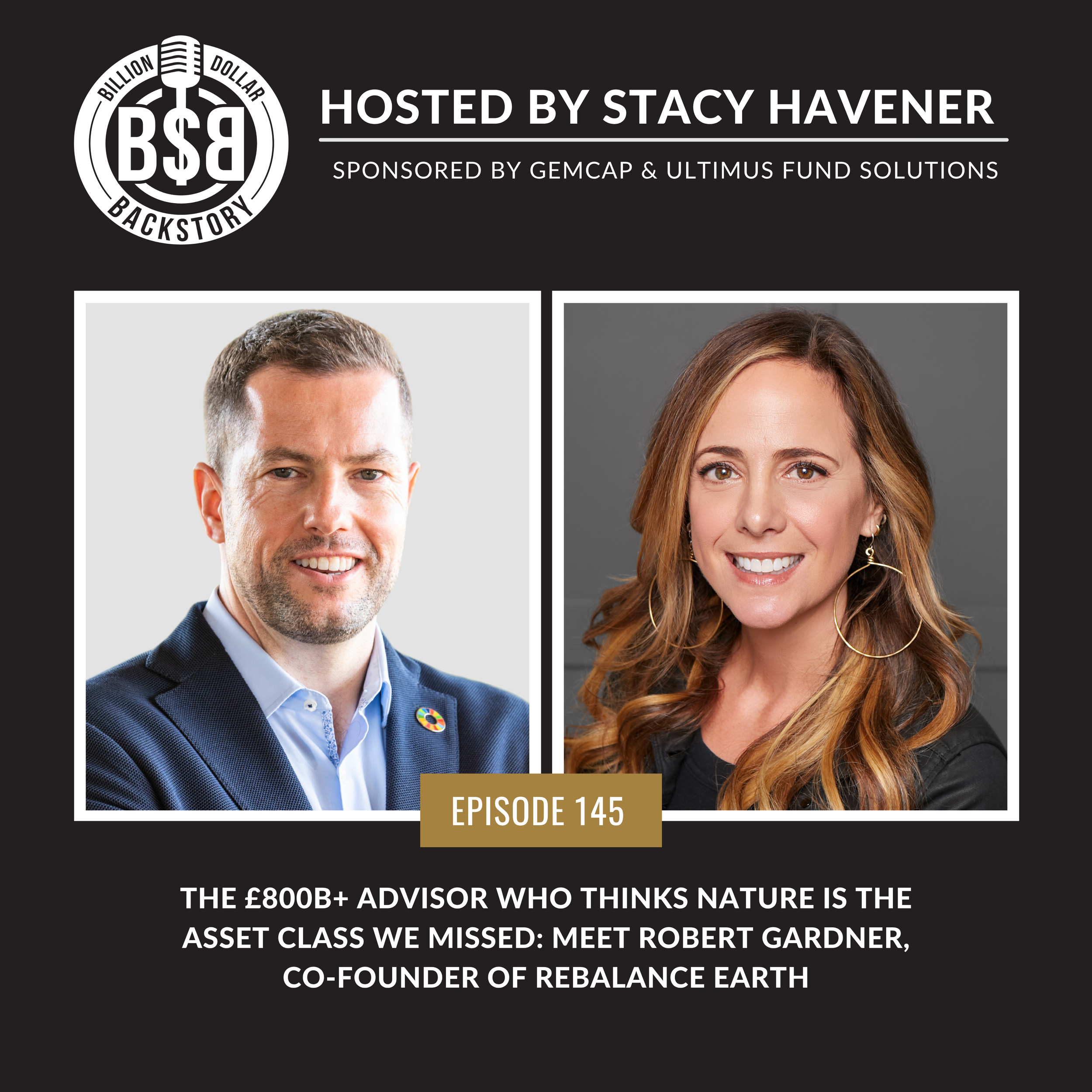
Robert Gardner has built four ventures in financial services, including Redington, the UK investment consultancy that’s advised on £800B+ in assets.
Now he’s taking on a new category: Natural Capital.
Because nature has always been “investable”, just usually as a commodity.
The old way looks like squeezing every ounce of value out of the Earth without any regard for long-term consequences. The playbook was essentially cut it down, harvest it, extract the value, and move on.
Rob thinks that model is outdated, and he’s building the alternative, making nature an investible asset class (more like real estate or infrastructure), where the value comes from what nature does, not what you can take from it.
In this episode, Stacy Havener sits down with Rob to get concrete about what investing in nature looks like in the real world.
Listen in to hear:
What changes when you’re not raising money for a strategy… but for a new asset class
How Robert translates Natural Capital into familiar investing language (property/infrastructure)
A real case study (Nestlé + oyster reefs) and the incentive chain behind it
What underwriting looks like when your revenue is tied to nature doing its job
Why legitimacy comes from repetition + simplicity (not complexity)
The early-stage trust-building lesson every emerging fund manager needs
More about Robert Gardner:
Robert is Co-Founder & CEO of Rebalance Earth, the UK’s largest dedicated Natural Capital asset manager. He previously served as Investment Director at St. James’s Place and co-founded Redington, Mallowstreet, and RedSTART. His work is focused on making nature an investible asset class and proving finance can be a force for good.
TRANSCRIPT
Below is an AI-generated transcript and therefore it may contain errors.
[00:00:00] Stacy Havener: I love spending time with entrepreneurs. That founder vibe is so positive and hopeful and edgy. Regardless of the industry, we can learn something from the founder's journey and their experience even more so when that founder is a serial entrepreneur in the investment space, meet Rob Gardner. Rob has started, not one, not two, but four successful ventures in investments and financial services.
[00:00:30] Stacy Havener: Some of you may know him as the co-founder of Redington, the successful UK investment consultant advising on over 800 billion of assets. His latest company, rebalance Earth is helping asset owners and corporations rethink their approach to nature. Today we talk entrepreneurial lessons and deep dive on why nature just might be the asset class we didn't know we needed.[00:01:00]
[00:01:00] Stacy Havener: Without further ado, meet my friend Rob. Hey, my name is Stacey Haner. I'm obsessed with startups, stories, and sales. Storytelling has fueled my success as a female founder in the Toughest Boys Club, wall Street. I've raised over 8 billion that has led to 30 billion in follow on assets for investment boutiques, you could say against the odds.
[00:01:25] Stacy Havener: Yeah, understatement. I share stories of the people behind the portfolios while teaching you how to use story to shape outcomes. It's real talk here. Money, authenticity, growth, setbacks, sales and marketing are all topics we discuss. Think of this as the capital raising class you wish you had in college mixed with happy hour.
[00:01:50] Stacy Havener: Pull up a seat, grab your notebook, and get ready to be inspired and challenged while you learn. This is the Billion dollar Backstory podcast.[00:02:00]
[00:02:03] Stacy Havener: Wouldn't it be cool if you could diversify your investor base and add some non-US investors? Europe could be fun, or Latin America, maybe Antarctica. Hey, icebergs aren't really my jam, but you never know. You've only got one problem. How the heck do you do that? Fair question, but maybe this is a who not how thing.
[00:02:25] Stacy Havener: Meet my friends at Gem Cap. Not only do they handle all the back office stuff, the how. They'll also solve the who in your distribution conundrum. They have an incredible network of distribution partners who can help you sell the thing. Once you've built the thing and Gem Cap won't just help you launch globally, they'll tell you where to go and maybe more importantly, where not to go.
[00:02:51] Stacy Havener: Saving you time, money, and annoying headaches. Want to find out if your investment firm is ready to go global? Visit billion dollar [00:03:00] backstory.com/gem cap ge, G-E-M-C-A-P. We've created a quick quiz that'll help you figure out if you're ready to expand beyond the US. And side note, it's pretty fun too. Get your firm in front of the right investors in the right places with Gem Cap.
[00:03:21] Stacy Havener: Take the quiz and get more info@billiondollarbackstory.com slash gem. Cap GE M-M-C-A-P.
[00:03:34] Stacy Havener: Rob, thank you so much for being here today. This is such a joy for me. I swear. I think the reason I started a podcast was just so I could hang out with cool people and friends and talk and then invite other friends to listen in, and that's what we're doing today. I mean,
[00:03:49] Robert Gardner: yeah. I'm jealous. I, I, I agree with you.
[00:03:51] Robert Gardner: I, I think it's a great way to get really interesting people and
[00:03:54] Stacy Havener: Yeah.
[00:03:54] Robert Gardner: Get to know them.
[00:03:55] Stacy Havener: Yeah, absolutely. And I have had the joy and pleasure [00:04:00] of seeing a little bit about what you're working on now, and we're gonna get there when we get there. But because this podcast is all about the backstory and because it's my favorite thing, can we go on the way back machine?
[00:04:13] Stacy Havener: Um, did you always know that you wanted to be in finance? We'll even say that. Or did you have like, you know, when I grew up, I wanted to be, whatever, a footballer or something, like gimme the story, gimme the rob story.
[00:04:26] Robert Gardner: I mean, I'm a child of the eighties, so I wanted to be maverick. Uh, when I was younger, I applied for a flying scholarship.
[00:04:36] Robert Gardner: Uh, and the, and the plane, they fly here in the uk or the time was a, a tornado. It's the jet fighter jet. And so at 16, I applied to REF Crown Rail. Where you apply. Okay. Is one of the best things that's ever happened to me. Actually, two reasons. One is I discovered I needed glasses, uh, which meant I was never gonna be a fast jet [00:05:00] by pilot.
[00:05:01] Robert Gardner: Second of all, they produced all of these training simulations. I just didn't have the hand to eye speed coordination to be a fast jet pilot. But the third thing is, and you know, you're 16 years old. Yeah. I think I was there for two nights. So like three days. It, it's team building exercise, it's interviews, and you have an interview and they say, look, why do you wanna become a pilot?
[00:05:22] Robert Gardner: What do you know about the RAF? And they just asked a ton of questions. You know, tell me about the different variants of the tornado, what REF bases are there around the world. And I knew, I knew medium. I wasn't, I wasn't like nothing.
[00:05:36] Stacy Havener: Yeah. At
[00:05:37] Robert Gardner: the end of it, this is why I was so lucky. 'cause at the end of it, they give you a debrief.
[00:05:40] Robert Gardner: So this very senior person comes and sits you down and says, Rob, you didn't, you didn't get the scholarship, but lemme explain to you why. So I'm like, 16 years old. As, as is everyone else who's there. I said, look, when we asked you this question, the kids who got it knew the answer. They knew what the missile system was on the G five.
[00:05:58] Robert Gardner: They knew what the missile system was on the GL [00:06:00] three. When we asked you about like bases around the world, you said rf, Hong Kong, it's not called rf. Hong Kong. We have a base in Hong Kong. You didn't know the name of the base. The kids who got it knew that. And my advice to you is next time you go for an interview, make sure you've prepared and you really know that.
[00:06:15] Robert Gardner: And, and I took that and I'm, you know, maybe three, four years later, applying for internships at Deutsche Bank and other places. I, I took that lesson with me and I swear I see people make that mistake so often. And so, yeah, it was one of the best
[00:06:32] Stacy Havener: wow
[00:06:33] Robert Gardner: failures I've ever had of not getting that flying scholarship.
[00:06:36] Stacy Havener: Fascinating. And also I'm just like running through different scenarios in my own life of how often does somebody actually, when it doesn't work out, sit with you with such respect to tell you like, here's why it didn't work out.
[00:06:52] Robert Gardner: Yeah.
[00:06:52] Stacy Havener: And even if you take that to today, like think about all the funds that you know, work with allocators and get [00:07:00] so far and then it doesn't happen and they're like, I don't know why, I don't know how to get better.
[00:07:07] Stacy Havener: And gosh, there are a lot of lessons there. Thank you so much for sharing that with us. Okay, so Pilot Dreams Dash, I'm sorry that that happened to you, but also not sorry, because here we are today sitting and it's been a very amazing career for you. So how did it switch gears from planes to portfolios?
[00:07:25] Robert Gardner: So I go to university, I'm studying geography, and actually when I went to university, I think I wanted to join the foreign office.
[00:07:31] Robert Gardner: To be, be an ambassador, travel around the world. My parents had been teachers and taught all over the world, and so I arrived at university thinking I wanna join the foreign office. And then suddenly I, I come across these things called investment banks, Morgan Stanley and Goldman Sachs. I thought banks were HS, BBC and Barclay.
[00:07:50] Robert Gardner: What on earth is an investment bank And suddenly you have this thing. Yeah, the milk ground they call it in the uk, but where the universities come and [00:08:00] play, they tell you about their company and they play you with booze or they used to when I was there. And what's really cool is a, you figure out what you don't wanna be.
[00:08:08] Robert Gardner: I very quickly figured that I don't wanna be a lawyer of these investment.
[00:08:18] Robert Gardner: I'd actually worked in a bureau de my, my, my first girlfriend, her dad actually owned a bureau de in the old school days when he used to change sers.
[00:08:25] Stacy Havener: Oh, cool.
[00:08:26] Robert Gardner: French. And, and I'd grown up in Argentina where I knew the exchange rate at the age of seven to every currency to the US dollar, because that's how things worked.
[00:08:37] Robert Gardner: So if you wanted to buy something, it was just obvious to me that the unit of currency was a dollar and was obviously Australia, the peso. And so I've always had a really deep understanding for currencies. And through that I managed to my way onto a Deutsche Bank graduate program in, in 1999. And then I joined the global markets, which is fixed income car and commodities in [00:09:00] 2000.
[00:09:00] Robert Gardner: And that's where I began my, my career in sort of sales and structuring in, in foreign exchange, just as Deutsche Bank was becoming the number one bank in the world at Foreign Exchange. So it was an incredible time to, to join that firm.
[00:09:12] Stacy Havener: It, it's so true, isn't it? That some of it is luck, like. Those tailwinds that you can't architect really do matter.
[00:09:22] Stacy Havener: So you're there and Deutsche Bank is hitting a new level. Did you think that this was it? Or like when did it start to morph? Because somewhere entrepreneurship is gonna come into this story. And I'm curious where that thread comes from. See
[00:09:37] Robert Gardner: a graduate recruitment video from about 2000 or 2001. I think it's on Facebook somewhere.
[00:09:43] Stacy Havener: No way.
[00:09:43] Robert Gardner: And it's, it's the grad recruitment for Deutsche Bank globally. And it's to a beautiful day by you too. And it's got me walking onto the train and interviewing you. And I'm just talking about like coming on and every ba bam, bam, bam. And I'm so pumped. And I mean, the [00:10:00] first two, three years being on a training tour, oh
[00:10:01] Stacy Havener: yeah.
[00:10:02] Stacy Havener: I can't
[00:10:02] Robert Gardner: imagine 22 years old. I mean, it was full on. It was intense. But I loved it. I mean, I worked hard. It's something that I've always valued. It was kind of intellectually super interesting. It was, it was tough. I mean, you know this, in those days, my boss used to call me up at like nine o'clock at night and be like, Bob Bobo, where is six month Euro Swiss?
[00:10:24] Robert Gardner: And I'd be like, uh, uh. You're lower the whale shit at the bottom of the ocean. I mean, this is the stuff.
[00:10:30] Stacy Havener: It was it, and, and also the markets were kind of doing some wild things around this time as well. 'cause that's when I came into the, into the industry too. So like, there's a lot going on.
[00:10:41] Robert Gardner: But what it meant is like two years in, I, I'd done the work of someone who does five, seven years.
[00:10:48] Robert Gardner: I, I knew how to make PowerPoint presentations. I knew how to price understood derivatives. I knew what it was to have risk on and not hand it off to the trader properly. Mm. But that same boss, to be fair to him, [00:11:00] when you closed a big trade or you did something, he'd call over and at the time, like this is before an Jane became CE, but he was a big fan, an come over meet bubble.
[00:11:08] Robert Gardner: He's just closed a big So was this a very curious dynamic where in the desk he was like. A bit like the sergeant major in, you know, an officer and a gentleman. Yeah. But outside of it, he backed you, you know, very early in my career, he, he sort of paid me well and looked after me. And so I, I actually look back on those years and I'm still friends with all of the people I joined, you know, that cohort of interns and graduates we're still best friends today.
[00:11:37] Stacy Havener: That's
[00:11:37] Robert Gardner: awesome. And they're all super successful people all over.
[00:11:40] Stacy Havener: Yeah.
[00:11:40] Robert Gardner: The market now, which is also a, a valuable lesson, right? Which is, you don't realize that 25 years later, the people, you, you started out getting coffee and doing all of that, uh, sort of graduate hazing stuff, actually, suddenly they're all senior people all over the place.
[00:11:55] Stacy Havener: And that is also again, why you never burn a [00:12:00] bridge. Because, let's go back to our allocator example. We were saying to like take it into like. Super practical. Even if a deal doesn't work out, you don't know where that champion that was at that firm will end up later on. And so you never burn a bridge and you don't realize, I mean you do, I guess you do need some perspective, but how small this industry actually is.
[00:12:22] Stacy Havener: It's super small and it's a very tight-knit group. So people just pop up
[00:12:27] Robert Gardner: and people remember the smallest thing. So you remember when you're a graduate, you're just doing important stuff like get the coffee, do that. And this guy still remembers there was the sort of coffee shop on the floor and he remember he said, I just always remember you Rob, you would walk with such focus to get the tea coffees for the desk.
[00:12:44] Robert Gardner: You'd like walk at a pace, get them, get them back. And I always used to think you were going places. And it's just funny that something as simple as how I walked down the floor and back,
[00:12:54] Stacy Havener: yeah. To
[00:12:55] Robert Gardner: get teas and coffees, the desk left impression that, [00:13:00] you know, I was serious and I was here to. I say get shit done.
[00:13:04] Robert Gardner: And I think it's funny people describe me that way 25 years ago
[00:13:09] Stacy Havener: and still.
[00:13:11] Robert Gardner: And still. Yeah. And still. But it's, you know,
[00:13:14] Stacy Havener: they saw it.
[00:13:15] Robert Gardner: It's there, it was there, it was there 25 years ago. Getting the teas and coffees.
[00:13:19] Stacy Havener: Yeah. I love that. Um, and probably getting, remember fax, all the trades would come in. Oh,
[00:13:24] Robert Gardner: we, yeah, yeah, yeah.
[00:13:25] Robert Gardner: We still had, yeah. Stuff used to still be confirmed on facts. Exactly. It
[00:13:28] Stacy Havener: was crazy all morning. Those fax machines would just be going off. Um, okay, so, so you're there. I'm still like, I'm waiting with the popcorn for the entrepreneur bit to come in. 'cause that could have been a great career. Career. You would've done really well.
[00:13:43] Stacy Havener: You could have stayed there and,
[00:13:45] Robert Gardner: yeah. Well, I, I went from Deutsche Bank to Merrill Lynch where I met a guy called th Hulu. And then 20 years ago, this year actually, uh, we both quit Merrill Lynch and we started a company called Redington. So Redington. Became [00:14:00] a very successful investment consultancy in the uk, advising some of the largest pension funds and endowments and foundations and wealth managers.
[00:14:07] Robert Gardner: We took on Willis Towers, Watson and Mercer and Aaron Hewitt, and last year it, it got acquired by Gallagher, which is a, a big US insurance company, which everyone on your podcast will know who they're, but yeah, like 20 years ago, I was like 27. Yeah. Uh, I retired from Merrill Lynch and I kept my stock and Darren and I set up Remington in his attic and, and in my spare bedroom.
[00:14:29] Robert Gardner: And, uh, and then over the next 20 years, we built this incredible firm and, uh, with the most incredible alumni lists. You know, some of the people who work at Redington or worked at Redington are now, you know, incredibly successful people like Dan Koski, who, who, who I know, you know. And, uh, yeah. It's cool to, to think, you know, some very amazing people pass through Redingtons.
[00:14:52] Stacy Havener: It's so cool. I really wanna get into the mindset, because that's a hu I mean, so there's a, there's a lot [00:15:00] going on there 'cause you're, you're in your late twenties, so you still have, you have experience, but there's still that little bit of like, I can do anything and I'm going to, right. And I'm gonna take this leap.
[00:15:11] Stacy Havener: But where did that, like was, did you have people in your family that were entrepreneurs or like where did Yeah. So how did that, if you try to go back into your mindset then, like what was going on? Did you just see an opportunity? We needed a new consulting firm. There weren't enough. Like what was the deal?
[00:15:29] Robert Gardner: Yeah, I think it's that. Spotting something that's not good enough and like, Hey, why don't I jump in and try and fix
[00:15:34] Stacy Havener: Yeah.
[00:15:36] Robert Gardner: What, what I would say is my mom and dad were both teachers. They, but they left to go and teach in Argentina in the 1980s, which isn't obvious for a British family.
[00:15:44] Stacy Havener: Yeah.
[00:15:44] Robert Gardner: I was born in Holland, so they went to teach in Holland in the seventies.
[00:15:47] Robert Gardner: They, they taught in Qatar. They moved Saudi Arabia after the first Gulf War to teach. So there's sort of like a degree of risk taking.
[00:15:54] Stacy Havener: Yeah.
[00:15:55] Robert Gardner: They're definitely not entrepreneurial. And so when, when I left Merrill Lynch, they thought I was crazy. [00:16:00] They were like,
[00:16:00] Stacy Havener: I bet, I like,
[00:16:01] Robert Gardner: whatcha you doing? Are you mad?
[00:16:04] Robert Gardner: But yeah, that, that was my first business. Uh, I then started a second business called Mallow Street, which is still going and down, and I are still part of that. Started this amazing charity called Red Start, which is now merged with another charity. And then I went back to corporate. I went, I, uh, seven years ago.
[00:16:21] Robert Gardner: I, I signed up and joined sort of St. James' Place and I joined the executive board of, you know, the UK's largest wealth manager and was responsible. So effectively I became an asset owner. Listed with all of the, that's not being listed company. Uh, I did that for four years and then three years ago I quit and went all in on, on re, which is, you know, where I'm today, back in the building a business from scratch.
[00:16:51] Robert Gardner: Uh, hopefully taking all the lessons from sort of 25 years of being an investment banker or founding Redington and Street, going back and being an asset [00:17:00] owner and going, look, how do I, how do I take that all and design a, a fund manager that's sort of fit for the next 25 years
[00:17:07] Stacy Havener: and I wanna really camp out on Rebalance Earth, but before we do given So you're a multi youpreneur, that's a thing.
[00:17:14] Stacy Havener: Did you know that's a thing? So that's you.
[00:17:15] Robert Gardner: I didn't wear that, but I
[00:17:17] Stacy Havener: Well, there you go.
[00:17:17] Robert Gardner: You see, I'm, I'm a three times entrepreneur. Yeah.
[00:17:19] Stacy Havener: I take that you're apr, um, serial entrepreneur, uh, d all the above. So, and it's also interesting 'cause you've had. Corporate jobs, including for a public company. So I wanna pause and think this through because the entrepreneurial leap in asset management typically is someone who's been successful at a big, decides something's broken.
[00:17:47] Stacy Havener: So kind of, or there's an opportunity to do something differently and then makes this leap after spending years working at a big company to become an entrepreneur. Then they get out into like that seat [00:18:00] with 18,000 hats on their head and they're like, WTF, what did I just do? This is crazy. But they also like, we love it and we also know it's crazy.
[00:18:09] Stacy Havener: So you've done it multiple times. What advice, like what learnings that? That I'm sure now at Rebalance Earth, you're like, okay, I'm gonna take the things with me that I've learned along the way. What advice do you have for founder fund managers who are doing the same thing?
[00:18:26] Robert Gardner: I mean, I think you've gotta really love and care and be passionate about what you're gonna do, because I think without that you'll, you'll give up, right?
[00:18:34] Robert Gardner: Because yeah, there's no carrots for a long time, so you've gotta be really good at deferred gratification, or your gratification has to come because your work, whatever, you know, floats your, you know, makes you get out of bed and go, yeah, I'll figure out. Yeah, it doesn't have to be like save the world stuff, but it needs to be something that you care deeply about and, and you enjoy doing for the sake of doing it without being paid.
[00:18:59] Robert Gardner: I [00:19:00] think if you can solve those two things, because look, typically it's that old adage, right? It takes 10 years to become an overnight success. So you need, you need to kind of put in the hard yards to get that payoff, and the payoff is very backended. And so what are the things that will kind of keep you motivated, keep you on the road, help you get out of bed every morning?
[00:19:24] Robert Gardner: I would say is the most important thing. I think the second thing is my coach mentors a guy called Mike Harris. He's, he's quite a famous entrepreneur in the uk. Okay. He, he founded First Direct, which was the first telephone bank, and he founded Ag, which was the first internet bank. And he says to me, Rob, is this a game worth playing?
[00:19:42] Robert Gardner: Win, lose, or draw? Mm. But I think that's really important because if I'm honest, investment banking, as much as I love Deutsche Bank, that was a game to win.
[00:19:51] Stacy Havener: Mm-hmm.
[00:19:53] Robert Gardner: The psychology of that is very different to a game. Win, lose or draw. So I can play Rebalance [00:20:00] Earth and if I fail, I don't mind because I know I gave it my best shot.
[00:20:05] Stacy Havener: Mm-hmm.
[00:20:05] Robert Gardner: And I feel good about doing that. And it changes your, your mindset. And if you're into like Simon Sinner, this is basically jumping into infinite game stuff, right? Yeah. I'm, I'm, once you follow that quote, you are effectively playing an infinite game because I'm gonna keep playing until, you know, win or draw.
[00:20:25] Robert Gardner: Uh, whereas it's if, if, if you are like, I need to get it to this, or I'm, I need to be a billion by this day, or I need to make this much by, or my performance, I need to make 20%, then it's a game to win, which I, I think is hard to sustain consistently over, over many, many years.
[00:20:42] Stacy Havener: So, well said. Love that quote.
[00:20:45] Stacy Havener: And there's something embedded in that whole riff right there that I want to pull forward because people who will know you will know your charisma and just kind of who you are as a person [00:21:00] and how much people vibe with you. But you were like, you have to get up, you have to get on the road, you have to do the things.
[00:21:08] Stacy Havener: And for you, that's easy. But I also would say in my point of view, it's not optional. So you do that stuff and I don't know, you're good at it, but that doesn't mean you love it. So that's, I guess, a separate issue. But you're willing to do it and you're willing to be the face and you're willing to go on the road, and you're willing to stand in the center of a rotary or you, or a roundabout or whatever you call it in the uk and film videos, or you're willing to do all that.
[00:21:36] Stacy Havener: And I think every founder in that founding team, someone has to be willing to do that. And sometimes I feel like in the fund management side, that person, founder, fund manager is like, well, no, my job is to sit behind this Bloomberg and invest. And so how do you respond to that?
[00:21:56] Robert Gardner: Look, I mean, I'm, but I'm not a trader.
[00:21:58] Robert Gardner: I, I suppose I've [00:22:00] approached fund manager, you know, I'm not the CIO, I'm not the one. I'm an entrepreneur. So the, the stuff about the, you know, a thousand things in your head, the 18 different hats. This is a movie I've seen before and now I didn't know that at Reddington and I've read lots of books, I've been on lots of courses I have.
[00:22:19] Robert Gardner: So I really understand the, of culture and, and setting all of these things of hiring great people, of getting rid of people when they don't share those values, which got nothing to do with trading. It's got nothing to do with investing. And so I think there's something about role clarity and know what you're good at and not, and I suppose if you are not good at that, that's okay, but then you probably need to get someone
[00:22:43] Stacy Havener: Exactly
[00:22:43] Robert Gardner: who is good at that.
[00:22:45] Robert Gardner: I, you know, I have forced myself to understand all the operational stuff or the regulatory stuff. I don't love it. That's why I need someone amazing like Kirsty, who I know you, you.
[00:22:55] Stacy Havener: That's fantastic.
[00:22:56] Robert Gardner: You know, the thing I learned from from Reddington is the sooner you can get [00:23:00] to a high quality team of people.
[00:23:03] Robert Gardner: Who, you know, who share that common vision, who share the same values, who wanna play it. We we're all bought in and aligned to that game. Worth playing windows or draw then. That's very, that's very powerful. Uh,
[00:23:17] Stacy Havener: and would you say somebody needs to, because like I really want people to hear if it's true, I'm leading the witness, but if it's true that you do need a face, especially when, no.
[00:23:28] Stacy Havener: Okay, so Rebalance Earth is a great example. 'cause not only was it a new company, it's a totally new everything, new asset class, new. And we're gonna talk about that in a moment. But like, if you don't have somebody out there that's saying like, this is what it is, and, and I'm, I'm the guy, or I'm the gal, like I'm championing this and I'm the face and I'm gonna keep beating this drum until the business is.
[00:23:58] Stacy Havener: Standing on its own two feet.
[00:23:59] Robert Gardner: I [00:24:00] think if you're a CEO of a startup, whether it's management or not, you do have to be the chief storyteller. But I would say that we're not just me. I mean, if you go on our YouTube, oh, follow our Instagram everyone to, you know, from our interns, to our grads, to our CIO to, you know, because also then you have kind of key man risk, key personal risk as well.
[00:24:24] Robert Gardner: Percent. But, you know, and, and it's a Kirsty Post. Jo writes the most amazing blogs. Yeah. And yeah, check out our, you know, check out our Instagram, we're putting video and everyone's, their authentic say self. Right? They,
[00:24:39] Stacy Havener: yeah.
[00:24:41] Robert Gardner: So I, I, I, I hear you. And, and I feel very strongly I own the message house.
[00:24:45] Stacy Havener: Mm-hmm.
[00:24:46] Robert Gardner: That's use, that's something we were doing on Tuesday. This is our message house. But I say this is our message house. But you play with it. I
[00:24:53] Stacy Havener: love
[00:24:53] Robert Gardner: that, how you wanna use it. You tell the stories that are, are authentic to you, but let's just [00:25:00] make sure that we have consistency within the message house. But you tell it how you wanna tell it.
[00:25:07] Stacy Havener: Yeah. You have been early on that employee advocacy vibe of not just having founder led marketing, but having all employees engage in that. And, and I would double down on what Rob is suggesting here. If you wanna see what that looks like, go check out Rebalance Earth on LinkedIn or any of the social platforms and see what we're talking about because it is really different, especially in the investment space.
[00:25:38] Stacy Havener: And with that, we're gonna bridge to rebalance Earth and what you guys are doing. And I am going to be very honest with everyone because when I met you I was like this. Super cool rebalance Earth, and I totally don't get it. Like it's very esoteric and I think in some of our first [00:26:00] conversations I was really like, okay, wait, tell me again.
[00:26:03] Stacy Havener: All right, let me now. So I'm gonna, it was very real for me that I had to pause and take it all in. So I want you to explain it to everyone the way you explained it to me. Like tell us what Rebalance Earth is and is it okay if I just ask you questions as we go? Okay.
[00:26:19] Robert Gardner: Yeah, and, and actually just so bridging back to the previous point, yeah.
[00:26:23] Robert Gardner: I think as a fund manager, or certainly as a fund manager in the uk, I think you're not just selling to the CIO or the investment committee because at some point they have to sell you and your fund to the members.
[00:26:35] Stacy Havener: 100%.
[00:26:37] Robert Gardner: And we get, we get people engaged with our Instagram and their message and go, how do I get my pension fund to invest in your fund?
[00:26:45] Stacy Havener: Oh, that's awesome.
[00:26:46] Robert Gardner: That reverse.
[00:26:48] Stacy Havener: Yeah. Reverse inquiry.
[00:26:50] Robert Gardner: Yeah. Phone member. They're literally like a teacher. Love that person who's like, this is the sort of thing we should be invested in. How do I get my local [00:27:00] council to invest in your fund? So I think there's two, there's obviously the, the rational I have to convince what, how are we gonna generate returns?
[00:27:08] Robert Gardner: How's this gonna scale with your team? But then set behind that at some point there needs to be, be, how can we communicate this really simply?
[00:27:18] Stacy Havener: Yes.
[00:27:20] Robert Gardner: In, in our fund, and I'm not saying we've cracked it, but what, what Every Instagram video, what every LinkedIn post does is it forces you to communicate it to, to that man or woman, and.
[00:27:32] Robert Gardner: So it's just practice. It's,
[00:27:34] Stacy Havener: it's, it's repetition. It's reps. You just need to get the reps in. And that's the thing with story is it's iterative. So every time you tell a story, you go, okay, well that part hit. Or everyone's looking at me and their eyes are crossed. So that definitely didn't hit. So I'm gonna have to try a different way.
[00:27:50] Stacy Havener: And eventually over time, you know, you get closer to, to dawn. But it's, it's an evolution. And I, I love the idea of message [00:28:00] house, which I think is, is something people can take forward. Like just sort of what are the key messages and give people a chance to practice them and practice them yourselves until you figure out what resonates.
[00:28:10] Stacy Havener: That's what matters. What will people remember? What are they gonna go to their. Pension and say to them, because if you just throw up all these gobbledygook stats at them, they're not gonna, that's not gonna resonate, and they're not gonna be able to recite it back. So I love the simplicity and I love the idea of really thinking about who's receiving the message.
[00:28:31] Stacy Havener: 'cause it's not always because we think,
[00:28:34] Robert Gardner: yeah,
[00:28:36] Stacy Havener: let's be real. No one wakes up and says, I can't wait to build some operational infrastructure today. You are here to manage money, to build something that lights you up, not chase down reports across five systems and 15 service providers. That's where Ulis Fund solutions comes in.
[00:28:54] Stacy Havener: They're your ops dream team, consolidating all your middle and back office [00:29:00] chaos into one clean, scalable setup. Registered funds, private funds, SMAs, all integrated. One team, one tech platform, one rock solid source of data. But here's the real differentiator service. I know that Fund in a box sounds convenient.
[00:29:21] Stacy Havener: It's also a box. Know what? You can't put in a box? A human who picks up the phone when you call and need help. Real life people who know your name and your fund, and they care about getting it right. Ultimas was built on people doing business with people. You get institutional strength combined with boutique level service without getting stuck in a phone tree of doom.
[00:29:46] Stacy Havener: If you're ready to simplify scale and start working with a team that feels like an extension of yours, check out billion dollar backstory.com/ultimas. That's [00:30:00] U-L-T-I-M-U-S. You've got the investment strategy, the vision, the track record. Now it's time to upgrade the engine behind it all with Ultimas. All right.
[00:30:12] Stacy Havener: Tell us about Rebalance Earth. Tell us about the idea of it and then like what it actually is.
[00:30:18] Robert Gardner: So the, the idea is right now, nature, you can invest in it, but we invest in it as a commodity, something we grow and cut down. For wood, for furniture, for, for construction, or we harvest it for food. So it it, it's a commodity business.
[00:30:37] Robert Gardner: Our big idea was what if we can make it an asset like a property or like an infrastructure asset, like a road. So if, if we could let nature be, and instead of having to cut it down to extract value by letting it be. When it performs certain things like reducing flood risk or reducing drought risk, what if we could get those companies who benefit from that to [00:31:00] pay us almost like a lease on a property or an offtake agreement on, on, on an offshore wind project.
[00:31:07] Robert Gardner: And so the analogy that we use, depending on who we're speaking to, I think the simplest is the property. One is say, well look, you invest in property and you understand that you build a property and you might lease that to a tenant, and that's how you make money over time. Or you might invest in a big project like the Kings Cross in London and have multiple tenants and multiple sources of revenue, and that's how you make money.
[00:31:31] Robert Gardner: Now what we do is instead of build buildings, we restore nature. So the best example of that is we restored an oyster reef. It's gonna have 4 million oysters and Nestle are gonna pay us for those oysters not to harvest and eat, but to be and to be forever. Because 4 million healthy oysters is a reef clean.
[00:31:56] Robert Gardner: One oyster cleans 200 liters of water a day. [00:32:00] That's 800 million liters of water a day. But the second thing, and this is the thing that's really valuable to Nestle, is they're basically the nursery where you have baby fish, which are the bottom of the food web, which supports all of the fish. And the third thing is they're really good at protecting the coastline.
[00:32:17] Robert Gardner: But why is it that Nestle would pay us?
[00:32:20] Stacy Havener: Yeah.
[00:32:20] Robert Gardner: For this to keep doing that.
[00:32:21] Stacy Havener: Yeah.
[00:32:22] Robert Gardner: So let's go all the way to the other end and go, well, Nestle big, huge consumer goods company known for chocolate and coffee and pet food. Well, pet food is actually their most profitable business line. So a third of their global p and l comes from pet food.
[00:32:38] Stacy Havener: Wow.
[00:32:38] Robert Gardner: And half of that comes from UK and Europe. And half of that comes from cat food and all of that cat food comes from a part called Area 27 of the North Sea. And they've tried to diversify. They've tried to do insects based protein, cat food they've tried to do beyond meat, cat food. They've tried [00:33:00] everything.
[00:33:01] Robert Gardner: And you know, you don't need to be an ecologist or biologist. But if I told you that the ball of fish in the North Sea has been shrinking, shrinking, shrinking, shrinking over the last 50 years, that wouldn't come as a surprise. It's because the water is polluted. It's because we've stripped our ocean floor or our sea floor of the habitats where fish can go and be their nurseries.
[00:33:22] Robert Gardner: And so in in finance terms, they're short marine biodiversity. So they've got this huge MA Marine biodiversity short on their book underpinning a multi-billion dollar revenue.
[00:33:34] Stacy Havener: Oh gosh. Yeah.
[00:33:36] Robert Gardner: And we have can use those oyster reefs. That's a really cool way. Restore marine biodiversity. And so we, we go, we get the lease from the crown estate in the same way you would do to build an offshore wind.
[00:33:50] Robert Gardner: We get permission from Natural England and then we lay 40,000 bricks and each brick is pre impregnated with a hundred oyster spas. [00:34:00] Those bricks break down and those oysters start to form and they'll grow and they'll grow and grow and grow. And when they become outta oysters, they'll start to deliver those benefits that I talked about.
[00:34:11] Robert Gardner: And if we deliver those benefits, it's a bit like if I build a building that, you know, that's got air conditioning and lighting elevates and all the rest, you say, yeah, I'll buy that off you, or I'll lease that off you. And that's what we do. And when you've done that, all of a sudden, if I was to draw it on a whiteboard or in a PowerPoint deck, apart from the fact there's an oyster reef in the box, in the S pv, it looks like every other PowerPoint deck with sort of cash flows coming in, cash flows upfront to do that.
[00:34:38] Robert Gardner: And that's. So Dick Ed, the way people jumped high jump. And then, yeah, before that everyone jumped in one way and then literally after he broke the world record in 1968, everyone changed the way they jumped. Long jump. And that's our big idea. We want change the way every company, every engineering firm [00:35:00] thinks about a problem and goes, maybe not always, but maybe a nature-based solution like an oyster reef might be a cleaner, better way of cleaning water, reducing flood risk, protecting us from drought and a whole host of other benefits.
[00:35:16] Robert Gardner: And so we are in the business of finding those projects, finding those buyers, financing them, and making it happen.
[00:35:24] Stacy Havener: It's so. Cool. I still, every time you say it, like I get it more, but I still, my brain twists a tiny little bit and I'm like, okay. Right, right. I'm tracking with everything you're saying so far.
[00:35:37] Stacy Havener: Now help me with this piece. So I am like, this is amazing and I wanna be a part of it and I wanna invest in this, but I'm not exactly sure my role as an allocator if I do that. Like how do I get paid? Like how does this work for me if I'm an investor?
[00:35:58] Robert Gardner: Yeah. So we we're owned by [00:36:00] West Yorkshire Pension Fund and, and they want us to become, as do we, the kind of I fm, which is this big Australian infrastructure fund manager of nature as infrastructure.
[00:36:08] Robert Gardner: So that's what they're backing us in. So literally the payments from Nestle into the SBV will get paid into our fund and then will get paid to West Yorkshire. And then they get used to pay the members in the exactly the same way.
[00:36:26] Robert Gardner: Uh, it's the same cashflow profile, and not only that, we can show 'em un well on the map. They're, and people can go and visit them, and we can have underwater drones and show the fish coming back. And there's a whole social benefit to this. This is all the icing on the cake. This is, yeah. Yeah. But, you know, we've improved the lives of the local, local crab fishermen and we're protecting the coastline and we've created some additional jobs.
[00:36:51] Robert Gardner: So it's a, a really powerful way to engage those members. And it's telling that story where I told you earlier, where people have reached out to us on [00:37:00] Instagram. So that's 0.1. Point two though is, okay, this is interesting, but, you know, that's one deal. Can you scale this?
[00:37:06] Stacy Havener: Yeah. Yeah.
[00:37:07] Robert Gardner: And so at the other end, we wanna do these big catchment problems.
[00:37:14] Robert Gardner: And here's the The uncomfortable truth. The inconvenient truth. The UK is the most exposed GA country in the world to flooding by population. By GD at risk. Our railways were built in the 1850s to 1870s as were our sewers. And the distribution of rainfall then was very different to today. Our motorways were built in the 1960s.
[00:37:38] Robert Gardner: The rainfall then was very different to today. All of our infrastructure that underpins, you know, a $5 trillion economy is crumbling and was not built for today's climate. On top of that, we know that the climate of tomorrow, and by tomorrow I mean 20, 35, 20 40. So next 10, 15 years will be even worse. So the UK suffers from what's called [00:38:00] climate whip sawing.
[00:38:00] Robert Gardner: So we get extreme rainfall, we get flooding, and then we can get drought, uh, almost at at the same time. And that's because. We have completely degraded our, our landscape. So, you know, if you were a geographer, like I studied geography at university, everything sits in the river catchment. Everything about our river catchment is degraded, the soil is degraded, the peak are degraded.
[00:38:23] Robert Gardner: We straightened and canalized, you know, over 90% of our rivers. Uh, what we've stripped the land of biodiversity. But what that means is that the land can't hold water.
[00:38:35] Stacy Havener: Mm-hmm.
[00:38:35] Robert Gardner: When it hits the ground, it runs off, which causes it to flood, but it also means that in the summer there's no water there to extract.
[00:38:46] Robert Gardner: And then on top of that, when you have a healthy system, all of those things working together are really good at cleaning the water and you don't need to build as much water treatments. That now has manifested itself [00:39:00] and it means that our railway network operator network rail. Lots of fines every year for many reasons.
[00:39:07] Robert Gardner: But one of the biggest reasons is flooding. Every time a line floods, it costs them about,
[00:39:12] Stacy Havener: oh my god,
[00:39:13] Robert Gardner: about millions water. One of our water utilities is being fined because the sewers overflow and the substations work and they can't pump, uh, the water out. Our substation operator, they get flooded. Uh, and that causes knock on, uh, knock on effects.
[00:39:32] Robert Gardner: And so, and, and they've tried everything. They've tried cement and flood defenses. Mm-hmm. That stuff doesn't work.
[00:39:39] Stacy Havener: Right.
[00:39:40] Robert Gardner: What works is a holistic catchment approach. None of them can pay for it on their own. So we can come in and say, we'll take this entire river catchment. There's the one we're working on is called the even load.
[00:39:52] Robert Gardner: It's, it's near Oxford. It's our big catchment, and we're gonna fund all of that. We're gonna fund that transition. We're gonna help farmers [00:40:00] stop using pesticides and fertilizers to focus on soil carbon focus, to improve the health of the soil, to make their farms more resilient. But when we get 60 farmers all doing that, we make the whole thing more resilient.
[00:40:12] Robert Gardner: We're gonna rewe those rivers, we're gonna plant trees, and then we can model, we've built this thing called GA, but it's basically our Aladdin for nature. We can model the impact on the reduction.
[00:40:25] Stacy Havener: Wow.
[00:40:26] Robert Gardner: In flooding. In the same way that a fixed income manager can model their sort of duration of pvo one. We can model that for flood risk, for drought, risk for water quality.
[00:40:37] Robert Gardner: And then we can model that through. And then we say, Hey Stacy, you are at Network Rail. If we reduce your flooding by this much, we think you save that much. Why don't you pay us X million a year for the next 12 years for us to take care of,
[00:40:50] Stacy Havener: to do
[00:40:50] Robert Gardner: that? You go, yeah, that's great. That saves me millions and you know, we'd never be able to do this ourselves.
[00:40:56] Robert Gardner: And then we go and have the same conversation with ssn, [00:41:00] the distant network operator with tent water. These are all British companies. Mm-hmm. In the structured space. Then on top of that, we generate a whole lot of biodiversity net gain units, which is, you know, in the UK is another way of getting paid for biodiversity.
[00:41:15] Robert Gardner: And then on top of that, we'll generate a whole load of soil carbon credits and we can sell them to our UK banks, we can sell them to businesses in the area. And we've, we've built an infrastructure project, but instead of building roads or railways or buildings, we've restored an entire landscape. And in the same way that we, you know, if you build a shopping center, you have multiple tenants.
[00:41:37] Stacy Havener: Yep.
[00:41:37] Robert Gardner: We have multiple tenants and those tenants pay us for the benefits that we've created.
[00:41:42] Stacy Havener: It's so, it's so like when you break it down, you're like, it makes such sense. And then also there's this press like, oh my gosh, how would, how do you even get that done? And that's why I think you're in such a unique spot because you are defining an asset class and defining how this all works and sort of saying, we'll [00:42:00] be the ones to, to go first and try to solve these problems if I am an allocator.
[00:42:07] Stacy Havener: And I'm like, okay, so where am I putting this? Like, you've obviously talked a lot about property, so do you see it as like a proxy for real estate, for infrastructure? Like how, you know, the investors you're working with, how are they thinking about it or how are they sort of modeling that internally for return expectations and risk, et cetera?
[00:42:31] Robert Gardner: We've very specifically designed this, first and foremost for UK asset allocators.
[00:42:36] Stacy Havener: Yeah.
[00:42:36] Robert Gardner: So local government pension schemes in DC and we need to deliver three things. A, a, we're targeting return of 10% net of fees. So it needs to be kind of growth asset, you know, if they sell their equities
[00:42:48] Stacy Havener: Yeah.
[00:42:48] Robert Gardner: It can't, it can't be six.
[00:42:50] Robert Gardner: It, it needs to be the same or hot.
[00:42:52] Stacy Havener: Yeah.
[00:42:53] Robert Gardner: The second thing is they want something that is diversified from US equities and AI stocks and all the rest. This is very diversified. Yeah. I would say you [00:43:00] the correlation of oyster reef and, uh, Nvidia is very low.
[00:43:04] Stacy Havener: Yeah.
[00:43:05] Robert Gardner: Uh, but aside, actually, what they really value is the resilience this provides because as a UK pension fund.
[00:43:11] Robert Gardner: You lend money to network rail, you lend money to United Utilities, you, you have stocks and shares in Bury and Tesco who are all at risk of these things. So they actually, this is a bit of an insurance hedge portfolio. And then the third thing is that in the UK we love this called place based impact. So if you're the Greater Manchester Pension Fund, you like to invest in stuff in Manchester.
[00:43:35] Robert Gardner: If you're the Norfolk Pension Fund, ideally you wanna invest in stuff Yeah. In Norfolk. And so we as a fund, we can sort of deliver all of those things. We can deliver your 10 on return. We can deliver you diversification, we can deliver you resilience, and we can start to show you and go, we'll just show you deals in this area or that area.
[00:43:52] Robert Gardner: Our fund only invests in the British Isles and coastal waters, so that's, that's what they [00:44:00] want. What I would say is, right now in the uk, more and more of these pension funds actually want to allocate to. So of asset class or a portfolio. And within natural capital there's this concept called the spectrum of natural capital, which you've got sustainable forestry.
[00:44:22] Robert Gardner: And actually there's some big US managers, man live JB Morgan Campbell. Uh, in the UK we've got Gresham, who I think are Europe's largest natural capital manager. Then you've got sustainable agriculture. Again, people like Gresham, Kemp regenerate. This whole idea that we need to build resilience into our farming system to climb up, to marry onshore, uh, food production closer to home.
[00:44:47] Robert Gardner: And then we are at the end, which is what's called, this is quite technical, which payments for ecosystem services. We're at the more infrastructure end. But research in the UK steadily over the last two or three [00:45:00] years has shown that pension funds want to allocate somewhere between two and 5% to natural capital.
[00:45:06] Robert Gardner: And what they want is base of diversified portfolio. Five, seven natural capital managers across forestry, renewable, sustainable forestry, renewable agriculture, and what we do. And then the other question is how much UK versus how much rest of the world. And there are, you know, there are, there are fund managers like Fulcrum who will build those portfolios for, for their clients.
[00:45:31] Robert Gardner: And that that's what allocators want because they go, I get the contact, but I want someone who can build me that portfolio.
[00:45:40] Stacy Havener: Mm.
[00:45:40] Robert Gardner: And some of the investment consultants now are starting to do that as well. They, they actually see more demand from natural capital than they have fund managers to develop their products.
[00:45:50] Robert Gardner: Uh, IPE uh, have told me that it's the first time they've ever seen more asset owner demand for an asset class than there is actually the supply of [00:46:00] fund managers. For
[00:46:00] Stacy Havener: real?
[00:46:01] Robert Gardner: Yeah.
[00:46:02] Stacy Havener: Is that so You must be like, it's happening.
[00:46:07] Robert Gardner: Yeah. And sorry when I wasn't meaning specifically.
[00:46:09] Stacy Havener: No, no, but I'm just saying not even for a rebalance earth, just this asset class.
[00:46:14] Stacy Havener: It's happening.
[00:46:16] Robert Gardner: Yeah. I mean, you can see it. I mean, BT Patal, Manu five, JP Morgan Campbell, BMP bought a, a, a a firm, you know, a lot of the firms being bought up are natural capital. Japanese insurers love this stuff. Uh, AXA, which is now part of uh, BMP, have a huge kind of global south natural capital firm manager.
[00:46:42] Robert Gardner: Look, we're still in the early days. It's like renewables 15, 20 years ago, but it's, it's definitely moved a long way in the last three years. And it's, it's, I think the sophistication of the asset managers, the approach, the sophistication of the sort of [00:47:00] off-takers for, for these deals, the structuring of it, and then.
[00:47:05] Robert Gardner: Then now there's enough managers that you can actually start to do a bit of portfolio production. Right? And that and, and again, that, that makes it attractive. That makes it a lot easier if you're a UK pension fund to go, yeah, I want a bit of that. How much do I want? 2%, 3%, 5%? How much do I want in uk? 50%? How much the rest of world, I'll ask my vestment consultant Watson on Mercer to build me a portfolio or I'll ask someone like Fulcrum to build me a portfolio and that happy days.
[00:47:32] Stacy Havener: That was amazing and super helpful. And there are some lessons here that I'd like to point to for other fund managers who may be listening because one of the things that you did really well was obviously simplifying something that's super complex and I feel that that to me is actually the mark of true.
[00:47:57] Stacy Havener: Sort of intelligence in smarts. [00:48:00] Whereas a lot of fund managers think the more complicated I can speak and the more esoteric I can make it, the more it's a sign of my chops as an investor. And in fact, the opposite is true. 'cause you really understand what you're doing. You can explain it to anyone, and you did an amazing job of that.
[00:48:19] Stacy Havener: You kind of let the asset owner or the allocator, or the investor or whomever take you deeper and you can meet them there. But I think the lesson on that bit for me was that you start at the lowest, simplest, easiest to understand and then go deeper as the conversation goes on. So that was amazing. The other lesson that jumps out to me is how, how narrowly defined your target market was.
[00:48:47] Stacy Havener: It was super specific. It is for these people. Sorry. No, the US is cool. It's not for you. We didn't build it for you. We built it for these pension funds and here's what they care [00:49:00] about and we can help them get there. They're here at point A and they want to get to point B, and we are the guide to take them on that journey from point A to point B, but super specific and deep knowledge of what matters to them.
[00:49:18] Stacy Havener: And I also think that that's a lesson, the simplicity and also the focus and really not trying to be everything to everyone.
[00:49:29] Robert Gardner: No, I I, I agree. I think one of one, two things. You know, when I was at St. James' Place, we had a million clients and
[00:49:37] Stacy Havener: literally
[00:49:38] Robert Gardner: thing I know from going from Redington to there is it's not just about the investment when you are an asset owner.
[00:49:45] Robert Gardner: I had to think about the operational complexity. How does this set, you know, we, at the time we used stage two, it doesn't really matter. Has this got a lot of derivatives? Has it got a lot of leverage? Is it at liquid? We had a million clients. These funds were daily trading. Yeah. And then when stuff went wrong, [00:50:00] how easy was it to communicate?
[00:50:01] Robert Gardner: We had clients who were like literally babies, and we had clients who were a hundred years old up and down the country from Cornwall to Scotland. And so I started to build out, I go, it's not just about investment and capacity and risk and return, but how easy is this to slot in and out of our operational platform?
[00:50:19] Robert Gardner: But can I communicate this to members? Can I communicate? Yeah. Performance. And so I was the CEO of their what's called unit trust group. And we have this thing in the UK called the Value Assessment. But one of those value assessments is, can I communicate this to my mom and dad?
[00:50:34] Stacy Havener: Yeah.
[00:50:34] Robert Gardner: And so I go back to my previous comment that it's not.
[00:50:37] Robert Gardner: I don't think about communicating to the CIO or the chair of the investment committee, I think about, but your job is to build a portfolio for the members of your fund.
[00:50:45] Stacy Havener: Yeah.
[00:50:45] Robert Gardner: And if I can kind of go right the way to the end, if I can communicate to him or her, then it can come back. And then as you say, obviously if we get asked lots of questions, we can go underneath that and we can talk about how do we price it and how do we match the risk and how do we, you all, all of the [00:51:00] questions, but you've gotta start at that pyramid.
[00:51:03] Robert Gardner: I think the second thing that I've realized is, as, uh, a chair of trustees this morning, a guy called Mark Thompson, who I've known for a long time, he said, no, Rob, you, you, you are really, you need to be a sweetie and a sweetie jar. So you need someone else to build that sweetie jar. And by that I mean meant the sort of natural capital sweetie jar.
[00:51:20] Stacy Havener: Mm-hmm.
[00:51:21] Robert Gardner: And you're the sweet, and then you just need people to buy this, the sweet jar. And you just need to make sure that you're the best sweetie in that jar. And, and it's, it's, it's true because. By being a sweetie and a sweetie jar that de-risks all of the first time manager or all of the track record.
[00:51:41] Robert Gardner: Uh, but people get what we do. And you know, I, the, I think the difference between us and having, you know, been an investment consultant, having been a, you know, the UK's largest asset owner with over 158 billion in assets at the time, the, we're an asset [00:52:00] manager of, of one, which is rare. Normally you are one of like hundreds of high yield managers or this manager or that manager.
[00:52:09] Robert Gardner: We have a different problem, which is, as you say, it's a new asset class. We're a new fund manager and we don't have three years track record. But when we can take people on that journey, then there is any rebalanced earth
[00:52:21] Stacy Havener: that's kind of mic drop right there. Um, very, very well said. The other, you know, so there's a little bit in here.
[00:52:29] Stacy Havener: That we can talk about, we've probably talked about it just in our meetups, but I'll, I'll do it for everyone's benefit, which is the Rogers adoption curve normally applied to technology, but in my opinion is really just a, a sort of human behavior curve, which says people adopt things or are willing to invest in things at different points in time.
[00:52:50] Stacy Havener: And everyone falls somewhere on that spectrum. And so I think there is this perception that's built up by the industry that [00:53:00] no one cares until you have three real three years of track record. And the reality is the majority of people are on an adoption curve that says three years of track record matter.
[00:53:10] Stacy Havener: They're like early majority, late majority or laggards. Right? But there's a front part of the curve that still applies in the asset owner and allocator world, which is innovators and early adopters. And they don't necessarily need three years of track record. In fact, they like being first and they like being the one that says, I've been investing with Rob in the Rebalance Earth team from day one.
[00:53:38] Stacy Havener: And that's part of their DNA. And while they may be needles in the proverbial haystack, they're still out there and they're still worth finding. The mismatch that happens is that a fund manager, and regardless of asset class who's newer, says, well, I am gonna, you know, call my [00:54:00] boy who worked at, you know, huge pension and, and they're not an early adopter.
[00:54:05] Stacy Havener: And then it's like, it's not working. It's not working. We need to wait till we have three years track record when the reality is you're just not, it's not working because you're at the wrong part of the adoption curve. And so I think for you. The trick is to time those conver, you know, you always wanna be sort of planting the seeds, but you need the west Yorkshires.
[00:54:26] Stacy Havener: I, I said that right West. Yeah. Yeah. You need them, the, the firms who are proud to be first and they're just a little bit more difficult to find, but the work you're doing is gonna help pull them to you. And so I think that's amazing.
[00:54:39] Robert Gardner: So yeah, I mean, all of our prospect, and by the way, we have to do it twice.
[00:54:43] Robert Gardner: We have to do it on the investor side, other company
[00:54:45] Stacy Havener: side. Yeah. Because
[00:54:46] Robert Gardner: it's, there's really true
[00:54:47] Stacy Havener: sales. Isn't
[00:54:48] Robert Gardner: we gonna bring, what you gonna do that with a oyster reef? Uh, how does that work?
[00:54:52] Stacy Havener: Yeah.
[00:54:52] Robert Gardner: Uh, so it, we, we, we have it on both sides, but you know, when we track everything in pipe drive, you know, we have [00:55:00] a six steps.
[00:55:00] Robert Gardner: And I know, and I'm like, my whole thing is with or without you energy. And I'm like, I know you're not gonna buy until three years time. And that's cool. I just wanna say hello. Yeah. Let you know what we're up to. Actually, lots of people wanna know what we're up to. I, I normally know it's probably gonna be the most interesting meeting of the day.
[00:55:16] Robert Gardner: Even if they're not gonna allocate any time tunes. But yeah, you've gotta go what's today's potential funders and, and, and who are tomorrows. And you know, my version of that curve is, there's a very cool Ted video. Uh, it's only about four minutes long. It's about leadership and it says we need leaders. But people think leaders are the crazy one who stands up and it's got, it's this, it's this slope.
[00:55:43] Robert Gardner: It's sunny, it's nice. And this guy gets up and he's got his top off and he's dancing and everyone else has sat there looking at him like he's crazy. And, uh, Ted Speaker says, you know, you think that person is the leader, but actually the real leader watch this. And then [00:56:00] 20 seconds later, some other guy gets up and starts dancing with him, and then another person gets up and then another, and then for the course of the thing, everyone on this
[00:56:09] Stacy Havener: Yeah.
[00:56:10] Robert Gardner: Slope stands up and starts dancing. Really the leader is the the first follower. The second follower. Oh, I love that. So West Yorkshire is that first leader. Uh, when Dar and I first set up Redington, there was a guy called Frank who was the finance director of, of Royal Mail. Uh, and I made up a little stamp with his face on because he was the first client who, who backed me.
[00:56:35] Robert Gardner: So for, for every business I've always started, you always know who's your Frank Chanel, who's your Leandro from West Yorkshire? Uh, you know, who are the people who backed you? But they had to stick their head about the power. 'cause you go about why did you back? They were startup from manager. They didn't have three years track record.
[00:56:54] Robert Gardner: Uh, why, why would you do that? So, I, I think it's worth acknowledging all, all of [00:57:00] those value adopters, all of those, you know, those first followers who, who stick their neck out to, to help. You know, boutique farm managers, startups off the ground and, and going
[00:57:12] Stacy Havener: Me too. And I think part of what's in their DNA is that knowledge or that role that they can play to say that they, that they did help you.
[00:57:22] Stacy Havener: And I know if, if any one of those people ever called you at any point in time and needed anything, you would do whatever it took to help them. Because that is the whole idea of people doing business with people. And you don't forget those people who took a chance on you in the beginning.
[00:57:39] Robert Gardner: A hundred percent.
[00:57:40] Robert Gardner: And those first few clients, yeah. You look after them because they, they took all the risk.
[00:57:46] Stacy Havener: Yeah. It's an amazing journey, Rob, and I'm so honored that you came on onto the podcast today to share it with us. I have a few questions. They're not like fast fire, but they're sort of fast fire ish, [00:58:00] um, modeled after pro's questionnaire to just get us, you know, give us a chance to get to know you a little better, though you've been very great in your storytelling today, both on the personal side and the professional side.
[00:58:11] Stacy Havener: So the first one, and this does not have to be a business book by the way, just what is a book that inspires you?
[00:58:19] Robert Gardner: It, well, it's a business and a personal book. Yeah. I read it about once every two or three years. It's how will I measure my life by Clay Christensen. Oh. And you know, because you're married, you have kids.
[00:58:32] Stacy Havener: Mm-hmm.
[00:58:32] Robert Gardner: You, you know, you're an entrepreneur. Yeah. Life's a juggle. Uh, and thinking about your health, thinking about your friendships, thinking about. Are you a good or a good daughter? Mm-hmm. Are you a good husband or a good wife? Are you good mom? Are you a good dad before you've even gotta you a good leader?
[00:58:49] Robert Gardner: Are you a good boss? Are you, uh, it's a lot. And, and back to my Deutsche Bank, you know that 25 years later, 26 years later, [00:59:00] where we're, we're still friends. So that's a, if you've never read that book, it is a fantastic book. I think a book that helped me make the leap from St. James' Place to Rebalance Earth is the Almanac of Naval.
[00:59:14] Stacy Havener: Oh, I haven't read that.
[00:59:15] Robert Gardner: You have to have to read it. Uh, it is it that, that reading the rereading, how will I measure my life? Because it was like. In 10 years, if I don't do this, I'll regret it. Yeah. So you, and then another Rev account is all about thinking in payoffs and option and, and I gotta
[00:59:36] Stacy Havener: order that every time
[00:59:38] Robert Gardner: I see that, I'm like, you read it in an hour.
[00:59:40] Robert Gardner: It's a short little book. Uh, he's a genius philosopher. Yeah, definitely. Go and read that.
[00:59:48] Stacy Havener: Okay. That's a good one. I'm doing that. Okay, we're gonna switch gears from book to places. What place inspires you? What's your happy place? [01:00:00]
[01:00:00] Robert Gardner: So, uh, it, it's the glassier that I did my dissertation on. It's the glassier that's almost disappeared, which kind of inspired me to, to quit.
[01:00:08] Robert Gardner: It's in CMA in Switzerland and it, it overlooks the Matterhorn. Uh, for those of you who dunno, the Matterhorn, if you know toler and chocolate, that's the shape. It's an iconic mountain. It's very spiritual. It is the most beautiful place I think on earth. It, you know, in summer it's green with the cows and this incredible mountain and the glassier, uh, it is, you know, I'm not a religious person, but very spiritual, very an incredible place.
[01:00:42] Stacy Havener: Don't you have a picture somewhere? Or maybe I saw it in the office of, of like, it's like a time lapse, not a literal time lapse, but it's like a picture of you A number
[01:00:52] Robert Gardner: of years. I mean, we have it in our PowerPoint that
[01:00:54] Stacy Havener: Oh yeah. Okay. Yeah.
[01:00:55] Robert Gardner: If I'm speaking at a conference or, and I have a picture of me there in like [01:01:00] 1998 and I have a picture of it now.
[01:01:01] Robert Gardner: And you, and you can see the, the, the glasses. Yeah.
[01:01:03] Stacy Havener: Yeah.
[01:01:04] Robert Gardner: Uh, and you can see I'm a little bit older, uh, but yeah.
[01:01:07] Stacy Havener: Yeah. Right. We, we didn't even get to talk about the tennis meetups. We'll have to save that for the next podcast. Yeah, yeah. Um, okay. Alright. So we're gonna do the walkout anthem. And usually I paint a picture of a stadium and why am I blank?
[01:01:19] Stacy Havener: Wembley, is that the big stadium? What's the big state? Yeah, yeah. All right. So you're there, you're gonna give a talk. Everyone's like, you know, I want you to meet the founder of Rebalance Earth. Thousands of fans are gonna listen to this talk before you take the stage. They're gonna play your hype song.
[01:01:36] Stacy Havener: What is it gonna be?
[01:01:37] Robert Gardner: So, and this has happened. So SJP, they'd have this big annual conference. They
[01:01:42] Stacy Havener: did it
[01:01:42] Robert Gardner: at the oh two. You'd have 7,000 advisors in there. Yeah. Uh, and at the beginning of the year, it was literally about this time, end of January, 7,000 people. You feel like a rockstar.
[01:01:54] Stacy Havener: Yeah. Total.
[01:01:54] Robert Gardner: And you'd go out and you'd have to give like a 15, 20 minute talk.
[01:01:58] Robert Gardner: And, [01:02:00] uh, I would, the song, my, my favorite song is Read All About It by Emily Sand. And one year she was there and she played it live. Uh, yeah, it was pretty cool. It's the closest I've come to feeling like a rock star and, and one talk I gave, I, I had this giant block of ice behind me. It was sort of like five meters high and it was basically melting as I was talking and I was using it to kind of make,
[01:02:27] Stacy Havener: oh my gosh.
[01:02:28] Robert Gardner: Yeah. No, it's, uh, anyone who was at St. Joseph Place at that point remembers, uh, remembers that talk and yeah, if you don't like public speaking, giving a talk to 7,000 people at there too will definitely make your heart flutter.
[01:02:42] Stacy Havener: Yeah. And also, um, a good walkout anthem might help a smidge, but maybe not if it's that, if it's that, if it's that big of a stage.
[01:02:50] Stacy Havener: But I love that story. And also a very unex unexpected artist and song I would say. Cool. Okay. [01:03:00] Moving on. What profession, other than your own, would you like to attempt.
[01:03:05] Robert Gardner: I'd love. So when I was younger after the, uh, pilot, brief pilot dream, uh, I really wanted to be a film director. I loved Ron Howard. Made movies like Ron, uh, raft.
[01:03:18] Robert Gardner: My girls are really into acting. I think now I'd be a film producer because as I tell my girls, being a film producers basically an entrepreneur.
[01:03:25] Stacy Havener: Yeah, entrepreneur,
[01:03:25] Robert Gardner: producer takes all the equity risk has to think about packaging it together. I love movies. I love films. I love storytelling. So something either director, producer of movies, or big, you know, Netflix Paramount shows.
[01:03:42] Robert Gardner: Cool. I love Land Landman. I love Yellowstone. Yeah.
[01:03:45] Stacy Havener: It's so funny when you were talking about something before, and I was gonna say, I can't remember what the hell you were talking about, but Josh Brown, if you know him or follow him on LinkedIn, so he just did a LinkedIn post a few days [01:04:00] ago about landman.
[01:04:02] Stacy Havener: He broke down. Why? It's the perfect show for Gen X. I, I think he is. He is such a great writer. I mean, people know him 'cause he has the podcast and, and a, a huge personality and is on CNBC and stuff. But he is a very talented writer and that post is amazing. I'm gonna send it to you. Haven't seen I I'll send it to you.
[01:04:25] Stacy Havener: It's so good. So I have on my list to watch Landman because I was like, this is so epic. Have you watched it? I
[01:04:33] Robert Gardner: have. And, and, and I'm watching season two at the moment. It, it, yeah. It's very cool.
[01:04:38] Stacy Havener: Okay.
[01:04:39] Robert Gardner: But I mean, I, Taylor Taylor Sheridan is incredible. I mean, I, I've watched everything. Yellowstone.
[01:04:43] Stacy Havener: Yeah. Uh,
[01:04:44] Robert Gardner: 18 83, 19 23.
[01:04:46] Robert Gardner: Uh, all of them. I love his movies. Uh, very talented. He's an amazing entrepreneur as well.
[01:04:53] Stacy Havener: Yeah. Okay. I'm definitely send, lemme make an, I gotta send you that post 'cause it's so good. Um, okay. [01:05:00] Alright. Flip side. What profession would you not like to do?
[01:05:04] Robert Gardner: Yeah, I, auditor accountant
[01:05:07] Stacy Havener: for obvious reasons,
[01:05:08] Robert Gardner: very compliant.
[01:05:09] Robert Gardner: It's very, yeah, rule following. Uh, yeah, it's, I'm not designed for that.
[01:05:15] Stacy Havener: Isn't it also interesting, like, it's actually interesting in your journey that you went from, I guess two, you went from, you went to St. James after two entrepreneurial endeavors. 'cause that's sometimes very challenging for an entrepreneur to go from being an entrepreneur to an, to a quote employee.
[01:05:36] Robert Gardner: Yeah, it was, uh, I was like Che evaro in disguise. The, the, the, the organization. Yeah.
[01:05:44] Stacy Havener: I can imagine. Okay. Okay. And last but not least, and hopefully this is a long time away. What do you want people to say about you after you've retired or left the industry?
[01:05:56] Robert Gardner: Uh, he had fun. He did what he loved. [01:06:00] Uh, and the people who maybe worked at Redington or Monastery or Redstar or Rebalance said, I learned the most I ever learned working at those companies.
[01:06:11] Stacy Havener: That's amazing. I bet there are people who saying that right now. You do have fun and you are an inspiration and I'm lucky to know you and call you a friend. Thank you so much for being here today, Rob.
[01:06:22] Robert Gardner: Well, thank you and thank you for this podcast and, and everything that you do, Stacy, and yeah, I'm excited that you are branching out to the uk.
[01:06:30] Stacy Havener: Me too, me too. This podcast is for informational purposes only and should not be relied upon as a basis for investment decisions. The information is not an offer, solicitation, or recommendation of any of the funds, services, or products or to adopt any investment strategy. Investment values may fluctuate and past performance is not a guide to future performance.
[01:06:50] Stacy Havener: All opinions expressed by guests on the show are solely their own opinion and do not necessarily reflect those at their firm. Manager's appearance on the show does not constitute an [01:07:00] endorsement by Stacey Haven or Haven or Capital Partners.
Resources