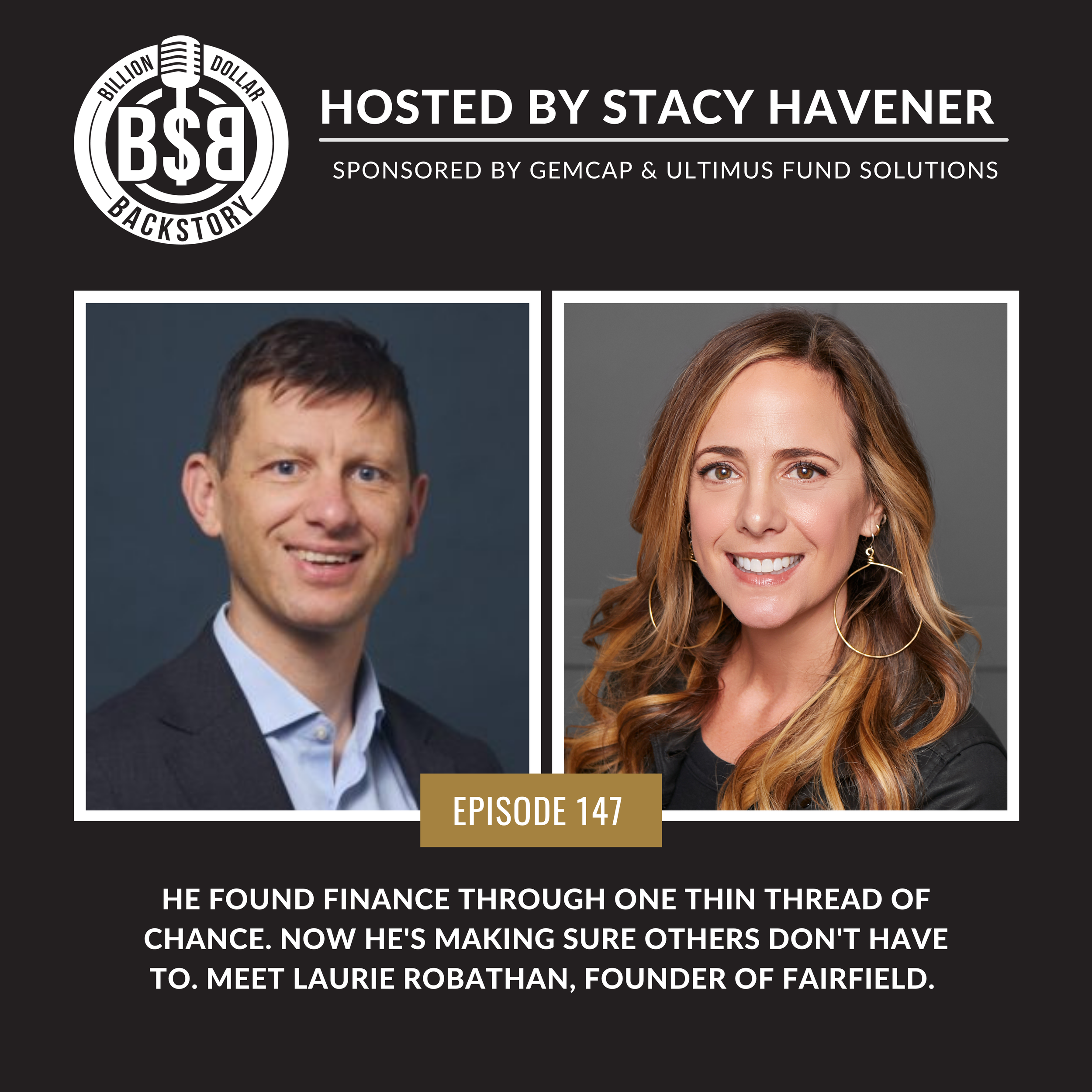
Episode 147: He Found Finance Through One Thin Thread of Chance. Now He's Making Sure Others Don't Have to. Meet Laurie Robathan, Founder of Fairfield.
Subscribe to Billion Dollar Backstory on Apple Podcasts, Google Podcasts, Spotify, or wherever you listen to podcasts.
93% of the population. Almost entirely locked out of an industry that says it wants the best talent.
Laurie Robathan grew up on the wrong side of that statistic. He was raised in inner-city Bristol, went to a state school, and grew up in a single-parent family. He found his way into finance through one thin thread of chance, and he's never forgotten how easily it could have gone the other way.
At some point, that thread started to feel less like luck and more like a problem. Because what about everyone who never gets that thread at all?
So Laurie walked away from a successful career in finance and built Fairfield in its place. It's a charity on paper, but really it's a business proposition designed to fix what he calls an inefficiently functioning labor market. Because when 80% of senior finance leaders come from just 7% of the population, that's not meritocracy. That's a pipeline problem.
And he's not solving it from a boardroom. He's on trains, in school assemblies, at North London career fairs at 8pm. Doing the work.
In this episode, Stacy Havener sits down with Laurie for one of those conversations that stays with you long after it's over.
Listen in to hear:
Why finance doesn't have a talent problem, it has an access problem
Why the best person for the job may never make it to the interview room
How Fairfield prepares students to belong before they ever walk through the door
What individuals and firms can do to help
More About Laurie Robathan:
Prior to his retirement from the finance industry, Laurie worked in the City for over 15 years, the last 10 years being at Kepler Partners LLP as Senior Partner. Before Kepler, he had roles at Scottish Widows Investment Partnership and Close Brothers Bank. As a member of Kepler’s management committee, Laurie had input into all areas of the asset management business. He holds the Investment Management Certificate (IMC) and has an MSc in Finance & Investment from the University of Bristol.
TRANSCRIPT
Below is an AI-generated transcript and therefore it may contain errors.
[00:00:00] Stacy Havener: What's the thing that was missing from your life as a kid became the very thing you dedicated your life to as an adult? Lori Robisan is British. He grew up in Bristol, an inner city, state school, single parent, family, and stumbled into finance entirely by accident because of one person, one connection, one random thread, and he never forgot how thin that thread was.
[00:00:30] After building a successful career in asset management from Scottish widows to Kepler, where he helped grow a boutique from the ground up, Lori walked away, not because he had to, but because he couldn't unsee what he saw. 93% of the population almost entirely locked out of an industry that needed them.
[00:00:54] He launched Fairfield. It's a charity. Yes, but really it's a business proposition [00:01:00] designed to fix what he calls an inefficiently functioning labor market. Because when 80% of senior finance leaders come from 7% of the population, that's not meritocracy. That's a pipeline problem. And Lori is out here on trains, in assemblies in North London career fairs at 8:00 PM doing the work to fix it.
[00:01:24] He is a special person, the kind of person who will make you know, like and trust him inside of five minutes, and then inspire you to do more in the best possible way. This is a podcast episode and a story that is very near and dear to my heart as a blue collar kid who also found her way to finance.
[00:01:47] Please meet my friend Lori. Hey, my name is Stacey Er. I'm obsessed with startups, stories, and sales. Storytelling has fueled [00:02:00] my success as a female founder in the Toughest Boys Club, wall Street, I've raised over 8 billion that has led to 30 billion in follow-on assets for investment boutiques. You could say against the odds.
[00:02:12] Yeah, understatement. I share stories of the people behind the portfolios while teaching you how to use story to shape outcomes. It's real talk here. Money, authenticity, growth, setbacks, sales and marketing are all topics we discuss. Think of this as the capital raising class you wish you had in college mixed with happy hour.
[00:02:37] Pull up a seat, grab your notebook, and get ready to be inspired and challenged while you learn. This is the Billion Dollar Backstory podcast.
[00:02:50] Wouldn't it be cool if you could diversify your investor base and add some non-US investors? Europe could be fun, or Latin America, [00:03:00] maybe Antarctica. Hey, icebergs aren't really my jam, but you never know. You've only got one problem. How the heck do you do that? Fair question, but maybe this is a who not how thing.
[00:03:13] Meet my friends at Gem Cap. Not only do they handle all the back office stuff, the how. They'll also solve the who in your distribution conundrum. They have an incredible network of distribution partners who can help you sell the thing. Once you've built the thing. And Gem Cap won't just help you launch globally.
[00:03:34] They'll tell you where to go and maybe more importantly, where not to go. Saving you time, money, and annoying headaches. Want to find out if your investment firm is ready to go global? Visit billion dollar backstory.com/gem cap, G-E-M-C-A-P. We've created a quick quiz that'll help you figure out if you're ready to expand [00:04:00] beyond the US And side note, it's pretty fun too.
[00:04:03] Get your firm in front of the right investors in the right places with Gem Cap. Take the quiz and get more info@billiondollarbackstory.com slash gem cap G-E-M-C-A-P.
[00:04:21] So tell me why you're pissed off.
[00:04:23] Laurie Robathan: I went to a college careers fair yesterday, uh, for 16 to 18 year olds in North London. Which was an amazing setup, unbelievable job by the teachers there. Incredibly enthusiastic group of students and parents. It was an evening. Nice. Were there and they'd gone to the trouble of setting up a kind of finance zone.
[00:04:46] So for, you know, for companies within them, within the industry. We're talking 25 minutes in a cab outside of the city of London, which is just about probably still hanging on as one of the, as the biggest financial center in Europe on most [00:05:00] metrics. There were three companies on the list, Cambridge Associates, Aviva, JP Morgan, JP Morgan didn't turn up.
[00:05:10] So of the entire, the entire city of London that could have gone, you know, talked about the industry, talked to these young students about potential careers in the industry, and potential career paths and potential opportunities. Three of them on the list, one of them, the biggest bank in the world didn't even, didn't even turn up.
[00:05:27] Stacy Havener: Why? Okay. Why, why did that happen?
[00:05:30] Laurie Robathan: I just, it just, it genuinely frustrates me, I think, I dunno why. So I'm not even gonna theorize as to why, because who knows. But the fact is it is happening. And I just think, you know, obviously that frustrates me from an opportunity, you know, young people's opportunity point of view.
[00:05:47] But even if you, this, you know, even if you look at it from the other perspective as an industry, we're just, we're blowing it. Right. You know, we need to keep evolving and developing and encouraging talent from as, as kind of broader range of mindsets as [00:06:00] possible. And, you know, you get an opportunity like that and for whatever reason.
[00:06:05] Nobody's there. Right. And it's like, it winds me up. Put it that way.
[00:06:09] Stacy Havener: Well, I'm, I, I'm glad that you're doing the podcast post that. 'cause it's gonna be spicy.
[00:06:14] Laurie Robathan: Yeah.
[00:06:14] Stacy Havener: So, well, let's, let's unpack this a little bit because here's the thing, the first problem as I'm listening to you talk is why were there only three this problem, number one.
[00:06:26] Okay. Because the reality is who knows why the, the JP Morgan person didn't show. There could be any number of reasons that could have disrupted that. Which is always the case when you have an event, right? Like, you get the people, they say they're gonna come, they don't always show for various reasons.
[00:06:42] Some are legit, some are lame. But here we are. The real root of the problem here to me is why were there only three to begin with.
[00:06:51] Laurie Robathan: Yeah. Yeah. No, I mean, I'm not, I'm definitely not having to go JP Morgan for not showing, I mean, credit for them to be on the list in the Yeah. The
[00:06:59] Stacy Havener: bigger [00:07:00]
[00:07:02] Laurie Robathan: an industry as a whole.
[00:07:03] Stacy Havener: Exactly.
[00:07:04] Laurie Robathan: Why is asset management not doing more to engage
[00:07:07] Stacy Havener: Exactly,
[00:07:08] Laurie Robathan: Alan. And this is, you know, totally discount any sort of, you know, de and i or diversity or whatever, which is, and we can talk about maybe the lens that we look at things from.
[00:07:19] Stacy Havener: Yeah.
[00:07:19] Laurie Robathan: But we basically think about, as an industry should be trying to draw from the widest available pool of talent, right.
[00:07:28] As, even as a default provides equal opportunity or, or breadth of opportunity for young people. I just find it impossible to comprehend that you wouldn't as an organization, be it JP Morgan, be it BlackRock, be it Morgan Stanley, anyone, right?
[00:07:44] Stacy Havener: Yep.
[00:07:44] Laurie Robathan: Go Right. Okay. We need to encourage young people to join our industry, join our firm.
[00:07:48] Yeah. Create value for us as a, as a, as a business. Most kind. Certainly in my 20 years, the biggest inflection for the industry, let's go and get, [00:08:00] right. There's an event in it's 25 minutes. There's two people from six different colleges. No brainer. Get a cab, get there and see if we can get the next hot trader or hot shot fund manager or whatever.
[00:08:14] It's, and it just isn't happening. Right. And I just cannot, for the life of me understand why they're not doing it.
[00:08:19] Stacy Havener: It's, uh, we're, we're gonna throw a BS flag on it. Um, you know, here's the thing, and I'm gonna ask a question and I, it's gonna sound sort of, I don't mean to be a jerk when I ask this question.
[00:08:30] Um, what were the colleges,
[00:08:33] Laurie Robathan: uh, so yeah. In this country? So when we say college, that's like 16 to 18 years old.
[00:08:37] Stacy Havener: Oh, so this is more like high school.
[00:08:39] Laurie Robathan: This is
[00:08:41] Stacy Havener: our equivalent of high school, yes. Okay, keep going. I'm tracking.
[00:08:44] Laurie Robathan: So we have Exactly, so it goes to like 18 and then that can transfer. So you have.
[00:08:52] Education system is effectively 97%, uh, sorry. 93% of students in the UK go to [00:09:00] state school, which is non paying school. What's either called private or public schools, which confusingly in public school in this country means private school.
[00:09:10] Stacy Havener: Yeah.
[00:09:12] Laurie Robathan: So there is obviously a skew of, you know, resources. Let's say today 7% fine.
[00:09:21] That is what it's, but as I said, purely on a probabilistic point of view, if I'm an employer, I wanna engage, you know, certainly from 16 up, I wanna try and engage, especially as there's a skew more now to apprenticeships and
[00:09:34] Stacy Havener: Yeah.
[00:09:34] Laurie Robathan: You know, people, young people are not gonna university. They're going directly into, into, into employment.
[00:09:41] Yes. Those. Six colleges are in low income areas, you know, we as a charity and
[00:09:45] Stacy Havener: mm-hmm.
[00:09:47] Laurie Robathan: Maybe start at the beginning again in a minute. We'll
[00:09:49] Stacy Havener: go back, but this is good. Keep going. This is what I was thinking.
[00:09:52] Laurie Robathan: Yeah. We focus in on, on, uh, low income areas, you know, students from low income background, so Yeah.
[00:09:58] They're off the, off the, you know, [00:10:00] they're wrong side of the tracks, let's put it that way. Right. But even taking that, you know, it's just common sense that you would think, right. Well, talent is potentially in any area or any can come from any background as a, you know, ultimately, you know, effective organization that wants to attract the best people.
[00:10:20] We should be going out there and, and, and meeting these young people. And by the way, you know, obviously there's less opportunity in these colleges, in these lower income areas. Yeah. But laws doing it. Account, you know, you get the accountancy practices, you get the legal firms, you get, you know, it's predominantly a lot of, of kind of, you know, what we call here public sector jobs.
[00:10:41] So the police, the health service, the army, et cetera. But other professional services organizations are going and doing this essentially outreach work, you could call it. And for whatever reason, finance is just behind the curve. And I just can't understand why
[00:10:57] Stacy Havener: you know it. You're so right. And it's common sense to [00:11:00] you.
[00:11:00] And by the way, this is why we need Fairfield, right? This is why we need you for, for the exact thing that you're pissed off about right now is why you exist, which we're gonna go back to the whole story here in a moment. But I think you've hit on the exact problem. It's common sense to you, and it's common sense to me, and it's common sense to a handful of other people in our, in our industry.
[00:11:21] But the status quo and common sense are not the same thing. And that's sad, and it's infuriating because there's so much talk. There's so much talk and who's walking that, who's really showing up, who's walking the walk. It's real easy to talk a good game, but it's much different to show up there and And do the things and do the work
[00:11:47] Laurie Robathan: well.
[00:11:48] So that's my big thing. Exactly that. So my mantra is do the work. Right. But what I don't wanna put across is that on an individual basis, there's not that desire and there's not actually that work being done [00:12:00] and
[00:12:00] Stacy Havener: great.
[00:12:00] Laurie Robathan: My experience in Fairfield in five years is that the support from the industry has been absolutely phenomenal.
[00:12:07] Stacy Havener: Good.
[00:12:08] Laurie Robathan: But it's almost all on an individual basis. Right? So we have six corporate sponsors who are incredible, and those firms are unbelievable, by the way. Five of the six hedge funds. I dunno if that
[00:12:17] Stacy Havener: Interesting.
[00:12:17] Laurie Robathan: Does there anything in that? Who knows?
[00:12:18] Stacy Havener: Yeah.
[00:12:20] Laurie Robathan: But every big, we've got volunteers from every big firm.
[00:12:23] We've got volunteers from JP Morgan, we've got volunteers from Morgan Stanley, you know, Goldman Sachs, Lazard, Citi, whatever you wanna, whatever you wanna say. So the intent is there and the work is there, right? Yeah. And these guys are on their own time and no credit, no, you know, no publicity for it at all.
[00:12:42] But they're having to do it almost in spite of the support from their corporate Oh my. You know, their employers. It's, it's just, I find it, yeah. As I said, I think there's layers of bureaucracy and I dunno what, what that subtext is, and I don't theorize on that. But as I said last night, I just thought, this is ridiculous.
[00:12:59] Stacy Havener: [00:13:00] It's crap. This is crap.
[00:13:01] This
[00:13:01] Laurie Robathan: is what it's,
[00:13:02] Stacy Havener: it's what, it's, and also that's why, that's part of the reason why I'm so glad that Simon, Evan Cook made this connection for us, because I think the more I've talked to people. Who know you and know the work you're doing at Fairfield. And the more I've read and learned about what you're doing, it's incredibly important.
[00:13:22] And as I said to you in the green room before we started the conversation, I wish you had been around when I was in high school or in that, you know, age of in my late teens trying to figure out what to do because I didn't even know Wall Street was a place I probably could have done the whole, like here it is on a map.
[00:13:40] But that was about the extent of it. And so tell us about the journey, because the work you do, there's such a big why that must be driving you and I wanna understand that. I wanna understand that why. And I think in order to do that, we need to understand the person behind Fairfield. So would [00:14:00] you be willing to share your story?
[00:14:03] Laurie Robathan: Yes. I'm more and more been asked to do this, so, uh, yeah, I'm getting more comfortable with Yeah's, not kind of anything special in the sense that, you know. I grew up in the UK in a city called Bristol, grew relatively modest, uh, background, was single parent, family, um, in a kind of inner city area, but not, you know, not terribly in any sense.
[00:14:24] But I suppose the determining factor relating to what I do now is the school that I went to. So I went to the local school that served that area again in the city area and was kind of firsthand, um, experience of the.
[00:14:47] Professional services, careers in general, and a complete lack of any sort of, uh, visibility on finance. I mean, we're going back, right? So forget about that, you know? [00:15:00] Um, but yeah, there was, you know, there was the kind of, the emphasis was on, it was incredibly enjoyable school to go to, and I'm still mates with all my mates from school, and it's, it was great.
[00:15:09] But, um, yeah, there's just not that sense of what could be achieved or, you know, that breadth of, of, of kind of awareness of different career paths, either within the school or, you know, contact with employers or obviously kind of influences from social groups or, you know, parents, et cetera. So that probably was, and it didn't preoccupy me at the time, but that's probably one of the determining factors of, of wanting to do what I'm doing now.
[00:15:38] Stacy Havener: So. It's gotta be. And that was my, I mean, the whole time I'm looking at all the materials, I'm like, okay, so there's a story here, and it is special, by the way. I'm not gonna let you get away with that disclaimer at the start. So if, if you didn't have the visibility into finance, how the heck did you end up in finance?
[00:15:57] Laurie Robathan: Yeah. So I guess that's an interesting point. And um, [00:16:00] so it's actually randomness, right? Yeah. So the whole ethos behind Fairfield is trying to reduce randomness and increase the kind of probabilities and success and the systematic kind of, um, uh, provision of opportunities. Um, a friend of my sister who was five or six years older than me, I can't remember exactly, but yeah, he was, uh, he got a job in, um, asset management and was the kind of, you know, the one person he went to the same school and, um, so he, uh, yeah, he, I knew about the industry 'cause of him effectively.
[00:16:33] And again, that. Probably had something within me where I wanted to kind of do something and you know, we've all had that where you got that,
[00:16:40] Stacy Havener: yeah, that
[00:16:41] Laurie Robathan: urgent or that that desire to do something, you just dunno how to or where to direct it. Um, so yeah, I kind of heard about the industry via that route and yeah, so kind of he, he obviously told me about it and yeah, and it kind of developed from there.
[00:16:56] I guess the interesting point, which to is totally [00:17:00] unrelatable to now, and I'm, I'm, as far as I'm aware, it's similar in the States with, with cities like in New York, but in that period you could move, which I did, you know, post university, you could move, I could move to London, right?
[00:17:11] Stacy Havener: Mm-hmm.
[00:17:12] Laurie Robathan: Without a job, well, you know, with a temporary job.
[00:17:15] And then I was digging away trying to do interviews and, you know, study from IMC and, and kind of hustling into the industry, which is totally financially unviable now, right? You cannot live in London without, uh, you know, a really stable job and a, and a kind of a decent, decent pay. It was one of those where you kind of, you know, you find your way in.
[00:17:37] Um, but again, that the relatability of that career path to the students we work with now is, is close to zero, just because it's not practically possible.
[00:17:46] Stacy Havener: So you get, which is a, that's another podcast that would require a whole Yeah. Right. That's like a huge problem and so many levels. But it, but again, in the seat you're in, you're looking at all of these headwinds and all of these [00:18:00] obstacles for these talented young people to consider finance as a career and flip side, as you said earlier, for these institutions to get fresh different ways of thinking from creative people, um, that aren't maybe the norm.
[00:18:16] There's incredible challenges that we didn't face, you know, when we came up into the industry. So I wanna dig in a little bit more because the, the next sort of turning point that I think is, is interesting is, so you get into asset management. Give us a little feel for what you were doing and then what was the pivot?
[00:18:35] What was the point that said, you know, okay, I'm gonna leave this business to set up a charity because, you know, maybe you're a lot younger than you. Look, I'm winking that nobody can see, but like, this is not who I was expecting to see sitting across from me in the podcast studio today. I would have expected somebody who had already, you know, was much [00:19:00] older, decided I'm at a point in my life that I want, that legacy is important to me and I'm gonna start giving back.
[00:19:06] So what were you doing in asset management? What was the catalyst to spring you from, you know, practicing it to sort of doing something on the nonprofit side to support the industry?
[00:19:17] Laurie Robathan: Yeah, so I got into the asset management industry. So I started in, in a sales role. Mm-hmm. So the Scott Investment Partnership, which was at the time the biggest asset manager in the UK is now kind of through a acquisition, I guess Aberdeen Asset Management.
[00:19:31] Stacy Havener: Okay. Yeah.
[00:19:33] Laurie Robathan: And yeah, so I worked in sales selling their kind of, you know, the, the investment. Um, and completely by chance that was a job that was suited to me. Again, circum, you know,
[00:19:46] Stacy Havener: randomness,
[00:19:48] Laurie Robathan: but was randomness. Right. And then, so I did relatively. Well in that role, good right place, right time. This is 2005, four 2005.
[00:19:58] Markets are doing well. [00:20:00] You know, there was a lot more opportunity to kind of take on responsibility and, and, and what have you. So I did pretty well there. Then I moved on to Close Brothers, which was, um, you asset or the asset management arm of Close Brothers Bank. Again, weirdly circumstance worked in my favor.
[00:20:15] That was over 2008 and basically I was young enough to not be expensive enough to get sacked. Everyone above me basically got the, got the chop. And uh, I was the last one just about, you know, kind of like the ax just took the top of my air off and I ma I managed to, um, to stay alive. Um, but then you kind of get promoted by default because you're a large one in the, in the building, right?
[00:20:39] So yeah, I did kind of, uh, yeah, kind of relatively, got a couple of rungs up the ladder and then I joined a firm called Kepler at, uh, formative stage. And that was again, in the, this is always kind of in the distribution side, the sales side. And then we, so I was the fourth person in at Kepler, or another guy and I were the joined at the same time, [00:21:00] the fourth and fifth people, six months in or something.
[00:21:02] And then we had an open runway, right? So it was an advisory business. We were gonna build an asset management business within that firm. Great. The guys who started Kepper, uh, the interview and Tom were top, top people. And then we just, again, similar right place, right time. We were in the kind of regulated hedge funds, which were growing at that point, and we all just dug in and kind of made it happen, which was, which was really enjoyable and, and really, really good fun to be in that entrepreneurial environment.
[00:21:30] Yeah. And it happened. So, you know, we spent, I joined there in 2010, beginning of thousand 10. And then by kind of 20 17, 20 18, it. Well, and you know, as one of the partners done well, we've grown be a kind of medium-sized boutique. And the really interesting point in relation to how I then
[00:21:51] Stacy Havener: yeah,
[00:21:52] Laurie Robathan: exit the industry was the four other partners were all privately school educated.
[00:21:58] You what? In the old [00:22:00] day, uh, you could've called them aristocrats, certainly two of them, right? They were friends with the royal family and, you know, in the upper echelons of society. Top, top people, incredibly down to earth, super meritocratic, really supportive and just, just hard workers. Grafters as I, I would call them over here.
[00:22:17] But, you know, we're in this totally opposite end of the social spectrum, and. Actually, weirdly, what that taught me was, again, it did not pre preoccupy me that much, but you know, you go away the weekend and I'm doing whatever I'm doing and they're going and doing something very different. And you know, I noticed we lived in London, but they spent every weekend going the countryside and shooting and whatever, which I know, you know, and you come back on a Monday and you just have a chat and Oh yeah, that was good fun.
[00:22:43] Yeah. What'd you do? Yeah, yeah, yeah. I, oh, super open. Look, ask if you ever wanna, will come and stay with us, come to our, you know, stay or whatever. And you're like, oh. But the really interesting thing about that is one of them, bill, um, who was one of the founders, essentially the why, the idea of [00:23:00] Fairfield almost came from him.
[00:23:01] He came in one day. We were hiring people, we were in a growing kind of state or growth state, and all 90 something percent of the interviewees that we had coming in were basically public school boys. So male attended public school again from the 7% of the population. Mm-hmm. Everyone's different, right? So he had attributes, positive, negative, but demographically they were all very, very similar.
[00:23:27] It was Billy who went, who
[00:23:33] in the, who came in and you know,
[00:23:39] he tell us, he said the percentage of people that attended public school in this country, and then he said, told us it's 7%, right? Where's this going? He said, so why don't we get any CVS from the 93% of the people that didn't go to private school? And there was five of us, me and the other four partners. And he looked at me and he pointed at me, [00:24:00] used call, well we got L.
[00:24:04] I said, bill, it's a good point actually. And the petty drop, right? This is 2016, by the way, the petty drop. This is not. A demand side issue to use financial kind of,
[00:24:16] Stacy Havener: mm-hmm.
[00:24:17] Laurie Robathan: Terminology, right? The demand broadly is there for the best talent, right? We want our businesses to create a best p and l or, you know, to turn out the best performance numbers or whatever it might be.
[00:24:30] And, you know, unconscious biases aside, you know, whatever that is, we're all just gonna hire the right person regardless. Right? So then it made me think this is more of a support side issue, right? I know from personal experience that there's huge amount of talent in that 93%, and particularly the lower income portions of that, you know, the country in general.
[00:24:53] It must be that they either dunno about the industry or they know about it and they can't get it. There's only two reasons, right? [00:25:00] Why wouldn't they want good jobs that are well paid in an industry, industry that's got, you know, loads of interesting intellectual challenges and all these things that, that we know.
[00:25:08] So that was kind of when the penny dropped, right? I'm like, okay, well there's, there's a job to be done here, you know?
[00:25:13] Mm-hmm.
[00:25:14] Laurie Robathan: That was simultaneous with me having kids.
[00:25:16] Stacy Havener: Mm-hmm. And
[00:25:17] Laurie Robathan: that obviously you're then thinking back to, makes you kind of almost shine a mirror on yourself. Yes. And when you were young and
[00:25:23] Stacy Havener: Yep.
[00:25:24] There's
[00:25:24] Laurie Robathan: stuff and you got a bit soppy so you know, you know, do something a little bit more for the good of, you know, the, the wider world and come a bit less selfish maybe, and whatever. And yeah, that means my passion is helping young people and it's what I wanna do, but I was really determined for it to not be charity for charity's sake.
[00:25:44] Stacy Havener: Mm-hmm. And
[00:25:45] Laurie Robathan: I was really motivated by the fact I could sit in front of anyone, and this is when I started thinking about it, 2016, I eventually launched Barefoot in 2020. Mm-hmm. It was an intervening four years, but I had it planned out that when I went for funding and [00:26:00] industry engagement and support and.
[00:26:03] I'll be able to sit across the table from Bre Howard, or you know, JP Morgan or Goldberg, whoever it was, and go, listen, put your ideology aside. Irrelevant, right? Mm-hmm. What I'm doing is offering you a value proposition, okay? You're part of an inefficiently functioning labor market, and I'm gonna help you create some efficiencies and access the best, you know, some of the best talent that by definition, statistically speaking, you are not currently accessing fact, right?
[00:26:33] 50% of all new entrants to the finance industry come from private schools. 7% of the population, 80% of senior management in finance comes from 7% of the population that attended public school. It's a statistical impossibility that that is the best. 80% coming from seven percentage just. Unless you've got some pretty hard line viewpoints on, on where talent [00:27:00] comes from, it cannot be efficiently functioning market.
[00:27:03] Right. So it's in the industry's interest to help me, support me, provide the opportunities to these young people and help these young people. And therefore it's not charity for charity's sake. It's uh, it's a functional operation. Right? And that was what I felt. I could stand toe to toe, eye to eye with anyone who had any belief and say, it's the right thing to do from a business point of view, it's the correct thing to do.
[00:27:31] So that was what, you know, kind of got me going. And then from a purely practical point of view, Keppler was successful enough for me to be able to do it.
[00:27:39] Stacy Havener: To do it
[00:27:39] Laurie Robathan: sooner rather than, yeah. Plan for. So,
[00:27:42] Stacy Havener: okay. I wanna pause. That was amazing. By the way, but I wanna pause 'cause one of the things we talk about on this podcast is just the art of storytelling and how valuable that is in raising money, earning more money, advancing your career, et cetera.
[00:27:59] And I wanna [00:28:00] point out what you did there, either knowingly or unknowingly, it could just be you. So a couple things. I'm gonna try not to lose them. The first thing is when you kind of roleplayed with us about what you wanted to be able to do, when you sat across from Bren Howard, what you did was not talk about Fairfield.
[00:28:19] You talked about them and you said, you have a problem. And the problem is this. And you described that you're, you know, you, well, you were, you spoke their language, you spoke in finance terms, and you talked about the fact that they were in an inefficient labor market and not getting the best talent.
[00:28:38] That's poking the bear big time, isn't it? 'cause now they're like, oh, sh. You didn't wait because then you did something. Even this is 0.2. So you told them, you, you made them the hero of the story. And if they didn't know they had that problem, they did know it. Now after sitting with you and then, and only then did you talk about the stats [00:29:00] you led with the story of them as the hero in that story.
[00:29:04] And you as the person who was gonna fix this problem for them, and you backed it up with data. I'm gonna throw my pen on that. That was so good. And again, that may have been instinctual for you, but what you did right there and what you've probably been doing unknowingly is really, really powerful from the art of storytelling and also the science of human behavior because of how people make decisions and it, I just want you, you, when you get this podcast and all the clips and all the things, I want you to go back and listen to that.
[00:29:41] Because it was incredibly powerful. And of course, there's one piece missing from where I sit, which is the piece that was the most difficult for you when we started. When I said, tell me your story, I also want you to listen to that because you were very honest and said, [00:30:00] this is, this is not easy for me to do, and I've been asked to do it more frequently.
[00:30:04] And then you disclaimed a whole bunch of stuff about you. And so I'm just, again, I don't wanna, I'm turning this into like, oh my gosh, there's this one piece. And if you click that piece in, you'd be like, gangbusters. Even more so than you, than you are now. But I, so let's save that. We'll put that on a shelf and we can come back to it later.
[00:30:25] But I want, I really want you to hear me when I say the way that you've positioned the value proposition for Fairfield is brilliant.
[00:30:33] Laurie Robathan: Well, I appreciate that. And I've kind of, that was initially five years ago, much more how I would talk to. Potential sponsors and, uh, yeah, and, and owners. Oddly, the, the feedback has often sometimes been, it's too businesslike and it's not, I'm not a charity, I don't come from a charity background.
[00:30:49] Right. So, yeah, that's how I looked at it. I mean, I would say, just for the record, in case it doesn't come up organically, I forget say, but what really we're in the [00:31:00] position of now is absolutely the ambassadors and the, the, the public face of Fairfield Enterprises. Percent, the students themselves. Right.
[00:31:10] Stacy Havener: Yeah.
[00:31:11] Laurie Robathan: I love
[00:31:11] Stacy Havener: that.
[00:31:12] Laurie Robathan: So who are now the alumni? I give, I was thinking, I dunno if it's the right point to say it, I just thought it would be a good example. I was thinking of it earlier, which didn't, hasn't occurred to me. I've not really said it before. We had, so we had a fundraising event, which was chaired by Christophe by the way, who, uh, you said, you mentioned, you know, he did, he compared it and ceed it.
[00:31:31] We did a, a, a kind of quite fun called place called Hi Jingo Lingo in, in London, which is futuristic Japanese Bingo, which was, you have bingo in the states.
[00:31:42] Stacy Havener: We have bingo in the states, but I don't know that we have futuristic Japanese Bingo. So this is above my, my knowledge base.
[00:31:50] Laurie Robathan: Imagine, well, it was way above mine.
[00:31:52] I was pleasantly surprised. But imagine, you know, blade Runner with Harrison Ford.
[00:31:56] Stacy Havener: Yeah.
[00:31:56] Laurie Robathan: Meets, that's exactly the vibe they go for meets bingo. [00:32:00] So kind of people.
[00:32:00] Stacy Havener: Bingo. I don't even know how to imagine that.
[00:32:03] Laurie Robathan: Yeah, I mean I, it's completely beyond my, my, anyway, we're in this place, right? Yeah. And uh, we had a couple hundred people from the industry and obviously it's the first time we ever done a kind of, so we're trying raise some capital, raise some money, but also just kind of spread the word of what we're doing.
[00:32:22] Uh, and again, you know, try and talk about the value proposition, but also talk about the achievements that happen. And, uh, I've noticed, uh, midway through proceedings, we had this bingo, and then between the bingo games, they have a dance competition for whatever reason, you know,
[00:32:36] Stacy Havener: come on. That's amazing.
[00:32:38] Laurie Robathan: There was a managing partner got up from a kind of boutique private equity firm, and. Just, I thought this is a really good, and it took me a while to make the whole connection in my mind, but he got up, he kind of had won the bingo and then, or he is a draw. That was it. So then they had to have a dance competition to out who was gonna win.
[00:32:56] And it's him and a another woman. And the music [00:33:00] started. He was a kind of middle aged, probably in his fifties though. And he just went absolutely bananas. He was like, put absolutely everything into it. He like fully, fully committed for about a minute to this dancing. Got his coat off, was swinging it over his head.
[00:33:16] I
[00:33:17] Stacy Havener: love this. Okay.
[00:33:19] Laurie Robathan: Of like 15 of his employees. So he had a graphite, I've just said the name of the firm now. He had a, he had a table from his business and just chucked everything into it. And I thought, God, that's absolutely amazing. And obviously all of his employees are like, everyone was cheering him and he's the hero.
[00:33:36] And I thought it's so good to see the commitment and the kind of like. Freedom to just be honest and be like, you committed to this, and just think this is a fun event and I'm gonna fully put everything into, I then realized we'd done a fair bit of work with this private equity, and about two months [00:34:00] before we had six of our candidates, our students go in there and do a week, an inside week they call it.
[00:34:06] So, you know, they go, they spend a week there, they get to learn about private equity, they get to learn about this firm. They have a look at a few deals. They go different departments, understand what it's like to operate an investment business. And some of the specifics about what they do. We prepare these young people, we work with them on a really intensive one-on-one basis.
[00:34:24] So we prepared them, we'd really specifically pick them to go into this, this program, and we'd prepared them, but ultimately they went in there, right? Mm-hmm. And these are 18, 19 year olds. They'd gone in there, they'd done all the prep in the world. And they'd completely smashed it. Right? And they met all the senior people from the business.
[00:34:42] Again, it's a boutique. So they got loads of exposure to these, these senior people, and they represented themselves and by association Fairfield. Mm-hmm. To an absolutely incredible level. And that's something we always try to press upon all of our candidates. Look, you're gonna create an opportunity for yourself, [00:35:00] or you're gonna create an opportunity for more than one other person.
[00:35:03] Mm-hmm. Right? An exponential growth of the success that you as an individual will have. And that's about, that's in their own grasp, right? We can facilitate that, but it's their commitment and their passion and determination that, that it gets them results. And it made me realize that, you know, because obviously Graphite mentioned them again, this firm had not doing a very well good job of making this anonymous.
[00:35:28] They'd come back and say, look, yeah, we're gonna do another program next year. So you know, your guys were great, et cetera, et cetera. But I thought. This individual who'd got up and committed to this fundraising event. You know, maybe part of the reason he'd done that. And then by the way, he then was incredibly generous from a purely financial donation point of view.
[00:35:47] But what struck me more was his commitment into what we are and just embracing the whole event and just committing to the, the kind of the cause of what we're doing in every sense. And in reality, [00:36:00] why did he do that? Because he's seen it firsthand, right?
[00:36:02] Stacy Havener: Right.
[00:36:03] Laurie Robathan: He's met him and he's seen them come into his business and he's seen the commitment levels, the preparation, the opportunity, or the way they've taken the opportunity that presented to them.
[00:36:14] So he's come into that event on a like, right, well Fairfield, I see it. I've had firsthand experience. I'm gonna reflect that back in. And obviously that kind of energy in the room feeds through to others. So the point of that story, I guess, is that whatever we do. And whatever the work we do, and we'll, we, we do put the work in as an organization, as a group of volunteers.
[00:36:38] It's a fraction of the impact of the success of the students and the work of the students themselves, because that is what creates that feedback loop of more opportunity, more understanding of the talent that's out there, more desire to find more of that talent. Do you see what I mean? Mm-hmm. And just keeps opening that door so it sounds cheesy and whatever, but like genuinely all [00:37:00] credit goes to those students who snap your hand off for that opportunity and then take it.
[00:37:06] And just, you know, knock it outta the park.
[00:37:08] Stacy Havener: A hundred percent. A hundred percent. Also not gonna let you totally disclaim because they are, you're right, the alumni, we call these impact stories. But anytime you have, so you have actually two sides of an impact story at play here because you have the asset management firms who are a story in and of themselves because they've had the students come in and do amazing work and add to, you know, the fabric of that company.
[00:37:37] And then you also have the impact stories that that play out for the alumni. And the powerful thing about story in general is that it's one when you say like, here's what we're doing, and you explain it, that appeals to someone's intellect, right? I'm going to present a case, this is [00:38:00] the case I'm presenting, and when you're speaking there, you're speaking to their brain.
[00:38:04] How humans make decisions, however, is very different than that. It's not that the brain is not involved, it's just not involved first. So the arbiter of a decision is actually the heart. And the reason why story is so powerful is because it, it's not speaking to the brain, it's speaking to the heart through emotion.
[00:38:25] And once the heart buys, the heart goes, oh my gosh, I'm feeling something here. This is super cool. Gosh, there's this guy, he's dancing like, you know, like a total rock star. And there's these students and something's happening here and tap, tap, tap, brain. I think I'm, I'm tagging you in because we need to explore whatever this magic is.
[00:38:45] I feel it. And I need you now to help me intellectually determine if this is a good choice for us. And that's what you've done by these stories.
[00:38:56] Laurie Robathan: It's really interesting. It is exactly that. And I think what we've, [00:39:00] what I've learned, you know, from coming into this charitable space is that is obviously so much more, you know, the heart is so much more dominant than the head.
[00:39:10] Yes. Because it's, you know, it's ultimately all emotive, right? Mm-hmm. You know, maybe my kind of practical, not obsession, but you know, my focus that this isn't deemed charity, right? These aren't charity cases. You're not giving someone something.
[00:39:27] Stacy Havener: Yeah.
[00:39:27] Laurie Robathan: These young people just require an opportunity and they will create the value themselves for themselves, but also for their employers.
[00:39:36] And, you know, you could go any steps beyond, right? For the, for the industry, for the economy. Yeah. This is the benefit, but actually that, what that does is, I, I completely agree with you and I think, you know, I kind shoulda spoken to you right at the beginning because I then thought I'm gonna. Focus. So on that, that the heart won't come into it because I won't be
[00:39:56] Stacy Havener: mm-hmm.
[00:39:57] Laurie Robathan: Going down that road. You see what I mean? I won't be kind of [00:40:00] trying to leverage people's sympathy because I didn't want it be anything other than a logical kind of case and a value proposition that is kind undeniable. But as you say, to see when people's emotions get engaged, that's it. Right? Um,
[00:40:18] Stacy Havener: it's incredibly powerful.
[00:40:20] It's one of the most underutilized, it's actually a science, which is so interesting because it's so underutilized in finance, because we're so quantitative and so intellectual and there's so many smart people here just doing smart things that when you talk about emotion or heart or even qualitative, it's kind of like a massive eye roll for most people.
[00:40:40] The reality though is that it undermines the fact that we're people. We're humans. Humans and the way that we operate is heart first. As much as we don't want to believe that as much as our schooling and our training and our CFA makes us feel like, you know, we're [00:41:00] numbers and we're objective and all those things, the reality is that that's just not how humans operate.
[00:41:07] And so I wrote down one thing in this, well mostly 'cause I'm just so engaged in what you're saying. I think it's amazing. I could talk with you for hours, but the one thing I wrote down was what you said when I. You said something when I said, oh, the way that you kind of positioned this was really powerful and you said, oh well I felt like it was too business.
[00:41:29] That's the one note I've written down so far. And so, and that goes back to this storytelling. 'cause what you did right there and what these stories of these students and what these stories of these investment firms are, are, it's not gonna be business. It's going to be sort of storytelling and it's gonna have emotion in it.
[00:41:49] And the piece that is the next piece I think for you is, is, and this is just my opinion, but I am [00:42:00] passionate about what you're doing and I'm passionate about story, is that your story has to come in at the front. You have to, so the way the visibility effect works is we have to be, it's super difficult and, and no one can see you laughing right now because, you know, you're probably also sweating because the, you know, the, the, the vulnerability it requires to tell our story is it's massive.
[00:42:27] It's massive. It's difficult work, but also the visibility effect, which feels self-promotional. We're talking about ourselves and it's like, me, me, me, me, me. But the reality is every one of those students is inspired by your story. And every one of these asset managers will be inspired by your story and the doors that you'll be able to open by leaning into your own visibility, like coming on this podcast and doing things to say, Hey, this is why I'm doing this.
[00:42:59] It, it's [00:43:00] not that. It's about you, it's about what you can do for everybody else. And that's the visibility effect at its best.
[00:43:09] Laurie Robathan: Yeah. Yeah. That more, and.
[00:43:19] Stacy Havener: Let's be real. No one wakes up and says, I can't wait to build some operational infrastructure today you are here to manage money to build something that lights you up, not chase down reports across five systems and 15 service providers. That's where Ultimas Fund Solutions comes in there. Your ops dream team, consolidating all your middle and back office chaos into one clean, scalable setup, registered funds, private funds, SMAs, all integrated.
[00:43:52] One team, one tech platform, one rock solid source of data. But here's the real [00:44:00] differentiator service. I know that Fund in a Box sounds convenient. It's also a box. Know what? You can't put in a box? A human who picks up the phone when you call and need help. Real life people who know your name and your fund, and they care about getting it right.
[00:44:17] Ultimas was built on people doing business with people. You get institutional strength combined with boutique level service without getting stuck in a phone tree of doom. If you're ready to simplify scale and start working with a team that feels like an extension of yours, check out billion dollar backstory.com/ultimas.
[00:44:41] That's U-L-T-I-M-U-S. You've got the investment strategy, the vision, the track record. Now it's time to upgrade the engine behind it all with Ultimas. I'm gonna get you off the hot seat 'cause I want you to like me at the end of this one. [00:45:00] So I wanna talk about just like the practical parts, because when I was going through your materials and, and just kind of learning about how you do this, you know.
[00:45:11] That that was, it was like, how do you do, I guess that was where it started for me. I was like, please tell me these materials, gonna talk about how there was an interesting bit in here about like your training, which I thought was fantastic. And it's not that one, it's this one, which the Amplify Me Academy.
[00:45:27] I wanna learn more about like how this happens. Like how are you preparing the students for this?
[00:45:32] Laurie Robathan: For this? Yeah. So I guess there's a, it's the kind of classic funnel really, in the sense that the two main kind of problems we're solving for, as I said at the beginning, is either people, either students from low income backgrounds cannot get into the industry, but they've heard of it.
[00:45:47] Mm-hmm. Or they've never heard of it in the first place
[00:45:48] Stacy Havener: Yeah.
[00:45:49] Laurie Robathan: Of it. And they're, they're put off for whatever reason.
[00:45:52] Stacy Havener: Yeah.
[00:45:52] Laurie Robathan: But essentially we, we sold for that in the most simple way we can. So. For the never heard of it problem. Mm-hmm. There's all sorts [00:46:00] of quite UK specific kind of things. I dunno if it applies in the States, but I mean, it's pretty logical.
[00:46:04] The further away one is from a financial center, the more difficult it's to visualize working in that space. Yeah. And in the uk obviously London is dominant, so, and there's a generally quite a big kind of, um, issue with, uh, lack of opportunity in outside of the capital, let's say. Mm-hmm. In provincial cities and towns and, and rural communities.
[00:46:26] So the most simple way we could solve for that is just by going to those communities. So what we do in that sense, uh, is we travel to see 5,000, a minimum of 5,016 to 18-year-old students a year in schools and colleges. So in their, in their kind of educational settings, in assemblies, in classrooms, in careers fairs.
[00:46:49] The finance industry on their radar, right? Just to talk to them about the existence of the industry, the accessibility of opportunity in the industry, the demand for certain skills, personality types [00:47:00] and capabilities. And then just give them the information to kind of either engage or not, right? If they don't never heard of it, then how are they gonna gonna know whether it could be something that's of interest.
[00:47:11] So on a very practical level, that means getting on trains, it means traveling, it means going across the uk and we go from the furthest north to the south to south and east and west. Um, we've traveled about 17,000 miles to see those young people in, in their communities and we engage with the teachers and local charities and, and what have you.
[00:47:32] And that's been really, really enjoyable. 'cause who doesn't like going somewhere new and just chatting to a load of new people got, you know, who are in Sheffield or something who speak totally differently, but everybody's basically. Got the same stuff going on usually, you know, so that's been great. And you know, yesterday, like I was saying, I was at a careers fair and that was in the evening and that was 16 to 18-year-old.
[00:47:56] But because it's in the evening load, their parents were there. So that's so
[00:47:58] Stacy Havener: cool. [00:48:00]
[00:48:00] Laurie Robathan: Know, whatever. So there's that. Then where that interest is, is peak. So you get your 10 to 15% of a 300 room assembly. You know, 90% of them know they wanna do something else or don't engage or whatever, and that's absolutely fine.
[00:48:16] We're not trying to sell them the industry, we're trying to make them aware of it. Those 10 to 15% they come in, we give them practical advice on how to pursue that interest. And one of the things we do is offer them a place on, as you say, our level four diploma, which is an accredited qualification here in the uk.
[00:48:32] So,
[00:48:32] Stacy Havener: cool. That's
[00:48:33] Laurie Robathan: a three day virtual program. The next one is on the 17th, the 19th of February. We pay Amplify me, who are the biggest training provider, finance training provider in the country. They train incoming grads from coming into Millennium, coming into Citadel, coming into UBS, Morgan Stanley, RBC, and they go to previously top end private schools.
[00:48:56] So they go to Eaton or to, you know, these other top schools. We pay [00:49:00] them to do the same thing, but for students in Sheffield or Nottingham or Sunderland or Portsmouth or wherever. So again, just Democrat democratizing that opportunity. And then that's a three day crash course in finance. Are you interested doing an m and a simulation?
[00:49:16] You know, a little investment simulation and you know, get that CE training, LinkedIn building and stuff like that. So again, something tangible, right? Something that they can then we're not forcing it on a, but you know, if they get that interest, then they can come and.
[00:49:34] Take you three days off playing PS five, kicking in, whatever. But again, we offer that opportunity to them and that's, you know, opportunity. And then, so that's kind of, if this is narrowing right? Yep. We start with 5,000 and then we just offer opportunities. And then when it comes to the 18th, 24 year olds, we have what we call our core program.[00:50:00]
[00:50:00] And this is circa 50 a year, super specific coaching and careers guidance really about suitability, right? Knowing the individual inside out, really understanding from a professional and academic perspective where their strengths are, where their personality strengths are, what their ambitions are. And then guiding, you know, we all know finance is incredibly complex, but this was a very broad, so.
[00:50:25] You know, someone who most of 'em come and say, I wanna wear an investment banker. If they've already heard an industry and you go, really?
[00:50:33] Stacy Havener: Do you know what that means?
[00:50:36] Laurie Robathan: I'd, I'd be like, uh, sleep. No, but yeah,
[00:50:38] Stacy Havener: Josh, I was just gonna say,
[00:50:40] Laurie Robathan: but genuinely, there'll be a proportion that do and wanna, and that's a career path we progress them on.
[00:50:46] But again, it's usually because that's been their touch point. So we break the industry down and we match them up from a suitability perspective with different roles, different sectors, and then we use our network of volunteers. So Christophe, Simon, [00:51:00] uh, you know, people from across the industry who are senior successful experts within their field and we, ie that student in that thing, wealth management, right?
[00:51:12] Sath, right. Whatever it is, fund selection. We're gonna speak to Charlotte Richards, who's MD at JP Morgan, or whatever that might be. And again, that's where all of this commitment from individuals, from the industry is like mind blowing because they give up their time, they give up their expertise, but what they get is an hour with someone who's done six month Pratt to even be in the room with them in the first place.
[00:51:37] You see what I mean? So there's that, right? I've got thousands of questions because you're the person who does the thing that I'm, I've been learning about and I've been reading about, and now I wanna know, you know, how do you pick a fund or how do you pick a stock? Or how do you put a trade on, or whatever it might be.
[00:51:54] And then that's a knowledge and network thing, right? So then they build a network, they build more knowledge, it compounds up. And then when it [00:52:00] comes to them being in the job interview for that internship or that graduate program, it's like culmination of, of all of that work and they're just comfort level through the roof and they're in the right room because they're.
[00:52:16] Correct job for what their skills are and their personality are, and their success rate is, is, you know, is is material above what it would've been otherwise. And that's the probability bit, right? That's where we're trying to reduce the randomness of just happening to see something online or whatever, and just really increase the probability of that individual succeeding for themselves and then for the next group behind them and the next and the next, and then a second order effect of that, if you could call it that, is that that employer gets absolute best person for the job.
[00:52:51] And then guess what? Come recruitment time next time. Yeah, they up.
[00:52:56] Stacy Havener: That's
[00:52:57] Laurie Robathan: right. And Chance been up to Sheffield again, because we could do it [00:53:00] a few more of them. So
[00:53:01] Stacy Havener: that's an amazing journey for both sides.
[00:53:05] Laurie Robathan: Yeah. And look, you know, the, the, and then those young people, by the way, just the last point is that without even asking them, they'll always loop back in immediately.
[00:53:16] What does that mean? They actively, well, they ring me up and they say, oh, I've got a, I've got a job at Aveva, amazing, blah, blah, blah. And then immediately, is anyone else I can help? Do you need anyone who I see? Yeah. Can I go into school of you? Can I do this? Can I do that?
[00:53:29] Stacy Havener: Oh,
[00:53:30] Laurie Robathan: and that is like,
[00:53:32] Stacy Havener: that's
[00:53:33] Laurie Robathan: the relatability, the impact, the power of that, that young person loop back in is, is, is again a massive multiplier effect.
[00:53:41] So,
[00:53:41] Stacy Havener: yeah, that it's, you're doing such incredible work. And I wanna ask a very practical question in a moment, but there was one thing as you were talking about the journey that the students go on that I thought was really powerful. So obviously you're giving them an incredible knowledge base [00:54:00] and really practical skills, but there's something sort of more intangible that you're giving them, which is confidence.
[00:54:07] Which is confidence that they deserve to be here. You're giving them permission to believe that they deserve a seat at that table. And as somebody who did not take a traditional path, who benefited from that randomness? Because my high school soccer coach happened to be a fund manager. And that is the only reason I ended up here.
[00:54:28] And because I, I came from a family that couldn't afford school and I had to make it my own way. Um, the journey of believing you belong can take a very long time. And I think what your program does is it knocks that out right away because you're saying, we're gonna give you the training and they believe this is what makes me belong.
[00:54:57] I've got the skills, I've got [00:55:00] Fairfield in my corner. I've been, I've slowly built it up over time with all these various trainings and one-to-one conversations so that when they do step into that room for that interview, for that job, the imposter syndrome is gone. If it's not gone, it's mitigated significantly.
[00:55:23] Laurie Robathan: It's interesting. I mean, I totally agree and I think, you know, again, that was that confident, you know, that was one of the real things we thought is let's people talk about, particularly over the states, but Polish, there was this word polish. Mm. You know, it's got a bit more polish or a bit more, you know.
[00:55:40] Stacy Havener: Yes. Which
[00:55:41] Laurie Robathan: is confidence. Right. You know? Yeah. You, or whatever. It just breeds a certain sense of belonging, as you say, and, and, and confidence. And my view is always confidence derived from real foundational understanding. Yeah. Why you are in a, in the room that you are and why you're interviewing for the job you're [00:56:00] interviewing for, and the understanding of that sector or that, you know, role or whatever should be polished, right?
[00:56:07] Stacy Havener: Mm-hmm.
[00:56:07] Laurie Robathan: More often than not, and maybe it does, you know, there's all sorts of variables you can't control for, but that's always been the one, is that people would say, oh, you know, initially, like, right, well, let's speak a bit different. And I was told, you know, talk like there's a program called Match of the Day, which was like the football highlights program.
[00:56:24] And the presenter was a guy called Gary Lineker who spoke quite well. I remember someone telling me, learn speak like Gary Lineker. And I was like, I don't care about, I just tell me what I need the meat of what I need to know. I don't wanna, you know, do an impression of some guy on tv. Tell me about the information I need to know.
[00:56:42] Yeah. But so I, I definitely, you know, I always say to people, speak in your own voice, speak in your own accent. Don't. It's about what you say, not how you say it. Right. You know? Mm-hmm. There's a certain layer and you have to have in a professional environment, don't get me wrong, but you're not mimicking or or doing an impersonation of somebody else.
[00:56:59] You are. Mm-hmm. [00:57:00] You're kind of developing a, a knowledge that can provide you that confidence. So I totally agree. And in addition, which is what I, just for the first time, I thought when you were just saying that was to what you said is actually the confidence of belonging, I've, now I'm thinking interest, like free therapy.
[00:57:21] Stacy Havener: Welcome to my world. Yes.
[00:57:23] Laurie Robathan: No, we talk about the ecosystem, right. High barrier to entry to come into, don't come in here if you're gonna mess about, or you're not gonna put in or whatever. You're not allowed in.
[00:57:31] Stacy Havener: Yeah.
[00:57:32] Laurie Robathan: Volunteer student, whatever, donor. We don't need it. So there's that barrier to entry. But when you're in.
[00:57:40] Is a collective. And that in itself is an ecosystem. You know, people pay hundreds of thousands of dollars for MBAs to get an alumni really right kind of network. And we've always thought if we can have a really high quality network of alumni, of new students, of volunteers, [00:58:00] of everything that just feeds into itself.
[00:58:03] And I guess, yeah, maybe a, uh, a kind of outcome of that is a, at least a confidence to say, right, well, I'm in fair, you know, I know people from Fairfield who've succeeded and who've helped me out and part of that. So yeah, maybe that's the truth. So,
[00:58:18] Stacy Havener: okay, so here's my practical question. My practical question is, how can people help?
[00:58:27] How can people help individually? How can companies help? Mm-hmm.
[00:58:34] Laurie Robathan: The way help just by engaging with the thing that. Stay good at and the information they have, it's a, you know, partially it's a, it's an informational kind of transition as well, right? We all collectively know, as you said, what we didn't know.
[00:58:48] Stacy Havener: Mm-hmm.
[00:58:49] Laurie Robathan: You know, you, as you said, may benefited from the randomness and now you've built on a, you know, an incredible knowledge base and, you know, people who have that experience and that knowledge, it can be transferred. [00:59:00] So there's a kind of download aspect, but again, on a relevant basis to, you know, to the individual who needs to know what you know, or what someone at Bren Howard know knows or, or whatever it might be.
[00:59:13] So it's just a purely, and that's just a case of meeting the people as and when, and we've got a really incredible group of a hundred and as I said, about 150 volunteers who do that are in what I kind of slightly old Fashionly called our call our Rolodex. So one of our candidates is like, right, I'm really into private markets.
[00:59:31] I'm, you know, really wanna get into. Or something. And I really wanna speak to someone who understands how to break down a company's balance sheet. From that point of view. I even got a clue, right? So we bring up someone from KKR and then they give us an hour. Mm-hmm. And it's essentially a plugin and they transfer the information.
[00:59:51] Obviously there's outcomes where there's a, you know, connection on different basis, but at its very core, it's just that person telling another [01:00:00] person what that other person needs to know. So that is on an individual basis, how we operate on a corporate basis. We have six corporate sponsors who are absolutely unbelievable and shout out to all of them.
[01:00:12] It's just incredibly hard to get the large asset managers particularly
[01:00:17] Stacy Havener: mm-hmm.
[01:00:17] Laurie Robathan: To really understand that value proposition I was talking about earlier. Right?
[01:00:22] Yeah.
[01:00:22] Stacy Havener: Yep.
[01:00:23] Laurie Robathan: So what we need really, from a scale perspective
[01:00:26] Stacy Havener: mm-hmm.
[01:00:27] Laurie Robathan: Is organizations to support us. Yes. Financially we're a charity, but. Structurally, we, I go all over the uk I go to these towns and cities, stand up and I talk about the finance industry.
[01:00:40] If I had someone standing next to me who was from that local wealth manager or that local, you know, financial advisor, I would make it doub as powerful, right? Because I go, look, I'm not just telling you this, and I've come up from the south and I'm now in somewhere I've never been before, and this guy works around the corner.
[01:00:58] Or, you know, she works for the wealth [01:01:00] manager up the road and they're hiring, or they're, they have an apprentice apprenticeship program. That's the bit that I've never got is, uh, a kind of a partnership program where that's understood this network and this, this kind of systematic ability to go and just, just knock it off.
[01:01:18] Right? In this country, there's hundred 38,000 people from who free school meals in this country. If you, I'm sure the same parents. Below a certain amount, you get free school meals. Mm-hmm. Afford pay for them, which is essentially a marker of being in a low income environment.
[01:01:34] Stacy Havener: Mm-hmm.
[01:01:35] Laurie Robathan: Of 6,000 people who took their gcse, their 16, their exams at 16 years old, 38,000 from, got free school meals.
[01:01:43] Over the last four years, we've seen, I think 18,000. Right now we're a small organization. Right. But to me that's a pretty good,
[01:01:55] Stacy Havener: it's amazing
[01:01:55] Laurie Robathan: return.
[01:01:56] Stacy Havener: Yeah.
[01:01:56] Laurie Robathan: But all I see is 20,000 that we haven't seen what [01:02:00]
[01:02:00] Stacy Havener: I mean?
[01:02:01] Laurie Robathan: Yeah. Where we just need to keep the, like you said at the beginning, do the work. So, uh, engagement, financial support, yes.
[01:02:10] But from a corporate perspective. We need some really, we need some leaders to step up and just say, you know what? Let's have it, let's just go and just really make a difference here. And, and you say it's not talk, it's action. Mm-hmm. We've had that from an individual level in spades, but it's about getting it through that committee.
[01:02:29] That's a bit of a hassle, really trying to force it through the vote of when everyone's got 20 other different priorities at that point. So yeah, that's a long-winded answer, but, um, no, but
[01:02:39] Stacy Havener: it's a helpful
[01:02:40] Laurie Robathan: answer. We need everything.
[01:02:45] Um,
[01:02:46] Stacy Havener: we need it all. Well, listen, I, I am just, I don't, I'm almost speechless. That doesn't happen very often, but I'm gonna be thinking about. This conversation and you, and the work you're doing and the students [01:03:00] for a long time after this. And I, I mean, I'm sitting here in Newport, Rhode Island, which is extremely small, um, island off of the smallest state in the us.
[01:03:11] But I can tell you that after listening to you and hearing your story and hearing the stories of the kids, I shouldn't say kids, the students and the companies that you are helping, um, I am raising my hand to help in any way that I can. And I look forward to having that conversation with you. Can I end by putting you back on the hot seat?
[01:03:35] Laurie Robathan: Please do. And before you do that, I say massive appreciation for that offer and I definitely will be taking you up on it. And a huge amount of what you've said today is exactly what we're missing from and like, and actually, you know, aside from the direct work we do with the kids, something we've never focused on.
[01:03:53] I Christoff got up during our fundraiser in November and said, you know, Fairfield's marketing [01:04:00] budget is, has been zero, which is,
[01:04:12] um, report. So I'm getting, I'm getting alright at that. But look, genuinely like the messaging of what we're doing. Mm-hmm. I'm, I just get pissed off basically and just start ranting.
[01:04:22] Stacy Havener: That's probably what the best stuff you do, by the way.
[01:04:25] Laurie Robathan: Well, yeah. You know, uh, people are kind of like, you know, can't get taken aback, but I mean, genuinely, like, you know, everything you've said is, is exactly what, what we kind of need to, I guess.
[01:04:36] You know, just more effectively communicate what we're doing. So yeah, I'll definitely,
[01:04:41] Stacy Havener: well, I'll help. I'm, I'm, I'm here to help. We can do some work. Um, and my next trip, let's get together, if that works out schedule wise and, and we can talk more. And we've talked about Christophe a little bit. So regular listeners with the podcast will know that Christophe has been on our show.
[01:04:58] Um, and [01:05:00] I wanna end, I'm totally going off script. So how you like this with all those sets of questions I gave you? We didn't do probably one of them except tell me your story. I, I wanna read you something because I pinged Christophe yesterday and said, I can't believe this. I just see your face in my podcast preparation.
[01:05:18] And he sent me a note and said, here's something you can share with Lori. You ready? Lori's leadership of, uh, yeah. Brace yourself, Lori, you're gonna be uncomfortable and sweating. It's fine. That's my job. Part of my job. Lori's leadership of Fairfield is an inspiration to us all. He gave up a very successful career in finance at a very young age as he felt the pull to do more and have a broader impact.
[01:05:47] His passion is to help kids from less socioeconomical privileged backgrounds, find pathways and build bridges towards careers in finance. Where the UK has a big problem with representation, [01:06:00] he does this through practical grassroots efforts and spends hundreds of hours per year on trains in communities and in schools.
[01:06:09] He is a grafter. Thousands of school kids are better off for him. Multiple different businesses are better off for him as he's helped place a number of excellent candidates that have gone on to thrive with private equity, hedge funds, and asset management. He does everything via donations and his community and own network.
[01:06:30] In summary, one of life's great people and we need more lorries in this world.
[01:06:38] Laurie Robathan: That's very nice of him to say. So, uh, yeah, well he, he just done that. He knows how
[01:06:51] appreciate
[01:06:56] been unbelievable as well be. He was one of the first people I message [01:07:00] and, uh, yeah, straight away he was like, yep, in anywhere I can support. And that was like when we were setting up in 2020 and yeah, he's done, he supported us in every way you can imagine. Um, so, uh, yeah, he's been, and he's also, you know, you know, been on the, been on the podcast.
[01:07:17] He's a great communicator.
[01:07:19] Stacy Havener: He's
[01:07:20] Laurie Robathan: so, um, yeah, he's, uh, yeah, he's always telling me what to say.
[01:07:26] Stacy Havener: But here's the thing again, your homework is to basically, once this is all done, is to watch it and listen to it and really. Try to let it in and hear it and feel it, because those are really amazing words, and that is about you and what you're building and who you serve, and it's incredibly inspiring and incredibly powerful from one of those students who would've benefited massively from what you're doing.
[01:07:58] So I really want [01:08:00] to thank you not just for being in this podcast studio, but for what you're doing every single day.
[01:08:05] Laurie Robathan: Well, thank you very much. Like I
[01:08:06] said,
[01:08:07] Stacy Havener: I look forward to talking with you soon about all the things.
[01:08:10] Laurie Robathan: Yeah. Well, yeah, I'd be really look forward to seeing you when you come over. And like I said, it's been a real, real pleasure and um.
[01:08:18] Spent about three hours trying to work out what my walkout music was.
[01:08:22] Stacy Havener: Okay, well hit me because, yeah, we can't have that. I mean, those questions are so good, but I'm like this poor man. I've had him in the studio for like over an hour. I can't ask him all these questions. So let's end with that because also we need a light in the mood.
[01:08:34] It got heavy there for a moment. Well, it's your walkout Anthem.
[01:08:41] Laurie Robathan: Burning Love by Elvis Presley. That was what I ended up on. So yeah, that was, uh, can you
[01:08:46] Stacy Havener: tell, alright, so here's what I've found with this question. Typically it's either the beat or the lyrics. So in this case, what [01:09:00] is the reason you chose that song?
[01:09:02] Laurie Robathan: Well, ironically it went, so it's my wife's birthday today, so
[01:09:06] Stacy Havener: Oh, happy
[01:09:06] Laurie Robathan: birthday. Yeah. And um, uh, we had, we, so we're putting a playlist together for a party. So it, it came at a time when I was like adding these songs on and, uh. Yeah, so Worly, it's like all of those things I wanted just remind you of. It's quite always fun.
[01:09:22] It's quite fun to go through.
[01:09:23] Stacy Havener: Yeah.
[01:09:25] Laurie Robathan: But um, yeah, when I used to, I used to play football to a kind of half decent amateur level and, uh, I was on a good team of creators and I was the kind of help them create by doing the dirty work kind of thing. Maybe a bit of a grasping, but, um, I'd always just play burning love when I was driving into the car park.
[01:09:44] I love that, that I'd forgotten in South London. So I'd be going, uh, going there. So, yeah, that was it. I always think music, so best thing to get your hyped up, isn't it?
[01:09:54] Stacy Havener: Yes.
[01:09:56] Laurie Robathan: Yeah. So that would be,
[01:09:57] Stacy Havener: all right, well I'm gonna play that today. Gotta
[01:09:59] Laurie Robathan: get [01:10:00] what?
[01:10:04] A bar or a pub or doing whatever, or you get kind of
[01:10:07] Stacy Havener: Yeah.
[01:10:07] Laurie Robathan: End of watching day. That is a good one to listen to.
[01:10:10] Stacy Havener: Okay. Game on. Um, were there any other questions that inspired you now? I feel bad that I'm not doing the questions.
[01:10:18] Laurie Robathan: No, I just, that was the one
[01:10:19] that,
[01:10:19] Stacy Havener: that's, that's the one that I love.
[01:10:21] Laurie Robathan: Yeah. So, uh, yeah.
[01:10:23] I can't remember what the, the other ones were. Who cares Who I did, I had, I had answers just in case, but, um,
[01:10:28] Stacy Havener: yeah,
[01:10:29] Laurie Robathan: that's the one that I was like, right. Good.
[01:10:31] Stacy Havener: Yeah. This is so good. Burning love. Yeah. And also I think probably if, if we really sat and unpacked and got super meta about the whole thing probably is a, is just a good phrase for what you're doing.
[01:10:44] 'cause I don't think you do what you do if you don't have that. Right.
[01:10:49] Laurie Robathan: Yeah. Well, it's enjoyable, like you said. Yes. You know, no one does anything other than to, because they want to do it Right. And, uh, you know, I wanna do it. And it's, it's, it's enjoyable and it's, uh, [01:11:00] it's obviously rewarding but really. As I take it how you will, but what I enjoy is succeeding in a team and uh, when you look at like, it comes to the end of every year, you do your impact report and you put all these numbers and it's literally just a way of going, right.
[01:11:16] They did that. They did that. Yeah. And an effective team, everyone does the thing that they're best at and gets involved. There's no one that could have compared that fundraiser or who can, he does a lot of, um, mentoring with the students. And for those students at that point, there's no one better than him to provide the message that he's providing.
[01:11:36] There's no one better to hit than him to get a crowd going and big someone else up. Like he who's not enough to do for me. And the same with every person, right? They all contribute the thing that they're the best at Fairfield. The best of the best of every different skillset and personality type. So, so yes, that's what makes it enjoyable is seeing just really successful people kind of passing [01:12:00] that on and, and helping out.
[01:12:01] Stacy Havener: Well, I can't wait to be a part of it. You are doing amazing work. Thank you for being here today, and as I said before, thank you for what you're doing. It's super inspiring.
[01:12:11] Laurie Robathan: Brilliant. Much appreciate. Thanks a lot, STAI.
[01:12:14] Stacy Havener: This podcast is for informational purposes only and should not be relied upon as a basis for investment decisions.
[01:12:20] The information is not an offer, solicitation, or recommendation of any of the funds, services, or products, or to adopt any investment strategy. Investment values may fluctuate and past performance is not a guide to future performance. All opinions expressed by guests on the show are solely their own opinion and do not necessarily reflect those at their firm.
[01:12:40] Manager's appearance on the show does not constitute an endorsement by Stacey Haven or Haven or Capital Partners.
Resources