Subscribe to Billion Dollar Backstory on Apple Podcasts, Google Podcasts, Spotify, or wherever you listen to podcasts.
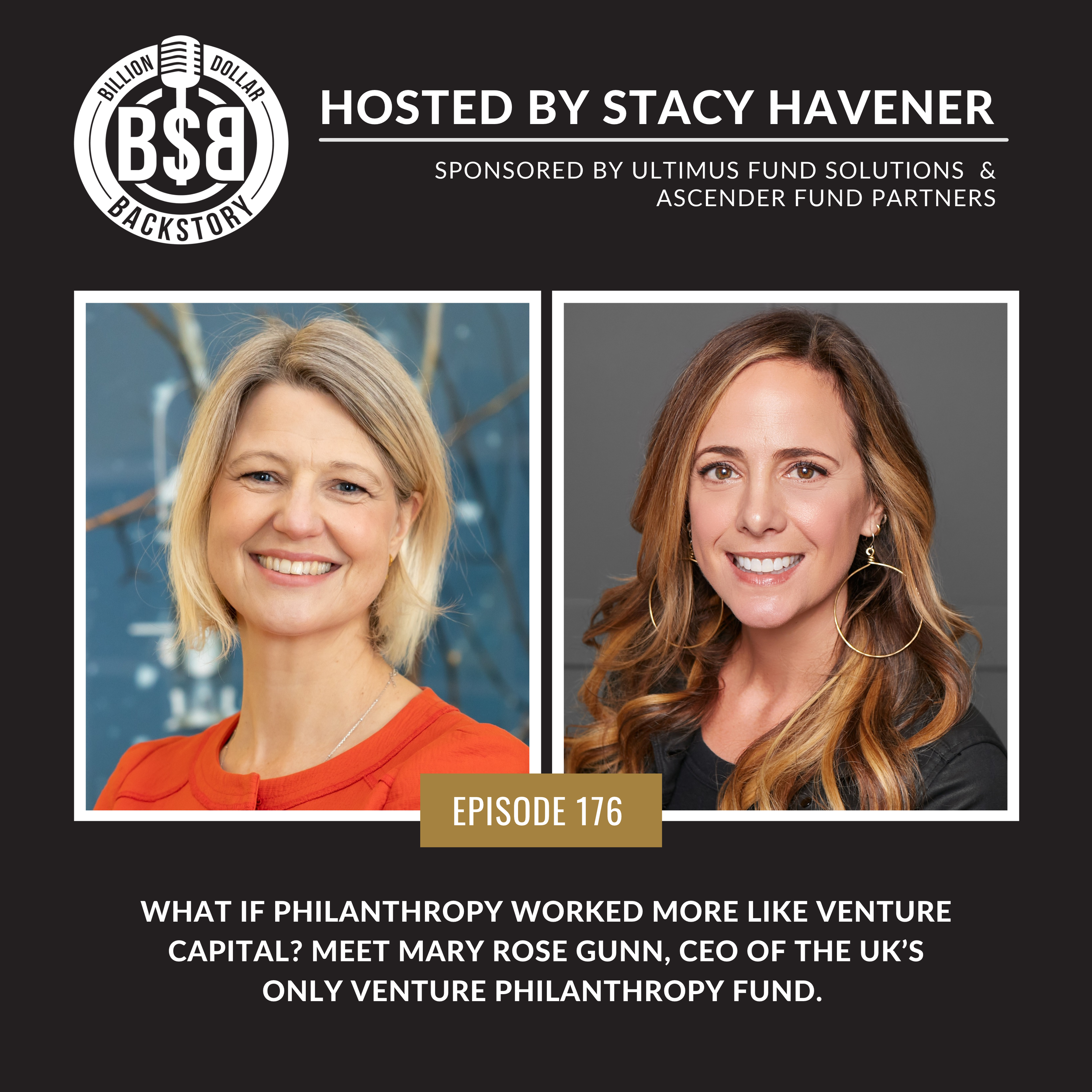
What if the people who know how to solve some of our biggest problems are the same people who can't get the funding to do it?
That's the gap Mary Rose Gunn saw in the UK charity sector.
There were plenty of people willing to give money. But early-stage social entrepreneurs with promising ideas? They weren't exactly swimming in funding opportunities.
So Mary Rose decided to do something about it.
She's the founder and CEO of The Fore, an organization that approaches philanthropy a lot like venture capital. Her team backs early-stage social entrepreneurs with funding, expertise, and the kind of investment discipline usually reserved for businesses.
Except the return they're after isn't financial. Its impact.
Mary Rose joins Stacy Havener to talk about what happens when you start investing in the people behind the solutions, not just the outcomes you want to see.
Listen in to hear:
➤ Why some of the people best equipped to solve problems in their communities are the ones struggling to access capital
➤ What Mary Rose saw missing from traditional philanthropy that made her want to build The Fore
➤ How venture philanthropy works, and what it means to take an investment approach to giving
➤ Why a relatively small check at exactly the right time can make a MUCH bigger difference than you might think
➤ The 4.5x income growth behind The Fore's portfolio and how Mary Rose measures impact
➤ How a £30,000 grant helped a grassroots organization grow into one influencing NHS policy
➤ Why your professional experience might be more valuable to a nonprofit than you realize
➤ How Mary Rose went from wanting to make social documentaries to funding changemakers (and the mission that's connected it all)
If you're an investor, entrepreneur, or someone who wants to make a difference with the resources you have, this conversation might change the way you think about philanthropy.
More About Mary Rose
Mary Rose Gunn is the Founder and CEO of The Fore, the UK’s only venture philanthropy fund turbocharging the best small charities and social enterprises. Since 2017, The Fore has awarded £13.6m in 678 unrestricted grants and provided over 32,000 hours of skills support to organisations tackling some of society’s toughest issues. The goal is for exceptional grassroots solutions to achieve nationwide impact in 5 years – currently over 30% of charities backed are succeeding.
Based in London, Mary Rose is passionate about all things cultural – and when she’s not exploring the city’s arts scene, you’ll often find her walking her dog around London’s wide range of green spaces.
TRANSCRIPT
Below is an AI-generated transcript and therefore it may contain errors.
[00:00:00] Stacy Havener: Today's conversation is about venture philanthropy, what it means to bring an investment-minded, impact-focused approach to funding nonprofits, and why backing social entrepreneurs can look different from simply funding outcomes. My guest today, Mary Rose Gunn, has more than a decade of experience acting on the belief that somewhere out there, someone has already solved an important problem.
[00:00:28] They just don't have the capital and expertise to make it scale. Mary Rose is the founder and CEO of The Fore. The Fore combines venture philanthropy with the rigor, data, and discipline of an investment shop. Her portfolio is outpacing its benchmark by four and a half times, but she'll explain the real return is in impact.
[00:00:52] Mary Rose's work in the UK charity sector focuses on early-stage social ventures and the challenge of getting [00:01:00] capital and support to the people closest to the problems they're trying to solve. There are lessons on entrepreneurship and capital raising here that we can all learn from. Without further ado, meet my friend Mary Rose.
[00:01:22] Hey, my name is Stacy Havener. I'm obsessed with startups, stories, and sales. Storytelling has fueled my success as a female founder in the toughest boys' club, Wall Street. I've raised over 8 billion that has led to 30 billion in follow-on assets for investment boutiques. You could say against the odds.
[00:01:42] Yeah, understatement. I share stories of the people behind the portfolios while teaching you how to use story to shape outcomes. It's real talk here. Money, authenticity, growth, setbacks, sales, and marketing are all topics we [00:02:00] discuss. Think of this as the capital raising class you wish you had in college, mixed with happy hour.
[00:02:07] Pull up a seat, grab your notebook, and get ready to be inspired and challenged while you learn. This is the Billion Dollar Backstory podcast.
[00:02:21] Mary Rose, thank you so much for being with us today in the Billion Dollar Backstory studio. This is an honor for me because we share a mutual friend who's a really fantastic human being, fund manager, entrepreneur, all the things, who is Sean Pesch, and I'm very grateful to him for this introduction. So thank you for being with us.
[00:02:44] Mary Rose Gunn: Thank you for having me. Uh, Sean is fantastic. We're huge fans of his.
[00:02:48] Stacy Havener: Yeah, he really is. So high five, Sean. Thank you for connecting us. So I like to start with my favorite thing, and also I think something that's missing in a lot of [00:03:00] business conversations, which is sort of the people parts of it, and I know this resonates with you 'cause I've spent time reading about what you do But before we talk about your journey, I need to get some foundational understanding under my belt and perhaps our listeners as well.
[00:03:17] Because what you specialize in is something called venture philanthropy. And before we kind of talk about your journey, can you just explain what that means?
[00:03:27] Mary Rose Gunn: So yeah, I'm delighted to do that. So venture philanthropy is basically, it's resourcing and funding civil society, and for us in particular, it's all about grassroots social environmental innovation, but basically with an investment mindset.
[00:03:45] So it's doing philanthropy, but doing it with a much more impact-focused commercial-
[00:03:54] Stacy Havener: Hmm ...
[00:03:54] Mary Rose Gunn: framework around it. And I mean, it, it is-- What we do is 100% nonprofit. [00:04:00] We are a nonprofit, The Fore is a nonprofit, and we are investing in nonprofit organizations, and we are not getting a financial return. The return is impact.
[00:04:08] But we are doing it with the sort of metrics and data and analysis that commercial investors use.
[00:04:21] Stacy Havener: Got it. Okay. Very helpful, and also, like, sparks a whole bunch of questions, but we'll get there when we get there.
[00:04:27] Mary Rose Gunn: Can I just very quickly add one thing? The reason why we do this is because it's so much better both for supporting and backing and funding innovation, but also for the people who are resourcing it.
[00:04:39] They have much greater impact. So that, that's-
[00:04:41] Stacy Havener: Ah.
[00:04:42] Mary Rose Gunn: Yeah.
[00:04:43] Stacy Havener: Is it-- Okay.
[00:04:44] Mary Rose Gunn: Much more effective.
[00:04:44] Stacy Havener: Clarifying question. So I got the venture investment angle. Yeah. Is it also related to, like, size of charity that you're supporting? Or is that part of it, too? Like early stage or smaller? Yeah.
[00:04:59] Mary Rose Gunn: Very much so. [00:05:00] So we are basically, we are like a VC fund for-
[00:05:03] Stacy Havener: Okay
[00:05:04] Mary Rose Gunn: the nonprofit sector in the UK.
[00:05:06] Stacy Havener: Okay. Fascinating. Yeah. This is gonna be such a fun conversation. Okay, so now we all understand what you specialize in. How did you get into this, Mary Rose? Like, what was your journey to be sitting here as the CEO of The Fore?
[00:05:19] Mary Rose Gunn: So back in 2012, 2011, 2012, so 15 years ago, I had been working in the UK charity sector for about five years, and I was really in a, quite an unusual position in that I was running a small family foundation, but I was also having to fundraise for-- 'cause the foundation owned a stunning building- Mm
[00:05:43] but it didn't actually have that much ready cash. So to, to set up operations and to make the most of this building, I was having to fundraise. But because we were a foundation and we had a fantastic headquarters I was both meeting lots of charity leaders who were thinking that we would be able to [00:06:00] give grants to them, and also being invited into, you know, quite hallowed, in inverted commas- Yeah
[00:06:06] places with other funders. And so I got a really broad view of the nonprofit sector and how the nonprofit sector is funded, and the attitudes of the-- all of the different players in a very short space of time, which I think is very, very unusual. But what became clear to me very quickly was that there was a huge gap in the market, and there was nowhere for early stage social entrepreneurs to go to get hold of the equivalent of seed funding or, you know, the kind of- Mm-hmm
[00:06:38] VC type backing. Because the way that the sector is funded in the UK, and I think this is also replicated in a lot of other countries around the world, is that a lot of philanthropy is given as philanthropists are sort of shopping for outcomes. So they say, "Oh, I really care about climate [00:07:00] change. How many trees are you gonna plant me?"
[00:07:02] Or, "I really care about children's literacy levels. How many kids are gonna-- you gonna teach to read for me?" Rather than finding entrepreneurs who are social entrepreneurs as opposed to commercial entrepreneurs and saying, "Wow, you have in your community identified that this is the challenge that is not being addressed because you are a teacher, you are a prison governor, you are somebody who left school at 14, you're somebody who's been homeless or has worked in shelters, and the problem with the sick system is X, and you have worked out that the way to solve the problem is to do Y.
[00:07:43] That seems really clever. Let's invest in you doing more of that 'cause you know what you're talking about." That's what is really effective philanthropy. Rather than coming in and saying, "Oh, I want, you know, 100 more people who [00:08:00] are sleeping rough to be in shelters."
[00:08:01] Stacy Havener: Yeah.
[00:08:02] Mary Rose Gunn: Like, that's short term. It's getting some people into shelters.
[00:08:05] But is it actually turning their lives around and giving them the opportunity to live in permanent homes? Quite possibly not
[00:08:13] Stacy Havener: Fascinating. So it's the difference between funding the outcome- Yeah ... and funding the person and team- Yeah ... that can actually influence the outcome at a much bigger scale.
[00:08:24] Mary Rose Gunn: And it's, it's the difference between funding the outcome and funding a person or a team with a mission- Yeah
[00:08:31] and investing, investing in that mission.
[00:08:33] Stacy Havener: Yes.
[00:08:34] Mary Rose Gunn: And that's what venture philanthropy is, and that's what nobody was doing in the UK. And there were, there were, you know, the odd philanthropist, you know, one up in Scotland working in a tiny area up in Scotland, one up-- but there was no formal structures that were doing that.
[00:08:52] And the reason why it's so important is not... I mean, obviously, equity is a massive reason why it's important, 'cause the people [00:09:00] that could get hold of the resources to change things were the people who happened to live next door to somebody who ran a hedge fund.
[00:09:06] Stacy Havener: Right.
[00:09:08] Mary Rose Gunn: But, you know, kind of by definition, people who live next door to hedge funds are probably people who...
[00:09:14] doing all right. Um, whereas, you know, if you were someone who had, was a teacher, your networks are other people who are teachers or people who don't have charitable funds to give away, large amounts of charitable funds to give away. So it's very difficult to get investing in your mission. And that is obviously detrimental from an equity perspective, because people with access can solve the problems that they want to solve, but people without can't.
[00:09:42] But it also fundamentally, on a much bigger scale societally, it meant that- Yeah ... we weren't solving our problems. Because we argue very strongly that basically there isn't a problem out there that hasn't been solved by somebody. It's just the vast majority of the people who have the [00:10:00] answers don't have access to capital.
[00:10:02] Stacy Havener: And- I love that line. Yeah. And it's so true.
[00:10:06] Mary Rose Gunn: I mean, yeah, it's so true. Like, communities know how to solve things, and that might be a geographic community, or it might be a community that is much more dispersed because it's around, you know, an idea of kind of disability access or, you know. A community can l- be defined in very different ways.
[00:10:25] But fundamentally, people know what is wrong and they know how to fix things.
[00:10:29] Stacy Havener: Yeah.
[00:10:29] Mary Rose Gunn: It's just those people- They
[00:10:30] Stacy Havener: don't know how to get the capital to do it.
[00:10:32] Mary Rose Gunn: Yeah. And the skills as well. You know, they might need help writing a business plan, need help knowing how to build a campaign, but they fundamentally, the entrepreneurialism and the drive and the energy is there.
[00:10:43] Stacy Havener: Yeah.
[00:10:43] Mary Rose Gunn: It's just connecting them.
[00:10:45] Stacy Havener: Wow. Okay. So now I wanna go way back Before 2012, even like back to when you were young, I mean, is this what you envisioned that you wanted to be when you grew up?
[00:10:58] Mary Rose Gunn: No. I had no [00:11:00] idea what I wanted to do when I grew
[00:11:02] Stacy Havener: up. Yeah.
[00:11:03] Mary Rose Gunn: I always, I think I always felt like I wanted to do something that was useful.
[00:11:10] Stacy Havener: Mm-hmm.
[00:11:10] Mary Rose Gunn: And I mean, I did, I did at one point say I wanted to be the prime minister. I- that was a joke. We won't go into that one.
[00:11:16] Stacy Havener: But why does it have to be a joke? Yeah. That would've been amazing. Yeah.
[00:11:20] Mary Rose Gunn: Um, uh, yeah, politics in this country at the moment is so difficult. But, um, I mean, when I left university, I had an idea that I wanted to try and make documentaries, like social documentaries- Wow
[00:11:33] try and raise awareness of different people's lives and experiences to other. I was incredibly lucky. I grew up with basically every advantage that you could possibly ask for. I have very happy, loving family, was given an amazing education, was supported throughout, you know, you-- I couldn't ask for more.
[00:11:56] And I think I always felt like I wanted to try and pass that [00:12:00] on in some ways and help-
[00:12:01] Stacy Havener: Hmm ...
[00:12:02] Mary Rose Gunn: raise awareness that if you don't grow up with that, it's very different. You have very different life chances and opportunities and all of that sort of thing. And I think I always felt like I just sort of, something about leveling the playing field and-
[00:12:15] Stacy Havener: Yeah.
[00:12:16] Oh, that's interesting that you had, you know, that it says a lot about you at a young age that you had that self-awareness, but also awareness of the world around you to say, "I have been blessed, and I also know there are lots of people who have not, and part of my mission is to fix that imbalance." And I think it does-- I often find that when you go way back in someone's history, there's a thread that gets pulled forward that you maybe can't see as it's happening.
[00:12:46] And you sort of did this work even as you were storytelling about some of the firms and entrepreneurs that you're backing. You know, they were a teacher or they were homeless or they, they experienced something firsthand that [00:13:00] impacted them and led them to have a mission around the problems they wanna solve.
[00:13:04] So I thank you for sharing that. I, I think that is a powerful thread. The access to capital piece, was your experience with that just in the work you were doing in fundraising? 'Cause that's also like an incredible skill set that's not easy to develop.
[00:13:20] Mary Rose Gunn: I think, yeah, so when I was seeing the UK nonprofit sector from all angles, 'cause I was when in this- Yeah
[00:13:28] amazing position, it was just so frustrating to me 'cause I was meeting these people and, and I, I learnt a lot from the founder of the, the family foundation I was running who-- he was a venture philanthropist but would never have used that term and didn't really know what it was, or I imagine he wouldn't have known what it was.
[00:13:48] Um- Mm. He was very much about-- He was an angel investor, and then when he supported charities, he did it with the same mindset.
[00:13:56] Stacy Havener: Yeah.
[00:13:57] Mary Rose Gunn: And but because I was meeting some [00:14:00] charity leaders And the ones that sort of found their way into my orbit because we weren't, you know, we weren't really making that many grants.
[00:14:07] It wasn't like we had a big... But they were such impressive people, and I just was like, "This is so wrong that they found their way into my orbit 'cause they happened to have known somebody who knew someone who knew the founder." I was like, "This is not... If there are people of this caliber who have got those very random connections to him, imagine how many people of this caliber there must be out there and across the whole of the UK.
[00:14:31] And how can we create a system where you don't need to have that random connection to be able to access capital? If you are talented and you've got drive and you've got an answer, it should be reasonably automatic that you can get ahold of support." And I, I basically pitched the idea to another foundation that I knew had some additional capital and said, "Look, I, I wanna try and see if we can do [00:15:00] early-stage grant-making, you know, with a kind of VC mindset," because I think it'll have much more impact.
[00:15:06] And y- you know, if you can find these people, these social entrepreneurs, they do not give up. I love that. It's very, very... I mean, the success that we have as an organization, and we've now had an enormous amount of success in that we've just done some analysis, and our goal is for exceptional solutions to be able to get from grassroots to nationwide impact in five years.
[00:15:31] Stacy Havener: Okay.
[00:15:31] Mary Rose Gunn: We set that goal about a year ago, um, and we tracked back to the stuff that we've backed since 2017, and 31% of the organizations that we've backed since 2017 have achieved nationwide impact.
[00:15:46] Stacy Havener: That's amazing.
[00:15:46] Mary Rose Gunn: And then we've-- Because we've only just started, we've broken it down. So financial year-end 2020, 50% of the charities that we've backed have achieved nationwide impact in five years, and they were average turnover [00:16:00] 119,000 pounds when we backed them.
[00:16:01] Wow. So they're tiny organizations, but they are led by phenomenal people who just, they don't give up They're resilient
[00:16:10] Stacy Havener: They have grit.
[00:16:11] Mary Rose Gunn: They're resourceful. Yeah.
[00:16:13] Stacy Havener: Yeah.
[00:16:13] Mary Rose Gunn: They are imaginative.
[00:16:15] Stacy Havener: So I wanna talk about some of those stories. I would love to hear a few stories. But before that, there's a very interesting connection point here, because obviously on the fund side, fundraising is similar yet different to what you're doing, right?
[00:16:32] So you're raising funds, you know, the hedge funds and investment boutiques that are starting up are also raising funds. And so while different, similar, and I wonder, like there's probably something we can learn from how you went about that. So if you go back to when you were talking about how capital was being sourced and funded- Hmm
[00:16:53] there was a sort of randomness to it, right? There was a network- Yeah ... effect to it. This person knows this person, and therefore [00:17:00] they are interested in, in- Yeah ... you know, funding something with us. What did you do when, when you said, "Oh, there has to be a, a different way to maybe put some repeatability and develop a process to not have it be so random," what did that look like?
[00:17:18] Mary Rose Gunn: So I first, I raised the money first- Mm-hmm ... because we couldn't develop a process without having... We didn't wanna put the-- I was like, "I don't wanna put the charities through time and effort-" Yeah ... and then there not be any gold in the pot at the end of the rainbow, basically. Um, so raised the money from our kind of founding anchor funders, which is, um, it's a private bank in the UK called C.
[00:17:41] Hoare & Co., which is, it's one of the oldest banks in the UK, but it is unbelievably innovative. Um, so I, I raised the money from them, and they said basically, "Yeah, we'll fund the grants. If you find us some really good fr- grants, we, we will fund them." And I managed to persuade somebody who was on [00:18:00] maternity leave.
[00:18:01] Well, she was on maternity leave, but then she w- was working while on maternity leave 'cause this is the kind of person she is. Uh, who her-- She had a background in private equity and, um- Yeah ... yeah. And, and basically said to her, "Look, this is my idea, is that we can develop a process that adds value to the organizations as they are going through it.
[00:18:21] So it's about basically helping them write a strategy, and while you are helping them write a strategy or assessing who are the most impressive and who are the ones who are most deserving of funding." So the due diligence process is this kind of gentle strategic review that becomes more in depth the further you get through it.
[00:18:40] So the more likely you are to get the money, the more information you have to share- Mm-hmm ... and, and the, the deeper the questioning. And she kind of, because she's that kind of person, you know, she got this idea straight away 'cause she was like, "Oh, you know, I've got a background- Yeah ... in strategy consulting and, and private equity.
[00:18:55] This is investing." And she went away and I s- [00:19:00] went with her to the first few... So a really cool part of it was I said we need to spend time with the applicants. Mm-hmm. So it doesn't matter if they're not successful, they are still getting feedback. They're learning from the process.
[00:19:12] Stacy Havener: Mm-hmm.
[00:19:13] Mary Rose Gunn: Um, and you know, this Person, as she was doing this, was sharing all of her expertise and strategy knowledge with these organizations that were trying to set themselves up for success.
[00:19:24] So it meant that they went away even though they didn't-- They went away having had, like, an hour's worth of free strategic advice.
[00:19:30] Stacy Havener: Mm-hmm.
[00:19:31] Mary Rose Gunn: Um, and she set up the process. She sort of ran it. I went, you know, the first few meetings, I went with her to check that she was asking the right questions of these organizations and was, you know, treating them with the kind of-- Like, the whole point is we're a friend, we're a critical friend, but we're a friend to them.
[00:19:47] Yeah. And we had to make sure that they weren't coming out a bit demoralized, they were coming out a bit feeling positive. And she was amazing at it. And, you know, after not even two, I don't think I sat in like one and a half, I was like, "Oh, she doesn't need me here." [00:20:00] Um, she completely gets it. She is doing exactly what these organizations need.
[00:20:05] So off she went, and we-- That was the, the process that we now run is more structured, and we have multiple people doing due diligence, but they are a similar caliber, and they are doing exactly what she first set us up to do, which is help the applicants design their strategy-
[00:20:25] Stacy Havener: Yeah ...
[00:20:25] Mary Rose Gunn: basically.
[00:20:26] Stacy Havener: So I love this, and that also relates to the investment side.
[00:20:31] Can we also go to the fundraising side? So you got- Yeah
[00:20:36] Mary Rose Gunn: Yeah.
[00:20:36] Stacy Havener: So this is like due dil-- So there's kinda two processes that are very similar to what we, we go through on the investment side. This process with this gal who sounds amazing that does the applicant sourcing and due diligence. What about on the fundraising side?
[00:20:53] 'Cause the bank obviously was your anchor, and that was huge.
[00:20:56] Mary Rose Gunn: Yes.
[00:20:57] Stacy Havener: So then how are you, like, building out that [00:21:00] process to find more people who this idea of venture philanthropy resonates with them?
[00:21:04] Mary Rose Gunn: So to begin with, we didn't.
[00:21:07] Stacy Havener: Okay,
[00:21:07] Mary Rose Gunn: so it was just the bank. It was just the bank. They funded the pilot, and we did it with the pilot.
[00:21:12] But always in the back of my mind, I thought, "If this works, I'm gonna wanna scale this, this-"
[00:21:16] Stacy Havener: Yeah.
[00:21:16] Mary Rose Gunn: I could have this sort of internal sense- Yeah ... I think, this is gonna be my life's mission, potentially, if it, if it works. Um, so it started, and then because I was still doing my day job, so- Oh, so
[00:21:27] Stacy Havener: this was a side hustle?
[00:21:28] Mary Rose Gunn: This was, yeah, this was a side hustle- Oh my ... basically. Um, so, um, so the pilot lasted four years basically, and I was spending, like, maybe a day a week on it. I can't remember how much, like a day and a half a week- Mm-hmm ... while still doing my day job. But after about two years of that, I realized the results were so successful.
[00:21:47] We were finding such amazing people. They were doing such amazing things with the really very small amounts of investment, grant investment that we were giving them. So at the time, we were giving them 30,000 pounds over up to three years, so it's [00:22:00] really tiny amounts of money in the grand scheme of things, and they were going on to achieve such amazing results from it that I was-- started immediately to think, right, if we were to scale this- Yeah
[00:22:12] what would this, this look like? And obviously we'd need to get other support in- Yeah And I mean, my first sort of business plan was around getting in lots of other businesses because- Hmm ... there was so much opportunity to give business access to backing early-stage innovation. Um, you know, at a time when the charity of the year thing was still really popular, but also not really working.
[00:22:40] Everyone was saying, you know, for businesses it's like, "Yeah, we do the charity of the year," but the employees think that it's marketing. We kind of think it's marketing. The charities think that it's marketing. Um, so-- And this was a way to not just get them involved in really exciting early-stage social environmental- Yeah
[00:22:58] innovation, but also [00:23:00] plug their staff into amazing skilled volunteering opportunities.
[00:23:04] Stacy Havener: I love that.
[00:23:05] Mary Rose Gunn: Yeah, getting their staff involved in the selection process. So our corporate partners send volunteers who we train to sit on, like dragons in the dragons' den, basically, alongside the social entrepreneurs that we've backed.
[00:23:19] So once you join the portfolio, you get invited to come and help decide who else should join the portfolio after you. And you do that sitting alongside, you know, trained analysts from BlackRock as one of our corporate partners. Uh, Seahawk & Co. is still one of our corporate partners. Um, we work with some private equity funds, you know, these sorts of- Got
[00:23:38] Stacy Havener: it
[00:23:38] Mary Rose Gunn: really analytical people. But also it's not just that. It is about plugging the portfolio organizations into this incredible talent. Now, they need people to help them write business plans. They need people-
[00:23:52] Stacy Havener: Yeah ...
[00:23:53] Mary Rose Gunn: to help them with financial modeling, to like think about marketing, to think about governance structures.
[00:23:59] You know, they need [00:24:00] all of the expertise that business people have in spades, and being able to plug them into amazing pools of knowledge is really exciting for the social entrepreneurs. But it's really, really exciting for the people who think, "I'm really good at writing spreadsheets, but am I helping the world?"
[00:24:18] When they're like, "Oh, I can write a spreadsheet," and suddenly here's an organization that the founder is now saving two days a month, and with that two days a month, they are, you know, helping a number more of young people access opportunities for work and reducing school exclusion or whatever it may be that they, they are doing- Wow
[00:24:40] with that extra time. And it's, it's a win-win for everybody, basically.
[00:24:44] Stacy Havener: It really is. And it's an incredible masterclass that you just did right there on really understanding your target market, because you didn't go after wealthy individuals. Yeah. You said this is more of like a [00:25:00] B2B fundraising, isn't it?
[00:25:03] Mary Rose Gunn: Yeah, although we then-- I, yeah. Anyway.
[00:25:06] Stacy Havener: Okay. So, uh- We can go down to the dark pit ... we can go there. You're, you are literally like every fund manager I've worked with, which is yes, except one time, I, I did have a wealthy individual invest, but- Or
[00:25:18] Mary Rose Gunn: not even just one time, it's like-
[00:25:20] Stacy Havener: Like multiple.
[00:25:21] Mary Rose Gunn: Yes. Logically it makes sense, but the reality is that actually getting the businesses involved is really, really hard.
[00:25:27] Stacy Havener: So let, so let's stay with this, 'cause this is- Yeah ... this is great. So it sounds like you were, you said, "Okay, so I had the bank and I have-" Yeah "... like BlackRock and these amazing-" Yeah "... organizations." You understood their pain point, you understood what they were gonna get out of it. I loved the example with the spreadsheet guru who was like, "Wow, I'm actually helping someone do something really meaningful."
[00:25:48] So that was like an incredible masterclass. And if I guess where, where you also went was, I'm gonna guess, I could totally be wrong, tell me if I'm wrong, [00:26:00] to wealthy individuals who were entrepreneurs who could also understand the entrepreneurial angle of what you were doing.
[00:26:12] Mary Rose Gunn: Yes, basically. And, uh, wealthy investors as well.
[00:26:16] They, 'cause they have that investment mindset there, so they totally get it.
[00:26:20] Stacy Havener: Yep.
[00:26:21] Mary Rose Gunn: And it is-- Like, we love the business relationships that we have, the corporate partnerships. They bring massive value. Um, but actually at the moment, they are really, really, their budgets are seriously squeezed. Yeah.
[00:26:36] Stacy Havener: Yep.
[00:26:36] Mary Rose Gunn: And it, it has-- I mean, it sort of goes in, it's gone in waves over the years, but at the moment we are really seeing that there is...
[00:26:45] It's difficult for a lot of businesses- To do that ... to prioritize this. But we are seeing a massive increase in private philanthropy. So, there is huge numbers of people putting money into-- being very generous, putting money into [00:27:00] donor-advised funds, and then not quite knowing how to spend it, and not wanting to give it to the big charities because-
[00:27:07] Stacy Havener: Hmm
[00:27:08] Mary Rose Gunn: like, yeah, but what's the impact? You know, they're doing good work, but, you know, unless you can give enormous amounts of money to those really big charities 'cause they have massive, massive hundreds of million pound budgets, you're not gonna move the needle.
[00:27:20] Stacy Havener: That's so interesting.
[00:27:22] Mary Rose Gunn: Whereas if you can get funds into the innovators, then you actually really can solve some problems.
[00:27:28] Stacy Havener: Um- Yeah. So it's also-- So it's, so there's a nice thread, entrepreneur to entrepreneur. I love that. Yeah. That's super cool. Yeah. And then there's also a thread of somebody who wants to make a difference, and if they go to the bigs, they can't because they're just like a drop in the bucket. Yeah. And I think that's a very real-- There is a psychographic that you're tapping into there, which is different.
[00:27:57] Like, there are people who probably are very happy to [00:28:00] write a check to a big charity, and that's like, that's who they are, and that's fine. Yeah. And that's great. I mean- And that's great. There's a place for that. And it's, you know, so that works. But then there's also a place for somebody who really does wanna make an impact, as you said, and not to use that word 'cause that's not how I mean it, but to make a difference to the group that they're investing- Yeah
[00:28:20] with.
[00:28:20] Mary Rose Gunn: And I mean, we, we call it catalytic philanthropy.
[00:28:23] Stacy Havener: Oh, I love that phrase. What does that mean?
[00:28:26] Mary Rose Gunn: W- well, it's, it's when the support that you are offering is able to catalyze something.
[00:28:31] Stacy Havener: Yeah.
[00:28:31] Mary Rose Gunn: You know, you are able to... What, what we do is basically find really talented leaders who are running organizations with solutions that are working, and they are at an inflection point.
[00:28:43] And an injection of capital and skill support at this point has the potential to really- Love that ... move the needle. And Yeah. Our results bear out that it really does work. We, we, um, we're quite-- [00:29:00] not quite, actually, we are l- I'm gonna go a bit more American on this. Yeah, do it. We are really into impact measurement.
[00:29:05] We are, like, at the vanguard of impact measurement, um, in the UK and possibly even-- I'm-- I know some people who work in US, um, venture philanthropy funds and, and I think we are doing stuff that is akin to the sort of measurement that they are doing. So since 2019, and we were the first person that ever did this, we started benchmarking the portfolio organizations that we were backing against an algorithmically created control group and looking at the changes in income over time to see how were they performing, and the ones that we're backing are four and a half X, basically.
[00:29:42] It's amazing. If we were VC, we would be so rich. We would be.
[00:29:48] Stacy Havener: I'm loving this American side of you. It's very good.
[00:29:53] Mary Rose Gunn: But we don't, we don't care about that. We want to impact.
[00:29:57] Stacy Havener: Let's be real. No one wakes up and says, "I [00:30:00] can't wait to build some operational infrastructure today." You're here to manage money, to build something that lights you up, not chase down reports across five systems and 15 service providers.
[00:30:12] That's where Ultimus Fund Solutions comes in. They're your ops dream team, consolidating all your middle and back office chaos into one clean, scalable setup. Registered funds, private funds, SMAs, all integrated. One team, one tech platform, one rock solid source of data. But here's the real differentiator: service.
[00:30:39] I know that fund in a box sounds convenient. It's also a box. Know what you can't put in a box? A human who picks up the phone when you call and need help. Real-life people who know your name and your fund, and they care about getting it right. Ultimus was built on people doing business with people. You [00:31:00] get institutional strength combined with boutique-level service without getting stuck in a phone tree of doom.
[00:31:07] If you're ready to simplify, scale, and start working with a team that feels like an extension of yours, check out billiondollarbackstory.com/ultimus. That's U-L-T-I-M-U-S. You've got the investment strategy, the vision, the track record. Now it's time to upgrade the engine behind it all with Ultimus Okay, wait.
[00:31:34] So questions. Yeah. And this is like, you know, I just, I have to ask it because I can imagine listening to this and saying, "I wanna be involved." And so I guess, so questions on that. Is it just for UK investors or can US investors also participate and, and work with you?
[00:31:55] Mary Rose Gunn: Anyone. We do have some partners who are from the US, yeah.
[00:31:58] Stacy Havener: Okay. And what is- Yeah ... the [00:32:00] minimum amount that you look for with a partner?
[00:32:03] Mary Rose Gunn: We don't have a minimum-
[00:32:04] Stacy Havener: Mm-hmm ...
[00:32:04] Mary Rose Gunn: because if people want to... We have a kind of range of partnership models. So we help people s- s- sort of split into three groups. We help people who want to do it themselves, so we have education, access to kind of resources, and, um, you know, the kind of library of organizations we've backed.
[00:32:23] They, so they can learn about who are the players that are doing really interesting things in different areas, and they can become part of the community.
[00:32:30] Stacy Havener: Oh.
[00:32:31] Mary Rose Gunn: Um, and that is a kind of very low, sort of like subscription fee almost. Then we have a kind of do it together option where we can help people build bespoke portfolios, help people, like, double down, um, support in areas that they might have identified that there's very little early-stage funding going into.
[00:32:50] So for example, in the spring, we're runding, running a nature recovery fund for a funder who was really upset about the lack of support for- Hmm ... um, [00:33:00] innovation in nature recovery. Uh, we also help people do grant structuring, uh, when they want to do scale-up funding, we call it. So if they want to do larger ticket sizes basically for organizations that they have fallen in love with and are like, "Oh, this is amazing."
[00:33:16] And, you know, our core program, the grant size is now 52,000 pounds, so it's not that much money. And that's clearly never gonna be enough to help somebody change the world. But, you know, if one of our partners really falls in love with one of the core organizations, we can help them, um, do additional support.
[00:33:34] And then there's also just the investing, you know, let us do it, where they just put money into the pot to kind of grow- Mm-hmm ... the catalytic philanthropic capital available to really inspiring organizations in the UK. So-
[00:33:49] Stacy Havener: So if someone's interested, they should reach out to you because you probably- Exactly
[00:33:52] have a way of- Yeah ... helping them, and they don't need to put in... It sounds like they could even be sub 100,000- [00:34:00] Yeah ... and- Yeah ... and make a, a difference.
[00:34:03] Mary Rose Gunn: Yeah. Absolutely. Definitely.
[00:34:05] Stacy Havener: Amazing. Okay, I had to ask 'cause I'm like, there, I, I would be like- Thank you ... how do I, how do I work with you? Okay, so now I wanna go to a story about one of these amazing social entrepreneurs that you've backed, maybe somebody who's gone full cycle.
[00:34:22] And I'd love to understand... You know, just tell us the story of that team and what they worked on. You can pick one that is, you know, really resonates for you.
[00:34:32] Mary Rose Gunn: I'm gonna pick one that is an incredibly pertinent issue, I think, at the moment, and partly because it's completely front of mind because I saw them yesterday.
[00:34:44] Stacy Havener: Yeah.
[00:34:44] Mary Rose Gunn: Um, but so the horrific, and it's very also relevant for, for the States because the, um, horrific Lindy Clancy-
[00:34:55] Stacy Havener: Yeah ...
[00:34:56] Mary Rose Gunn: um, trial that has been going on. So, uh, she was [00:35:00] suffering from something called postpartum psychosis when everything, um, happened. And postpartum psychosis, for those people who don't know, it's a type of psychosis that can come on like four days, five days often after childbirth.
[00:35:15] Um, and you have a, a extraordinarily traumatic, um, psychotic episode, and it is something that has been traditionally not really very well understood and not really very well supported at all. Anyway, about, I think it was back in 2018, we met somebody called Jess Heron, who is a doctor, who had been involved in some research onto postpartum psychosis and had decided to set up an organization called Action on Postpartum Psychosis, um, which was about providing a holistic package of support for women who, and about in the UK, about 1,200 women a year, um, experience postpartum [00:36:00] psychosis.
[00:36:01] Um, she... A holistic package of support for women, which included both clinical support, the right kind of psychiatric support. So one of the things that's absolutely vital in treatment of postpartum psychosis is that you are sectioned, 'cause a lot of people who, um, suffer from it are sectioned, but you must be sectioned with your baby-
[00:36:21] Stacy Havener: Oh
[00:36:22] Mary Rose Gunn: because it's extremely traumatic.
[00:36:23] Stacy Havener: Right, sure.
[00:36:24] Mary Rose Gunn: It really makes it very difficult for people to recover when they are separated at such a crucial time from their, from their child. So mother and baby units, um, within psychiatric, um, spaces, and also peer support. So having support from people who have been through it, 'cause it's, it is completely possible to recover from.
[00:36:45] There are horrifically high rates of suicide from people- Yeah ... who experience it when they are not given the right support. But when you're given the right support, it is v- Like, there are... I was with people last night who are 100% recovered from it. Wow. And [00:37:00] at least 50% of people who undergo postpartum psychosis have never had a mental health incident- Wow
[00:37:06] before. So it's, it's terrible. But anyway Uh, back in 2018, we met Jess Heron, who had set up Action on Postpartum Psychosis and was kind of building this network of people, peer support groups, clin- bringing together clinicians, bringing together the, um, um, psychiatry to provide the right kind of support.
[00:37:25] Now, in 2026, they have designed and implemented the NHS guidance on how postpartum psychosis should be treated, and the number of maternal deaths from it has fallen so, so much because of that. I can't tell you the exact figures, but it's, it's made a significant difference. And they are-- in their next stages, they are basically wanting to champion research into looking at how can we make sure that no one even has- Mm
[00:37:56] to go through postpartum psychosis. But so this is an example of a [00:38:00] tiny grassroots organization that was basically one doctor and her networks, and that has now changed NHS, as in UK healthcare policy in this. And one of the academics who was at the event that I was at last night where we were talking about this, was saying how she was recently on a podcast and there were three women who had experienced postpartum psychosis.
[00:38:23] Two of them were American, one of them was British, and this is not that usual, I think, for us at the moment, certainly here in Britain. But the American women were talking about how there was no support. They had an utterly horrific time. No one understood what was going on. No one was out there to help them.
[00:38:39] While the British woman was saying, "Actually, I was really well cared for. It was horrific. It was absolutely horrific, but people knew how to look after me."
[00:38:48] Wow. "
[00:38:48] Mary Rose Gunn: I was given what I needed, and here I am now, like, with happy children, gone on to have more children." Wow. And- Wow ... there were no horrific outcomes.
[00:38:59] Stacy Havener: Yeah. [00:39:00] Wow. So, okay, what a great story, by the way, and I'm sure the Lindsay Clancy trial was just like, you know, it was horrific for all of us, but for people who are trying to solve that problem, it's like, oh my gosh- Yeah ... this is exactly why we exist.
[00:39:17] Mary Rose Gunn: Yeah.
[00:39:18] Stacy Havener: Um, and so within that, you find Dr. Heron. Yep. You find her.
[00:39:26] She has this mission. You obviously have capital to support her, but then you also have this expertise that you're gonna br- Yeah ... because, uh, like the path from small charity- Yeah ... you know, doing great work, but sort of under the radar, to writing the policies for the NHS, that's pretty, like, that's massive.
[00:39:50] It's huge. And so, so how did you help-- Like, what was, besides the capital, what was the s- strategic parts that went into it?
[00:39:57] Mary Rose Gunn: This is what is, I think, so [00:40:00] exciting about it, particularly from the philanthropist or the potential philanthropist perspective, is that it's not nearly as complicated as you might think.
[00:40:07] Stacy Havener: Yeah.
[00:40:08] Mary Rose Gunn: In that we provided the capital, and through the due diligence process, helped suggest to figure out what was, at that point, what was her kind of two-year, I think the grant was over two years, strategic plan. Um, and we then offer... So we provide a, a massive package of wraparound support to all of the organizations that we're backing, um, and some of them that haven't yet got backing from us, but mainly to the ones we're backing.
[00:40:36] And the, the thing that's really important, though, about the package of support is it's like an all-you-can-eat buffet.
[00:40:42] Stacy Havener: Mm.
[00:40:42] Mary Rose Gunn: So they can come and get what they need when they need it, because often in philanthropy, you say, "Oh, well, here's a grant, and we have to write you a strategy now." Yeah. It's like, well, we don't really need a strategy now 'cause we're not ready for it.
[00:40:54] And, and also, if somebody has written you a strategy that you didn't really want, you're never gonna follow it. Yeah. It's not very helpful. [00:41:00] Um, so we, uh-- Or, you know, if you've got somebody who is gonna redo your finances for you, but you're not ready to have your finances redone, it's, it's not gonna help.
[00:41:09] Stacy Havener: Yeah.
[00:41:09] Mary Rose Gunn: You need to be at the point as a business to say, "We now need new modeling." Mm-hmm. "We're now big enough that our current systems are not-" fit for purpose anymore. We need to... But if you do that too early or if you do that too late, it doesn't work. So that, so we really advocate for the fact that these organizations to successfully support them, you need to give them access to what they need when they need it- Mm-hmm
[00:41:32] rather than when you think and well, when suits your timetable.
[00:41:36] Stacy Havener: Oh, God. So good.
[00:41:36] Mary Rose Gunn: So, so we, in terms of the support that we gave to APP, is that we gave them some money.
[00:41:43] Stacy Havener: Mm-hmm.
[00:41:43] Mary Rose Gunn: Um, and it was a grant of £30,000, so not a huge amount of money. We helped Jess formulate what her plan was going to be. Mm-hmm. We gave her, opened the door to all of this wrap-around support, so you know, access skilled volunteers when you want them.
[00:41:58] We run [00:42:00] curator program of training and workshops, so she can come and learn about fundraising, or her team come, or like whoever, when they want to- Yeah ... come and get all of this. We help people think about impact measurement when they're ready to, when it's right for them. And then all of the other stuff, all of the, like how do you get in with the NHS?
[00:42:17] Like, one of the reasons why she was successful during the due diligence process is 'cause she had all those contacts. She,
[00:42:22] Stacy Havener: yeah. She didn't need that. She knew that.
[00:42:24] Mary Rose Gunn: She knew those. She had more than enough people. Wow. You know, she's a doctor who'd sat on research panels. Yeah. Chair was the leading- psychiatrist on, from Cardiff University on mental health and m- and p- bipolar disorder and postpartum psychosis.
[00:42:41] Like, sh- she knew all of those people, but what she didn't necessarily know was someone who'd been to INSEAD who could help her write a business plan. Oh, wow. So that's the bit that we are giving. But it, you know, s- there are loads of people who went to INSEAD who'd love to help someone like Jess write a business plan.
[00:42:58] Stacy Havener: And it really does- And it was- Like, [00:43:00] it makes me smile because to your earlier comment that it seems like such a big leap, but actually the things that she needed were things that those of us who know how to do it probably are like, "Oh, well that's so, that's-" Yeah. "... that? Of course we can help you with that."
[00:43:13] Yeah. You know?
[00:43:14] Mary Rose Gunn: Ex- exactly, yeah.
[00:43:17] Stacy Havener: Wow.
[00:43:18] Mary Rose Gunn: And it, you know, people operate in such silos, and one of the things that I find so kind of charming about what we do is we'll work with business people who are so successful in their professional space, and you say to them, "Oh, you know, I think you could be really helpful to a charity."
[00:43:35] And they're like, "Oh, no, I, I don't think I could. I don't think I could." They're so humble about their skills. I'm like, "No, I'm pretty sure you really could." They're like, "No, no, I, no, I, I don't." I was like, "You're a senior part- partner in a, like, Magic Circle law firm." And they're like, "No, but it's not charity law, so I don't think it'd be useful."
[00:43:54] I'm like, "No, no, no, you've been a senior partner. That means you've run an organization, you know about [00:44:00] politics and management, and obviously a lot about law. And it might not be charity law, but that's not-"
[00:44:06] Stacy Havener: Wow. "...
[00:44:07] Mary Rose Gunn: of the be all and end all in terms of what a charity needs from a legal perspective. They need so much more than just charity law."
[00:44:13] Stacy Havener: Well, and it's, it's so great. You're so needed because also the-- on, on both sides Because the people who can help don't think that, that they can.
[00:44:24] Mary Rose Gunn: Yeah. Yeah. Absolutely.
[00:44:26] Stacy Havener: They're telling themselves a story that is, "I can't be useful because I don't know anything about charity or-" Yeah ... philanthropic law or work or whatever.
[00:44:34] Mary Rose Gunn: Yeah. Wow. And it... One of the things that we kind of coach, I mean, we coach both sides a little bit in this, and it doesn't... You know, when I say coach, that makes it sound really grand, but it's really not. It's just often just a really short conversation saying, "Oh," you know, for the charity leaders, it's like, "Have confidence.
[00:44:49] You are doing something amazing."
[00:44:50] Stacy Havener: Yeah.
[00:44:51] Mary Rose Gunn: And for the business people, it's, it's also just like a sort of open your mind up a little bit, because what you don't realize is that [00:45:00] your 25-year career, or even five-year, you know, might- they might not be that experienced yet, but you have built a level of professional expertise and confidence that somebody who comes from a totally different side of the kind of, uh, industry and a totally different industry does not have, and you are bringing that to the table and you don't realize how valuable that is.
[00:45:24] You know, somebody who has, you know, spent their lives working in homeless shelters, if they need some legal advice and they go to a lawyer and the lawyer says, "Oh, this is gonna cost you 5,000 pounds," they are gonna say, "Okay, well, the lawyer says it's gonna cost 5,000 pounds. It costs 5,000 pounds." If you have a lawyer on your board, doesn't matter what kind of law they are an expert in, and they go, "That's ridiculous.
[00:45:47] All we're asking them to do is write one letter. That's ridiculous. It's crazy to..." You know, that in itself has just saved the charity four and a half grand.
[00:45:55] Stacy Havener: Yeah.
[00:45:56] Mary Rose Gunn: If not more. 'Cause they'd be like, "No."
[00:45:59] Stacy Havener: It's just [00:46:00] such great... It's, it's such a great lesson in the stories we tell ourselves- Mm-hmm ... and how they get in our way.
[00:46:07] Mary Rose Gunn: Yeah.
[00:46:08] Stacy Havener: On both sides Absolutely.
[00:46:09] Mary Rose Gunn: Yeah.
[00:46:09] Stacy Havener: And so you're sort of like, "No, no, no. We're not gonna say it. That's not the narrative. I'm gonna give you-" Yeah ... a different narrative, and it's this." And that- Yeah ... is such a massive unlock.
[00:46:19] Mary Rose Gunn: And it's amazing what people can achieve together-
[00:46:22] Stacy Havener: Mm ...
[00:46:23] Mary Rose Gunn: when they have the right chemistry.
[00:46:25] I mean, what-- the, the thing that is really, really important is you have to start with the right chemistry, and we say that to everyone we talk to on both sides. You know, the charity leaders is like, if we introduce you to somebody and the chemistry isn't right, say no, we'll find you someone else. Mm-hmm.
[00:46:40] And similarly with the business people, it's like you have to be feeling it.
[00:46:44] Stacy Havener: Oh.
[00:46:44] Mary Rose Gunn: Because if you don't, the relationship will never be positive.
[00:46:48] Stacy Havener: Gosh, I could spend hours with you, Mary Rose. This is such fascinating work. And the intersections with the investment space, there's just, there's so many. [00:47:00] I'm so glad you came onto the, the podcast, and I'm so grateful to Sean for this introduction, and I hope we can meet in person- I'd love to, yeah
[00:47:08] on one of my next trips to London. Um, before we wrap, I'd love to ask you a couple questions just to, like, get to know you a little more. You've been gracious with your candor and, and telling us about your journey and, and some of the stories of the people you help. But a couple, couple more for Mary Rose, if that's okay.
[00:47:28] Are you ready?
[00:47:29] Mary Rose Gunn: I'm ready.
[00:47:30] Stacy Havener: Okay. What book influenced how you view the world? Doesn't have to be business, can be business or personal.
[00:47:38] Mary Rose Gunn: I think probably Middlemarch by George Eliot.
[00:47:44] Stacy Havener: Not what I was expecting. Tell me more.
[00:47:48] Mary Rose Gunn: Um, the heroine in Middlemarch is, I mean, she's just somebody who wants to try and do something useful and [00:48:00] helpful and make a better world.
[00:48:03] And she s- tries and fails and sort of tries and succeeds. But she's so human and, you know, all around her there's obviously... Well, I don't know if you know Middlemarch- Yeah ... but there's a huge number of characters. It's a 19th century novel, um, by George Eliot, who is actually a woman. And the huge numbers of characters that are swimming around her are all, you know, all doing different things.
[00:48:26] And again, some of them good people failing and bad people succeeding. Mm-hmm. So it's a sort of microcosm of life. But fundamentally, I think for me, the message of it is, is it's worth trying.
[00:48:38] Stacy Havener: Oh, love that. As a literature major, I... That's, like, one of my favorite answers ever on the podcast, so that was fantastic.
[00:48:46] Okay, going from books to places- Yeah ... what's your happy place?
[00:48:52] Mary Rose Gunn: I wouldn't say it's a place. I would say I'm a singer. I love singing. So [00:49:00] singing. Cl- like classical singing. I, yeah.
[00:49:03] Stacy Havener: Like, like for example, like what do you love to sing?
[00:49:07] Mary Rose Gunn: So, oh, you know, a, a Mozart mass, or I sing in a choir, and we do-
[00:49:12] Stacy Havener: Amazing
[00:49:13] Mary Rose Gunn: Haydn's Creation. I mean, that's the most phenomenal piece of music.
[00:49:17] Stacy Havener: Wow. Um- I mean, I don't know where this is gonna take us next, because my next question is actually music related.
[00:49:25] Mary Rose Gunn: Okay.
[00:49:25] Stacy Havener: So what... If you were taking the stage to do a talk about venture philanthropy, and they say, "Mary Rose, you know, we wanna get the, the crowd kind of amped up and, and jazzed for your, your talk," what's your walkout song?
[00:49:42] Mary Rose Gunn: Uh, something like "Seven Nation Army" by The White Stripes.
[00:49:50] Stacy Havener: I just listened to that yesterday.
[00:49:52] Mary Rose Gunn: Really?
[00:49:53] Stacy Havener: I'm trying to acquaint myself with all the British music.
[00:49:57] Mary Rose Gunn: It may, it may be sort of... I think [00:50:00] it's sort of lost its political... It was sort of had some political connotations- Yeah ... for a while. I'm, I think I, I, I would...
[00:50:05] The apolitical version of that.
[00:50:07] Stacy Havener: Okay. So good. Also not what I was thinking, given that you're a classical-
[00:50:12] Mary Rose Gunn: Yeah.
[00:50:12] Stacy Havener: Yeah. Okay, here we go. What profession other than your own would you like to attempt?
[00:50:20] Mary Rose Gunn: I would have loved to have been good enough to be an opera singer.
[00:50:23] Stacy Havener: Oh.
[00:50:24] Mary Rose Gunn: I'm really very, very much an amateur, but I would like...
[00:50:27] Yeah.
[00:50:28] Stacy Havener: I love that
[00:50:29] Mary Rose Gunn: Um, or when I, you know, to the, when I first left university, I wanted to make social-
[00:50:34] Stacy Havener: The documentary ... justice
[00:50:36] Mary Rose Gunn: movies. Yeah. It was terrible. I can't, I have no eye for a cam- a camera angle. So I was like, I tried it, and I was just like, "I'm never gonna succeed 'cause-"
[00:50:44] Stacy Havener: Again, great self-awareness.
[00:50:45] Like, that would be awesome, but I'm probably not the one.
[00:50:49] Mary Rose Gunn: Yeah.
[00:50:49] Stacy Havener: Okay. Okay, so flip side, what profession would you not like to do?
[00:50:53] Mary Rose Gunn: The thing that immediately springs to mind is I just, I, I am forever in awe [00:51:00] of the people that do the walking the streets, trying to get people who are rough sleeping into shelters.
[00:51:09] Mm-hmm. Social care, working with the elderly. I c- I couldn't do those jobs, and that's sort of, I think, one of the reasons why I've ended up doing what I'm doing is 'cause they are, for me, they, you know, they are the heroines and the heroes of society. And if we... I can use my ability to, you know, persuade people-
[00:51:34] Stacy Havener: Mm-hmm
[00:51:34] Mary Rose Gunn: to give money to help people like that actually change the system, that's where I feel like I, I'll, I'll have hopefully done something worthwhile.
[00:51:44] Stacy Havener: Oh, that was so well said. And last but certainly not least, I wanted to talk about success and how that definition has changed for you. So what does success mean to you now versus what it meant to you early, earlier in your [00:52:00] career?
[00:52:01] Mary Rose Gunn: I think it probably hasn't changed very much. Mm-hmm. In that it took me a long time to kind of end up where I am and find what I really wanted to do. Mm-hmm. Um, and I think partly it was because I didn't really know what success looked like. Ooh. I kind of felt, I think I, I, I always felt that success for me would feel like changing things and- Mm-hmm
[00:52:27] at the risk of sounding like a Miss World candidate, leaving the world a better place.
[00:52:35] And here's my silver-
[00:52:36] Stacy Havener: And now I'm gonna sing you a song.
[00:52:38] Mary Rose Gunn: Okay.
[00:52:40] Stacy Havener: And also I get it 'cause it sounds so like Pollyanna-ic, but-
[00:52:44] Mary Rose Gunn: Yeah ...
[00:52:45] Stacy Havener: but on the other hand, that is what you're doing. And I also think just saying it the way that you did gives so many of us hope/permission that it's okay not to know. [00:53:00]
[00:53:00] Mary Rose Gunn: Yeah. I think I, I think I...
[00:53:03] 'Cause I always, when I was younger, I always wished that I had always really wanted to be a vet. Or you know how some people are like, "Oh, since I was a child I wanted to be a doctor." And, and I always wished that I had known- Mm-hmm ... 'cause I felt quite at sea, I think, for a lot of my 20s, 'cause I didn't really know what I wanted to do or what I wanted to be.
[00:53:24] But actually, I, yeah, and I think it would've helped to have had somebody say, 'cause I think-- and I think there's so much more pressure now on young people- Yeah ... to sort of feel like they know. Mm-hmm. But actually we're all gonna be working until we're 95, let's face it now, 'cause... So it's okay to have seven different careers.
[00:53:41] Stacy Havener: Yeah. It's absolutely okay. And actually each one of them probably is exa- The exact That's right. So it's, it kinda goes back to what we said in the beginning- Yeah ... that the, the one of the really amazing things about people's backstory is that when you go back to all these things that don't seem to be [00:54:00] connected and don't seem to make any sense on paper, you realize that actually they're the exact things that needed to happen for, for the person- Yeah
[00:54:08] to be where they are now.
[00:54:09] Mary Rose Gunn: Yeah. No, I, I totally agree with that. There is a, there's a thread.
[00:54:13] Stacy Havener: Yeah.
[00:54:13] Mary Rose Gunn: There's a thread that's running through it. And I think it's, yeah, it's, it's sort of exciting. I'm so lucky 'cause I've done some really different and really interesting things. You know, I worked for a while in politics, I worked in the media, and, you know, everything you do, you learn from it, and then you hopefully bring it forward into-
[00:54:30] Stacy Havener: Mm-hmm
[00:54:31] Mary Rose Gunn: the next thing that you're trying to achieve.
[00:54:33] Stacy Havener: So true. If people wanna follow along or connect with you, Mary Rose, what's the best way to do that?
[00:54:39] Mary Rose Gunn: LinkedIn-
[00:54:40] Stacy Havener: Okay ...
[00:54:40] Mary Rose Gunn: is, um, find me on LinkedIn or contact me through thefoi.org.
[00:54:45] Stacy Havener: Wonderful.
[00:54:46] Mary Rose Gunn: T-H-E-F-O-I.org. And if anyone is really affected by the postpartum psychosis sort of story, get in touch with them, Action on Postpartum Psychosis.
[00:54:55] Stacy Havener: Great. Thank you so much for being here. It has been such a pleasure.
[00:54:59] Mary Rose Gunn: Thank you so [00:55:00] much for having me. I, yeah, it's been really enjoyable to chat. I've loved it.
[00:55:04] Stacy Havener: This podcast is for informational purposes only and should not be relied upon as a basis for investment decisions. The information is not an offer, solicitation, or recommendation of any of the funds, services, or products, or to adopt any investment strategy.
[00:55:19] Investment values may fluctuate, and past performance is not a guide to future performance. All opinions expressed by guests on the show are solely their own opinion and do not necessarily reflect those at their firm. Managers' appearance on the show does not constitute an endorsement by Stacy Havener or Havener Capital Partners.
Resources