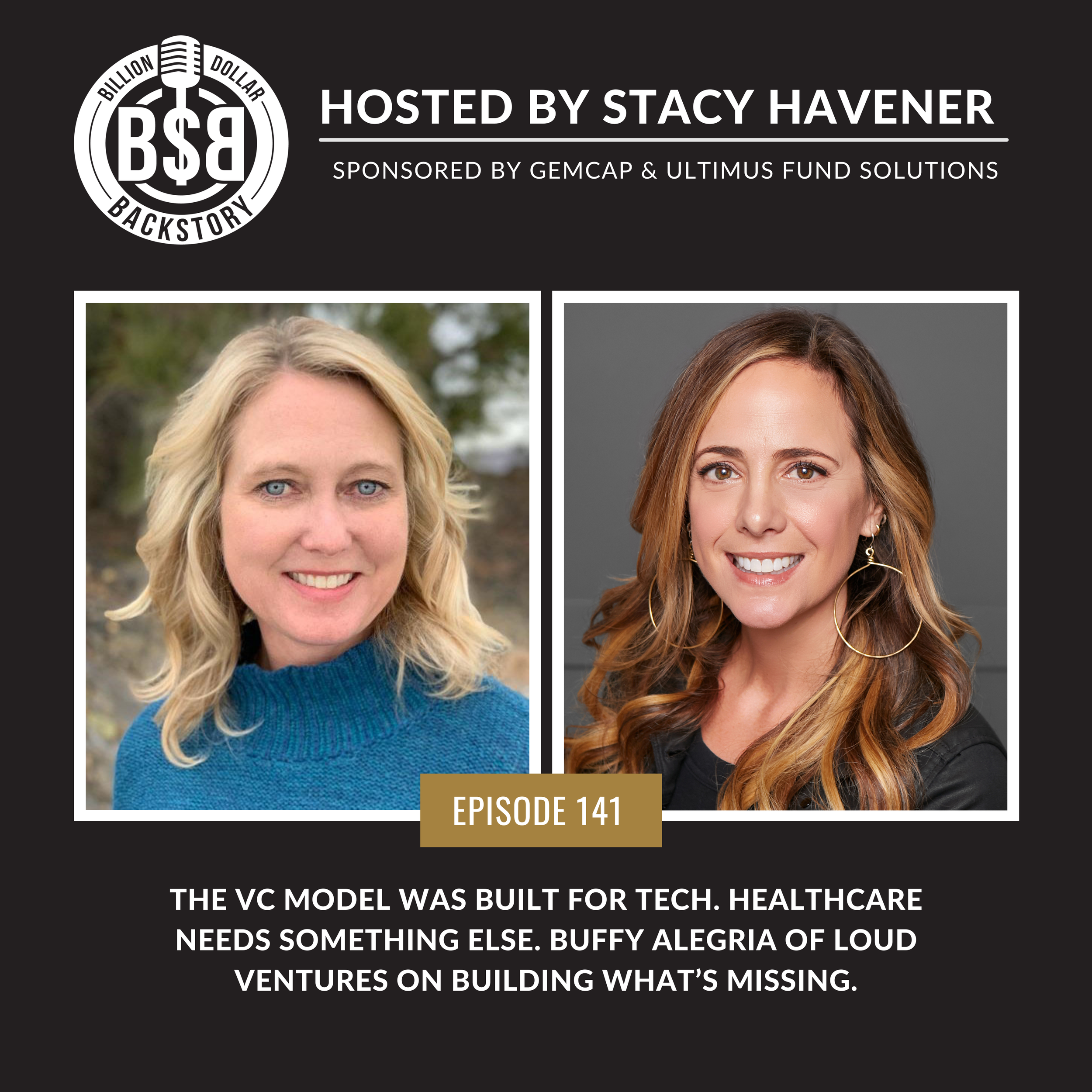
Episode 141: The VC Model Was Built for Tech. Healthcare Needs Something Else. Buffy Alegria of Loud Ventures on building what’s missing.
Subscribe to Billion Dollar Backstory on Apple Podcasts, Google Podcasts, Spotify, or wherever you listen to podcasts.
What if the questions you ask say more about you than the answers you give?
Two weeks before graduating from college, Buffy Alegria walked into a bank job interview knowing basically nothing about banking.
But she did walk in with four pages of questions on a yellow legal pad.
They hired her before she finished the first page.
That moment set the tone for everything that came after.
Today, Buffy is the co-founder of Loud Ventures, a healthcare-focused venture capital firm built on a simple (and kind of radical) belief:
The traditional VC model was designed for tech, and Healthcare doesn’t play by those rules.
After years in commercial banking, negotiating remote work way before it was normal, raising a women’s health fund entirely virtually during COVID, serving on a rural health board for more than a decade, and learning firsthand (as a patient) what happens when systems break down… Buffy and her co-founder Navin decided to build something different…
Venture capital for healthcare, by healthcare.
In this episode, you’ll hear:
The interview move that changed her trajectory (and why four pages of questions is a power play)
How she negotiated remote work postpartum before remote work was a thing
What it was really like raising a women’s health fund as a first-time manager… on Zoom… during COVID
Why “underserved” isn’t a buzzword at Loud Ventures (women’s health + rural health as a serious lens, not a niche)
What it actually means to be loud and active beyond the check
A real-world example of innovation meeting reality: pediatric anesthesia in dental offices, reimbursement pathways, and why “great idea” isn’t enough
Buffy’s diligence philosophy: why qualitative signals like curiosity and adaptability can matter more than early numbers
If you’re building in healthcare (or allocating to it), this one will make you think differently about what “good” looks like.
More about Buffy Alegria:
Buffy Alegria doesn't just invest in healthcare: she's lived it. From the NICU to the boardroom, her path through banking, women's health venture, and hospital governance taught her that real progress takes more than a check.
As Managing Partner of LOUD Ventures, she’s proving that healthcare venture can be done differently by building alongside founders with capital, clinical depth, and operational grit.
When she's not building the future of healthcare, she's skiing, hiking, or water skiing in the Pacific Northwest with her two dogs. Oh, and wearing her newest hat: dedicated college campus road-tripper cheering on her athlete daughters.
Resources Mentioned in This Episode:
Book:
10x Is Easier Than 2x (Dan Sullivan + Benjamin Hardy)
Song:
TRANSCRIPT
Below is an AI-generated transcript and therefore it may contain errors.
[00:00:00] Stacy Havener: Today's guest was the first in her blue collar Oregon family to go to college, the goal to become a surgeon. Then when she was two weeks from graduating, she walked into an interview for a bank job she knew nothing about with four pages of questions on a yellow legal pad. She didn't even finish the first page before they hired her.
[00:00:26] Stacy Havener: That's Buffy Allegria, and it turns out the questions you ask say a lot more than the answers you know or don't know, as the case may be. Buffy is the co-founder of Loud Ventures, a healthcare focused venture capital firm, built on a simple but radical idea that the VC model was designed for tech and healthcare doesn't play by those rules.
[00:00:55] Stacy Havener: After years in commercial banking, raising a women's health fund through COVID, [00:01:00] sitting on a rural health board for over a decade and learning firsthand as a patient what it means when the systems break down. She and her co-founder, Naveen, built something different. It's venture capital for healthcare by healthcare.
[00:01:18] Stacy Havener: Oh, and she was once told to go by a different name because Buffy didn't have enough credibility. She did it for a while, then she didn't meet my friend. Buffy. Hey, my name is Stacey Haner. I'm obsessed with startups, stories, and sales. Storytelling has fueled my success as a female founder in the Toughest Boys Club, wall Street.
[00:01:44] Stacy Havener: I've raised over 8 billion that has led to 30 billion in follow-on assets for investment boutiques, you could say, against the odds. Yeah, understatement. I share stories of the people behind the portfolios while teaching you how to [00:02:00] use story to shape outcomes. It's real talk here. Money, authenticity, growth, setbacks, sales and marketing are all topics we discuss.
[00:02:10] Stacy Havener: Think of this as the capital raising class you wish you had in college mixed with happy hour. Pull up a seat, grab your notebook, and get ready to be inspired and challenged while you learn. This is the Billion dollar Backstory podcast.
[00:02:31] Stacy Havener: This is so much fun. Buffy, thank you for being here in the billion dollar backstory studio. You are a client of ours. You are a friend. You are one of my most inspiring stories of 2025. Um, move me to tears at our accelerator and it's just a pleasure to have you with us.
[00:02:54] Buffy Alegria: Well, thank you for having me. I mean, it's been a journey and like coming [00:03:00] to, you know, the accelerator and meeting your team and just kind of engaging with you guys.
[00:03:04] Buffy Alegria: I mean, I think that the thread of just the who we are and why we're doing business and how we're doing business is just completely overlapping and it feels really good. So
[00:03:15] Stacy Havener: good.
[00:03:15] Buffy Alegria: Even though you've pushed me to be a little bit, you know, like
[00:03:18] Stacy Havener: totally
[00:03:18] Buffy Alegria: outside my, well, a lot outside my comfort zone, but you know, it's all good.
[00:03:22] Stacy Havener: That's my job. That's my job. Yeah. So it, it's true. And you know, I love what you said there because owning our story, which sounds very simple, simple is actually not easy. And it's a journey and sometimes we're so close to it. That we can't even see the differentiators or the magic, and we need somebody to help us pull that forward.
[00:03:47] Stacy Havener: And your story has so much depth and so much gravitas, and so much like passion, as you said. I didn't really give you a choice. I was like, you're coming onto the um, podcast, so I'll [00:04:00] see you, uh, you know, on Thursday. Um, but thank you for being here. And let's start with that. Let's talk a little bit about your journey.
[00:04:08] Stacy Havener: I mean, you sit here in the venture capital space, but I don't know if when you were a young gal were you like, I'm gonna grow up one day and be in vc. Um, tell us about that. What did you wanna be when you grew up, when you were young?
[00:04:23] Buffy Alegria: Yeah, I mean, I, I grew up in Oregon in a blue collar family. My dad was a electrical lineman.
[00:04:30] Buffy Alegria: Um, he worked on power poles all his life, you know, and, um, my mom hadn't gone to college yet. She. I was a stay at home mom, but she, she did, you know, looking back, like after you've had me go through this kind of like, thought process, it's like she kind of did a lot of side hustles. She like, time fishing flies for, you know, Jim Tini fishing in the northwest, you know, and just to bring in money at home.
[00:04:51] Buffy Alegria: Like, so she kind of like formed these things, you know, so that she could be around us and kind of created our own schedule. So maybe that's where I like got inspired from. [00:05:00] But I was the first in my immediate family to go to college and, you know, they always just kind of encouraged me that I could do anything that I wanted to do.
[00:05:07] Buffy Alegria: And it was kind of like always a running joke because my mom always used to say, you could be the president of the United States if you wanted to. And I was like, why would I ever wanna do that? Like,
[00:05:17] Stacy Havener: this is what I don't wanna do. Yeah,
[00:05:19] Buffy Alegria: yeah, yeah. Um, but, you know, I went to college because I wanna become a surgeon actually.
[00:05:25] Buffy Alegria: So I was pre-med, I was biology, psychology. I, I didn't even know like anything about finance or anything about bc. Like I've never even heard of it. Um. I mean, during college, I shadowed in the ER and labor and delivery in a small rural hospital. Like I created these kind of job opportunities as credits.
[00:05:44] Buffy Alegria: And I saw, you know, what the power of, of being involved in like medicine could be. But then I was really discouraged, um, like the end of my college career by all the physicians actually that would come in and talk to us. Because back then, like the HMOs were all [00:06:00] very big, and the doctors would come in and say, whatever you do, don't go into private practice because we can't control, you know, anything anymore.
[00:06:08] Buffy Alegria: And so I kind of was a little bit discouraged. Um, I mean, I had all my, I had a biology degree, psychology degree, I had pre-med, and so I was kind of like, what am I gonna do? I mean, I had to pay my way through college. I had no idea like how I was gonna pay for grad school and if I was gonna go to medical school, like I needed to make sure that like, that was the right path.
[00:06:29] Buffy Alegria: And so I kind of paused. And I fully intended to like go back and get my master's degree in something. And so I was really just like, oh, I need a job to pay my student loans and whatever. And I had actually worked at US Bank back then, it was like a small five state bank, um, driving in every day, sitting on an auto dialer, collecting like consumer home and auto loans to pay my tuition.
[00:06:55] Buffy Alegria: Like it was just like a job, like a college job. But I had like full benefits [00:07:00] and it was kind of crazy. So when I got outta college, actually I wasn't even outta college, Stacy. I was like two weeks from graduating from college and I'm still trying to find a job and they post this internal job position at, at the bank.
[00:07:15] Buffy Alegria: It was like they were trying to create this brand new credit risk management department in commercial and business banking. And so I was like, Hmm, I'm gonna just like throw my hat in the ring because internal candidates get, you know, a first, a first. I knew nothing about commercial banking. I mean, I had never even taken a finance class in college.
[00:07:34] Buffy Alegria: Like nothing. I knew nothing. And all I did know was like I, I had sat on the auto dialer enough and like navigated through all the banking systems and stuff that I knew, like the laws and the regulations around consumer banking and collections, but I, and the systems. Um, and so I basically like went into the interview.
[00:07:53] Buffy Alegria: I wrote out like four pages of questions on a yellow legal pad with a pen and a pencil. [00:08:00] And I walked into the interview and it was in this empty building. 'cause I hadn't. The department yet. And it was just this guy and he interviewed me and at the end he said, do you have any questions? And I said, yeah, I, I, I actually have, you know, all of these question.
[00:08:13] Buffy Alegria: And so I start like rattling him off and I get about halfway down the first page and he stops me. And he just said, you're hired. And I was like, no. Oh my
[00:08:22] Stacy Havener: gosh.
[00:08:23] Buffy Alegria: I really don't have any clue what the answers to these questions are. Like, I was kind of almost just like, you're mistaken. Like I don't, I don't really belong here.
[00:08:31] Buffy Alegria: But I was like, oh, this is like a really nice salary and it's a full-time job. And like, yeah, I'll take it.
[00:08:38] Stacy Havener: Amazing. Here's to the power of asking questions. Asking.
[00:08:42] Buffy Alegria: Yeah. And I think I carry that forward with me. And, and I think I learned that just growing up, like just be curious about things. Yeah.
[00:08:50] Stacy Havener: And
[00:08:50] Buffy Alegria: I think the questions that you ask sometimes, you know, show more than, than what you know, the answers that you know.
[00:08:57] Stacy Havener: Okay. So here you are now you're, [00:09:00] now you're in credit risk. Obvious. Yeah. Obvious path as they all are. Right? Yeah. It doesn't make sense, um, until it does. Right. And so how did you end up getting, I mean, I know there's stops along the way here Yeah. But we're working towards getting into vc. When does healthcare kind of come back around or how does it go from, from the US bank into, into where you are now?
[00:09:23] Buffy Alegria: Yeah. You know, I spent, I ended up spending a long time at the bank because I got the, we started merging and growing and
[00:09:29] Stacy Havener: yeah.
[00:09:30] Buffy Alegria: Grew into like a 26 state bank. And I think there was like a couple turning points before I got into like actually combining healthcare with, with and getting in WC and, you know, I think one of 'em was, you know, I was, found myself working at the bank for a long time.
[00:09:47] Buffy Alegria: I had gone back and gotten my master's degree while I was there and my husband worked with me at the bank at the time in Oregon. And he got a call, he was, wanted to come back to work for [00:10:00] a family. Apple packing warehouse. Like apples that you eat? Yeah. Warehouse in the middle of Washington state.
[00:10:07] Stacy Havener: Okay.
[00:10:07] Buffy Alegria: And I, at the time, I worked for a man in management in, uh, Minneapolis. And so I was in Portland. I didn't really need to be there, but this was 23 plus years ago. And I basically called my boss and I said, I'm, I'm moving to the middle of Washington State. You can either let me work from home or I'm gonna leave and do something else.
[00:10:25] Buffy Alegria: And he said, okay, fine. But amazing, you know, nobody did that. It was like the only people that did that was the people selling Dell computers from their homes. Yeah. That was like a big headline, you know? And so we moved and, you know, I was like, suddenly kind of, it was really weird because we landed in this rural, you know, agricultural, like tight-knit community.
[00:10:46] Buffy Alegria: It was really strange because suddenly I was kind of isolated from the world I knew in, you know, the big city. I was also kind of energized from like, creating my own path and making this, you know, this work. And so it, [00:11:00] it was really strange because all my friends, you know, were, it's a small, like, you're either an accountant, a doctor, a, you know, business owner.
[00:11:07] Buffy Alegria: There's, it's very small. And so, you know, when I would be out and about, people would ask me, you know, what branch do you work at? Like, I, I don't work at a branch. Like, I've never worked at a branch. Oh, well aren't you a teller at a, at a branch? I'm like, no, I am. I've never been a teller. I've never, so there was kind of like this running joke with my friends of, um, you must actually work for the ccia A because, um, we actually have no idea what you do.
[00:11:35] Stacy Havener: Amazing.
[00:11:35] Buffy Alegria: And we just think, you just can't tell us the truth.
[00:11:38] Stacy Havener: It's front. Yeah, it's front.
[00:11:39] Buffy Alegria: Yeah. Yeah, yeah, yeah. It was, it was kind of funny because they just like, nobody understood. It was like, yeah. You know, it wasn't in the box even though it was in a box of a bank, you know, so I. Kept doing it. And then, you know, I had my first daughter and basically like, kind of a similar, you know, I stayed with the bank, [00:12:00] but I only did because he said, are you coming back from maternity leave?
[00:12:03] Buffy Alegria: And I was like, I don't, I don't know, like I do want to because I don't really have anything else, but I don't wanna work every morning for you because you're in the central time zone. Because that was the best time with my daughter. And he kind of said, well, what, you know, what would you propose if you came back?
[00:12:17] Buffy Alegria: And I said, so I thought about it and I, I kind of said, I'm gonna just propose like the wildest and most crazy like thing, knowing that it's a starting point, right? Like, he's gonna negotiate me down. So I kind of said, okay, I'm gonna work half time, 20 hours a week for the full-time salary. I'm gonna work one day where it's scheduled and then the rest of the time is like floating whenever I want.
[00:12:38] Buffy Alegria: And I'll just return calls within 24 hours and, you know, do get the job done. And, uh, thinking he's gonna, you know, change that. He said, okay. And so just
[00:12:49] Stacy Havener: Best
[00:12:49] Buffy Alegria: Buy ever. Yeah, I know. So, so I, you know, I did that until, and then later I had twins and I kind of just [00:13:00] ended up realizing in a rural community, like how little access people had to healthcare.
[00:13:05] Buffy Alegria: And then I just, a lot of my own healthcare journeys kind of led me to start like thinking about, Hey, why don't I, you know, combine my healthcare and science background with, you know, kind of like my banking background and start like learning how to, um, invest in mentor and advise founders. I wasn't really thinking BC at the time.
[00:13:25] Buffy Alegria: I was just kind of like, oh, you know, how do I combine this? And started thinking about that. And, you know, after I had my twins, I had like, worked for this little bank. I'd kind of moved on with the whole team that, that I'd been with. And, um, when I got done with maternity leave, I was kind of like the only.
[00:13:44] Buffy Alegria: Remote employee and I negotiated a two year severance package along the way. And so they kind of just didn't know what to do with me when I came back because they had been bought and sold so many times. And so I found myself like, actually, you know, they gave me my severance package for two years after I, so I had [00:14:00] three kids under the age of three, and they told me, okay, we're gonna give you your severance package.
[00:14:04] Buffy Alegria: You get two years of pay. And you know, and you know, everybody was like, oh, that's amazing. And I was like, no, that's let's, that's like really strange because now I have like no professional identity at all. Yeah. And so it was then I think that I was like, okay, how can I. Rebuild this, rebuild the way that I want.
[00:14:24] Buffy Alegria: And I started doing that within the startup space, but I didn't have a network. I, I had a healthcare network, but I did not have a VC network or a startup network. And so I really put myself out there intentionally to build my network in that space. Um, we didn't have that in, in my backyard. I mean, we, I live in a rural community, like nobody, you know, really knows what that is.
[00:14:45] Buffy Alegria: And so I had to really kind of like, insert myself in national, like angel networks and things like that. And I ended up kind of just doing that and like thinking, oh, I'm gonna advise and mentor all these startups, and like maybe I'll, I'll get a little bit more involved in like, [00:15:00] consulting with some of them and things like that.
[00:15:01] Buffy Alegria: And then I ended up partnering with another business partner that was, you know, on the, on the east coast. And we decided to raise a healthcare fund focused on women's health. And this was a time like. Basically we, we started this right before COVID hit, and so we both had worked virtually for a long time and um, so we ended up raising the entire women's health focused fund, two first time fund managers, institutional investors like banks, big health systems payers, all completely virtually during COVID.
[00:15:37] Buffy Alegria: And it was kind of crazy because the world shut down, like right. When we were supposed to have our first close and we kind of postponed it and ended up having it later, but like people were literally asking us like, are you guys investing? Because, you know, we don't make investments when we haven't had a site visit.
[00:15:53] Buffy Alegria: And it was the same for like both, yeah, making investments with co-investors, but also for like LPs making investments us. Yeah. [00:16:00] And you know, at first we were just kinda like, well yeah, I mean like how if you're not gonna do that then you're not gonna work for a while. So it kind of took the world a long time to catch up, but somehow all the stars aligned and like we were able to raise one of the largest women's health focused funds at the time, you know, for managers that didn't look like anyone else in a sector that's completely underfunded and
[00:16:25] Stacy Havener: Yeah.
[00:16:25] Stacy Havener: You know,
[00:16:25] Buffy Alegria: and so, you know, that's kind of, that's kind of what brought me into venture a little bit more.
[00:16:31] Stacy Havener: And, but what's the why? What was the why for that? Because it's a really big why for you. Yeah, it's a really big why and, and I want people to, if you're willing to share
[00:16:44] Buffy Alegria: Yeah.
[00:16:44] Stacy Havener: I want people to hear it because the spark that got you out of banking, traditional banking and lit a fire under you that said there are problems to be solved.
[00:16:57] Stacy Havener: What was that?
[00:16:58] Buffy Alegria: Yeah, [00:17:00] yeah. I think it was twofold. Like the, the spark that got me thinking about like how I could kind of combine the experiences that wasn't as big as it was at first was really like in my master's program, I had to present to a panel of VCs, like a business concept. And that was a long time ago and went to a grad program that was outside the Intel campus.
[00:17:20] Buffy Alegria: So it was like a bunch of guys in hoodies and backpacks and like two of us women. And then the VC panel was like six or eight, you know, for lack of a better term, like old white guys that
[00:17:33] Stacy Havener: Yep.
[00:17:33] Buffy Alegria: Like all had blue suits on from the same place. Yeah. You know. I read this article like probably before I actually had the twins about, you know, how much capital went to women, went to like women's health issues and went to like female managers just in general.
[00:17:50] Buffy Alegria: This is like, I mean, less than 2% for all categories, like by far, right? So, and I, I remember like a light bulb went off and I was like, nothing has changed. Nothing has [00:18:00] changed since, like almost 20 years ago, you know, however long ago I had gotten my master's degree and like done, pitched this panel of VCs and so that's when I kind of started thinking like, let's go down this route.
[00:18:11] Buffy Alegria: But then it wasn't really like, solidified with healthcare until, you know, let me, I'll tell you a story. I was on bed rest for almost six weeks when I was pregnant with the twins. And I had a 2-year-old at home. And at one point, you know, they were still about eight weeks, um, premature. I got discharged from the hospital after being there for, for that long, and they said, there's nothing more we can do to prevent, like, premature birth, so you're just gonna, we're gonna discharge you, and like the next time you come back, you're probably gonna just have them because we can't do anymore.
[00:18:45] Buffy Alegria: And so we left and about eight hours later we came back to the hospital and it was like night. So we had to go through the ER to get admitted, um, even though I'd called ahead and
[00:18:53] Stacy Havener: mm-hmm.
[00:18:54] Buffy Alegria: And, uh, we walked in and the receptionist, you know, was checking us in and she looked at me and she said, [00:19:00] I'm sorry, but we show you've already had your baby.
[00:19:03] Buffy Alegria: What? Yeah. Like, I mean, I, you know, it was like here, I, it was a moment of humor and also a moment of humor.
[00:19:11] Stacy Havener: Yeah.
[00:19:12] Buffy Alegria: What the f is happening right now. Right. Because it's like. You know, I'm pregnant with twins, I've been here for six weeks. I'm not pregnant with one baby. Like I'm about to have two babies on your floor.
[00:19:25] Buffy Alegria: Like,
[00:19:25] Stacy Havener: yeah, like right now,
[00:19:26] Buffy Alegria: um, I'm gonna go up to the labor and delivery room and you can sort that out. And so for me it was like this, like, and being there for the, you know, five weeks. Um, and then them being there for another. Like five or six weeks. It was like this blatant gap in care delivery with lives kind of hanging in the balance.
[00:19:49] Buffy Alegria: And you know, I've seen the brilliance of how when the doctors can, you know, they saved my kids' lives, like mm-hmm. The brilliance is there, the clinicians that are there and the health systems that, you know, are there [00:20:00] available, like in my community, save their lives. But also I've seen like the breakdowns when the systems aren't in sync and the barriers when the innovation hasn't, you know, hasn't reached the front line.
[00:20:08] Buffy Alegria: And there's a lot of barriers there. Like in healthcare specifically, like in rural health, you know, I was on the health board system for 12 years in my community and. They don't have the resources to vet innovations and to understand like what innovations are out there that can solve their pain points.
[00:20:27] Buffy Alegria: And you know, they're already strapped for resources, nor do they have, you know, the resources to like, or the expertise to kind of like understand like which ones are the most promising, like which ones can fit into our workflows, how, you know, and then there's also this founder kind of, um, lack, I mean, it's complex, right?
[00:20:46] Buffy Alegria: A lot of scientists and clinicians come up with brilliant ideas, but then they have no idea how to navigate the complex, the messiness, the regulatory world of healthcare. And, you know, no two health [00:21:00] systems are the same. There's no one buyer everywhere, right? There's no one way to get things in there. And so, you know, I just, that really like solidified it for me.
[00:21:10] Buffy Alegria: I was like, okay, yeah, there's so many problems here and there's so much promising innovation and so many solutions that are needed, but like how do we bridge that gap?
[00:21:21] Stacy Havener: It's so crazy. Thank you for sharing that, by the way, because I know that's a very personal story, but it really does speak to the passion.
[00:21:29] Stacy Havener: And the other thing that I always find fascinating in doing story work with people is. When you kind of tell the story, you know, sort of in a go forward way. Like, I went to college, I wanted to be a surgeon and I saw these things were problems and then I got a job at a bank 'cause I had to pay my student loans.
[00:21:49] Stacy Havener: And like none of it makes any sense.
[00:21:51] Buffy Alegria: Right?
[00:21:51] Stacy Havener: Right. But then when you get where you're going or where you're standing now and you look back, you're like, I mean I have chills even just [00:22:00] thinking about it. 'cause you're like, that all was meant to be. Yeah. 'cause those disjointed moments come together to say you are exactly where you need to be.
[00:22:12] Stacy Havener: You have the passion, you had the expertise, you had the life experience, um, and things that, you know, you wouldn't have designed it that way. Probably on a go forward basis when you look back, you go, this is exactly how it was supposed to play out. So the rural Definitely, yeah. The rural health piece is interesting because your co-founder or your business partner at Loud also
[00:22:38] Buffy Alegria: Yeah.
[00:22:39] Stacy Havener: You know, had experience with rural health. So how did you two connect?
[00:22:44] Buffy Alegria: Yeah. You know, I sort of, once I had raised kinda like the other fund and yeah, kind of, I guess I gained the confidence from that. Like that I could actually build the network I needed to, to do that. And that was a piece that I felt like I was really missing.
[00:22:58] Buffy Alegria: You know, I, I [00:23:00] had done all this stuff nationally working from home, but like, I didn't, it wasn't in that world, right? And so I had to really intentionally build that. And once I've kind of figured out like, oh, I can do that. Like, it's just, you know, building the people. Like I, you know, my overlapping philosophy with Naveen is really like.
[00:23:18] Buffy Alegria: We wanna be loud and active beyond the check because these founders need more than just capital. If you just write 'em a check, it's not gonna help. It's not getting patients, you know, solutions to patients faster. It's not, you know, speeding past any of these, you know, complex things. And Naveen is former anesthesiologist.
[00:23:37] Buffy Alegria: He's also been a, you know, a couple time healthcare founder of healthcare companies that are VC backed and, you know, started loud capital and, um, a long time ago to be loud and active, be on the capital. And, and we had just overlapping philosophies. Really extensively in that, in that way. And I also think there was some, you know, both of us had gone [00:24:00] through some different partnerships and things like that where, you know, we, it made us realize like what we didn't want and what Yeah.
[00:24:08] Buffy Alegria: What was important, right. So like, I think that, you know, we came together over like just a really, like trust and transparent, you know, trusting and transparent relationship as far as like what we both expected and what we both wanted out of, out of our partnership and, and how we saw what we needed to do really and, and how we saw funding healthcare in this space.
[00:24:31] Buffy Alegria: And, you know, being behind the founders, I mean, we've seen it, you know, I think from, for us, for Loud Ventures now, you know, we've kind of taken that, that coming together and really created this like, evolutionary model of what we both wanted to do, which is Loud ventures and, and, um. Our big thing is that like we've seen it from every seat, right?
[00:24:51] Buffy Alegria: Mm-hmm. I mean, we've seen it as clinicians, as board members, as patients. And you know, those experiences all change how we, how we [00:25:00] diligence, how we navigate the barriers alongside the founders and how we show up after we invest, after we write the check. And I think that's like a big differentiator because in, you know, traditional venture and especially healthcare, there's a lot of people out there that still just write a check, take a board seat, kind of silent until there's a problem, and then, you know.
[00:25:22] Buffy Alegria: I don't know if I can say this on your podcast, but I can zoom it out, but like, you know, they're assholes.
[00:25:26] Stacy Havener: Oh,
[00:25:26] Buffy Alegria: there's problem. Yeah. You can,
[00:25:27] Stacy Havener: you can swear we're
[00:25:28] Buffy Alegria: we're swearing. Yeah. Okay. And, uh, you know, they just like become, we've seen it, we've been alongside investors where it's like, why? You know, and so we just, that's not how we wanna do things.
[00:25:40] Buffy Alegria: Like we're in it to make it successful for everyone. Right. Like we, you know, traditional VCs kind of assumes that healthcare plays by the same roles as other industries, and that's not right. Like they're, they're wrong.
[00:25:52] Stacy Havener: Yeah. That right there, I mean, you know, the tagline I love that you use is for healthcare.
[00:25:59] Stacy Havener: By [00:26:00] healthcare. Yeah. And that to me, what you just said about venture capital thinks there's a certain set of roles that apply to every industry. And I have never thought about that until I met you. Um, but it seems so. Clear, glaring. Yeah. In healthcare, because as you described, when you are part of a, an infrastructure a hospital, I mean, talk about regulatory regime and process and how much goes into making sure everything is, all t's are crossed and i's are dotted.
[00:26:37] Stacy Havener: And knowing that from all the seats that you and Navin have been in, that is such an incredible advantage for founders.
[00:26:46] Buffy Alegria: Yeah. I, you know, there's obviously a lot of great co-investors out there who are like-minded, but I think that being able to actually, um, you know, roll up your sleeves and walk alongside the founders and [00:27:00] embed leadership and um, navigate those complexities with them is not.
[00:27:05] Buffy Alegria: You know, it's not really out there prominently. Yeah. And I think the other thing is, is that the traditional venture model, like the capital stack of venture, like it was built for tech, it was built for fast cycles. You know, scalable software solutions kind of winner take all right? Like, you know, let's just like grow as fast as we can and raise the next round so we get the markup and you know, spray and pray and, you know, focus on the unicorn, right?
[00:27:32] Buffy Alegria: And so healthcare doesn't work that way, you know, it's complex. It's, there's lives at stake and it's also, you know, it's a legacy system, so it's also hard to, you know, put innovation into kind of status quo also. And so it's like you're, you're taking these two industries and, you know, trying to mesh 'em together and make this possible.
[00:27:51] Buffy Alegria: But, um, I, I don't think you can do it in using traditional means. You know, you know, you're in, you're investing in innovation, [00:28:00] but then the model itself like hasn't been innovated.
[00:28:03] Stacy Havener: Yeah. The, it's like knowing the environment you're in.
[00:28:08] Buffy Alegria: Yeah.
[00:28:08] Stacy Havener: You're not, like tech as a space is like, go fast and break things and as you said, find the unicorn and raise the next round and all this stuff.
[00:28:16] Stacy Havener: And to your point, look, that's fine if that's the ecosystem you live in and operate in. But if you don't, that's totally at odds with your environment. And I think this is a huge, in, in some cases with fund strategies, the differentiators are almost embedded in the process. And that's true. I think here a little bit, you know, you have differentiators in a lot of different, you know, your, your experiences the, for healthcare by healthcare, but also just the fact that the, the rules are different and people don't realize that.
[00:28:56] Stacy Havener: And that is just, that's like challenging the [00:29:00] status quo, but in a very different way. It's almost like recognizing the status quo and figuring out how to get the challengers into it. 'cause if you can't mesh those two things together, it doesn't actually work. Yeah.
[00:29:15] Buffy Alegria: You
[00:29:15] Stacy Havener: can't just go in and break it all.
[00:29:17] Stacy Havener: 'cause it's not gonna get broken.
[00:29:20] Buffy Alegria: Yeah, exactly. So how do you, how do you, how do you operate? Yeah. Within the box, but outside of the lines?
[00:29:29] Stacy Havener: Yes.
[00:29:30] Buffy Alegria: At the same time. Like how, how do you manage that? And I don't know. I kind of look back after I've looked back on all this. I think, I guess that's what I've been doing my, my whole life.
[00:29:40] Buffy Alegria: Right? Like if the situation doesn't fit and the lines don't fit, then let's recreate the lines.
[00:29:46] Stacy Havener: Yeah. In the box and outside the lines. That is really good. That is really good. So like, what's an example? So I have so many questions, but I'm thinking about, so, alright, let's start with this one. And maybe [00:30:00] this leads us to a story because I want, I'd like to like bring it to life with the story of a company that you've helped, um, bridge that gap, um, that, that gap between innovation and legacy and regulation and, and all of those things.
[00:30:15] Stacy Havener: I'm also wondering, especially since you're a female founder, fund manager yourself and you raised a women's healthcare fund, like, do you find that you're able to kind of honor that original mission out loud? Like, do you see, are there still women out there, you know, creating these companies or are people creating companies to improve the situation of women's healthcare specifically?
[00:30:43] Stacy Havener: Like is that still something you're focused on?
[00:30:46] Buffy Alegria: Yeah, I definitely, I mean, for me, you know, women. Make up half the population and you know, we, we birth a hundred percent of the babies. So I think our health Yeah, is a little, should be pretty important to like everyone. [00:31:00] But yeah, I mean, it's kind of crazy because when I first started in this space, like everyone said, it was a niche space.
[00:31:07] Buffy Alegria: Like women's health was a niche space. And so like there's a handful of funds out there still that are exclusively focused on women's health and not all, not all just reproductive health, but, but now I think, you know, the market. Recognition of that being a, a big market is finally, you know, catching up.
[00:31:26] Buffy Alegria: Um, and so for me, you know, at loud we are, we are focused on healthcare, um, and we are focused, you know, not exclusively on women's healthcare. Mm-hmm. But what we do have is a lens towards underserved populations. So
[00:31:41] Stacy Havener: Okay.
[00:31:41] Buffy Alegria: Women is a big majority of that. Yeah. And like, rural health. And the thing is, is like.
[00:31:46] Buffy Alegria: Women's health really fits in with everything, right? It's like you can talk to any founder and then you can talk about like, well, how does this actually, mm. You know, how, how does this actually need to be looked at differently? Or, you know, do you have a specific [00:32:00] focus on women, even though the solution might apply to everyone?
[00:32:02] Buffy Alegria: And like, how do we think about that? 'cause many of the founders I've worked with, like found like, oh, if I focus on this female population, like they actually don't have any data on females in this space. Yeah. Like, I could not only provide the same solution I'm providing to everyone, but actually have an angle, you know, specific to, to women and, and their makeup.
[00:32:22] Buffy Alegria: And so I think that, that, that's exploding and the recognition of it is exploding. But I think there's still a lot of limitations because there aren't very many. Like, you know, I, I just, I feel like we need to like. Not creating the good old boys club into the good old girls club.
[00:32:40] Stacy Havener: Yeah.
[00:32:40] Buffy Alegria: Um, and so I've always, you know, I just have always felt strongly that like, we need to actually be joining hands with our male counterparts and like be bringing them on in this journey, right?
[00:32:52] Buffy Alegria: Because we can't just create the silo on the opposite side. We need to actually, you know, bring people, so Naveen has two daughters, you [00:33:00] know, I have three daughters. Um, our, our CEO of our operating arm. 'cause we add an operating arm, uh, over our, our investments is also has, you know, three daughters. And so I think it's just, it's prevalent.
[00:33:12] Buffy Alegria: I think in anything we do. We don't have to go shout like,
[00:33:14] Stacy Havener: yeah,
[00:33:15] Buffy Alegria: we're women's health, you know, from every, every corner. I, and I also think, you know, I've been in a lot of rooms where it's like, how do you, how do you talk about women's health and bring people along without making 'em feel excluded? Like even being set at times, you know, Hey am, oh, am I, um.
[00:33:31] Buffy Alegria: I probably won't be going to that, right? Because it's women's health. And I'm like, yeah, of course you're going, you know, like, yes. Like it just because it's women's health and it's, you know, doesn't mean that you're excluded. We actually want people in in the room. And so I think the threat of that still carries through and, and you know, the things that I focus on,
[00:33:52] Stacy Havener: that is such a great comment because I think not only does that apply in healthcare, but it applies really everywhere.
[00:33:59] Stacy Havener: Again, that [00:34:00] pendulum swing when you try to correct something, it swings usually too far, right? Like just mm-hmm. You know, human nature being what it is. And so I love the comment you made, that it's like, it's not that we wanna now create a different exclusionary club that's just for women. Yeah. Like what we're trying to say is it's all of us, it's hell Yeah.
[00:34:20] Stacy Havener: And that's not just men. Yeah. Um, so I think that's a great message. And I also. Think the underserved population, you know, you hear that a lot, but I, I love the nuance of the rural health because you don't really think about that.
[00:34:41] Buffy Alegria: Yeah.
[00:34:41] Stacy Havener: There's what's it's like unique re that's really unique. And that was Naveen, what was Naveen's company, wasn't it?
[00:34:48] Stacy Havener: Something like Yeah, like that was, yeah. Can you tell us about
[00:34:51] Buffy Alegria: that? Yeah. Yeah. I mean, I think that's, it's kind of an example of how we came together, but also, you know, really exemplifies kind of like our [00:35:00] model Yeah. And, and how effective it can be. I mean, he started a healthcare company years ago before COVID, which was kind of an alternative care model focused on providing anesthesia to kids on Medicaid for dental work, which is like, it's like the bottom, bottom of the barrel for like what would be actually reimbursed.
[00:35:19] Buffy Alegria: Right? And so, so he, he created this model where the anes, you know, without it basically these kids would have to wait. You know, a couple years or a year or two up to a year or two to get into a health system, um, because they needed teeth extracted. And when you need teeth extracted as a kid, like oftentimes you have to be put out, right?
[00:35:40] Buffy Alegria: Mm-hmm. But most anesthesiologists that don't, you know, provide those services for kids, like aren't comfortable. So a lot of communities like mine, actually, we don't have pediatric anesthesiologists. So kids would not only have to wait, you know, up to a year because they're on Medicaid, they don't have commercial insurance where they can get in with a week, but they might [00:36:00] also have to travel a couple hours to, you know, a more urban city to get that care.
[00:36:06] Buffy Alegria: And so he created this model where the anesthesiologists actually go to dental offices and do, you know, so many cases of the dental office put the kids to sleep, extract teeth? And, and you know, it, it was going before COVID, but there was still this kind of lack of. Reimbursement pathway for that model because, you know, until COVID, there was no real reimbursement pathway for like these digital healthcare models or alternative models of care.
[00:36:34] Buffy Alegria: And so they had gotten a pilot and done that, um, established it actually, it was like the Medicaid plans were calling them, saying, Hey, can you do this? And so they got a pilot, you know, and they, they got going and they're going in several states. They now help, you know, over 15,000 kids a year on getting this service.
[00:36:52] Buffy Alegria: Wow. And now there's a reimbursement pathway since COVID. Right? So like, now people recognize that that's like a valid [00:37:00] alternative care model that is actually helping all the stakeholders. Like it's helping the payers, it's helping the health systems, it's helping the kids and the parents. And if you think about it, so one kid, for example, went to the ER 30 times before they could get their teeth extracted because they were in pain.
[00:37:16] Buffy Alegria: And you know, they're, they're malnourished because they can't eat. They, they're missing school. Their parents are missing. They're taking them to the doctor. And so the cost to the health system and the community and.
[00:37:34] Buffy Alegria: Naveen being a former anesthesiologist, you know, I think he started this company when he was still practicing and, and had started kind of like getting involved in startups and saw, you know, got excited about like how yeah, he went to school to become a doctor, but he's helping one patient at a time. And, and obviously that's noble and worthy and we need that, but he thought I can, I can do more.
[00:37:54] Buffy Alegria: I can actually like impact thousands of people at one time and, you know, create [00:38:00] these other options that are really opening bottlenecks in the health system for other people that really need to be there. But also like serving these, these kids faster and, you know, saving, saving everybody
[00:38:11] Stacy Havener: on many levels.
[00:38:12] Buffy Alegria: Yeah, yeah. On many levels. Yeah.
[00:38:14] Stacy Havener: Yeah.
[00:38:14] Buffy Alegria: And so we kind of had come together over, he was having to restructure his leadership on that. He was on the board, um, and, you know, working from the venture lens, but he's also a founder of it and, you know. I saw the power of that model and how it would work in my community, and I was just like, this really resonates with other things that I've tried to do.
[00:38:35] Buffy Alegria: And so we kind of actually, before we joined forces, worked together on that, that company kind of try trying to change the leadership. And it was right when the market kind of tanked from a fundraising perspective. And so there was challenges in fundraising and, and things like that. But like there, you know, so we actually embedded a flexible CFO in the company from kind of like we had been forming this partnership to like embed [00:39:00] executives in our portfolio companies mm-hmm.
[00:39:02] Buffy Alegria: To be more capital efficient and to just help them navigate better. Right. And, and so we had done that and kind of like, kind of deployed like our whole like, philosophy of helping beyond the check and, you know, they're going gangbusters now. They're, they're growing, they're, you know, they're, they're in I think five states now.
[00:39:20] Buffy Alegria: I might, I know, I think they've been in four states for a long time. I think they just went into their fifth state and just, um. Like it's, it's so great. Such a cool example of like how, you know, and, and they could have gone down just because, you know, they couldn't find funding in a tough market or whatever.
[00:39:40] Buffy Alegria: Yeah. So we even navigated through that part of it and
[00:39:44] Stacy Havener: Yep. And the, it's a great example. It's a great example too, of it. It's like a part of the backstory of how you came together. Yeah. But just even going back to that, taking something that's innovative and making it work in a legacy system, you [00:40:00] know, when you were talking about reimbursement pathways, it's like, it's not enough to have a great idea.
[00:40:04] Buffy Alegria: Yeah.
[00:40:05] Stacy Havener: It's not enough to have the great idea. It's actually not even enough to have the great idea and be executing it well. Mm-hmm. Which is what typically you would say. Yeah. It's like, no, then you have to understand the rules of the game and how to fit that. Mm-hmm. Because, like you said, it is. Legacy, I think that's the right word.
[00:40:22] Stacy Havener: Yeah. It's not that it's just old, it's just there's it, it has a structure to it and coming in, you know, guns blazing and moving fast and breaking stuff isn't gonna get anything done.
[00:40:33] Buffy Alegria: No, and I mean, in that example, even more extreme is you're a medical physician going in to do a dental procedure. So that reimbursement code didn't even exist.
[00:40:43] Buffy Alegria: Right. Oh, wow. 'cause it's like, dental insurance is not gonna reimburse this. So like they had to go in and create a new Oh, so it's like, who,
[00:40:49] Stacy Havener: who owns this?
[00:40:49] Buffy Alegria: Yeah. Yeah. Ah, it was very innovative at the time. And, you know, it took a lot to figure out what that pathway looked like. It wasn't just like, oh, I have this great [00:41:00] idea, and then let's just like, oh, the payers want us to do this, so it's gonna happen.
[00:41:03] Buffy Alegria: No, it's, you know, there was a lot more nuances than that. And understanding that for, as an investor also, like, I mean, it helps you diligence better, it helps you, you know, see what the potential barriers are better, and then also like it helps you. Help them better. Right?
[00:41:22] Stacy Havener: Yeah. Let's talk about the diligence, because I think it's, it's interesting.
[00:41:27] Stacy Havener: I mean, to a certain extent, every fund manager is diligencing and being diligenced on, right? So you sort of are in, you're in the seat of the I'm in both. Yeah. You're in the seat of the researcher on companies and you're also in the seat that's being researched by allocators. Wouldn't it be cool if you could diversify your investor base and add some non-US investors?
[00:41:50] Stacy Havener: Europe could be fun, or Latin America, maybe Antarctica. Hey, icebergs aren't really my jam, but you never know. You've only got one problem. How [00:42:00] the heck do you do that? Fair question. Maybe this is a who not how thing. Meet my friends at Gem Cap. Not only do they handle all the back office stuff, the how.
[00:42:13] Stacy Havener: They'll also solve the who in your distribution conundrum. They have an incredible network of distribution partners who can help you sell the thing. Once you've built the thing and Gem Cap won't just help you launch globally, they'll tell you where to go and maybe more importantly, where not to go.
[00:42:32] Stacy Havener: Saving you time, money, and annoying headaches. Want to find out if your investment firm is ready to go global? Visit billion dollar backstory.com/gem Cat, G-E-M-C-A-P. We've created a quick quiz that'll help you figure out if you're ready to expand beyond the US. And side note, it's pretty fun too. Get your firm in front of the right investors in the right [00:43:00] places with Gem Cap.
[00:43:02] Stacy Havener: Take the quiz and get more info@billiondollarbackstory.com slash gem cap ge, M-M-C-A-P.
[00:43:15] Stacy Havener: So let's take the, the perspective of your diligence in potential portfolio companies and you're meeting with founders. And how much does qualitative come into play? Because I think to your point in vc, you know, there are these buzzwords and it's like, what's the tam and what's the, there's all these different, different stats than we have typically, um, on the investment side, but same idea.
[00:43:42] Stacy Havener: And so how do you square that? Like obviously you want it to make financial sense, a number sense. Mm-hmm. But is how, how big of a role does the qualitative play in it for you when you're doing due diligence on companies?
[00:43:57] Buffy Alegria: I mean, for me it's huge. [00:44:00] I would say it definitely outweighs, you know, the financial performance.
[00:44:03] Buffy Alegria: I mean, I came from commercial banking. We didn't, you don't lend anyone money in the bank unless they've got three years of profitability.
[00:44:10] Stacy Havener: Right. All stats.
[00:44:11] Buffy Alegria: Yeah. Now all, all this stuff. And I was evaluating, you know, companies that. Had been adversely risk grade and creating performance plans. So like we, I got used to seeing the, you know, founders kind of at their, facing their worst problems.
[00:44:25] Buffy Alegria: But it was from a completely different lens. We always had all the financials and all words, and we could analyze it a million different ways. And when I first got into venture and investing in, in my own money in startups, it was kind of strange at first because I felt like I had to analyze things differently.
[00:44:42] Buffy Alegria: But there's no financial statements oftentimes, or they're not, you know, it's like throwing darts at a board and Right. There's no track record. And, you know, we face this, I think, on both sides, right? Like, as, you know, looked up by allocators. It's like, um, and I've realized along the way that it's really the same process.
[00:44:59] Buffy Alegria: It's [00:45:00] different numbers, but it's really the human beings weren't different, right? Like, it's about how someone thinks, uh, you know, are they open to testing their model? Like, I started early on asking like, well, do you have, you know, have you done a sensitivity analysis on your. Financial protections. Like a worst case and a moonshot case.
[00:45:15] Buffy Alegria: Yeah. And it wasn't about numbers. It was about, and it's funny 'cause some people were like, why do you ask them that when it's like you're an angel investor or you know, a pre-seed investor and they barely have an idea of like where they're going. I'm like, I don't expect them to like give a spreadsheet with all the numbers.
[00:45:33] Buffy Alegria: Yeah. To be right. But it's a really good gauge because if they're not willing to engage in that discussion at all, then it's a pretty good signal that like they're actually not curious about what might break. They're not curious about like, what is another business model that could get them to the same place if they needed it.
[00:45:52] Buffy Alegria: And if they're willing to just engage in that discussion, even if they don't know what the answers are. And we can talk about like what are, what are your assumptions? Like what could go [00:46:00] wrong? That I think is the goal really. Mm-hmm. You know, are they willing to revise their thinking when they get new information?
[00:46:08] Stacy Havener: And it's tough, isn't it, to sort of. Yeah. Get to that without just saying, are you willing to revise your thinking if things go wrong? Right. Because of course they're gonna say yes.
[00:46:19] Buffy Alegria: Yes.
[00:46:20] Stacy Havener: Right. I mean, you're, you're trying to get funding. You're gonna say what you think they wanna hear. And so the real trick in qualitative due diligence, I think it's an art as much, probably more so than the science, is how do you ask a question that gets you the information you want without it being direct?
[00:46:39] Stacy Havener: It's not that you're sort of trying to like, you know, yeah. Hustle. But the way you ask that was so great. Um, you know, have you done this type of work? Yeah. And just seeing what their response is. And how do you think about this one? Because you hear this a lot in vc, like, uh, you know, the horse racing analogy, [00:47:00] like be the jockey, not the horse.
[00:47:02] Stacy Havener: Um, how do you think about that?
[00:47:06] Buffy Alegria: I think it's, um, you know, I think it's absolutely like one of the biggest things, right? We're investing in people. I mean, think about this ai, you know, yeah. The last couple months and like, obviously AI can help things so much, but AI is not a human that can actually run a business.
[00:47:22] Buffy Alegria: I mean,
[00:47:23] Stacy Havener: right? We
[00:47:23] Buffy Alegria: we're investing in the people, so we need to understand like, are these people the ones that can, you know, get us across the line? I mean, I haven't yet met a single founder whose plan was executed without flaw, including myself. I mean, right. Whose plans are executed without having to revise 'em.
[00:47:39] Buffy Alegria: And
[00:47:39] Stacy Havener: yeah,
[00:47:40] Buffy Alegria: so, you know, I think especially in healthcare, like health systems are always in fire drill mode, right? Like, they're never acting proactively. They're, they have restrained resources, they're kind of reactive by design. And I think we like to that on founders who have a more proactive mindset, like people who think ahead and [00:48:00] they can adjust early and think about.
[00:48:02] Buffy Alegria: How to prevent problems rather than just respond to them. I think. Um, and also think about that with us, right? Yeah. Like we want them to come to us and say like, Hey, I'm having this problem. Can, like, if you don't rely on the people around your table and you know, cap table is pretty serious commitment, like for helping you through the problems, then why are they there?
[00:48:26] Stacy Havener: Yeah. It's really, it's, you know, you think about so many of the qualities and characteristics you wanna see in that founder and, you know, sort of the, the willingness to admit when they need help and, and more than that, like ask for it. Without that feeling like it's some kind of failure. Like that's why you, that's why it's, you know, kind of beyond the check, right?
[00:48:47] Stacy Havener: Mm-hmm. It can't just be that you need the money, it's also that you need the expertise and the guidance and that you're open to not only receiving it, but to asking for it. Yeah. Um, that's also probably something that is, [00:49:00] 'cause again, if you ask that question, point blank. So, you know, are you going to add to come to us when you need help?
[00:49:06] Stacy Havener: It's like, of course I'm,
[00:49:08] Buffy Alegria: yeah, exactly. Well, and I think you have to be the kind of team too that is approachable for that, right? I mean, there's a lot of traditional VCs out there that really are just writing the checks. They just want the multiple and, you know, they want the writeup and they don't really wanna be bothered with like, how to solve the problems.
[00:49:26] Buffy Alegria: I just think that's, you know, everybody else's problem. And so, but you know, I think we just feel like if we roll up our sleeves and help them, then it's really. Benefiting everybody. It's benefiting our investors who are investing with us to help. Yeah. You know, to, to make these companies successful and return them on multiple, it's beneficial to the founders whose, you know, wants their solution to be successful.
[00:49:49] Buffy Alegria: And it's beneficial in healthcare to the patients at the end of the day who are actually getting the benefit of that solution rather than it being shelved or failing just because of business execution, isn't there?
[00:49:58] Stacy Havener: Yeah, it's [00:50:00] true. And I, I wonder, you know, now, so you obviously are in the seat of being diligence and sort of, I don't wanna say confronting, that feels very like antagonistic, but just sort of like confronting, for lack of a better word, or owning or stepping into your own authenticity in your own journey.
[00:50:20] Stacy Havener: How has that been, just generally speaking? And then also how has that either changed or helped you better understand the founders that you're, 'cause now you're kind of like, you're seeing it from your own personal side too.
[00:50:35] Buffy Alegria: Yeah, I mean, it's been really fascinating. Like I've, I'm kind of like, normally I think a pretty introverted person.
[00:50:43] Buffy Alegria: Mm-hmm. Like, I used to think when I was younger, I used to think I was extroverted, but I think it was just like, I liked to be around a couple people, but yeah, I didn't necessarily wanna be like, broadcasting, you know, out to the world. And I realized eventually that like, I'm kind of not really the extrovert.
[00:50:58] Buffy Alegria: Like I don't need to be the center of attention. [00:51:00] And, and then I, I've always worked in these, you know, kind of like male dominated industries and it's fine. Like I'm fine with it, but you don't, you just, it's like the louder you are, you know, I mean, you, you've been, you've done that too. Yeah. It's like sometimes the latter you are, and you know, if you're, you're coming to work in the pink suit instead of the blue suit or you know, this or that.
[00:51:20] Buffy Alegria: And so I think it was just kind of, I colored outside the lines, but I did it quietly. And, and I think that. Being able to just like, be authentic and tie my experiences and my lived experiences back to like our why out loud and my why in life.
[00:51:38] Stacy Havener: Yeah.
[00:51:39] Buffy Alegria: Like actually, you know, it feels good because it's, you know, we're not, we're not making stuff up, we're not, you know, like numbers.
[00:51:50] Buffy Alegria: All the financials for the founders that we look at, and for the, for us being looked at and compared to everybody else, it's like kind of table stakes really. Yeah. Like every, you know, I mean, what, [00:52:00] even the top what 30 investors, you know, that are all investing in kind of similar things by the way. Like only have, you know, performances vary by what few basis points, you know?
[00:52:10] Buffy Alegria: I mean, like, if you don't have the numbers then you know, that's, that's one thing. But I think it's more the, you know, what else do you bring to the table And yeah. And there's a lot to be said I think for. There's all these reports about how emerging managers and like diverse managers outperform. Um, and you know, probably a lot of your clients, like the boutique managers really like outperform.
[00:52:32] Buffy Alegria: And I, I think there's a lot of reasons for it. I think a lot of times it comes down to like grit and how we grew up. But
[00:52:38] Stacy Havener: yeah,
[00:52:38] Buffy Alegria: I think also it's, you know, we have a lot of skin in the game. Like it doesn't have to be cap. I have a lot more skin in the game. My reputation is on the line. My, my own personal capital is on the line.
[00:52:50] Buffy Alegria: And like my whole why for building this, you know? And so I feel like we just have, it's like, it's not just, I'm not just managing your money and trying to get you a [00:53:00] return. Like I'm trying to manage your money, get you a return, and I'm trying to get the patient a return for save life and I'm, you know, trying to, to help the founders show my daughters that like they can be whatever they wanna be kind of thing.
[00:53:12] Buffy Alegria: So,
[00:53:12] Stacy Havener: so good.
[00:53:13] Buffy Alegria: Yeah. Yeah. So I think there's, you know, it's, there's just a lot more, there's just a lot more in it. So I think the authenticity piece, like it's, you know, it has been uncomfortable for me to put stuff out there in a, in that way, you know, I'm not big on social media hat. You're doing
[00:53:33] Stacy Havener: great
[00:53:33] Buffy Alegria: stuff.
[00:53:33] Buffy Alegria: So, but I mean, I mean, it's because I have a lot people come up to recently that's like, oh my gosh, I love reading your stories because they're not too personal that they don't belong here, but they, you know, they just seem real. And I'm Well, they real.
[00:53:50] Stacy Havener: Yeah. You so, so interesting because I think, you know, I've been doing a lot of thinking and sort of unpacking of this whole visibility [00:54:00] effect, and I just did a session on this yesterday.
[00:54:04] Stacy Havener: One of the things that's sort of unexpected about it, at least it was for me, and I wonder if you feel the same is exactly what you just described. So you go through this like total storm
[00:54:15] Buffy Alegria: Yeah.
[00:54:15] Stacy Havener: Of of stepping into your authenticity and sharing and you're like pacing and you're sweating and you don't wanna do it.
[00:54:21] Stacy Havener: And it's all the things and same, right? And then you do it and you're also still pacing and sweating and it's awful. And then someone comes up to you and says, wow, that was really amazing and inspired me. And you're kind of like, are you talking to me?
[00:54:34] Buffy Alegria: Yeah, exactly.
[00:54:35] Stacy Havener: And they're like, exactly. And you're like, really?
[00:54:38] Stacy Havener: And all of a sudden you realize that just by choosing to be seen with bravery, you are giving people inspiration. They're borrowing your courage, and that becomes worth it. With all the, so much, [00:55:00] forget so true. Forget. Forget all the, like all the opportunities you get for your business and you get personally, it takes one, like I have chills.
[00:55:07] Stacy Havener: It takes one person to say, you inspired me. And you're like, I'm gonna run through a wall. I will keep showing up and it will be awkward and hard for me and I will do it because that one person who says like, that meant something to me or your daughters or whatever. Yeah. And then like that is, that's it.
[00:55:26] Stacy Havener: That's that flywheel that you don't realize that you're spinning right now.
[00:55:30] Buffy Alegria: Yeah. So true. I mean, it's just like, yeah, you hit it because there was a long time when I was. I saw a lot of women, um, you know, I like to mentor younger one and, you know, I, I just, and, and even men, but I see a lot of people that are afraid to ask for like their, the salary or afraid to ask for, like, the schedule they want.
[00:55:53] Buffy Alegria: And I just feel like by telling the story, like it is, it's like giving permission for other people to Yes. To take some of that. [00:56:00] And, and that's always been kind of a driving force, right? Like for me it's all about not just making healthcare better for my daughters and my mother and
[00:56:08] Stacy Havener: mm-hmm.
[00:56:08] Buffy Alegria: And my, and my husband, you know, for everybody and, and.
[00:56:12] Buffy Alegria: My world. World and everybody else's world, but it's really like making it better for, you know, giving permission to my daughters to be like, whatever they wanna be, whether it's, you know, working, you know, I'll tell you, when I got that severance package like that was. Kind of tough. 'cause it was like, I never saw myself as like a stay at home mom and how do I, you know, rebuild from that and then, you know, kind of come full circle.
[00:56:36] Buffy Alegria: And I'm like, you know, when I do this, my point is that you can, you can do whatever you want. You can work nine to five if you want. You can be a stay at home mom if you want. Absolutely. You can create your own business and set your own schedule. And you can actually do all of those. You can, you don't have to do one forever.
[00:56:53] Stacy Havener: Mm-hmm.
[00:56:53] Buffy Alegria: You can interchange 'em and it's all okay. It's, it's okay. You know?
[00:56:57] Stacy Havener: That's right.
[00:56:57] Buffy Alegria: So,
[00:56:58] Stacy Havener: and that's right. And you're [00:57:00] doing that. And that's where I think it's like we, we try to say, okay, well how can I help? I wanna help and I wanna, you know, and it's like, no, actually, just by sharing your lived experience, just by sharing your story, you are helping because you're showing them what's possible.
[00:57:14] Stacy Havener: And we can't be it if we don't see it. If we don't see someone do it. So the fact when you said like, look, you know, I mean nobody did remote and I asked for it. One of the pillars of this visibility effect that I think they're all difficult 'cause owning your story is difficult. Yeah,
[00:57:28] Buffy Alegria: yeah.
[00:57:28] Stacy Havener: Showing it is super difficult.
[00:57:30] Stacy Havener: Yeah. But that one about claiming it, which is behaving like you deserve it.
[00:57:37] Buffy Alegria: Yeah.
[00:57:37] Stacy Havener: Asking for the schedule, asking for the raise, saying you want the board seat, all of these things like that takes incredible courage. That's not easy to do. Walking into a room full of men and saying, oh, here I am again the only woman, and being like, and I deserve to be here.
[00:57:55] Buffy Alegria: Yeah, yeah.
[00:57:56] Stacy Havener: And I'm gonna take the space and
[00:57:58] Buffy Alegria: Yeah, take the [00:58:00] space. You know? Yeah. I mean, I think that's, it is like, don't wallow in the fact that there's a bunch of men in the room. I mean, they're men have been my, some of my biggest allies.
[00:58:08] Stacy Havener: Exactly.
[00:58:09] Buffy Alegria: Like the, the plan that you make, you know, doesn't. Barely survives kind of reality.
[00:58:14] Buffy Alegria: But I think it's especially true for women. Like we spend so much energy trying to fit into structures that were never built for us. And you don't, you don't have to fit into the box that wasn't made for you. Just like create your own box, you know? Yeah.
[00:58:27] Stacy Havener: Color outside the lines. Be in the outside the lines.
[00:58:29] Stacy Havener: Color outside the lines. Yeah. And that's it. And you know, I think along the way, and I wonder if, if you had a similar experience, but along the way, you know, I grew up playing soccer with boys, so I was very used to just being, I, it never, I, I don't think I actually ever really thought about it. Every once in a while I'd be like, oh wow, there's like a lot of people in here and I'm the only woman.
[00:58:50] Stacy Havener: But I never felt bad about it. I sort of would be like, and maybe it was just my own mind tricks, I was playing on myself, but I'd be like, huh. Not like, oh, [00:59:00] woe is me. I'm the only woman I was. I'd be like, wow. I'm the only woman in here. Like, I got a big job I gotta represent, you know? That's right. And also I'm the roses amongst thorns, so when I talk it sounds different.
[00:59:15] Stacy Havener: Yeah. And what I say has a different point of view, and so I sort of viewed it as like a strength. And like I said, maybe I was just playing tricks on myself, but it worked.
[00:59:26] Buffy Alegria: It worked.
[00:59:27] Stacy Havener: Is that, yeah,
[00:59:27] Buffy Alegria: it worked. So play tricks, you know?
[00:59:30] Stacy Havener: Yeah. Um, any advice for women in the industry or even just founders, that from your lived experience on this journey that you would say really, like, you wish you could tell your younger self?
[00:59:45] Buffy Alegria: I think it's like, you know, you can always design the next chapter.
[00:59:50] Stacy Havener: Mm.
[00:59:51] Buffy Alegria: Like, you're not, you know, nothing's gonna go according to your plan even if you make your plan and Yeah. Um, but you can always design. [01:00:00] The next day, you can always, you know, design your next chapter.
[01:00:03] Stacy Havener: That's so empowering, isn't it? If you own your story, it's yours to write and it doesn't have to make sense to anybody else.
[01:00:11] Buffy Alegria: Yeah.
[01:00:12] Stacy Havener: Yeah. That's so,
[01:00:12] Buffy Alegria: and I think, you know, just at the end of the day, you know, everything that every one of us is building, whether it's in healthcare or not, it's like, you know, you're not building something at the end of a spreadsheet. You're building something with people.
[01:00:25] Stacy Havener: Yeah.
[01:00:25] Buffy Alegria: You know, in healthcare, you're building something that affects a life at the other end.
[01:00:30] Buffy Alegria: And I think that's like, if you kind of keep that in front of you, every, every decision is a little bit clearer and
[01:00:35] Stacy Havener: Yeah. Like, why are we doing it? Yeah. I love
[01:00:39] that.
[01:00:39] Buffy Alegria: Yeah. Like, why do we do it? You know?
[01:00:40] Stacy Havener: Yeah. So. Great. Buffy, you're fantastic. I have a couple questions.
[01:00:45] Buffy Alegria: Okay.
[01:00:45] Stacy Havener: That you, you've been so candid and you've been, you've done a great job of honing your story today.
[01:00:50] Stacy Havener: These are just allow, like, allow us to get to know you a little more. Um. This book question, I, I designed it to be like the easy entry. But if you're a reader, it [01:01:00] can be really tough 'cause you're like, oh, this is a lot of pressure. So I'm gonna reword it to say, what is a recent book? Or any book. Don't, don't put it like, it doesn't have to be your favorite book of all time, but what is a book that inspires you?
[01:01:13] Buffy Alegria: I think I, I do read a lot and I have a book list that just like, I can't never finish.
[01:01:19] Stacy Havener: Yeah, me too.
[01:01:20] Buffy Alegria: Um, a recent book that I, that I kind of revisited was the 10 X is easier than two x. Oh, Dr. Dan Sullivan and Benjamin Hardy. Yeah. I was like, I, I'd read it and then like, I think just with this whole like kind of revisiting my own story and how everything ties together, it was like kind of suddenly like.
[01:01:40] Buffy Alegria: Was a framework that fit what I've been doing. But I didn't know it. Like, you know, I kind of just don't do anything incrementally. I mean, I, I don't know. The first race I ever trained for when I started running was a marathon. I was like, you
[01:01:53] Stacy Havener: need do, you're like, you know what, yeah. Couch Marathon, you could do Couch, but I'm going [01:02:00] Couch Marathon,
[01:02:00] Buffy Alegria: then.
[01:02:01] Buffy Alegria: Exactly. And then I did like, first Triathlon was a half Iron Man and first job I show, you know, got, I showed up and I knew nothing about it. So I talk
[01:02:11] Stacy Havener: about
[01:02:11] Buffy Alegria: that and you know, I mean I 10 X my family too. I had like, yeah, for real. Yeah. I mean obviously.
[01:02:17] Stacy Havener: So I love that. So the nutshell of that book is tell us why 10 X is easier than two X.
[01:02:24] Stacy Havener: 'cause it seems like it wouldn't be,
[01:02:26] Buffy Alegria: yeah. I think for me it fit where it's like, oh, you can, if you have something that you're reaching for, it's a lot easier to identify the steps to get there than it is the two x. Because the two X is just kind of seems like what you're doing every day and like you don't really need to rearrange any of your priorities.
[01:02:43] Stacy Havener: Yeah.
[01:02:44] Buffy Alegria: To kind of maybe naturally get to two X at some point. It's kind of just seems like, it's just like, oh, well obviously everybody's kinda like striving to get a little better, but like 10 x and I don't, you know, reading that book like gave me the context, but I didn't. Know that I was doing it, you [01:03:00] know, all, all the time.
[01:03:01] Buffy Alegria: So I think it was just reframed it in a way that was like, oh, that makes complete sense. And if you actually apply that framework too, then you know you can, you can continue repeating that.
[01:03:12] Stacy Havener: Yeah. Yeah. Because it's like there's many ways to two x, but there's probably only one clear path to 10 x and so that is, it's such a great book.
[01:03:22] Stacy Havener: Okay, so we're gonna go from books to places. Okay. What place inspires you?
[01:03:28] Buffy Alegria: The lake or the beach? The water. I grew up fishing, water skiing since I was three. Like anywhere on like the best version, I think though is also, you know, kind of anywhere my family is like on the dinner table, playing cards and like I have the best version of that is the dinner table on the deck overlooking the lake.
[01:03:48] Stacy Havener: There you go. Playing cards. Yes. Yes. Love that. That's so great. Okay. Now you're taking the stage, which is gonna be [01:04:00] really tough for you. 'cause I know you so, but you're gonna do it anyway. You're gonna take the stage, you're gonna give a talk. Um, there's room full. I'm gonna paint the context for you because it's a room full of young women who want to do what you do.
[01:04:14] Stacy Havener: And there's founders and they're all, everyone's here, like Buffy's gonna tell us the real deal. And before you step out onto that stage, they're gonna play a song. It's like your hype song. What's it gonna be?
[01:04:28] Buffy Alegria: Okay. This is probably something that a lot of people say, but I will give it a caveat. So I'll say, I could say a lot of things.
[01:04:37] Buffy Alegria: I'm gonna say Thunderstruck.
[01:04:38] Stacy Havener: Ooh,
[01:04:40] Buffy Alegria: but not the original. The Steven Segal's live cover 2015. It was like banjos, spoons, the whole thing. Come on. Okay. So the energy of the original is how I wanna walk into the room, but the version is. That's my actual life. Like my dad played bluegrass. He played the banjo in a bluegrass band [01:05:00] growing up and you can't make this shit up, Stacy, it was called the Meadow Muffins.
[01:05:05] Buffy Alegria: We had, yes, we had the, the bass was an upside down, you know, wash bin with a broomstick and a wire. My dad played the banjo, the guitar player had a handlebar mustache. And we had these huge like parties every year on Labor Day where everybody invited everybody. They roasted a pig underground. We chased greased pigs as the kids games come on.
[01:05:27] Buffy Alegria: So when that cover came out of Lake Thunderstruck and the guys like playing the spoons and the banjo and like the accordion, like in overalls, I was just like, oh my God. That is like,
[01:05:38] Stacy Havener: you're like, this is my life,
[01:05:38] Buffy Alegria: my childhood.
[01:05:40] Stacy Havener: I love that. That is so brilliant. And I'm gonna be who? Who'd you say it?
[01:05:45] Buffy Alegria: It's Steven Segal's.
[01:05:47] Stacy Havener: Okay.
[01:05:47] Buffy Alegria: Live cover.
[01:05:48] Stacy Havener: Okay.
[01:05:49] Buffy Alegria: Yeah.
[01:05:49] Stacy Havener: All right. I'm gonna, I'm listening to that. Yeah. Yeah. Oh my God, that's so good. Okay, well, here we
[01:05:53] Buffy Alegria: go. So it's like the collision of both worlds, right? Like big
[01:05:56] Stacy Havener: ambition. That's so great. I love
[01:05:57] it.
[01:05:57] Buffy Alegria: Yeah.
[01:05:58] Stacy Havener: What profession, [01:06:00] other than your own, would you like to attempt?
[01:06:03] Buffy Alegria: Um, probably a surgeon.
[01:06:06] Stacy Havener: I was wondering because, so this is really interesting because people either say, I would never do what I originally said, not that. Yeah. Yeah. And then sometimes it's like, I would, I'd wanna try it. Wow. That's,
[01:06:17] Buffy Alegria: yeah.
[01:06:18] Stacy Havener: I mean,
[01:06:18] Buffy Alegria: I mean, I think it's like the impulse never went away. The drive to,
[01:06:22] Stacy Havener: yeah. The
[01:06:22] Buffy Alegria: biggest, hardest problems, but also I feel like I'm kind of doing that now, but just, you know, in a different way.
[01:06:28] Stacy Havener: Yeah, I think, I think that makes sense.
[01:06:31] Buffy Alegria: Yeah.
[01:06:31] Stacy Havener: And again, that's why the backstory always sort of makes all the sense in the world and no sense at all on paper.
[01:06:36] Buffy Alegria: Yeah.
[01:06:37] Stacy Havener: Um, all right. Flip side, what profession would you not like to do?
[01:06:41] Buffy Alegria: I think a couple come to mind. I could name a lot, but one is an actuary. Like I, it's like calculating how long human lives are expected to last and gut crunching all these numbers about lives, but like never actually seeing the person behind it.
[01:06:57] Buffy Alegria: Ooh. And then I think that would kind of break [01:07:00] me. And then also, like, I would not wanna be like a Roto-Rooter plumber kind of person that, you know, deals with the sub tanks and stuff. Oh my gosh. It's like there's some things that are, that are left solved by other people.
[01:07:10] Stacy Havener: Other people. And then also at the same time you're like, but we so need those people, you know?
[01:07:15] Stacy Havener: I know. Because I know, I know. And it's like, I would pay a lot of money if I had that problem to have it fixed, and
[01:07:20] Buffy Alegria: I'm pretty happy when they show up
[01:07:21] Stacy Havener: Yeah. Of course's like. Never been so happy to see someone who wants to work. Yeah. Yeah. All right. Last but not least, and this is a long time away from today, what do you want people to say about you after you've retired or left the industry?
[01:07:37] Buffy Alegria: Ooh.
[01:07:38] Stacy Havener: I know it's hard.
[01:07:40] Buffy Alegria: It's hard because I don't think about, yeah. So, um, I don't know. Maybe just that I created a space to build differently, like in adventure, in healthcare and just in life. And that giving, you know, like you said before, giving others permission to be the same. Like not really by telling 'em, but by just showing them that it's possible.
[01:07:57] Stacy Havener: Yeah. I love that.
[01:07:58] Buffy Alegria: Yeah. [01:08:00] And that just that, that I cared about the people, like the founders. Yeah. And the investors. And the patients. And, um, 'cause you know, we touched on this before, but like, why do we all do what we do? Like, I mean, what's it all for? Like, it's,
[01:08:13] Stacy Havener: what's
[01:08:13] Buffy Alegria: it all for? Be around the people.
[01:08:15] Stacy Havener: Yep.
[01:08:16] Stacy Havener: It's gotta be fun and you know, different. Gotta be fun. It's gotta be fun. I mean, sorry, like I know we're all serious professionals here, but if we're not having fun, we're doing it wrong. And embracing different is such a great thing. And even, I just wanna say this because people need to hear it because your name is Buffy and Fun fact, it's your real name.
[01:08:39] Buffy Alegria: It's my real name. And I was even asked by a female manager at one point to, to go by a different name because
[01:08:47] Stacy Havener: I, no.
[01:08:48] Buffy Alegria: Yep, yep.
[01:08:49] Stacy Havener: Hope
[01:08:50] Buffy Alegria: you told
[01:08:50] Stacy Havener: her. Go.
[01:08:51] Buffy Alegria: Well I was young and I did go by another name for a brief period and Yep. Um, and that was the one time that I kind of [01:09:00] conformed. And you know, she was like, your name's Buffy.
[01:09:02] Buffy Alegria: You're young, you're blonde, you're working with CEOs in blue suits and. You don't have credibility with that name and that, you know, and, and it was like, oh, okay. Um, and so I, you know, kind of went along with her for a little bit and then I was like, no, this is not, this is not me.
[01:09:20] Stacy Havener: You know, this always happens to me because like the last part of the podcast, I'm like, this should have been first, but, so we'll have Mary and team put it first.
[01:09:30] Stacy Havener: Because here's the thing about that, you know, that's real talk right there.
[01:09:35] Buffy Alegria: Yeah.
[01:09:35] Stacy Havener: And also when you're young and you're in your twenties, like, I don't knock you for that. I don't knock you for that. Because when someone says it was all true, you're young, you're blonde. It was my
[01:09:46] Buffy Alegria: boss.
[01:09:47] Stacy Havener: Yeah. Yes. And so, and, and I thought it was more recent, but like at that time, I understand why that person gave you that advice.
[01:09:54] Stacy Havener: It's unfortunate that that's the world we live in, but that advice is very real. And you [01:10:00] know what? If you're young and you. Feel like it's so hard because I don't wanna be like, you should do it. 'cause there's like, I wanna rebel against that. I know. But I did the same thing. I had a mentor who was like, if you're too pretty, they're gonna think you're not smart.
[01:10:15] Stacy Havener: So you have to wear your hair in a low ponytail. Don't wear any makeup, you know, shop in the boys section at Brooks Brothers, you'll save a couple bucks. But like right now, this is the world you're in. You gotta play by this game. And I did for years. Yeah.
[01:10:29] Buffy Alegria: Yeah.
[01:10:30] Stacy Havener: I looked like some boring version of myself, you know?
[01:10:34] Buffy Alegria: Yeah. Yeah. I mean, she tr she tried to make it easy. She was like, I'll help, you know, change it, the email and we'll make an announcement. And I was, you know, pretty reticent. But I also, yeah, I was young and I was trying to make my way through the, the, the, the ranks. And then, you know, after a while it was, it was kind of interesting because everybody already knew me as Buffy.
[01:10:54] Buffy Alegria: And then it was like, oh, now, now they don't. And so it was, well, can I ask you what [01:11:00] name you
[01:11:00] Stacy Havener: picked?
[01:11:01] Buffy Alegria: Well, I went by part of my middle name, so it was Lane my, my middle name is Norwegian and it's actually full lane, but it was, she wasn't that, so she was like, we can't
[01:11:12] Stacy Havener: use that.
[01:11:12] Buffy Alegria: Yeah. She was like, we can't use any of your name, basically.
[01:11:17] Buffy Alegria: Yeah. Yeah. I'm sure my parents, I think my parents were calling Mortified because they actually, you know, picked my name even though,
[01:11:24] Stacy Havener: but here's the
[01:11:24] Buffy Alegria: thing, my brother has a normal name.
[01:11:26] Stacy Havener: This is Real Life People on the Billion Dollar Backstory podcast. Sometimes people tell us to change our names and we do, and you know what?
[01:11:36] Stacy Havener: That's just how it rolls. That's right. That's, and then you realize as you get older that now you tell the person to go take a hike. But at the time, sometimes it's, that's just what we do, Buffy. That is like, that's real talk and I appreciate that. I appreciate you. If people want to connect with you or follow along on the journey, what's the best place?
[01:11:53] Stacy Havener: What's the best, best way to do that?
[01:11:55] Buffy Alegria: Um, LinkedIn now.
[01:11:57] Stacy Havener: Yeah.
[01:11:58] Buffy Alegria: No. Thanks to Stacy and [01:12:00] yeah. Um, yeah, you can email me, um, ria at loud co com.
[01:12:05] Stacy Havener: Love it. Cheering for you. Proud to be by your side on the journey. Thank you so much for being here.
[01:12:11] Buffy Alegria: Thank you. Thanks for having me.
[01:12:15] Stacy Havener: This podcast is for informational purposes only and should not be relied upon as a basis for investment decisions.
[01:12:21] Stacy Havener: The information is not an offer, solicitation or recommendation of any of the funds, services, or products or to adopt any investment strategy. Investment values may fluctuate and past performance is not a guide to future performance. All opinions expressed by guests on the show are solely their own opinion and do not necessarily reflect those at their firm.
[01:12:40] Stacy Havener: Manager's appearance on the show does not constitute an endorsement by Stacey Haven or Haven or Capital Partners.

Resources